Monday, January 31, 2022
Classical Poetry
Clive James, Collected Poems 1958-2015 (New York: Liveright Publishing Corporation, 2016), pp. 561-562 (note on his lyrics to the song "Femme Fatale" — music by Pete Atkin):
The 'weeping fields' are Virgil's lugentes campos. Perhaps the best translation of the phrase was by the old scholar J.W. Mackail: 'the broken-hearted fields'. While at Cambridge I taught myself quite a lot of classical poetry. The circumstances were ideal: there were undergraduates all over the place who had been through the English public schools and could tell you where the best bits of poetry were in the acres of text. In the New Hall annexe where my wife and I had our first apartment, there was a young graduate student from New Zealand who would put her finger right on the indispensable passages in Homer and get me to recite until I could make a fair fist of the metre: sometimes, I learned, the way the rhythm worked was half the point of the line. Disciplinarians might have frowned at the shortcut but we rarely enjoy seeing someone acquire, just from love, the knowledge that was imparted to us at the point of a cane.Hat tip: John O'Toole.
Sunday, January 30, 2022
Writing
Augustine, On the Trinity 3, Prologue 1 (tr. Edmund Hill):
I must also acknowledge, incidentally, that by writing I have myself learned much that I did not know.
egoque ipse multa quae nesciebam scribendo me didicisse confitear.
Cast Away Care
Anonymous, from Academy of Compliments (1671), in The Oxford Book of Seventeenth Century Verse (Oxford: Clarendon Press, 1934), p. 898 (number 584; line numbers added):
Hang sorrow, cast away care,My notes:
Come let us drink up our Sack;
They say it is good,
To cherish the blood,
And eke to strengthen the Back; 5
'Tis wine that makes the thoughts aspire,
And fills the body with heat,
Besides 'tis good,
If well understood,
To fit a man for the Feat: 10
Then call,
And drink up all,
The Drawer is ready to fill,
A pox of care,
What need we to spare, 15
My Father hath made his Will.
10 the Feat = sexual intercourse
15 Drawer = servant who pours the wine
Saturday, January 29, 2022
Shortest Lecture Ever?
Richard Cobb (1917-1996), "Jack Gallagher in Oxford," People and Places (Oxford: Oxford University Press, 1985), pp. 1-10 (at 3):
Nothing gave Jack greater pleasure than for a solemn occasion to go wrong and for pomposity to trip up in its own robes. One of the stories most often repeated from his extensive Cambridge lore—and our sister University, in Jack's accounts, always appeared much more accident-prone than the apparently staider institution further west—concerned the Inaugural Lecture of a newly-elected Regius Professor of Moral Theology. The Professor, led in to the Senate House, preceded by the beadles, reached the dais, pronounced the single word 'I' and then fell down dead drunk. Jack returned to this account again and again with loving detail.Id. (at 7):
Jack had a healthy dislike for puritans, the politically convicted, radicals, revolutionaries, fanatics, ranters, and ravers. He distrusted legislation, believed that nothing could ever be solved by laying down rules to meet hypothetical situations, and hated theorists and generalizers.
Let's Stop Whining
Aristophanes, Knights 11-12 (tr. Alan H. Sommerstein):
Why are we just lamenting? Oughtn't we to look for some way
to safety, instead of going on and on wailing?
τί κινυρόμεθ᾽ ἄλλως; οὐκ ἐχρῆν ζητεῖν τινα
σωτηρίαν νῷν, ἀλλὰ μὴ κλάειν ἔτι;
Friday, January 28, 2022
Disputing with the Devil
Martin Luther, Table Talk, number 469 (Spring, 1533; tr. Theodore G. Tappert):
Almost every night when I wake up the devil is there and wants to dispute with me. I have come to this conclusion: When the argument that the Christian is without the law and above the law doesn't help, I instantly chase him away with a fart.
Singulis noctibus fere, wenn ich erwach, so ist der Teuffel da und will an mich mit dem disputirn; da habe ich das erfarn: Wenn das argumentum nit hilfft, quod christianus est sine lege et supra legem, so weyse man yhn flugs mit eim furtz ab.
From Liberty to Slavery
Plato, Republic 8.564a (tr. Paul Shorey):
"And so the probable outcome of too much freedom is only too much slavery in the individual and the state."
"Yes, that is probable."
"Probably, then, tyranny develops out of no other constitution than democracy—from the height of liberty, I take it, the fiercest extreme of servitude."
"That is reasonable," he said.
ἡ γὰρ ἄγαν ἐλευθερία ἔοικεν οὐκ εἰς ἄλλο τι ἢ εἰς ἄγαν δουλείαν μεταβάλλειν καὶ ἰδιώτῃ καὶ πόλει.
εἰκὸς γάρ.
εἰκότως τοίνυν, εἶπον, οὐκ ἐξ ἄλλης πολιτείας τυραννὶς καθίσταται ἢ ἐκ δημοκρατίας, ἐξ οἶμαι τῆς ἀκροτάτης ἐλευθερίας δουλεία πλείστη τε καὶ ἀγριωτάτη.
ἔχει γάρ, ἔφη, λόγον.
Thursday, January 27, 2022
Aristophanes, Knights 69-70
Aristophanes, Knights 69-70 (a slave speaking):
πατούμενοιThe Knights of Aristophanes Acted at the Lenaean Festival B.C. 424 Translated into Corresponding Metres by Benjamin Bickley Rogers (London: G. Bell and Sons, Ltd., 1920), p. 7:
ὑπὸ τοῦ γέροντος ὀκταπλάσιον χέζομεν.
We're sure to catch it thrice as bad from master.Aristophanes, The Eleven Comedies. Literally & Completely Translated from the Greek Tongue into English with Translator's Foreword, an Introduction to each Comedy & Elucidatory Notes (New York: Horace Liveright, n.d.), vol. I, pp. 14-15:
[T]he old man tramples on us and makes us spew forth all our body contains.The Comedies of Aristophanes, Vol. 2: Knights edited and translated with notes by Alan H. Sommerstein (Warminster: Aris & Phillips Ltd, 1981), p. 17:
[W]e get worked over by the old man and produce eight times as much by the back passage.Aristophanes, Acharnians. Knights. Edited and Translated by Jeffrey Henderson (Cambridge: Harvard University Press, 1998), p. 237:
The master will pound on us till we shit out eight times as much.Literally:
Trampled on by the old man we shit eightfold.
Tuesday, January 25, 2022
Personification of the People
Aristophanes, Knights 40-43 (one slave speaking to another; tr. Jeffrey Henderson):
We two have a master with a farmer's temperament, a bean chewer, prickly in the extreme, known as Mr. Demos of Pnyx Hill, a cranky, half-deaf little codger.Pliny, Natural History 35.69 (on the painter Parrhasius; tr. H. Rackham):
νῷν γάρ ἐστι δεσπότης
ἄγροικος ὀργὴν κυαμοτρὼξ ἀκράχολος,
Δῆμος πυκνίτης, δύσκολον γερόντιον
ὑπόκωφον.
His picture of the People of Athens also shows ingenuity in treating the subject, since he displayed them as fickle, choleric, unjust and variable, but also placable and merciful and compassionate, boastful <and . . . . >, lofty and humble, fierce and timid—and all these at the same time.
pinxit demon Atheniensium argumento quoque ingenioso. ostendebat namque varium iracundum iniustum inconstantem, eundem exorabilem clementem misericordem; gloriosum < . . . . > excelsum humilem, ferocem fugacemque et omnia pariter.
inconstantem codd.: incontinentem Otto Jahn
lacunam indic. Mayhoff
Monday, January 24, 2022
Bad News
Paul, 2 Corinthians 5.17 (KJV):
Old things are passed away; behold, all things are become new.
τὰ ἀρχαῖα παρῆλθεν, ἰδοὺ γέγονεν καινά.
The City Protects Us
Sophocles, Antigone 182-191 (Creon speaking; tr. H.D.F. Kitto):
And if any holdsJ.C. Kamerbeek on lines 189-190:
A friend of more account than his own city,
I scorn him; for if I should see destruction
Threatening the safety of my citizens,
I would not hold my peace, nor would I count
That man my friend who was my country's foe,
Zeus be my witness. For be sure of this:
It is the city that protects us all;
She bears us through the storm; only when she
Rides safe and sound can we make loyal friends.
This I believe, and thus will I maintain
Our city's greatness.
καὶ μεῖζον ὅστις ἀντὶ τῆς αὑτοῦ πάτρας
φίλον νομίζει, τοῦτον οὐδαμοῦ λέγω.
ἐγὼ γάρ, ἴστω Ζεὺς ὁ πάνθ᾽ ὁρῶν ἀεί,
οὔτ᾽ ἂν σιωπήσαιμι τὴν ἄτην ὁρῶν 185
στείχουσαν ἀστοῖς ἀντὶ τῆς σωτηρίας,
οὔτ᾽ ἂν φίλον ποτ᾽ ἄνδρα δυσμενῆ χθονὸς
θείμην ἐμαυτῷ, τοῦτο γιγνώσκων ὅτι
ἥδ᾽ ἐστὶν ἡ σῴζουσα καὶ ταύτης ἔπι
πλέοντες ὀρθῆς τοὺς φίλους ποιούμεθα. 190
τοιοῖσδ᾽ ἐγὼ νόμοισι τήνδ᾽ αὔξω πόλιν.
There is much in these words that reminds us of Thuc. II 60.2, 3 ἐγὼ γὰρ ἡγοῦμαι πόλιν πλείω ξύμπασαν ὀρθουμένην ὠφελεῖν τοὺς ἰδιώτας ἢ καθ' ἕκαστον τῶν πολιτῶν εὐπραγοῦσαν, ἁθρόαν δὲ σφαλλομένην κτλ.. Cf. also Democr. fr. 252 D.-K. πόλις γὰρ εὖ ἀγομένη μεγίστη ὄρθωσίς ἐστι, καὶ ἐν τούτῳ πάντα ἔνι, καὶ τούτου σῳζομένου πάντα σῴζεται καὶ τούτου διαφθειρομένου τὰ πάντα διαφθείρεται. Possibly Thuc. II 4θ.4 οὐ γὰρ πάσχοντες εὖ, ἀλλὰ δρῶντες κτώμεθα τοὺς φίλους has a certain relevancy to the meaning of τοὺς φίλους ποιούμεθα. The welfare of the state is the conditio sine qua non for the welfare of its citizens and the latter for establishing friendships. This implies that the making of real friends is only possible in connection with the welfare of the city and that enemies of the state never can become 'our' friends.
Sunday, January 23, 2022
Why Should Not We All Be Merry?
Anonymous, from Catch that Catch Can (1658), in The Oxford Book of Seventeenth Century Verse (Oxford: Clarendon Press, 1934), p. 810 (number 538, vi):
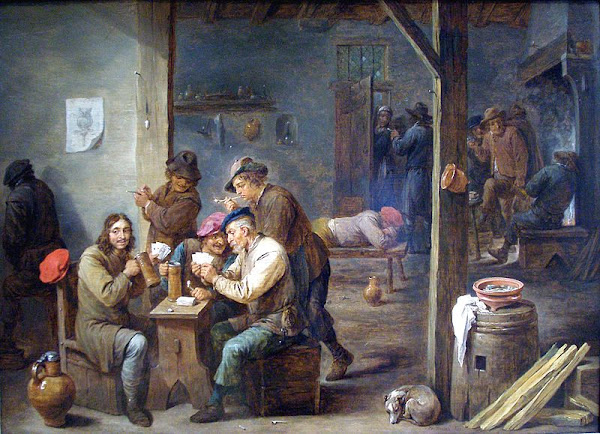
David Teniers the Younger, Tavern Scene (1658), in the
National Gallery of Art, Washington, D.C.
(accession number 1975.77.1)
Why should not we all be merry,
Our Ale is as brown as a Berry?
What then should be the thing,
Should hinder us to sing
Hey down, derry down derry,
Hey down a down hey down derry.
National Gallery of Art, Washington, D.C.
(accession number 1975.77.1)
The Smell of Christ
Tom Holland, Dominion: How the Christian Revolution Remade the World (New York: Basic Books, 2019), p. 151, with note on p. 553:
In an age when there existed no surer marker of wealth than to be freshly bathed and scented, Paulinus hailed the stench of the unwashed as 'the smell of Christ'.23But Paulinus, in the passage cited, seems to be talking about bad breath, rather than about the body odor of the unwashed. See the translation of P.G. Walsh:
23. Ibid. [Paulinus, Letters] 22.2.
The appearance, disposition, and smell of such monks cause nausea in people for whom the odour of death is as the odour of life, who regard the bitter as sweet, the chaste as foul, the holy as hateful. So it is right that we should pay them back, that their smell should be to us the odour of death, so that we do not cease to be the odour of Christ. For why should they who regard our odour as lethal be rightly angry with us if in turn their odour of life stinks in our nostrils? Marracinus finds my fasting distasteful; I cannot bear his drunkenness. He avoids the breath of a monk when he speaks; I avoid the breath of a belching Thraso. If my dry throat displeases him, I loathe his overloaded gullet. If my parched abstention annoys him, the gluttony of his belly annoys me. So I pray for visitors who are not drunk in the early morning but rather are still fasting at evening, who are not blown up with yesterday’s wine but rather are abstemious with today's, who are not crazily tottering through the drunkenness of lust but rather are healthily impaired with virtuous vigils and are drunk with sobriety, men who stagger not because of overindulgence but rather because of a meagre diet.Related posts:
Saturday, January 22, 2022
Ambition
Andrew Robert Burn (1902-1991), Persia and the Greeks: The Defence of the West, c. 546-478 B.C. (New York: St. Martin's Press, 1962; rpt. Minerva Press, 1968), p. 260:
Political events in early fifth-century Athens were chiefly the expression of the rivalries of prominent men and families. Ambition, in men born to greatness, was a proper feeling: 'Ever to be the noblest and superior to others' was a Homeric ideal.7 It is only after centuries of Christianity, or at least lip-service to Christianity, that this lust after the power and the glory has to be veiled, at least from the public eye, behind a programme of service; even at its most naked, expressed in such a saying as 'I believe that I can save this nation and that no one else can'. To a pagan Greek or Roman, the desire to be the best or noblest (aristeuein, a word devoid of moral connotation) was well expressed in the desire to shine in athletics, 'for', to cite Homer again, 'a man has no truer glory than that which he wins with his own feet and hands';8 and even in Greek feeling about athletics in this age, there is a sense of triumph over the defeated rival which is to us repulsive. Pindar twice reminds us of the shame of defeated wrestlers, slinking home, 'avoiding their enemies', as an ingredient in the joy of the victor.9 Sportsmanship, like humility, is a Christian virtue.
7 Il. vi, 208; xi, 784; etc.
8 Od. viii, 147f.
9 Ol. viii, 67/89ff, Pyth. viii, 81/116ff.
Cruel and Wicked
Herman Melville (1819-1891), White-Jacket, Chapter XXXII ("A Dish of Dunderfunk"):
"Well, sir, what now?" said the Lieutenant of the Deck, advancing.I was born and raised Down East, but I never heard the phrase "cruel nice," so far as I can recall. On the other hand, I often heard and uttered the analogous phrase "wicked good."
"They stole it, sir; all my nice dunderfunk, sir; they did, sir," whined the Down Easter, ruefully holding up his pan. "Stole your dunderfunk! what's that?"
"Dunderfunk, sir, dunderfunk; a cruel nice dish as ever man put into him."
"Speak out, sir; what's the matter?"
"My dunderfunk, sir—as elegant a dish of dunderfunk as you ever see, sir—they stole it, sir!"
Friday, January 21, 2022
Not Made of Wood or Stone
Walter Scott (1771-1832), Guy Mannering, chapter VI:
These things did not pass without notice and censure. We are not made of wood or stone, and the things which connect themselves with our hearts and habits cannot, like bark or lichen, be rent away without our missing them.
Truth
Sophocles, Antigone 1195 (tr. R.C. Jebb):
Truth is ever best.Basil Lanneau Gildersleeve, Syntax of Classical Greek from Homer to Demosthenes, First Part: The Syntax of the Simple Sentence, Embracing the Doctrine of the Moods and Tenses (New York: American Book Company, 1900), pp. 57-58 (at 57), § 126:
ὀρθὸν ἁλήθει᾽ ἀεί.
The neuter singular adjective is often used as the substantive predicate of a masculine or feminine subject, whether singular or plural.
Thursday, January 20, 2022
Oracles
Gustave Flaubert, Bouvard and Pécuchet, chapter 8 (tr. A.J. Krailsheimer):
The priest related still more astonishing stories. A missionary once saw Brahmins walking across a vault head downwards, the Grand Lama of Tibet strains his bowels open to give oracles.Related posts:
'Are you joking?' said the doctor.
'Not at all!'
'Come on now, that's a tall story!'
L'abbé rapporta des histoires plus étonnantes. Un missionnaire a vu des brahmanes parcourir une voûte la tête en bas, le Grand-Lama au Thibet se fend les boyaux, pour rendre des oracles.
—Plaisantez-vous? dit le médecin.
—Nullement.
—Allons donc! Quelle farce!
Labels: noctes scatologicae
Wednesday, January 19, 2022
A Mishmash
Plato, Laws 3.692e-693a (tr. Trevor J. Saunders):
If it hadn't been for the joint determination of the Athenians and the Spartans to resist the slavery that threatened them, we should have by now virtually a complete mixture of the races — Greek with Greek, Greek with barbarian, and barbarian with Greek. We can see a parallel in the nations whom the Persians lord it over today: they have been split up and then horribly jumbled together again into the scattered communities in which they now live.
ἀλλ᾽ εἰ μὴ τό τε Ἀθηναίων καὶ τὸ Λακεδαιμονίων κοινῇ διανόημα ἤμυνεν τὴν ἐπιοῦσαν δουλείαν, σχεδὸν ἂν ἤδη πάντ᾽ ἦν μεμειγμένα τὰ τῶν Ἑλλήνων γένη ἐν ἀλλήλοις, καὶ βάρβαρα ἐν Ἕλλησι καὶ Ἑλληνικὰ ἐν βαρβάροις, καθάπερ ὧν Πέρσαι τυραννοῦσι τὰ νῦν διαπεφορημένα καὶ συμπεφορημένα κακῶς ἐσπαρμένα κατοικεῖται.
Tuesday, January 18, 2022
First Sleep in the Odyssey?
Zaria Gorvett, "The forgotten medieval habit of 'two sleeps'," BBC News (January 9, 2022):
Newer› ‹Older
And far from being a peculiarity of the Middle Ages, Ekirch began to suspect that the method had been the dominant way of sleeping for millennia — an ancient default that we inherited from our prehistoric ancestors. The first record Ekirch found was from the 8th Century BC, in the 12,109-line Greek epic The Odyssey, while the last hints of its existence dated to the early 20th Century, before it somehow slipped into oblivion.A. Roger Ekirch, At Day's Close: Night in Times Past (New York: W.W. Norton & Company, 2006), p. 303:
However much it "colonized" the period of wakefulness between intervals of slumber, references to "first sleep" antedate Christianity’s early years of growth. Not only did such figures outside the Church as Pausanias and Plutarch invoke the term in their writings, so, too, did early classical writers, including Livy in his history of Rome, Virgil in the Aeneid, both composed in the first century B.C., and Homer in the Odyssey, written in either the late eighth or early seventh century B.C.Id., p. 406, n. 15, gives a reference to "Allardyce Nicoll, ed., Chapman's Homer: The Iliad, The Odyssey and the Lesser Homerica (Princeton, N.J., 1967), II, 73," i.e.
In his first sleep, call up your hardiest cheer,This is Chapman's rendering of Homer, Odyssey 4.414-416:
Vigour and violence, and hold him there,
In spite of all his strivings to be gone.
τὸν μὲν ἐπὴν δὴ πρῶτα κατευνηθέντα ἴδησθε,Here πρῶτα should be construed with ἴδησθε, not κατευνηθέντα. See Richard John Cunliffe, A Lexicon of the Homeric Dialect (1924; rpt. Norman: University of Oklahoma Press, 1963), p. 350, col. 2, s.v. πρῶτος, sense (5) (e), citing this passage: "With a temporal conjunction, when first, as soon as." A.T. Murray's translation is accurate:
καὶ τότ᾽ ἔπειθ᾽ ὑμῖν μελέτω κάρτος τε βίη τε, 415
αὖθι δ᾽ ἔχειν μεμαῶτα καὶ ἐσσύμενόν περ ἀλύξαι.
Now so soon as you see him laid to rest,The Wikipedia article on Biphasic and polyphasic sleep is typically obtuse:
thereafter let your hearts be filled with strength and courage,
and do you hold him there despite his striving and struggling to escape.
A reference to first sleep in the Odyssey was translated as "first sleep" in the 17th century, but, if Ekirch's hypothesis is correct, was universally mistranslated in the 20th.I suspect that Ekirch's other ancient references are also bogus, but I'm not going to waste time investigating them (please don't contact me if you do).
Labels: typographical and other errors

