Monday, October 24, 2022
Inappropriate Adjectives
Frederick M. Combellack, "Two Blameless Homeric Characters,"
American Journal of Philology 103.4 (Winter, 1982) 361-372 (at 361; footnote omitted):
A familiar feature of Homer's use of adjectives is what has come to be called the "generic" use. The adjective refers to what the character or the phenomenon is habitually, even though the word may be irrelevant or even inappropriate on a given occasion. The clothes of the Phaeacian royal family are "bright" even when they are dirty clothes on their way to the laundry (Od. 6.74). Aphrodite is laughter-loving even when she is in great pain and complaining to her mother about the wound that Diomedes has given her (Iliad 5.375).
These occasional inappropriate adjectives created a problem for the Homerists of antiquity, and they devised a solution (attributed in the scholia to Aristarchus). Their λύσις was: οὐ τότε ἀλλὰ φύσει "not at that time, but by nature."
A Thorough and Accurate Knowledge of the Poems
George M. Calhoun, "Polity and Society," in Alan J.B. Wace and Frank. H. Stubbings, edd., A Companion to Homer (London: Macmillan & Co Ltd, 1962), pp. 431-462 (at 432):
What is most needed is a thorough and accurate knowledge of the poems, conjoined with the sort of common sense that would be used in the study of a modern author. This can be better attained by reading Homer and consulting the literature of criticism than by reading the literature of criticism and consulting Homer.
Of a Mouse and a Man
John Scheid, "Roman Theologies in the Roman Cities of Italy
and the Provinces," in Jonathan J. Price et al., edd., Rome: An Empire of Many Nations. New Perspectives on Ethnic Diversity and
Cultural Identity (Cambridge: Cambridge University Press, 2021), pp. 116-134 (at 132-133):
We now leave Belgica to go first to Raetia, to the city of Cambodunum (Kempten), where a lead curse tablet was found with the following inscription:39 “Silent Mutes! Let Quartus be dumb, or be distraught; he wanders like a fleeing mouse or a bird before a basilisk, let his mouth be mute, Mutes! Let the Mutes be dread! Let the Mutes remain silent! Mutes! Mutes! Let Quartus go mad, let Quartus be brought to the Erinyes and Orcus. Let the Silent Mutes remain silent near the golden doors.” A classic curse tablet, but what is less classic is the invocation made to the Mutae Tacitae. This goddess, in the singular, is set by Ovid in the etiological myth of the Feralia, the festival of the dead at the end of February. This is the story that is connected to the birth of the Lares. A talkative nymph, Lara, from Lala, etymologically the “Talkative one,” revealed to Juno that her husband Jupiter was going to woo the nymph Juturna. She was punished and sent by the all-powerful to the underworld, to silence. It was Mercury who took her. Mercury, who was also the god of thieves and thugs, rapes her on the way. She clearly remained there and gave birth to two boys, who became the Lares. On our fragment of a curse tablet, Ovid’s Tacita Muta has become the Mutae Tacitae, following a relatively conventional practice that will not surprise us. The Eileithyiae, the Furrinae, the Camenae and others attest to this, being sometimes in the plural, sometimes in the singular. What is extraordinary, however, is the fact that Tacita Muta was only known to Ovid.40 His etiology is a small masterpiece of the kind, to the extent that he could be considered as having invented everything, including the name of the goddess. In addition, we will note the fate reserved for the brave Quartus, sent to Orcus like Lara, and the role attributed to the mouse that already intervenes in the rite as it is described by Ovid (placing incense in a hole dug by a mouse), as if the author of the curse tablet were winking at the poet with these allusions.Because erret is subjunctive, not indicative, instead of "he wanders like a fleeing mouse or a bird before a basilisk" I would translate "let him wander like a fleeing mouse or a bird before a basilisk." I learned about this curse tablet from Paul MacKendrick, Romans on the Rhine: Archaeology in Germany (New York: Funk & Wagnalls, 1970), p. 85, who retains the force of the subjunctive:
But — and this is what interests us — we see the name Mutae Tacitae show up in Raetia! From two things to one. Either Tacita Muta was a real divine figure, or the author of the curse tablet was literate and had composed his invocation according to Ovid, himself creating a specialized goddess intended to silence a rival or an enemy. Which solution to choose? I am inclined toward the first, for the change from the singular to the plural Tacitae indicates in my opinion a religious practice known for decades. This was also the case for Furrina, found in the singular in the name of her lucus, until the time of Varro, in the middle of the first century BC, and then it appears in the plural on inscriptions from the end of the second and third centuries AD found in this sacred wood.
39 AE 1958, 150 = Chapot and Laurot 2001: n° L 78 (Cambodunum, Kempten, Rhétie): Mutae tacitae! ut mutus sit | Quartus agitatus erret ut mus | fugiens aut avis adversus basyliscum | ut e[i]us os mutu(m) sit, Mutae | Mutae [d]irae sint! Mutae | tacitae sint! Mutae | [Qu]a[rt]us ut insaniat, // Vt Eriniis rutus sit et | Quartus Orco ut Mutae | Tacitae ut mut[ae s]int | ad portas aureas. Cf. Cf. R. Egger 1957.
40 Bettini 2006: 149–72.
One of the curiosities of the museum is a curse-tablet, inscribed as usual on lead, expressing the pious hope that the object of the curse "may run about frantic like a fleeing mouse" ("agitatus erret ut mus fugiens").Cf. the translation in Stuart McKie, Living and Cursing in the Roman West: Curse Tablets and Society (London: Bloomsbury Academic, 2022), pp. 197-198:
Silent Mutes, thus Quartus should be mute, he should scurry around like a fleeing mouse or bird in the face of a basilisk, so should his mouth be mute, Mutes. May the Mutes be dreadful, may the Mutae [sic] be silent. May Quartus be driven mad, may Quartus be driven to the Furies and to Orcus. May the Mutae be silent, mute and silent at the golden gates.On rutus see the Oxford Latin Dictionary s.v. (as a noun), sense 2 ("An act of rushing or hurrying"), citing only this curse tablet.
Sunday, October 23, 2022
Hoards
Max Martin, "Wealth and Treasure in the West, 4th to 7th Century," tr. Martin Brady, in Leslie Webster and Michelle Brown, edd., The Transformation of the Roman World, A.D. 400–900 (London: British Museum Press, 1997), pp. 48-66, with Plates 13-18, 30-31, 60 (at 63-64):

A single, unrecovered hoard can to some extent be seen as evidence of a sporadic or local discontinuity of ownership. On the other hand, geographical and chronological concentrations of hoards do not simply amount to several sporadic discontinuities, but may instead represent a widespread, or indeed complete, discontinuity in the owners concerned, or even of the entire social stratum to which they belonged. It must always be borne in mind that an unknown number of hoards may have immediately been expropriated by new owners, with the result that there may well have been a considerably greater number of discontinuities than we are able to ascertain today. At any rate there could not have been fewer.Id., Plate 60, with caption "Roman gold and silver coins from the Hoxne hoard, deposited in the early fifth century. (Heirs of Rome, cat. 5a.)":

Where Are They Now?
Hugh Kenner (1923-2003), The Pound Era (Berkeley: University of California Press, 1971; rpt. 1974), pp. 76-77:
Some things were current once that are current no longer. A public for an inexpensive bilingual Dante — Italian text, notes, and a facing version in unpretentious prose — was once discoverable in England in sufficient numbers to circulate thousands upon thousands of elegant pocket-sized volumes, price one shilling. Rossetti, not Milton, had prepared that taste, and J.M. Dent began the Temple Dante with the Paradiso. With its gravure frontispiece “after Botticelli,” it was issued in 1899 and reprinted 1900, 1901, 1903, 1904, 1908, 1910, 1912. . . . An afternote cites a Dante Primer also priced (1899) at one shilling. Inferno and Purgatorio followed, then the Convivio, then the Latin Works. By 1906 The Vita Nuova and Canzonieri completed a six-volume set. It was not presumed that the reader knew Italian, but that, “possessing some acquaintance with Latin or one of the Romance languages,” he would welcome a prose guide “to the very words of the master in the original.”
[....]
In 1902 the numerous students of Dante (where are they now?) could buy H.J. Chaytor’s The Troubadours of Dante, which offered as much as any one is likely to require who does not propose to make a special study of Provencal.” This meant working through 46 poems with a glossary, a grammar, and notes, unassisted by translations. People with Latin and French, who had been sipping at old Italian, seem not to have thought this formidable.
[....]
The collapse of that public, its supersession by folk absorbed in introspection and politics, is an unwritten story. The printing history of the Temple Paradiso affords an informal graph. The 13 years up to 1912 required eight printings. After a wartime hiatus demand began to slack off: five printings in 11 years. The copy from which I take these data was printed in 1930, not sold until 1946.
Phrygians v. Thracians
Menander, The Shield 241-244 (tr. Norma Miller):
WAITER: Where d'you come from?
DAOS: From Phrygia.
WAITER: Then you're no good, you're a queer. Only Thracians are real men. Getans — God, what heroes!
(Τρ) ποταπός ποτ' εἶ;
(Δα) Φρύξ. (Τρ) οὐδὲν ἱερόν· ἀνδρόγυνος. ἡμεῖς μόνοι
οἱ Θρᾶικές ἐσμεν ἄνδρες· οἱ μὲν δὴ Γέται,
Ἄπολλον, ἀνδρεῖον τὸ χρῆμα.
Our Doctrines
Pierre Hadot, Plotinus or The Simplicity of Vision, tr. Michael Chase (Chicago: University of Chicago Press, 1998), pp. 17-18, quoting Enneads V 1, 8 10-14:
Our doctrines are not novel nor do they date from today: they were stated long ago, but not in an explicit way. Our doctrines are explanations of those older ones, and they use Plato's own words to prove that they are ancient.A.H. Armstrong's translation and note:
καὶ εἶναι τοὺς λόγους τούσδε μὴ καινοὺς μηδὲ νῦν, ἀλλὰ πάλαι μὲν εἰρῆσθαι μὴ ἀναπεπταμένως, τοὺς δὲ νῦν λόγους ἐξηγητὰς ἐκείνων γεγονέναι μαρτυρίοις πιστωσαμένους τὰς δόξας ταύτας παλαιὰς εἶναι τοῖς αὐτοῦ τοῦ Πλάτωνος γράμμασιν.
And [it follows] that these statements of ours are not new; they do not belong to the present time, but were made long ago, not explicitly, and what we have said in this discussion has been an interpretation of them, relying on Plato's own writings for evidence that these views are ancient.3Hat tip: Eric Thomson.
3 The belief that the true doctrines are present, but often not explicit, in the writings regarded as traditionally authoritative is, for obvious reasons, essential for pagan and Christian traditionalists of the first centuries A.D. (and for Christian traditionalists later): cp. Origen De Principiis I 3.
Husband and Wife
Funerary stele of a married couple, from the Via Statilia in Rome, ca. 50 BC (Rome, Musei Capitolini/Centrale Montemartini, inv. no. MC 2142), photographs from Valentin Kockel, Porträtreliefs stadtrömischer Grabbauten: ein Beitrag zur Geschichte und zum Verständnis des spätrepublikanisch-frühkaiserzeitlichen Privatporträts (Mainz am Rhein: Philipp von Zabern, 1993 = Beiträge zur Erschließung hellenistischer und kaiserzeitlicher Skulptur und Architektur, 12), Tafeln 10a, 12a-b, 14a-b:


 See also Kockel, pp. 94-95.


Saturday, October 22, 2022
Arrows
Pseudo-Hesiod, The Shield 129-134 (tr. Glenn W. Most):

After this he cast around his chest the hollow quiver; many arrows were inside, chilling, givers of speechless death: for in front they held death and trickled with tears, in the middle they were smooth, very long, and in back they were covered with the feathers of a fiery red eagle.The same, tr. Barry Powell:
κοίλην δὲ περὶ στήθεσσι φαρέτρην
κάββαλεν ἐξόπιθεν· πολλοὶ δ' ἔντοσθεν ὀιστοὶ 130
ῥιγηλοί, θανάτοιο λαθιφθόγγοιο δοτῆρες·
πρόσθεν μὲν θάνατόν τ' εἶχον καὶ δάκρυσι μῦρον,
μέσσοι δὲ ξεστοί, περιμήκεες, αὐτὰρ ὄπισθε
μόρφνοιο φλεγύαο καλυπτόμενοι πτερύγεσσιν.
Across his chest he cast behindF.A. Paley ad loc.:
him a hollow quiver. There were many arrows in it, shivery,
the givers of speechless destruction. In front they held death,
trickling with tears. The shafts were smooth and very long,
and at their ends they were covered by the feathers of a reddish-brown
eagle.

Thomas Edwards' Canons of Criticism
Quoted in Albert H. Tolman, Falstaff and Other Shakespearean Topics (New York: The Macmillan Company, 1925), pp. 244-246:
I. A Professed Critic has a right to declare, that his Author wrote whatever he thinks he should have written; with as much positiveness, as if he had been at his Elbow.
II. He has a right to alter any passage, which he does not understand.
III. These alterations he may make, in spite of the exactness of the measure.
IV. Where he does not like an expression, and yet cannot mend it; He may abuse his Author for it.
V. Or He may condemn it, as a foolish interpolation.
VI. As every Author is to be corrected into all possible perfection, and of that perfection the Professed Critic is the sole judge; He may alter any word or phrase, which does not want amendment, or which will do; provided He can think of any thing which he imagines will do better.
VII. He may find-out obsolete words, or coin new ones; and put them in the place of such, as He does not like, or does not understand.
VIII. He may prove a reading, or support an explanation, by any sort of reasons; no matter whether good or bad.
IX. He may interpret his Author so; as to make him mean directly contrary to what He says.
X. He should not allow any poetical licences, which He does not understand.
XI. He may make foolish amendments or explanations, and refute them; only to enhance the value of his critical skill.
XII. He may find out an immodest or immoral meaning in his author; where there does not appear to be any hint that way.
XIII. He needs not attend to the low accuracy of orthography or pointing; but may ridicule such trivial criticisms in others.
XIV. Yet, when he pleases to condescend to such work, he may value himself upon it; and not only restore lost puns, but point-out such quaintnesses, where perhaps the author never thought of it.
XV. He may explane a difficult passage, by words absolutely unintelligible.
XVI. He may contradict himself; for the sake of shewing his critical skill on both sides of the question.
XVII. It will be necessary for the profess'd critic to have by him a good number of pedantic and abusive expressions; to throw-about upon proper occasions.
XVIII. He may explane his Author, or any former Editor of him; by supplying such words, or pieces of words, or marks, as he thinks fit for that purpose.
XIX. He may use the very same reasons for confirming his own observations; which He has disallowed in his adversary.
XX. As the design of writing notes is not so much to explane the Author's meaning, as to display the Critic's knowledge; it may be proper, to shew his universal learning, that He minutely point out, from whence every metaphor and allusion is taken.
XXI. It will be proper, in order to shew his wit, especially if the critic be a married man, to take overy opportunity of sneering at the fair sex.
XXII. He may misquote himself, or any body else, in order to make an occasion of writing notes; when He cannot otherwise find one.
XXIII. The Profess’d Critic, in order to furnish his quota to the bookseller, may write NOTES OF NOTHING; that is, Notes, which either explane things which do not want explanation; or such as do not explane matters at all, but merely fill-up so much paper.
XXIV. He may dispense with truth; in order to give the world a higher idea of his parts, or of the value of his work.
XXV. He may alter any passage of his author, without reason and against the Copies; and then quote the passage so altered, as an authority for altering any other.
Revel
William-Adolphe Bouguereau (1825-1905), La Jeunesse de Bacchus:


One Turns Backward
Gustaf Sobin (1935-2005), Ladder of Shadows: Reflecting on Medieval Vestige
in Provence and Languedoc (Berkeley: University of California Press, 2009), p. 8:
The past draws. It draws, I feel, to the extent that the present, the cultural and ultimately the spiritual present, has failed to generate generative image: the kind in which societies might come to recognize their veritable identity. In default of such image—such eloquent mirror—one turns backward. Goes under.
[....]
Against the cultural poverty of one's own times, it seems befitting, I feel, to travel under. Examine vestige.
Friday, October 21, 2022
Gurdus
Quintilian 1.5.57 (tr. H.E. Butler):
Thesaurus Linguae Latinae 6,2:2359: A. Walde and J.B. Hoffmann, Lateinisches etymologisches Wörterbuch, 3. Aufl., Bd. I (Heidelberg: Carl Winter, 1938), p. 627:
 Alfred Ernout and Alfred Meillet, Dictionnaire étymologique de la langue latine, 4th ed. rev. Jacques André (Paris: Klincksieck, 2001), p. 285:
 Michiel de Vaan, Etymological Dictionary of Latin and the Other Italic Languages (Leiden: Brill, 2008), p. 275:
 See also Nicholas Zair, "Latin bardus and gurdus," Glotta 94 (2018) 311-318 (at 314-317).
I have heard that gurdus, which is colloquially used in the sense of "stupid," is derived from Spain.Alessandro Garcea and Valeria Lomanto, "Gellius and Fronto on Loanwords and Literary Models: Their Evaluation of Laberius," in Leofranc Holford-Strevens and Amiel Vardi, edd., The Worlds of Aulus Gellius (Oxford: Oxford University Press, 2004), pp. 41-64 (at 59, n. 55):
gurdos, quos pro stolidis accipit vulgus, ex Hispania duxisse originem audivi.
On Quintilian’s testimony, which has long been debated by both literary and linguistic scholars, see e.g. F. Schöll, 'Wortforschung', 313–17, and J. Cousin, 'Problèmes', 63–4: both scholars acknowledge the vulgar connotation of gurdus, but while the former allows its Spanish origin, the latter doubts it.The references are to Fritz Schöll, "Zur lateinischen Wortforschung," Indogermanische Forschungen 31 (1912-1913) 309-320, and Jean Cousin, "Problèmes biographiques et littéraires relatifs à Quintilien," Revue des Etudes Latines 9 (1931) 62–76.
Thesaurus Linguae Latinae 6,2:2359:


Advice
Corpus Inscriptionum Latinarum VI 16169 (my translation):
 Franz Buecheler, Carmina Latina Epigraphica (Leipzig: B.G. Teubner, 1895), p. 44, number 85:
 Hat tip: Eric Thomson.
Gnaeus Cornelius Bassus, son of Gnaeus, of the Aniensian tribe.The stone:
Born eighteen years ago I lived as well as I could,
dear to my father and all my friends.
Jest, play, I encourage you: there is the utmost seriousness here.
His slave Fortunatus set this up.
Cn(aeus) Cornelius Cn(aei) f(ilius) An(iensi) Bassus
decem et octo annorum natus vixi ut potui bene,
gratus parenti atque amicis omnibus.
ioceris, ludas hortor: hic summa est severitas.
posuit Fortunatus ser(vus)


Once Bitten, Twice Shy
Menander, The Shield 27-30 (tr. Stanley Ireland):

But not being totally successful can be an advantage, so it seems. Someone who's taken a knock is also on his guard, but in our case over-confidence led to slack discipline in the face of what was to come.A.W. Gomme and F.H. Sandbach ad loc.:
ἦν δ' ὡς ἔοικε καὶ τὸ μὴ πάντ' εὐτυχεῖν
χρήσιμον· ὁ γὰρ πταίσας τι καὶ φυλάττεται.
ἡμᾶς δ' ἀτάκτους πρὸς τὸ μέλλον ἤγαγε
τὸ καταφρονεῖν.

Epitaph of a Pankratiast
Reinhold Merkelbach and Josef Stauber, edd., Steinepigramme aus dem griechischen Osten, Bd. 3: Der „Ferne Osten“ und das Landesinnere bis zum Tauros (München: K.G. Säur, 2001), p. 323, number 16/34/37 (click once or twice to enlarge):
 Werner Peek, Griechische Vers-Inschriften, Vol. I: Grab-Epigramme (Berlin: Akademie-Verlag, 1955), p. 69, number 263:
 Simplified transcription of the Greek:


βουλευτής περ ἐὼν [⏑⏑– τὸν τύμβον] ἔτευξεν.Translation:
εἰδὼς θνητογόνων τέρματα τοῦ βιότου,
εὐπατρίδης γεγαὼς οὗτος, φίλε, καὶ σθενέγαυρος
πολλοὺς ἀθλητὰς ἤνυσε πανκρατίῳ.
ἀλλὰ πόνου τόδε κῦδος· ὁ ζῶν δὲ τρυφῆς ἀπόλαυσον,
πρὶν σὲ λιπῖν τὸ φάος· τὰ γὰρ ὧδε κάτω μ' ἐπερώτα.
Being a councillor [...] he built the tomb,
knowing the limits of the life of those born of mortal parents.
Being of noble family, o friend, and exulting in his strength,
he defeated many combatants in the pankration.
But this is the renown of toil. You who live, enjoy luxury,
before you leave the light; for ask me about the things here below.
Thursday, October 20, 2022
Stronger
Phocylides, fragment 4 Gentili and Prato, 8 West (tr. Richmond Lattimore):
Phocylides said this also: a city that's small and is foundedThe same, tr J.M. Edmonds:
on a cliff's edge, well governed, is stronger than Nineveh crazy.
καὶ τόδε Φωκυλίδεω· πόλις ἐν σκοπέλῳ κατὰ κόσμον
οἰκέουσα σμικρὴ κρέσσων Νίνου ἀφραινούσης.
Thus also spake Phocylides—A little state living orderly in a high place is stronger than a block-headed Ninevah.
Athletes
Lekythos attributed to the Kephisophon Painter, ca. 500 B.C. (Toronto, Royal Ontario Museum 963.59):


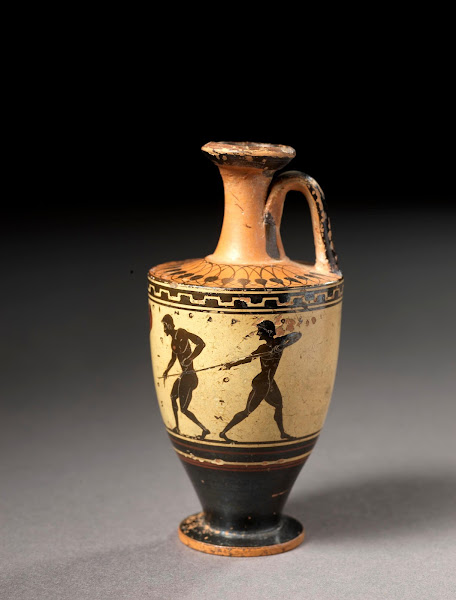 See Henry R. Immerwahr, "A Lekythos in Toronto and the Golden Youth of Athens," in Studies in Attic Epigraphy, History, and Topography: Presented to Eugene Vanderpool (Princeton: American School of Classical Studies at Athens, 1982 = Hesperia Supplements, 19), pp. 59–65 and Plate 6.


Genealogy
Robert Fowler, "Martin Litchfield West, 23 September 1937 - 13 July 2015," Biographical Memoirs of Fellows of the British Academy 17 (2018) 89–120 (at 92):
In a sparkling and typically amusing (unpublished) memoir of his childhood written for his family, West tells how on both parents’ sides he could lay dubious claim to royal ancestry: John Stainthorpe’s mother was said to have been an illegitimate daughter of George, the second Marquis of Normanby, and thus descended from James II; Robert West traced his lineage (via a great-great-grandmother who had eloped with the gardener) to Sir William Courtenay, ‘de jure eighth Earl of Devon and second Viscount of Powderham Castle’. Consequently, West calculated, he was tenth cousin to the Queen. More than that, the ultimate ancestor of all the royals, Egbert of Wessex, was separated by a mere twenty generations from Woden. ‘Once’, he confesses, ‘in filling up a form for some French biographical reference work, I amused myself by naming him as my ancestor. And so it appeared in my entry: “Ascendance: Woden, dieu germanique”.’Id. (at 93, quoting West):
One does have—at least I have—a deep-seated desire for a tribal identity. I always thought of myself as an Englishman, and now I have learned how I can think of myself as a Briton too. Having grown up during the Second World War, I could hardly avoid being imbued with patriotic feeling, which I have never disavowed. I cannot imagine living permanently in another country, and have more than once turned down invitations to do so.
Plural of an Adverb
Donna Zuckerberg, review of V. Liapis, A Commentary on the Rhesus Attributed to Euripides (Oxford: Oxford University Press, 2012), in Classical Review 63.1 (2013) 29-31 (at 30):
Hapax is short for hapax legomenon, whose proper plural is hapax legomena. Some will defend the solecisms above on various grounds and call me a mossbacked linguistic prescriptivist, a charge to which I cheerfully plead guilty.
Newer› ‹Older
He shows how the play's vocabulary choices, particularly its use of extensive hapaces (pp. liii-lv), and its metrics (pp. lxiv-lvii) defy easy grouping with either Euripides' early or late works."Classical battle over Facebook founder's sister," Evening Standard (29 April 2013):
Professor Colin Leach, formerly at Oxford University, whose enthusiastic review is due to be published in the Journal of Classical Teachers later this year, expressed his surprise that Classical Review did not allocate so important a book to a senior academic. He also notes: "Zuckerberg used the 'word' hapaces, which purports to be the plural of hapax. But hapax is not a noun, but an indeclinable adverb, meaning 'once', and hapaces does not exist. It may be a feeble joke, or even an Americanism." God forbid.One might wish that Zuckerberg's hapaces was itself a hapax, but no. See e.g. M. Gwyn Morgan, "The Long Way Round: Tacitus, Histories 1.27," Eranos 92 (1994) 93–101 (at 94, footnote omitted):
Then there is a pause (nec multo post), before his henchman Onomastus appears and delivers the message they have concerted as the indication that all is ready for their coup, a message requiring the use of two hapaces, one—if not both—of them a technical term (ab architecto et redemptoribus).and Pär Sandin, Aeschylus' Supplices: Introduction and Commentary on vv. 1-523 (Lund: Symmachus, 2005), p. 171, n. 469:
To mention only a few hapaces (some recurring in late authors) on -µα, we find Th. 278 ποίφυγµα (on which see Sandin 2001), Th. 523 εἴκασµα, Ag. 396 πρόστριµµα, Ag. 1284 ὑπτίασµα (also Pr. 1005), Ag. 1416 νόµευµα, fr. 79 σκώπευµα.The variant hapakes also occurs, regrettably, e.g. in Martin Bernal, Black Athena: The Afroasiatic Roots of Classical Civilization, Vol, III: The Linguistic Evidence (New Brunswick: Rutgers University Press, 2006), p. 124:
Szememrényi warns against accepting typological arguments on the ground that oddities or even hapakes (single exceptions) occur in all languages.and Victoria Wohl, Euripides and the Politics of Form (Princeton: Princeton University Press, 2015), p. 155, n. 8:
Both polupēna and prosthēmata are hapakes that take humble words (the woof of a weaving, pēnē, or the prosaic prosthēkē, appendage) and turn them into unique coinages.More common than either hapaces or hapakes is hapaxes. See e.g. Mark W. Edwards, The Iliad: A Commentary, Vol. V: Books 17-20 (Cambridge: Cambridge University Press, 1991), who uses hapaxes repeatedly on pp. 53-55.
Hapax is short for hapax legomenon, whose proper plural is hapax legomena. Some will defend the solecisms above on various grounds and call me a mossbacked linguistic prescriptivist, a charge to which I cheerfully plead guilty.

