Sunday, October 08, 2023
Illumination
Paul Valéry (1871-1945), Collected Works, Vol. 10: History and Politics, tr. Denise Folliot and Jackson Mathews (New York: Pantheon Books, 1962), p. 83:
We must make up our minds to dabble in examples. While dabbling we sometimes splash up a few drops of light.The original, from Propos sur l'intelligence (Paris: A l'Enseigne de la Porte étroite, 1926), pp. 45-46:
Il faut se résoudre à patauger dans les exemples. Patauger, quelquefois, c'est aussi faire bondir deux ou trois gouttes de lumière.Patauger = wade, splash, flounder.
Unbefitting
Aristotle, Politics 8.3.2 (1338 b 2; tr. H. Rackham):
To seek for utility everywhere is entirely unsuited to men that are great-souled and free.
τὸ δὲ ζητεῖν πανταχοῦ τὸ χρήσιμον ἥκιστα ἁρμόττει τοῖς μεγαλοψύχοις καὶ τοῖς ἐλευθερίοις.
Nobles
Trevor Dean and Daniel Waley, The Italian City-Republics, 5th ed. (London: Routledge, 2023), p. 126:
Again modern readers must use their historical imagination to think away modern politeness and to summon up a world in which strength and pride expressed themselves directly and brutally. They must think of men like the sixteenth-century nobles at Belluno who used to shout 'Take your hat off, dastard!' and to show their scorn for the multitude by writing 'Labouring plebs' on the walls.
Onward, Scholars!
Leon Battista Alberti (1404-1472), "The Deceased," Dinner Pieces, tr. David Marsh (Binghamton: Center for Medieval and Early Renaissance Studies, 1987 = Medieval & Renaissance Texts & Studies, 45), pp. 98-125 (at 114):
Onward, scholars! Devote yourselves eagerly, completely, and assiduously to literature! Wear yourselves out with studies! Publish your books! Strive with great and ceaseless efforts, and make sure that perfumers and fishmongers lack no elegant and finely lettered manuscripts for wrapping their salves and sardines!The Latin, from Leon Battista Alberti, Autobiografia e altre opere latine. A cura di Loredana Chines e Andrea Severi (Milano: Rizzoli, 2012), p. 416:
Pergite, litterati, date operam litteris acrem et, ut facitis, amplam atque assiduam! Conterite studiis vos, edite libros, agite isthac vestra multa et inquieta opera ut facitis, ne eleganter et accurate scripte ad unguentorum et pisciculorum tegmen desint tabernario atque unguentariis charte!
Friday, October 06, 2023
Good Things
Augustine, Sermons 29.5 (Patrologia Latina, vol. XXXVIII, col. 187; tr. Edmund Hill):
How many good things there are that you want, bad man! You're certainly bad. Tell me what you want that isn't good. You want a horse, only a good one; you want a farm, only a good one; you want a house, only a good one; you want a wife, only a good one; you want a shirt, only a good one, boots, only good ones. It's only your soul you want bad! Aren't you being a contradiction in terms, by wanting good things while being bad yourself?
Quanta bona quaeris, homo male? Certe malus es: dic mihi quid velis, nisi bonum? Equum quaeris, nonnisi bonum; fundum quaeris, nonnisi bonum; domum quaeris, nonnisi bonam; uxorem quaeris, nonnisi bonam; tunicam nonnisi bonam, caligam nonnisi bonam: animam solam malam. Nonne tibi ipse es contrarius, qui bona quaeris, cum sis malus?
Law and Order
Aristotle, Politics 7.4.5 (1326 a 29; tr. H. Rackham):
Law is a form of order, and good law must necessarily mean good order.
ὅ τε γὰρ νόμος τάξις τίς ἐστι, καὶ τὴν εὐνομίαν ἀναγκαῖον εὐταξίαν εἶναι.
Thursday, October 05, 2023
Rule by Machine
Paul Valéry (1871-1945), Collected Works, Vol. 10: History and Politics, tr. Denise Folliot and Jackson Mathews (New York: Pantheon Books, 1962), p. 77:
The machine rules. Human life is rigorously controlled by it, dominated by the terribly precise will of mechanisms. These creatures of man are exacting. They are now reacting on their creators, making them like themselves. They want well-trained humans; they are gradually wiping out the differences between men, fitting them into their own orderly functioning, into the uniformity of their own regimes. They are thus shaping humanity for their own use, almost in their own image.The original, from Propos sur l'intelligence (Paris: A l'Enseigne de la Porte étroite, 1926), p. 23:
La machine gouverne. La vie humaine est rigoureusement enchaînée par elle, assujettie aux volontés terriblement exactes des mécanismes. Ces créatures des hommes sont exigeantes. Elles réagissent à présent sur leurs créateurs et les façonnent d'après elles. Il leur faut des humains bien dressés; elles en effacent peu à peu les différences et les rendent propres à leur fonctionnement régulier, à l'uniformité de leurs régimes. Elles se font donc une humanité à leur usage, presque à leur image.
City Walls
Trevor Dean and Daniel Waley, The Italian City-Republics, 5th ed. (London: Routledge, 2023), pp. 110-111 (notes omitted):
Second only to the palace were the walls, another great source of pride. Giovanni Villani devotes two chapters to the Florentine walls which were being constructed in the 1320s. Most communes had officials entrusted with the upkeep of the walls — Pisa's 'captains of the walls' figure in the 1162 statutes. A good deal of legislation was devoted to the walls and in particular to the attempt — always destined to frustration — to keep them entirely clear of private and public buildings. Compulsory work by the population played a big part in the construction and maintenance of walls. In some cities each region had the obligation of providing labour for its own section of the walls and its gateway.Related posts:
Wall-building campaigns represented a huge commitment of money and effort. The necessary land could sometimes be acquired only slowly and with difficulty, in the face of resistance from local landowners. Some wall circuits were built quickly – for example, the first medieval circuit at Florence (1173-75); others much more slowly, such as the second circuit at Bologna (1250-1370). Often the walls were a very expensive item in the commune's budget. Florence's second medieval circle (mentioned above, p. 24) cost about 6,000 L a year in the first years of the fourteenth century, and in 1324 nearly 20,000 L was spent on it in five months, which represented roughly a quarter of the commune's total expenditure. The site, appearance and function of walls and gates combined the functional, the aesthetic and the symbolic. Walls had defensive functions against siege and attack, but also served to control daily movement into and out of the city and to act as points of taxation for goods. Aesthetically, the materials and design could give external impressions of solidity and antiquity. At Lucca, for example, the exterior faces were built with large stone blocks of similar size, while the interior faces were of brick, and the round gate towers have been said to recall those of ancient Rome. The profile of walls and gates then also projected urban power into the countryside and beyond. At Lucca, again, most of the towers were on the south and west sides, towards the city's main enemy, Pisa.
Wednesday, October 04, 2023
The Governing Class
Aristotle, Politics 4.13.8 (1297 b 9; tr. H. Rackham):
For it does not always happen that those who are in the governing class are gentlemen.χαρίεντας = "men of education" (W.L. Newman on 1267 a 1).
οὐ γὰρ ἀεὶ συμβαίνει χαρίεντας εἶναι τοὺς μετέχοντας τοῦ πολιτεύματος.
Our Daily Bread
Paul Valéry (1871-1945), Propos sur l'intelligence (Paris: A l'Enseigne de la Porte étroite, 1926), p. 30 (my translation):
Happenings themselves are required as nourishment. If there isn't some great misfortune in the world this morning, we feel a certain emptiness. — "There's nothing in the papers today," people say.
Les événements eux-mêmes sont demandés comme une nourriture. S'il n'y a point ce matin quelque grand malheur dans le monde, nous nous sentons un certain vide. — « Il n'y a rien aujourd'hui dans les journaux », disent-ils.
An Extra Zero
Barbara Reynolds (1914-2015), Dante: The Poet, the Political Thinker, the Man (Emeryville: Shoemaker Hoard, 2006), p. 14, with note on p. 424:
From Eric Thomson:
The chronicler Giovanni Villani48 records that the population in his day was about 900,000, not counting the religious orders of monks and nuns in monasteries and convents.For 900,000 read 90,000.
48. c.1280–1348.
From Eric Thomson:
The American Shoemaker Hoard edition must have unwittingly inflated the numbers (does 'decimate' have an antonym?). Perhaps shoemakers have their gremlins as well as their elves. All kosher in my I.B.Tauris copy anyway.
Labels: typographical and other errors
Tuesday, October 03, 2023
Three Mental Sicknesses
Barbara Reynolds (1914-2015), Dante: The Poet, the Political Thinker, the Man (Emeryville: Shoemaker Hoard, 2006), pp. 86-87, with notes on p. 431:
He has observed an evil disposition of the soul attended by three terrible kinds of sickness of the mind. The first of these is a boastfulness that leads people to believe that they know everything and to affirm as certain things that are not. Cicero condemns such people in the first book of his De Officiis (‘On Duties’), as does St Thomas Aquinas in Contra Gentiles (‘Against the Gentiles’):[T]here are many who by their natural dispositions are so presumptuous as to believe that they can gauge everything by their intellect, believing everything true that seems to them true, and false everything that does not.15Such people never attain to learning, believing they are already sufficiently instructed; they never ask questions, they never listen, they never desire to be questioned, and if they are, they reply before the question is concluded and their answer is wrong.
The second sickness he has observed is caused by a natural dejection of the mind, which leads people to deny the possibility that anything can be known, by themselves or by others. They never enquire or reason or heed what others say. Such people, Aristotle said, were not qualified to be students of moral philosophy, for they live in ignorance like beasts and despair of all learning.
The third sickness is a kind of levity or superficiality of mind which leads people to pass all bounds in their reasoning, leaping to a conclusion before they have framed a syllogism, flying off to another conclusion, believing they are arguing most subtly when they do not start from any principle. With those who deny first principles, as Aristotle said, it is useless to argue. Among them are many uneducated people who do not know their A B C and yet would dispute about geometry, astrology and physics.16
15. St Thomas’s words are: Totam Naturam divinam se reputant suo intellectu posse metiri (‘They consider that all Nature can be measured by their intellect’).
16. There is a delightful glimpse of such a person in E.M. Forster’s short story, ‘Other Kingdom’: ‘“Surely” — said Miss Beaumont. She had been learning Latin for not quite a fortnight, but she would have corrected the Regius Professor.’
Three Poems by Agathias Scholasticus
Greek Anthology 9.642 (by Agathias Scholasticus, Εἰς σωτήρια ἐν Σμύρνῃ ἐν προαστείῳ = "On a Latrine in the Suburbs of Smyrna"; tr. W.R. Paton):
All the extravagance of mortals and their expensive dishes excreted here have lost their previous charm. The pheasants and fishes, and the mixtures pounded in the mortar, and all that variety of kickshaws, become here dung. The belly rids itself of all that the ravenous gullet took in, and at length a man sees that in the pride of his foolish heart he spent so much gold on nothing but dust.Id. 9.643:
Πᾶν τὸ βροτῶν σπατάλημα, καὶ ἡ πολύολβος ἐδωδὴ
ἐνθάδε κρινομένη τὴν πρὶν ὄλεσσε χάριν.
οἱ γὰρ φασιανοί τε καὶ ἰχθύες, αἵ θ᾿ ὑπὲρ ἴγδιν
τρίψιες, ἥ τε τόση βρωματομιξαπάτη
γίνεται ἐνθάδε κόπρος· ἀποσσεύει δ᾿ ἄρα γαστὴρ 5
ὁππόσα πειναλέη δέξατο λαυκανίη.
ὀψὲ δὲ γινώσκει τις, ὅτ᾿ ἄφρονα μῆτιν ἀείρων
χρυσοῦ τοσσατίου τὴν κόνιν ἐπρίατο.
Why do you moan with the headache and groan bitterly for the heaviness you feel all over, and keep on smacking your belly, thinking to force out the work of your jaws? You would never have had all this trouble and labour if you had not largely exceeded yourself at table. When you are lying there guzzling you have a high opinion of yourself, and delight your palate with the viands, deeming that happiness. But here you are in distress, and your belly only gets many smacks to pay for the sins of your gullet.Id. 9.644:
Τί στενάχεις κεφαλὴν κεκακωμένος; ἐς τί δὲ πικρὰ
οἰμώζεις, μελέων πάγχυ βαρυνομένων;
ἐς τί δὲ γαστέρα σεῖο ῥαπίσμασιν ἀμφιπατάσσεις,
ἐκθλίψαι δοκέων μάστακος ἐργασίην;
μόχθων τοσσατίων οὔ σοι χρέος, εἰ παρὰ δαιτὶ 5
μὴ τοῦ ἀναγκαίου πουλὺ παρεξετάθης.
ἀλλ᾿ ἐπὶ μὲν στιβάδος φρονέεις μέγα, καὶ στόμα τέρπεις
βρώμασιν, εὐτυχίην κεῖνα λογιζόμενος·
ἐνθάδε δ᾿ ἀσχάλλεις· μούνη δ᾿ ἀλιτήματα λαιμοῦ
ἡ γαστὴρ τίνει πολλάκι τυπτομένη. 10
Blest are you, long-suffering labourer! You have only to put up, all your life, with the pains of hoeing and poverty. Simple are your meals, and you sleep in the woods, after satisfying your throat’s vast thirst for water. Yet you are perfectly sound, and sitting here for a few moments lighten your belly. You don't rub down the lower part of your spine, or beat your thighs, but you get rid of the burden naturally. They are in evil case, the rich and those who associate with them, whom feasting pleases more than sound health.See Ronald C. McCail, "The Erotic and Ascetic Poetry of Agathias Scholasticus," Byzantion 41 (1971) 205-267 (at 227-232).
Εὖγε μάκαρ τλήθυμε γεωπόνε· σοὶ βίος αἰεὶ
μίμνειν καὶ σκαπάνης ἄλγεα καὶ πενίης·
λιτὰ δέ σοι καὶ δεῖπνα, καὶ ἐν ξυλόχοισι καθεύδεις,
ὕδατος ἐμπλήσας λαιμὸν ἀμετροπότην.
ἔμπης ἀρτίπος ἐσσί, καὶ ἐνθάδε βαιὰ καθεσθεὶς 5
αὐτίκα γαστέρα σὴν θῆκας ἐλαφροτάτην·
οὐδὲ καταψήχεις ἱερὴν ῥάχιν, οὐδέ τι μηροὺς
τύπτεις, αὐτομάτως φόρτον ἀρωσάμενος.
τλήμονες οἱ πλουτοῦντες ἰδ᾿ οἱ κείνοισι συνόντες
οἷς πλέον ἀρτεμίης εὔαδεν εἰλαπίνη. 10
Labels: noctes scatologicae
Monday, October 02, 2023
Unanimity
Nicolás Gómez Dávila (1913-1994), Sucesivos Escolios a un Texto Implicito (Bogotá: Villegas Editores, 2005), p. 91 (my translation):
Modern man thinks he lives amidst a diversity of opinions, when that which dominates today is a stifling unanimity.
El moderno cree vivir en un pluralismo de opiniones, cuando lo que hoy impera es una unanimidad asfixiante.
A Secret Society
John Jay Chapman (1862-1933), Memories and Milestones (New York: Moffat, Yard and Company, 1915), p. 184:
Every generation is a secret society, and has incommunicable enthusiasms, tastes and interests which are a mystery both to its predecessors and to posterity.
Blaming God
Augustine, Sermons 25A.1 (Corpus Christianorum, Series Latina, vol. 41, p. 341; tr. Edmund Hill):
In this world the prosperity of evil men is the pit for sinners. People are habitually upset by this, and often religious people too, people who wouldn't dream of blaming the Lord and yet wonder to themselves why bad people are so often successful. And such people are supremely upset when they themselves are beset by miseries and disasters though they are well aware that they live better lives than the others. They see evil people prevailing successfully all along the line in all their business which is admittedly earthly and temporal, but is still good. And they sigh in their miseries, and can scarcely restrain their thoughts from blaming God.
In isto enim saeculo felicitas malorum fovea est peccatorum. Solent autem hinc moveri homines, et plerumque religiosi, et qui non audent reprehendere Dominum, tamen mirari apud semetipsos, quare sint mali plerumque felices. Et maxime hii moventur, qui cum se melius vivere noverint, miseriis et calamitatibus aguntur. Ipsi enim vident malos in omnibus, licet terrenis et temporalibus, tamen bonis omni felicitate pollere. Et suspirant in miseriis suis, et vix a reprehensione Dei sua corda refrenant.
Practice versus Preaching
Lucian, Menippus 5 (tr. A.M. Harmon):
But there was something else, far more unreasonable than that. I found, upon observing these same people, that their practice directly opposed their preaching. For instance, I perceived that those who recommended scorning money clove to it tooth and nail, bickered about interest, taught for pay, and underwent everything for the sake of money; and that those who were for rejecting public opinion aimed at that very thing not only in all that they did, but in all that they said. Also that while almost all of them inveighed against pleasure, they privately devoted themselves to that alone.
πολλῷ δὲ τούτων ἐκεῖνο ἀλογώτερον· τοὺς γὰρ αὐτοὺς τούτους εὕρισκον ἐπιτηρῶν ἐναντιώτατα τοῖς αὑτῶν λόγοις ἐπιτηδεύοντας. τοὺς γοῦν καταφρονεῖν παραινοῦντας χρημάτων ἑώρων ἀπρὶξ ἐχομένους αὐτῶν καὶ περὶ τόκων διαφερομένους καὶ ἐπὶ μισθῷ παιδεύοντας καὶ πάντα ἕνεκα τούτων ὑπομένοντας, τούς τε τὴν δόξαν ἀποβαλλομένους αὐτῆς ταύτης χάριν τὰ πάντα καὶ πράττοντας καὶ λέγοντας, ἡδονῆς τε αὖ σχεδὸν ἅπαντας κατηγοροῦντας, ἰδίᾳ δὲ μόνῃ ταύτῃ προσηρτημένους.
Reading
Ezra Pound, Guide to Kulchur (New York: New Directions, ©1970), p. 55:
Properly, we shd. read for power. Man reading shd. be man intensely alive. The book shd. be a ball of light in one's hand.
To read and be conscious of the act of reading is for some men (the writer among them) to suffer. I loathe the operation. My eyes are geared for the horizon. Nevertheless I do read for days on end when I have caught the scent of a trail. And I, like any other tired business man, read also when I am "sunk", when I am too exhausted to use my mind to any good purpose or derive any exhilaration or pleasure from using it.
Sunday, October 01, 2023
Muzzled
John Morley, On Compromise (London: Macmillan and Co., Limited, 1921), p. 139:
You have not converted a man because you have silenced him.
Pride in the City's Appearance
Trevor Dean and Daniel Waley, The Italian City-Republics, 5th ed. (London: Routledge, 2023), pp. 103-104, with notes on p. 123:
Newer› ‹Older
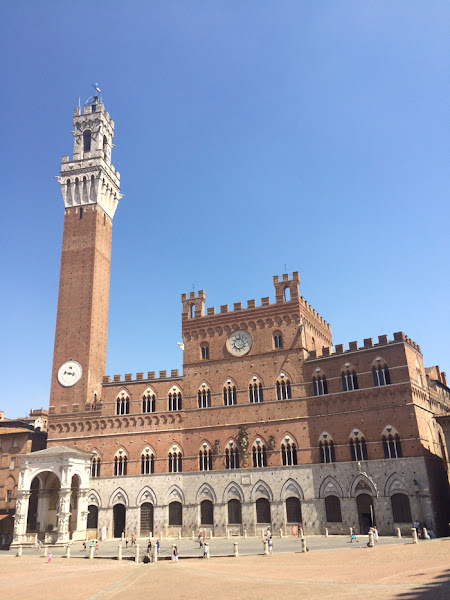
To the proud citizens of a major commune, their city's outward aspect was an important element in its prestige. It was in this spirit that the Sienese decided to have a public meadow within the city because:Siena, Palazzo Pubblico:Among those matters to which the men who undertake the city’s government should turn their attention, its beauty is the most important. One of the chief beauties of a pleasant city is the possession of a meadow or open place for the delight and joy of both citizens and strangers, and the cities and some towns of Tuscany, as well as some other honourable cities, are honourably supplied with such meadows and open places.1The element of pride in the city's appearance, and above all of a competitive determination to outshine their neighbours, was particularly strong among the Sienese, though the trait is to be found everywhere. The immensely ambitious cathedral which the Sienese began in the fourteenth century was a retort to the cathedral begun by the Florentines in 1296. Their Palazzo Pubblico, which was being built at the same time, was another attempt to show that Siena could build more impressively than its northern neighbour. The Sienese councillors decided, when discussing this building, that:It is a matter of honour for each city that its rulers and officials should occupy beautiful and honourable buildings, both for the sake of the commune itself and because strangers often go to visit them on business. This is a matter of great importance for the prestige (qualitatem) of the city.2A particular subject of pride to the Sienese (and rightly so, every visitor to the city will surely agree) was their Piazza, the Campo. Hopeful plans were formed as early as the thirteenth century for keeping the appearance of this piazza uniform by insisting that all the houses looking on to it should have the same type of window. And in 1346 the chronicler Agnolo di Tura proudly recorded:on 30 December they finished paving the campo of Siena in stone, and it is considered the most beautiful square, with the most beautiful and abundant fountain and the most handsome and noble houses and workshops around it of any square in Italy.31 Document cited by Braunfels, Mittelalterliche Stadtbaukunst in der Toskana, p. 208n.
2 G. Milanesi, Documenti per la storia dell'arte senese (Siena, 1854), I, p. 180.
3 RIS, n.s., XV, VI, p. 550.


