Saturday, March 12, 2022
The Professor of Profligacy
Alexis, fragment 25, from the Teacher of Profligacy = Ἀσωτοδιδάσκαλος (tr. Charles Burton Gulick):
What's this nonsense you are talking, for ever babbling, this way and that,See W. Geoffrey Arnott, Alexis: The Fragments, A Commentary (Cambridge: Cambridge University Press, 1996), pp. 819-830, who includes this fragment among the "False or Doubtful Attributions".
of the Lyceum, the Academy, and the Odeum gates —
mere sophists' rubbish? There's no good in them.
Let's drink, and drink our fill, my Sicon, Sicon!
Let's have a good time while we may still keep the life in our bodies. 5
Whoop it up, Manes! There's nothing nicer than the belly.
That is your father, and again, your only mother.
Ethics, embassies, army tactics —
fine pretences that sound hollow, like dreams.
Fate will snuff you out at the appointed time. 10
You will have only what you eat and drink.
All the rest is dust — Pericles, Codrus, Cimon.
τί ταῦτα ληρεῖς, φληναφῶν ἄνω κάτω
Λύκειον, Ἀκαδήμειαν, Ὠιδείου πύλας,
λήρους σοφιστῶν; οὐδὲ ἓν τούτων καλόν.
πίνωμεν, ἐμπίνωμεν, ὦ Σίκων, Σίκων,
χαίρωμεν, ἕως ἔνεστι τὴν ψυχὴν τρέφειν. 5
τύρβαζε, Μάνη· γαστρὸς οὐδὲν ἥδιον.
αὕτη πατήρ σοι καὶ πάλιν μήτηρ μόνη.
ἀρεταὶ δὲ πρεσβεῖαί τε καὶ στρατηγίαι
κόμποι κενὰ ψοφοῦντες ἀντʼ ὀνειράτων.
ψύξει σε δαίμων τῷ πεπρωμένῳ χρόνῳ· 10
ἕξεις δʼ ὅσʼ ἂν φάγῃς τε καὶ πίῃς μόνα·
σποδὸς δὲ τἄλλα, Περικλέης, Κόδρος, Κίμων.
Friday, March 11, 2022
The Good Old Days
Teleclides, fragment 1, from his Amphictyonies, preserved chiefly in Athenaeus 6.268a-d (tr. Charles Burton Gulick):

 See also S. Douglas Olson, Broken Laughter. Select Fragments of Greek Comedy. Edited with Introduction, Commentary, and Translation (Oxford: Oxford University Press, 2007), pp. 75-76, 101-103, 427-428.
I will, then, tell of the life of old which I provided for mortals.Apparatus from R. Kassel and C. Austin, edd., Poetae Comici Graeci, Vol. VII: Menecrates — Xenophon (Berlin: Walter de Gruyter, 1989), pp. 669-670:
First, there was peace over all, like water over hands.
The earth produced no terror and no disease; on the other hand, things needful came of their own accord.
Every torrent flowed with wine, barley-cakes strove with wheat-loaves
for men's lips, beseeching that they be swallowed 5
if men loved the whitest. Fishes would come to the house
and bake themselves, then serve themselves on the tables.
A river of broth, whirling hot slices of meat, would flow by the couches;
conduits full of piquant sauces for the meat were close at hand for the asking,
so that there was plenty for moistening a mouthful and swallowing it tender. 10
On dishes there would be honey-cakes all sprinkled with spices,
and roast thrushes served up with milk-cakes were flying into the gullet.
The flat-cakes jostled each other at the jaws and set up a racket,
the slaves would shoot dice with slices of paunch and tid-bits.
Men were fat in those days and every bit mighty giants. 15
λέξω τοίνυν βίον ἐξ ἀρχῆς ὃν ἐγὼ θνητοῖσι παρεῖχον.
εἰρήνη μὲν πρῶτον ἁπάντων ἦν ὥσπερ ὕδωρ κατὰ χειρός.
ἡ γῆ δ᾿ ἔφερ᾿ οὐ δέος οὐδὲ νόσους, ἀλλ᾿ αὐτόματ᾿ ἦν τὰ δέοντα·
οἴνῳ γὰρ ἅπασ᾿ ἔρρει χαράδρα, μᾶζαι δ᾿ ἄρτοις ἐμάχοντο
περὶ τοῖς στόμασιν τῶν ἀνθρώπων ἱκετεύουσαι καταπίνειν, 5
εἴ τι φιλοῖεν, τὰς λευκοτάτας. οἱ δ᾿ ἰχθύες οἴκαδ᾿ ἰόντες
ἐξοπτῶντες σφᾶς αὐτοὺς ἂν παρέκειντ᾿ ἐπὶ ταῖσι τραπέζαις.
ζωμοῦ δ᾿ ἔρρει παρὰ τὰς κλίνας ποταμὸς κρέα θερμὰ κυλίνδων,
ὑποτριμματίων δ᾿ ὀχετοὶ τούτων τοῖς βουλομένοισι παρῆσαν,
ὥστ᾿ ἀφθονία τὴν ἔνθεσιν ἦν ἄρδονθ᾿ ἁπαλὴν καταπίνειν. 10
λεκανίσκαισιν δ᾿ † ἀνάπαιστα † παρῆν ἡδυσματίοις κατάπαστα.
ὀπταὶ δὲ κίχλαι μετ᾿ ἀμητίσκων εἰς τὸν φάρυγ᾿ εἰσεπέτοντο·
τῶν δὲ πλακούντων ὠστιζομένων περὶ τὴν γνάθον ἦν ἀλαλητός.
μήτρας δὲ τόμοις καὶ χναυματίοις οἱ παῖδες ἂν ἠστραγάλιζον.
οἱ δ᾿ ἄνθρωποι πίονες ἦσαν τότε καὶ μέγα χρῆμα γιγάντων. 15
The Origin of the City
Plato, Republic 2.11 (369b-d; tr. Paul Shorey):
"The origin of the city, then," said I, "in my opinion, is to be found in the fact that we do not severally suffice for our own needs, but each of us lacks many things. Do you think any other principle establishes the state?"Related post: I Hear America Singing.
"No other," said he.
"As a result of this, then, one man calling in another for one service and another for another, we, being in need of many things, gather many into one place of abode as associates and helpers, and to this dwelling together we give the name city or state, do we not?"
"By all means."
"And between one man and another there is an interchange of giving, if it so happens, and taking, because each supposes this to be better for himself."
"Certainly."
"Come, then, let us create a city from the beginning, in our theory. Its real creator, as it appears, will be our needs."
"Obviously."
"Now the first and chief of our needs is the provision of food for existence and life."
"Assuredly."
"The second is housing and the third is raiment and that sort of thing."
"That is so."
"Tell me, then," said I, "how our city will suffice for the provision of all these things. Will there not be a farmer for one, and a builder, and then again a weaver? And shall we add thereto a cobbler and some other purveyor for the needs of body?"
"Certainly."
"The indispensable minimum of a city, then, would consist of four or five men."
γίγνεται τοίνυν, ἦν δ᾽ ἐγώ, πόλις, ὡς ἐγᾦμαι, ἐπειδὴ τυγχάνει ἡμῶν ἕκαστος οὐκ αὐτάρκης, ἀλλὰ πολλῶν ὢν ἐνδεής· ἢ τίν᾽ οἴει ἀρχὴν ἄλλην πόλιν οἰκίζειν;
οὐδεμίαν, ἦ δ᾽ ὅς.
οὕτω δὴ ἄρα παραλαμβάνων ἄλλος ἄλλον, ἐπ᾽ ἄλλου, τὸν δ᾽ ἐπ᾽ ἄλλου χρείᾳ, πολλῶν δεόμενοι, πολλοὺς εἰς μίαν οἴκησιν ἀγείραντες κοινωνούς τε καὶ βοηθούς, ταύτῃ τῇ συνοικίᾳ ἐθέμεθα πόλιν ὄνομα· ἦ γάρ;
πάνυ μὲν οὖν.
μεταδίδωσι δὴ ἄλλος ἄλλῳ, εἴ τι μεταδίδωσιν, ἢ μεταλαμβάνει, οἰόμενος αὑτῷ ἄμεινον εἶναι;
πάνυ γε.
ἴθι δή, ἦν δ᾽ ἐγώ, τῷ λόγῳ ἐξ ἀρχῆς ποιῶμεν πόλιν: ποιήσει δὲ αὐτήν, ὡς ἔοικεν, ἡ ἡμετέρα χρεία.
πῶς δ᾽ οὔ;
ἀλλὰ μὴν πρώτη γε καὶ μεγίστη τῶν χρειῶν ἡ τῆς τροφῆς παρασκευὴ τοῦ εἶναί τε καὶ ζῆν ἕνεκα.
παντάπασί γε.
δευτέρα δὴ οἰκήσεως, τρίτη δὲ ἐσθῆτος καὶ τῶν τοιούτων.
ἔστι ταῦτα.
φέρε δή, ἦν δ᾽ ἐγώ, πῶς ἡ πόλις ἀρκέσει ἐπὶ τοσαύτην παρασκευήν; ἄλλο τι γεωργὸς μὲν εἷς, ὁ δὲ οἰκοδόμος, ἄλλος δέ τις ὑφάντης; ἢ καὶ σκυτοτόμον αὐτόσε προσθήσομεν ἤ τιν᾽ ἄλλον τῶν περὶ τὸ σῶμα θεραπευτήν;
πάνυ γε.
εἴη δ᾽ ἂν ἥ γε ἀναγκαιοτάτη πόλις ἐκ τεττάρων ἢ πέντε ἀνδρῶν.
Thursday, March 10, 2022
Games
Clearchus, fragment 63 Wehrli, quoted by Athenaeus 10.457e-f (tr. Charles Burton Gulick):
[T]he ancients preferred such problems as these: answering the first guest who recited an epic or iambic line, each one in turn capped it with the next verse; or, if one recited the gist of a passage, another answered with one from some other poet to show that he had spoken to the same effect; further, each in turn would recite an iambic verse. In addition to this each would recite a metrical line containing as many syllables as were prescribed, or as many as kept to the correct theory of letters and syllables. Similarly to what has been described, they would tell the name of each leader against Troy, or of each leader among the Trojans, or tell the name of a city in Asia — all beginning with a given letter; then the next man and all the rest would take turns in telling the name of a city in Europe, whether Greek or barbarian, as prescribed. Thus their very play, being not unreflective, became a revelation of the friendly terms with culture on which each guest stood; and as a reward for success they set up a crown and bestowed applause, by which, more than anything else, mutual friendship is rendered sweet.
Wednesday, March 09, 2022
Modishly Crude Translations
Anne Pippin Burnett, Three Archaic Poets: Archilochus, Alcaeus, Sappho (London: Duckworth, 1983; rpt. 1988), p. 15:
In recent times, however, Archilochus has been the subject of another kind of admiration, for modishly crude translations have made him the brother of certain contemporary poets, while scholars have set him at the opening of their histories of the so-called Western mind.This is probably an allusion to Carmina Archilochi: The Fragments of Archilochus. Translated from the Greek by Guy Davenport. Forward by Hugh Kenner (Berkeley: University of California Press, 1964), reviewed unfavorably by Burnett in Classical Philology 60.1 (January, 1965) 49-51, e.g. (at 50):
...his intention being to transform the old poet into something preciously modern: the affected, apocryphal familiar of some youthful pseudo-Pound.
Current Events
John Dos Passos, 1919 (New York: Harcourt, Brace and Company, 1932), p. 92 (he = Blake "Ned" Wigglesworth):
[W]henever politics or the war or anything like that came up he had a way of closing his eyes and throwing back his head and saying Blahblahblahblah.
The Vanity of Earthly Glory
Petrarch, Africa 6.885-918 ("the Punic youth" = Hannibal's brother Mago; tr. Thomas G. Bergin and Alice S. Wilson):
And as the Punic youth thus fared uponWilfred P. Mustard, "Petrarch's Africa," American Journal of Philology 42.2 (1921) 97-121 (at 111-112, n. 14):
mid-ocean, there the ever-waxing pain
of his deep wound and the clear prescience
of bitter death, as if with fiery goads,
assailed his fever-stricken breast. Aware
that his last hour drew nigh, he voiced his grief:
"Ah, sorry ending to my life of glory!
How blind the soul to its true good and weal!
What mad, tempestuous force of folly moves
a man of mark to struggle to ascend
vertiginous heights! The summit is exposed
to countless tempests, and ascent must end
in ruinous collapse. The lofty peak,
deluding hope of man, is hollow fame
daubed with the glittering tint of false delight.
Our lives are wasted in incessant toil
of no sure issue; only our last day,
to which we give no heed, is fixed and sure.
Alas for the injustice of man's lot:
the brutes in peace live out their tranquil lives;
mankind alone is harried and harrassed
and driven through laborious year on year
along the road to death. Nay, Death, thou art
the fairest thing we know; thou dost erase
our faults and dissipate our idle dreams,
quenching our lives. At last I can perceive
how long and fruitless have my labors been.
What countless toils I've faced that I might well
have put aside! Doomed though he be to die,
man still aspires to Heaven, but death reveals
the worth of his endeavor. What served it me
to ravage Latium with fire and sword,
to breach the universal peace that ruled
throughout the world and spread a panic fear
in countless cities? What did it avail
to raise up golden palaces and gird
their walls with marble if I am at last
to die, ill-starred, upon the lonely sea?
Dear brother, what are you devising now,
all unaware of Fortune's plan and of
my wretched lot?" And, as he spoke, his soul
broke from the flesh and straightway mounted high
to Heaven, whence it surveyed the earthly plain
and Rome and Carthage with its citadel;
and in its passage Mago found a sad
contentment, that in life he might not see
the final ruin, the shame of mighty arms
once glorious, and the sorrow yet to fall
upon his land, his brother, and his race.
Hic postquam medio iuvenis stetit aequore Poenus, 885
vulneris increscens dolor et vicinia durae
mortis agens stimulis ardentibus urget anhelum.
Ille videns propius supremi temporis horam,
incipit: 'Heu qualis fortunae terminus altae est!
Quam laetis mens caeca bonis! Furor ecce potentum 890
praecipiti gaudere loco. Status iste procellis
subiacet innumeris et finis ad alta levatis
est ruere. Heu tremulum magnorum culmen honorum,
spesque hominum fallax et inanis gloria fictis
illita blanditiis! Heu vita incerta labori 895
dedita perpetuo semperque heu certa nec umquam
sat mortis provisa dies! Heu sortis iniquae
natus homo in terris! Animalia cuncta quiescunt;
irrequietus homo perque omnes anxius annos
ad mortem festinat iter. Mors, optima rerum, 900
tu retegis sola errores et somnia vitae
discutis exactae. Video nunc quanta paravi,
ah miser, incassum, subii quot sponte labores,
quos licuit transire mihi. Moriturus ad astra
scandere quaerit homo, sed mors docet omnia quo sint 905
nostra loco. Latio quid profuit arma potenti,
quid tectis inferre faces, quid foedera mundi
turbare atque urbes tristi miscere tumultu?
Aurea marmoreis quidve alta palatia muris
erexisse iuvat, postquam sic sidere laevo 910
in pelago periturus eram? Carissime frater,
quanta paras animis? Heu fati ignarus acerbi
ignarusque mei!' Dixit; tum liber in auras
spiritus egreditur, spatiis unde altior aequis
despiceret Romam simul et Carthaginis urbem, 915
ante diem felix abiens, ne summa videret
excidia et claris quod restat dedecus armis
fraternosque suosque simul patriaeque dolores.
The thirty-four lines on the death of Mago have a special history of their own. In 1343 Petrarch gave them to a friend at Naples, under a strict pledge of secrecy. But the friend promptly forgot his pledge, and the passage was soon widely copied and distributed, and so was handed on in a good many MSS. And Petrarch records that it was severely criticized, on the ground that the sentiment and tone were not in keeping with the time, the place, or the speaker (Sen. 2, 1). In 1781 a French editor, J.B. Lefèvre, claimed the lines for Silius Italicus, and actually printed them in an edition of the Punica (after xvi, 27). (Apparently, even in 1781 a new editor liked to offer something new.) Lefèvre had found them, not in a MS of Silius at all, but in a collection of excerpta. Yet he professed to believe that Petrarch had a copy of the Punica, that he thought it the only one in existence, that he borrowed these thirty-four lines bodily, and deliberately suppressed the rest. In 1823 a verse translation of the passage was printed in Ugo Foscolo's Essays on Petrarch, and attributed to Lord Byron. In the following year the translation was claimed by Byron's friend, Thomas Medwin.Medwin's version:
The Carthaginian rose—and when he found
The increasing anguish of his mortal wound
All hope forbid—with difficult, slow breath
He thus address'd the coming hour of death—
"Farewell to all my longings after fame!
Cursed love of power, are such thine end and aim
Oh, blind to all that might have made thy bliss,
And must ambition's frenzy come to this?
From height to height aspiring still to rise,
Man stands rejoicing on the precipice,
Nor sees the innumerable storms that wait
To level all the projects of the great.
Oh, trembling pinnacle of power on earth!
Deceitful hopes! and glory blazon'd forth
With false, fictitious blandishments! Oh, life
Of doubt and danger, and perpetual strife
With death! And, thou! worse than this night of woe
That comest to all, but ah! when none can know,
Hour singled from all years! why must man bear
A lot so sad? The tribes of earth and air
No thoughts of future ill in life molest,
And when they die, sleep on, and take their rest;
But man in restless dreams spends all his years,
And shortens life with death's encroaching fears.
Oh, thou, whose cold hand tears the veil from error,
Whose hollow eye is our delusion's mirror!
Death, life's chief blessing! At this hour of fate,
Wretch that I am! I see my faults too late.
Perils ill-sought, and crimes ill worth the price,
Pass on in dire review before my eyes;
Yet, thing of dust, and on the verge of night,
Man dares to climb the stars, and on the height
Of heaven his owlet vision dares to bend
From that low earth, where all his hopes descend.
What then avails me in this trying hour,
Or thee, my Italy, this arm of power?
Why did I bid the torch of ravage flame?
Ah! why as with a trumpet's tongue proclaim
The rights of man? confounding wrong and right,
And plunging nations in a deeper night?
Why did I raise of marble to the skies
A gorgeous palace ? Vain and empty prize!
When with it lost my air-built dreams must lie
Gulph'd in the Ocean of eternity.
My dearest brother, ah! remember me,
And let my fate avert the like from thee."
He said, and now, its mortal bondage riven,
His spirit fled, and from its higher heaven
Of space look'd down where Rome and Carthage lay,
Thrice blest in having died before the day
Whose wing of havoc swept his race away,
And had not saved by valour vainly shewn
His country's woes, his brother's, and his own.
Tuesday, March 08, 2022
Like a Grotesquely-Shaped Balloon
Martin L. West, Studies in Greek Elegy and Iambus (Berlin: Walter de Gruyter, 1974), p. 30 (on Hipponax):
An admixture of the high-flown adds another dimension to the style. Compounds such as ὀμφαλητόμος (19), κατωμόχανος (28.1), πασπαληφάγος (103.11), μεσσηγυδορποχέστης (114c) and others, like the burglar's prayer, are amusing in the same way as a balloon that turns out to inflate into a grotesque shape.Definitions from Franco Montanari, The Brill Dictionary of Ancient Greek (Leiden: Brill, 1995):
- ὀμφαλητόμος (p. 1460): who cuts the umbilical cord [a medical term, not that unusual, the only word in West's list that's not a hapax legomenon]
- πασπαληφάγος (p. 1593): grain-eater [cf. pultiphagus and Pultiphagonides in Plautus]
- μεσσηγυδορποχέστης or μεσηγυδορποχέστης (p. 1315): one who defecates halfway through dinner
Monday, March 07, 2022
Address to the Heart
Archilochus, fragment 128, tr. Anne Pippin Burnett, Three Archaic Poets: Archilochus, Alcaeus, Sappho (London: Duckworth, 1983; rpt. 1988), p. 49:
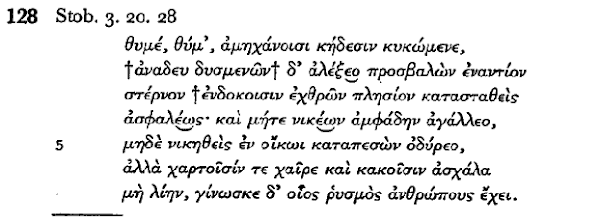
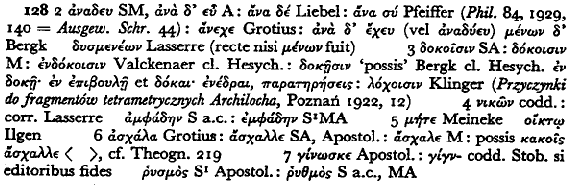 Commentary in David A. Campbell, Greek Lyric Poetry (1967; rpt. London: Macmillan, 1988), pp. 153-154, and Laura Swift, Archilochus: The Poems. Introduction, Text, Translation and Commentary (Oxford: Oxford University Press, 2019), pp. 315-317.
O heart, heart that seethes with unresisted grief,Text and apparatus from M.L. West, ed., Iambi et Elegi Graeci ante Alexandrum Cantati, 2nd ed., Vol. I (Oxford: Clarendon Press, 1998), p. 50:
rise, fight, thrust a hostile breast
against the ambushed enemy! Stand close,
hold fast and if you win don't boast
to every ear nor, beaten, hide at home
to wail. Welcome joy and yield to pain
without excess — learn what rhythm governs man.
θυμέ, θύμ᾿, ἀμηχάνοισι κήδεσιν κυκώμενε,
†ἀναδευ δυσμενῶν† δ᾿ ἀλέξεο προσβαλὼν ἐναντίον
στέρνον †ἐνδοκοισιν† ἐχθρῶν πλησίον κατασταθεὶς
ἀσφαλέως· καὶ μήτε νικέων ἀμφάδην ἀγάλλεο,
μηδὲ νικηθεὶς ἐν οἴκῳ καταπεσὼν ὀδύρεο, 5
ἀλλὰ χαρτοῖσίν τε χαῖρε καὶ κακοῖσιν ἀσχάλα
μὴ λίην, γίνωσκε δ᾿ οἷος ῥυσμὸς ἀνθρώπους ἔχει.
A Nursery Word
J.P. Mallory and D.Q. Adams, edd., Encyclopedia of Indo-European Culture (London: Fitzroy Dearborn, 1997), p. 187:
 Calvert Watkins, The American Heritage Dictionary
of Indo-European Roots (Boston: Houghton Mifflin Company, 1985), p. 26:
 Carl Darling Buck, A Dictionary of Selected Synonyms in the Principal
Indo-European Languages (Chicago, University of Chicago Press, 1949; rpt. 1988), cols. 275-276:

Labels: noctes scatologicae
Sunday, March 06, 2022
Restaurant Review
Eupolis, fragment 365 Kassel-Austin (tr. S. Douglas Olson):
bad food expensively prepared
ὄψῳ πονηρῷ πολυτελῶς ἠρτυµένῳ
Portrait of the Blogger as an Old Man
Aristophanes, Clouds 908 (tr. Alan H. Sommerstein):

You're senile and out of touch.The same (tr. Jeffrey Henderson):
You're an outmoded old blowhard.The Greek:
τυφογέρων εἶ κἀνάρμοστος.W.J.M. Starkie ad loc.:
Gone
Bruce Catton, A Stillness at Appomattox (1953; rpt. New York: Anchor Books, 1990), p. 216:
The old unities were gone: unities of blood, of race, of language, of shared ideals and common memories and experiences, the very things which had always seemed essential beneath the word "American."
Friday, March 04, 2022
Epitaph of Bacchidas
Werner Peek, Griechische Vers-Inschriften, Vol. I: Grab-Epigramme (Berlin: Akademie-Verlag, 1955), p. 409, # 1368 (epitaph of Bacchidas, from Athenaeus 8.336 b, tr. Charles Burton Gulick):
Drink, eat, indulge in all things the heart's desire!The verbs in the first line are aorist infinitives for imperatives.
For lo! I stand here, a stone to represent Bacchidas.
πιέν, φαγὲν καὶ πάντα τᾷ ψυχᾷ δόμεν·
κἠγὼ γὰρ ἕστακ'ἀντὶ Βακχίδα λίθος.
Peace
Bruce Catton, A Stillness at Appomattox (1953; rpt. New York: Anchor Books, 1990), p. 173 (note omitted):
A soldier in a New York heavy artillery regiment wrote that it seemed, now and then, as if an increasing number of Confederates were willing to slip over to the Union side after dark and surrender, yet he added wryly that "when it comes to fighting, one would not suppose that any of them had the faintest idea of surrendering." Between fights, he said, Northerners and Southerners talked things over, concluded that peace would be a very fine thing, and agreed that "if a few men on both sides who stayed at home were hung, matters could easily be arranged."Id., pp. 175-176:
The soldiers had got the point perfectly, and they expressed it very simply: Hang a few troublemakers and we'll all go home. Mysteriously, the fighting seemed to be bringing them mutual understanding, and they may almost have been closer to each other, in spirit, than they were to their own civilians back home. Yet there was nothing they could do about it. They had not made the war and they would not end it. They could only fight it.
And the men who had made the war—the sharp politicians and the devoted patriots, the men who dreamed the American dream in different ways and the other men who never dreamed any dreams at all but who had a canny eye for power and influence—most of these, by now, were prisoners of their own creation.
Thursday, March 03, 2022
On Listening to a Certain Political Leader
Aristophanes, Clouds 628-629 (tr. Stephen Halliwell):
I've never in all my life met a bumpkin like this,W.J.M. Starkie ad loc.:
So helpless in every respect, so crass and forgetful!
οὐκ εἶδον οὕτως ἄνδρ᾿ ἄγροικον οὐδαμοῦ
οὐδ᾿ ἄπορον οὐδὲ σκαιὸν οὐδ᾿ ἐπιλήσμονα...

Not Allowed
J.R.R. Tolkien, The Lord of the Rings, Part 3: The Return of the King (VI.8: The Scouring of the Shire):
'You know talk o' that sort isn't allowed. The Chief will hear of it, and we'll all be in trouble.'
Wednesday, March 02, 2022
Archaism and Futurism
Arnold J. Toynbee, A Study of History, Vol. V (1939; rpt. London: Oxford University Press, 1955), pp. 385-386 (footnotes omitted):
Archaism may be defined as a reversion from the mimesis of contemporary creative personalities to a mimesis of the ancestors of the tribe: that is to say, as a lapse from the dynamic movement of Civilization to the static condition of Primitive Mankind in its latest state. It may be defined, again, as one of those attempts at a forcible stoppage of change which result, in so far as they succeed, in the production of social enormities. In the third place, Archaism may be taken as an example of that attempt to 'peg' a broken-down and disintegrating society which, in another context, we have found to be the common aim of human Utopias and of those insect societies to which the arrested human societies approximate. In corresponding terms we may define Futurism as a repudiation of any mimesis of anybody—present or past, creative or conservative—and also as one of those attempts at a forcible accomplishment of change which result, in so far as they succeed, in the production of social revolutions that defeat their own purpose by tumbling over into reaction. In fine, Futurism only avoids the static immobility of Archaism at the price of moving like a convict on a treadmill or like a captive mouse in a revolving cage; and the futility of this revolutionary motion is summed up in the devastating aphorism Plus ça change, plus c'est la même chose.
Splendid Liars
Bruce Catton, A Stillness at Appomattox (1953; rpt. New York: Anchor Books, 1990), p. 53 (note omitted):
There were the age-old attempts to wangle furloughs. An Irish private one day went to his regimental commander, explaining that his wife was ill and the children were not well and that it was necessary for him to make a short visit to his home. The colonel fixed him with a beady eye and said: "Pat, I had a letter from your wife this morning saying she doesn't want you at home; that you raise the devil whenever you are there, and that she hopes I won't grant you any more furloughs. What have you to say to that?"
Quite unabashed, the soldier replied that there were "two splendid liars in this room" and that he himself was only one of them: "I nivir was married in me life."
Tuesday, March 01, 2022
A Fixed Time for Study
Beethoven, Tagebuch 48, tr. Maynard Solomon, Beethoven Essays (Cambridge: Harvard University Press, 1988; rpt. 1990), p. 259:
Newer› ‹Older
Always study from half-past five until breakfast.
Immer von halb 6 bis zum Frühstück studiert!

