Monday, August 22, 2022
Unspotted From the World
Walter Hooper, introduction to C.S. Lewis, Present Concerns (San Diego: Harcourt, Inc., 1987), p. 7:
The phrase "unspotted from the world" comes from James 1:27 (KJV):
"Who is Elizabeth Taylor?" asked C.S. Lewis. He and I were talking about the difference between "prettiness" and "beauty", and I suggested that Miss Taylor was a great beauty. "If you read the newspapers," I said to Lewis, "you would know who she is." "Ah-h-h-h!" said Lewis playfully, "but that is how I keep myself 'unspotted from the world'." He recommended that if I absolutely "must" read newspapers I have a frequent "mouthwash" with The Lord of the Rings or some other great book.
The phrase "unspotted from the world" comes from James 1:27 (KJV):
Pure religion and undefiled before God and the Father is this, To visit the fatherless and widows in their affliction, and to keep himself unspotted from the world.
θρησκεία καθαρὰ καὶ ἀμίαντος παρὰ τῷ θεῷ καὶ πατρὶ αὕτη ἐστίν, ἐπισκέπτεσθαι ὀρφανοὺς καὶ χήρας ἐν τῇ θλίψει αὐτῶν, ἄσπιλον ἑαυτὸν τηρεῖν ἀπὸ τοῦ κόσμου.
Sunday, August 21, 2022
A Good Journey
Sophocles, Philoctetes 641 (tr. R.C. Jebb):
'Tis ever fair sailing, when thou fleest from evil.
ἀεὶ καλὸς πλοῦς ἔσθ᾽, ὅταν φεύγῃς κακά.
KWFA PROSWPA
Aristophanes, Clouds, Wasps, Peace. Edited and Translated by Jeffrey Henderson (Cambridge: Harvard University Press, 1998 = Loeb Classical Library, 488), p. 426 (in the Dramatis Personae for Peace):
 A friend once called me Λοεβομάστιξ (Loebomastix, i.e. castigator of the Loeb Classical Library; cf. Ὁμηρομάστιξ = Homeromastix).
kwfa proswpaThis a mistake for ΚΩΦΑ ΠΡΟΣΩΠΑ (i.e. non-speaking characters). See pp. 8 and 220. And yes, I know what caused the mistake—something like this:

Labels: typographical and other errors
A Pair of Fools
Sebald Beham (1500-1550), A Couple of Fools (British Museum, accession number 1892,0628.185):
 Margaret A. Sullivan, "Fools/Folly," in Helene E. Roberts, ed., Encyclopedia of
Comparative Iconography, Vol. 1 (Chicago: Fitzroy Dearborn Publishers, 1998), pp. 331-336 (at 331):
Margaret A. Sullivan, "Fools/Folly," in Helene E. Roberts, ed., Encyclopedia of
Comparative Iconography, Vol. 1 (Chicago: Fitzroy Dearborn Publishers, 1998), pp. 331-336 (at 331):

When a bladder is substituted for the traditional bauble, as in Hans Sebald Beham's small print (circa 1530) of a male fool seated on the ground next to a female fool, its phallic shape emphasizes his inability to control his sexual appetites, a failing that further associates the fool with animals. Grotesque features such as a big nose, large lips, crossed eyes, or some other deformity that is the antithesis of a desirable physiognomy also characterize the imagery of the fool and are used to mark the fool as a deviant.Charles Zika, The Appearance of Witchcraft: Print and Visual Culture in Sixteenth-Century Europe (2007; rpt. London: Routledge, 2009), pp. 76-77 (notes omitted):
Murner's image, for instance, probably alluded to contemporary use of the German word for pot or cauldron, Hafen or Häfelin, for the vagina. The association was not just limited to language, but also related to communal practices. On the feast of St. John in southern Germany, for instance, unmarried women would hang from the eaves of their houses small pots filled with rose petals, with a burning candle inside. The pot symbolized the vagina and so the hanging of these pots at mid-summer marked a woman's sexual fertility and availability. It is not surprising, therefore, that the pot, vase or vessel was frequently used pictorially to represent female sexuality, most graphically and obviously so in a small engraving of Two Fools by Sebald Beham, in which a phallic stick held by the male fool is matched by the vessel held by the female.John H. Astington, Stage and Picture in the English Renaissance: The Mirror up to Nature (Cambridge: Cambridge University Press, 2017), p. 103:
The print shows a male and female fool sitting facing each other, drinking. They both wear the traditional headgear of the Brant tradition, and their lascivious interest each in the other is signalled not only by their poses, each leaning forward, but by the prominent left foreground detail of the phallic 'bauble' the male figure holds in his right hand, made of leather or cloth, and stuffed to take on its characteristic shape, not unlike the ancient costumes worn by Greek actors in comedies. The flies around the heads of the two figures are symbols of their corruption, animality, and empty-headedness. The drinking vessels — the flask held by the man, with its projecting spout, and the prominently shaded mouth of the flagon in the right lower foreground, at the same level as the woman's thighs — further symbolise the lechery of the encounter ...
Saturday, August 20, 2022
Theta and Zeta
I just encountered theta and zeta as nouns in Walter of Wimborne's Ave Virgo Mater Christi, in his Poems, ed. A.G. Rigg (Toronto: Pontifical Institute of Mediaeval Studies, 1978), pp. 146-147.
Theta isn't in Alexander Souter, A Glossary of Later Latin to 600 A.D. (Oxford: Oxford University Press, 1949), Albert Blaise, Lexicon Latinitatis Medii Aevi (Turnhout: Brepols, 1975), or J.F. Niermeyer, Mediae Latinitatis Lexicon Minus (Leiden: E.J. Brill, 1976). Rigg ad loc. refers to Isidore of Seville (560-636), Etymologies 1.3.8 (tr. Stephen A. Barney et al.):
Zeta, on the other hand, is in all the dictionaries just cited, with the meaning diaeta = house.
Theta isn't in Alexander Souter, A Glossary of Later Latin to 600 A.D. (Oxford: Oxford University Press, 1949), Albert Blaise, Lexicon Latinitatis Medii Aevi (Turnhout: Brepols, 1975), or J.F. Niermeyer, Mediae Latinitatis Lexicon Minus (Leiden: E.J. Brill, 1976). Rigg ad loc. refers to Isidore of Seville (560-636), Etymologies 1.3.8 (tr. Stephen A. Barney et al.):
There are also five mystical letters among the Greeks. The first is ϒ, which signifies human life, concerning which we have just spoken. The second is Θ, which [signifies] death, for the judges used to put this same letter down against the names of those whom they were sentencing to execution. And it is named 'theta' after the term θάνατος, that is, 'death.' Whence also it has a spear through the middle, that is, a sign of death. Concerning this a certain verse says:Walter of Wimborne used theta in the phrase theta tetre mortis, i.e. the death of death.How very unlucky before all others, the letter theta.Quinque autem esse apud Graecos mysticas litteras. Prima ϒ, quae humanam vitam significat, de qua nunc diximus. Secunda Θ, quae mortem [significat]. Nam iudices eandem litteram adponebant ad eorum nomina, quos supplicio afficiebant. Et dicitur Theta ἀπὸ τοῦ θανάτου, id est a morte. Vnde et habet per medium telum, id est mortis signum. De qua quidam:O multum ante alias infelix littera theta.
Zeta, on the other hand, is in all the dictionaries just cited, with the meaning diaeta = house.
Saint Erasmus
Dedication of Jeff Persels and Russell Ganim, edd.,
Fecal Matters in Early Modern Literature and Art: Studies in Scatology
(2004; rpt. London: Routledge, 2016):
Related post: The Company of Saints.To Erasmus, patron saint of intestinal disorders
Ora pro nobis.
Friday, August 19, 2022
Food Fit for Sheep
Greek Anthology 11.413 (by Ammianus; tr. W.R. Paton):
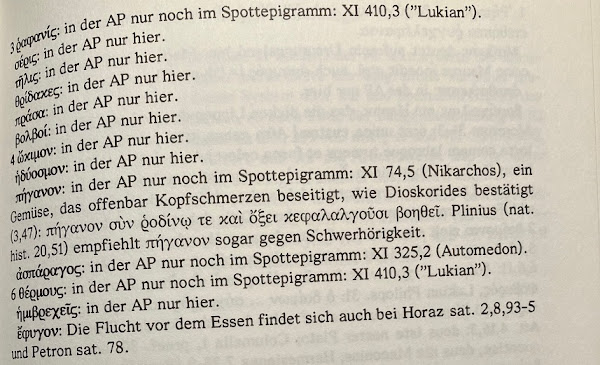
Thanks very much to Michael Hendry for sending me a photocopy of the relevant pages of Hendrich Schulte, Die Epigramme des Ammianos: Text, Übersetzung, Kommentar (Trier: Wissenschaftlicher Verlag Trier, 2004):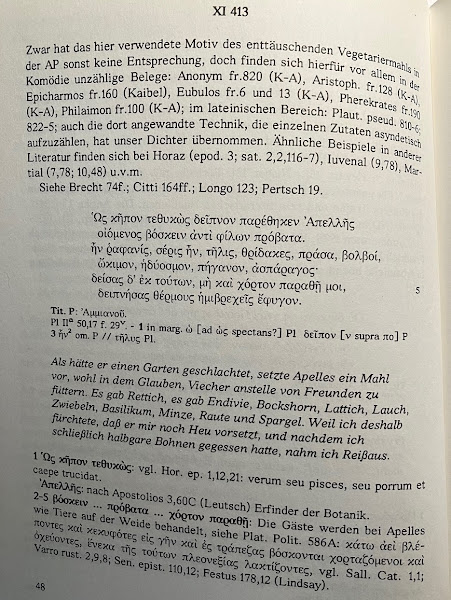
Apelles gave us a supper as if he had butchered a garden,The same, tr. H.C.I. Gwynne-Vaughan and F.A. Wright:
thinking he was feeding sheep and not friends.
There were radishes, chicory, fenugreek, lettuces, leeks, onions,
basil, mint, rue, and asparagus.
I was afraid that after all these things he would serve me with hay,
so when I had eaten some half-soaked lupins I went off.
ὡς κῆπον τεθυκὼς, δεῖπνον παρέθηκεν Ἀπελλῆς,
οἰόμενος βόσκειν ἀντὶ φίλων πρόβατα.
ἦν ῥαφανίς, σέρις ἦν, τῆλις, θρίδακες, πράσα, βολβοί,
ὤκιμον, ἡδύοσμον, πήγανον, ἀσπάραγος·
δείσας δ᾽ ἐκ τούτων μὴ καὶ χόρτον παραθῇ μοι,
δειπνήσας θέρμους ἡμιβρεχεῖς, ἔφυγον.
He went among his garden rootsSee Friedrich Marx, C. Lucilii Carminum Reliquiae, Vol. II: Commentarius (Leipzig: B.G. Teubner, 1905), pp. 81-82 (on fragment 193), and Francesco Citti, "La Gola Frustrata: Invitati Delusi da Plauto ad Ammiano Epigrammatista," Lexis 9-10 (1992) 163-175.
And took a knife and cut their throats;
Then served us greenstuff, heap on heap,
As though his guests were bleating sheep.
Rue, lettuce, onion, basil, leek,
Radishes, chicory, fenugreek,
Asparagus and peppermint,
And lupines boiled—he made no stint.
At last in fear I came away:
I thought the next course would be hay.
Thanks very much to Michael Hendry for sending me a photocopy of the relevant pages of Hendrich Schulte, Die Epigramme des Ammianos: Text, Übersetzung, Kommentar (Trier: Wissenschaftlicher Verlag Trier, 2004):


Surprise
J.P.V.D. Balsdon, Romans and Aliens (London: Duckworth, 1979), p. x:
A learned friend of mine expressed surprise at the antiquity of some of the books which I quote; these are in the main doctorate dissertations of the nineteenth century, the sort of work which, with its close concentration of interest on the subject in hand, never seems to me to lose its value. Scholars have grown no cleverer in the last hundred years; it is simply that they have more (particularly in the way of inscriptions and papyri) to be clever about.
Thursday, August 18, 2022
Strange Tricks
M.I. Finley, The World of Odysseus, 2nd ed. (1965; rpt. Harmondsworth: Penguin Books, 1983), p. 17:
The human mind plays strange tricks with time perspectives when the distant past is under consideration: centuries become as years and millennia as decades. It requires conscious effort to make the necessary correction ...
The Eloquence of the Manager of a Freak Show
Greek Anthology 11.353 (by Palladas; tr. W.R. Paton, with his note):
Jean François Boissonade ap. Friedrich Dübner, Epigrammatum Anthologia Palatina, Vol. II (Paris: Firmin Didot, 1888), p. 388:
Alfred Franke, De Pallada Epigrammatographo (Leipzig: Hesse & Becker, 1899), p. 82:
Wulf D. Hund, "Racist King Kong Fantasies: From Shakespeare's Monster to Stalin's Ape-Man," in Wulf D. Hund et al., edd., Simianization: Apes, Gender, Class, and Race (Vienna: LIT Verlag, 2015), pp. 43-73 (at 45-46, with mention of Palladas in n. 8):
Hermolycus' daughter slept with a great ape and she gave birth to many little ape-Hermeses. If Zeus, transformed into a swan, got him from Leda Helen, Castor, and Pollux, with Hermione at least a crow lay, and, poor woman, she gave birth to a Hermes-crowd of horrible demons.2Paton's translation is awkward. I would revise it slightly as follows:
2 The epigram seems very confused. Is Hermione the same as Hermolycus' daughter, and how did she manage to have such a variety of husbands?
Ἑρμολύκου θυγάτηρ μεγάλῳ παρέλεκτο πιθήκῳ·
ἡ δ᾽ ἔτεκεν πολλοὺς Ἑρμοπιθηκιάδας.
εἰ δ᾽ Ἑλένην ὁ Ζεὺς καὶ Κάστορα καὶ Πολυδεύκην
ἐκ Λήδης ἔτεκεν, κύκνον ἀμειψάμενος,
Ἑρμιόνῃ γε Κόραξ παρελέξατο· ἡ δὲ τάλαινα
φρικτῶν δαιμονίων ἑρμαγέλην ἔτεκεν.
Hermolycus' daughter slept with a great ape and she gave birth to many little ape-Hermeses. If Zeus, transformed into a swan, begat Helen, Castor, and Pollux from Leda, with Hermione at least a crow lay, and, poor woman, she gave birth to a Hermes-crowd of horrible demons.This epigram seems to have attracted little notice among scholars. Some subsidia interpretationis follow.
Jean François Boissonade ap. Friedrich Dübner, Epigrammatum Anthologia Palatina, Vol. II (Paris: Firmin Didot, 1888), p. 388:
CCCLIII. In Plan. ἄδηλον. — In quandam deformium liberorum matrem. — 1. «Hermolyci filia Hermione deformi viro concumbebat; nam sic est πιθήκῳ capiendum; conf. ad ep. 196. — 2. Nomen tanquam ex avi et patris nomine compositum. — 5. Dixerat cum simia rem habuisse; nunc cum corvo dicit, non nitide; nec Ἑρμαγέλη exspectatur post Ἑρμοπιθηκιάδας: ut crediderim esse confusa duo epigrammata, quorum prius primo disticho includatur. — 6. Ἑρμαγέλη, grex quem pascat Mercurius larvarum praeses.» B. Omnia integra, neque ea lance expendendus Palladas.In other words, Boissonade thought there were two separate epigrams (lines 1-2 and 3-6), not one.
Alfred Franke, De Pallada Epigrammatographo (Leipzig: Hesse & Becker, 1899), p. 82:
Constat inter omnes horum saeculorum, quae commemoravi, poetas in primis Nonnum et eius sectatores maxime valuisse novis verbis fictis. In Palladae quoque epp. multa invenimus nova verba haud parva cum sagacitate ficta aut parodiae aut annominationis causa. De nominibus propriis certis de causis fictis iam supra dixiiuus, addimus hoc loco alia: ... praeterea Ἑρμοπιθηκιάδης et ἑρμαγέλη comice fingit secundum Ἑρμόλυκος ep. XI. 353.Id., pp. 83-84 (footnotes omitted):
Particulas quoque, quae saeculis Ch. n. sequentibus in dies rarescebant, apud Palladam perraras esse observamus. Ex eis particulis, quas Blass in Novo Testamento non iam exstare explicavit, perpaucae in epp. Palladae reperiuntur ... γὲ coniunctum legitur et apud Parthenium et reliquos eroticos plane desideratur, semel inveni in Palladae ep. XI. 353, 5., quo loco cum etiam propter sententiarum conexum suspicionem moveat, fortasse rectius in δὲ mutandum est.Georg Luck, "Palladas: Christian or Pagan?" Harvard Studies in Classical Philology 63 (1958) 455-471 (at 467, with note on p. 470):
His eloquence is, indeed, the eloquence of the manager of a freak show70; he does not have to appeal to moral standards in order to attract his public.Heather White, "Eight Convivial and Satirical Epigrams," Minerva. Revista de filología clásica 11 (1997) 67-71 (at 70):
70 Cf. Anth. Pal. 11.353.
In this epigram Hermolycus' daughter (i.e. Hermione) is said to have slept with an ape and produced ugly children. For the fact that apes were considered ugly cf. A.P. XI, 196. The poet then states that if Zeus transformed himself into a swan in order to produce beautiful children, then Hermione must have slept with a crow in order to produce her children. For the comparison between the beautiful white swan and the ugly black crow cf. Callimachus fr. 260,56 ff.Of course Hermolycus' daughter didn't literally sleep with an ape and produce offspring. On the first line πιθήκῳ probably refers to "a despicable or ugly person": see Franco Montanari, The Brill Dictionary of Ancient Greek (Leiden: Brill, 1995),p. 1663, where this passage is not cited, however. I wonder if perhaps Πίθηκος could be a name or nickname here. Pithecium is a proper name in Plautus, Truculentus 477.
Wulf D. Hund, "Racist King Kong Fantasies: From Shakespeare's Monster to Stalin's Ape-Man," in Wulf D. Hund et al., edd., Simianization: Apes, Gender, Class, and Race (Vienna: LIT Verlag, 2015), pp. 43-73 (at 45-46, with mention of Palladas in n. 8):
Aware of the Spanish atrocities in America and the Portuguese slave trading in Africa, Bodin opposes slavery.7 But at the same time he is equipped with the racist knowledge of his era. On the one side it is traditional, peopled by devils and witches. Satan appears as ›God's ape‹ and seduces sinners full of carnal desire. Unsurprisingly, in this ambience women mix with apes. Respective evidence dates back to the eleventh century. The cardinal and Doctor of the Church Peter Damian has already told the story about the spouse of a count from Liguria whose playmate was a monkey as lecherous as herself. Thus the atrocity happened: »com [sic, read cum] femina fera concubuit« — the woman copulated with the animal.8 After that the monkey, looking on the husband as a rival, mangled him with claws and teeth. On top of that, a child arose from this liaison that was described not as a bestial but as an infernal monstrosity.9Could the consort of Hermolycus' daughter be an Aethiops? If so, then the note of Lindsay Watson and Patricia Watson on Juvenal 6.599-600 may be relevant:
7 Cf. Henry Heller: Bodin on Slavery and Primitive Accumulation; Claudia Opitz-Belakhal: Das Universum des Jean Bodin, pp. 86-89.
8 Petrus Damianus: Opera, p. 143; cf. Alfred Adam: Der Teufel als Affe Gottes; Horst W. Janson: Apes and Ape Lore in the Middle Ages and the Renaissance, p. 268; Samuel G. Armistead, James T. Monroe, Joseph H. Silverman: Was Calixto's Grandmother a Nymphomaniac Mamlūk Princess?, refer to similar motifs in Fernando de Rojas' ›La Celestina‹ and the ›Arabian Nights‹. The Greek Anthology records an earlier epigram of Palladas who asserted: »Hermolycus' daughter slept with a great ape and she gave birth to many little ape-Hermeses« (XI, 353, p. 237).
9 At that time the ape's immortal soul presumably had disappeared which on the way from Augustine to Thomas Aquinas definitely got lost (see Richard Sorabji: Animal Minds and Human Morals, pp. 201 f.). Admittedly an ape may have had the right to court proceedings, but »medieval animals fared badly when facing trial« (Jan Bondeson: Animals on Trial, p. 135).
The Roman matrona who gave birth to an Aethiops was a theme in declamation (Balsdon 1979: 218). Martial jests upon the topic (6.39.6-9); Plin. HN 7.51, Arist. Gen. an. 722a10-11 and Plut. De sera 563a report the procreative results ...Balsdon 1979 = J.P.V.D. Balsdon, Romans and Aliens (London: Duckworth, 1979), where most of the relevant information is in n. 29 (p. 294). To the references adduced by the Watsons add Claudian, The War Against Gildo 1.188-193.
Wednesday, August 17, 2022
Praise and Blame
Salvian, On the Governance of God 8.1.1 (tr. Jeremiah F. O'Sullivan):
In a way, all wish to be praised. Reproof is pleasing to nobody. What is much worse, no matter how bad, no matter how depraved a man, he prefers to be lauded in a lying manner than reproved in a right manner. He prefers to be deceived by the mockery of false praise, rather than made whole by the most healthful advice.
omnes enim admodum se laudari volunt; nulli grata reprehensio est. immo, quod peius multo est, quamlibet malus, quamlibet perditus, mavult mendaciter praedicari quam iure reprehendi et falsarum laudum inrisionibus decipi quam saluberrima admonitione salvari.
No Longer Communities
Donald Davidson, "Some Day, in Old Charleston," in his Still Rebels, Still Yankees and Other Essays (1957; rpt. Baton Rouge: Louisiana State University Press, 1972), pp. 213-227 (at 226):
Communities that accept such perversions of the beautiful and the gallant are no longer communities in any true sense. They have passed into a state of social disequilibrium and instability that makes them exceedingly dangerous. If they do not know what use ought to be made of beauty and gallantry, and, still worse, do not care what use is made of these so long as impressive material results are obtained, there is nothing to stop them from perverting and using as an instrument of power anything that can be so perverted and used. They are mobs, made vastly more dangerous than the ordinary spontaneous mob because, though spiritually mobs, they retain the rational organization supplied to them by science and education, and can thus use chaos itself as a form of power.
Good Health
Lucian, A Slip of the Tongue in Greeting 11 (tr. K. Kilburn):
Then Pyrrhus of Epirus also is worthy of mention. As a general he was second only to Alexander and endured a myriad changes of fortune. In all his prayers to the gods and sacrifices and offerings he never asked them for victory or increased kingly dignity or glory or excessive wealth; his prayer was for this thing alone—good health; he was sure that if he had this he would easily get all the rest. I think he was right when he considered that all the blessings in the world are worth nothing when health is the one thing he hasn't got.
ἄξιον δὲ καὶ Πύρρου τοῦ Ἠπειρώτου μνησθῆναι, ἀνδρὸς μετὰ Ἀλέξανδρον τὰ δεύτερα ἐν στρατηγίαις ἐνεγκαμένου καὶ μυρίας τροπὰς τῆς τύχης ἐνεγκόντος. οὗτος τοίνυν ἀεὶ θεοῖς εὐχόμενος καὶ θύων καὶ ἀνατιθεὶς οὐδεπώποτε ἢ νίκην ἢ βασιλείας ἀξίωμα μεῖζον ἢ εὔκλειαν ἢ πλούτου ὑπερβολὴν ᾔτησε παρ᾽ αὐτῶν, ἀλλ᾽ ἓν τοῦτο ηὔχετο, ὑγιαίνειν, ὡς ἔστ᾽ ἂν τοῦτ᾽ ἔχῃ, ῥᾳδίως αὐτῷ τῶν ἄλλων προσγενησομένων. καὶ ἄριστα, οἶμαι, ἐφρόνει, λογιζόμενος ὅτι οὐδὲν ὄφελος τῶν ἁπάντων ἀγαθῶν, ἔστ᾽ ἂν τοῦ ὑγιαίνειν μόνον ἀπῇ.
The Isolated Worker
A.G. Sertillanges (1863-1948), The Intellectual Life, tr. Mary Ryan (Westminster: The Newman Press, 1960), p. 9:
The same is true of the isolated worker, deprived of intellectual resources and stimulating society, buried in some little provincial spot, where he seems condemned to stagnate, exiled far from rich libraries, brilliant lectures, an eagerly responsive public, possessing only himself and obliged to draw solely on that inalienable capital.Maurice Platnauer, review of John Jackson, Marginalia Scaenica (London: Oxford University Press, 1955), in Classical Review 6.2 (June, 1956) 112-115 (at 112):
The greater part of Jackson's life was spent not in the studious seclusion of a university but in a remote village in the wilds of Cumberland, where he managed his mother's farm, his reading and writing being of necessity done on his return from the day's work. He was further inhibited by having no public library to which to go for new editions or books of reference, and by the fact that his own texts and commentaries were neither very numerous nor always up to date; yet he has produced a collected body of emendations the like of which, at least for brilliance and ingenuity, has not seen the light of day since the publication of Madvig's Adversaria and Cobet's Variae and Novae Lectiones more than a century ago.
Tuesday, August 16, 2022
Wholesale Condemnation of Africans
I don't see Salvian of Marseille mentioned in the index of Benjamin Isaac, The Invention of Racism in Classical Antiquity (Princeton: Princeton University Press, 2004; rpt. 2006), although his book covers a wide
chronological range,
"from the fifth century B.C. till late antiquity" (p. 2). The seventh book of Salvian's On the Governance of God is full of condemnations of Africans. I've selected just a few examples below.
7.13.57 (tr. Jeremiah F. O'Sullivan):
7.13.57 (tr. Jeremiah F. O'Sullivan):
But in almost all Africans, insofar as it pertains to both, that is, being equally good and evil, there is no balance, because almost the whole population is evil. After the purity of their original nature has been cut off, vice has created in them, as it were, another nature.7.15.63-64:
in Afris vero paene omnibus nihil horum est, quod ad utrumque pertineat, id est bonum aeque ac malum, quia totum admodum malum. adeo exclusa naturae originalis sinceritate aliam quodammodo in his naturam vitia fecerunt.
As all dirt flows into the bilge in the bowels of a ship, so vices flowed into the African way of life, as if from the whole world. I know of no baseness which did not abound there. Even though pagans and wild peoples have their own special vices, yet, all their crimes do not merit reproach.7.18.80:
The Gothic nation is lying, but chaste. The Alani are unchaste, but they lie less. The Franks lie, but they are generous. The Saxons are savage in cruelty, but admirable in chastity. In short, all peoples have their own particular bad habits, just as they have certain good habits. Among almost all Africans, I know not what is not evil. If they are to be accused of inhumanity, they are inhuman; if of drunkenness, they are drunkards; if of forgery, they are the greatest of forgerers; if of deceit, they are the most deceitful; if of cupidity, they are the most greedy; if of treachery, they are the most treacherous.
nam sicut in sentinam profundae navis conluviones omnium sordium, sic in mores eorum quasi ex omni mundo vitia fluxerunt. nullam enim improbitatem scio quae illic non redundaverit; cum utique etiam paganae ac ferae gentes etsi habeant specialiter mala propria, non sint tamen in his omnia exsecratione digna.
Gothorum gens perfida, sed pudica est; Alanorum impudica, sed minus perfida; Franci mendaces, sed hospitales; Saxones crudelitate efferi, sed castitate mirandi. omnes denique gentes habent, sicut peculiaria mala, ita etiam quaedam bona. in Afris paene omnibus nescio quid non malum. si accusanda est inhumanitas, inhumani sunt; si ebrietas, ebriosi; si falsitas, fallacissimi; si dolus, fraudulentissimi; si cupiditas, cupidissimi; si perfidia, perfidissimi.
Who could believe or even hear that men converted to feminine bearing not only their habits and nature, but even their looks, walk, dress, and everything that is proper to the sex or appearance of a man? Therefore, everything was put contrariwise, so that, since nothing should be more shameful to men than if they seem to have something feminine about them, in Carthage nothing seemed worse to certain men than to have something masculine about them.Somewhat milder is the anonymous Expositio Totius Mundi et Gentium 17.61 Rougé p. 202 (tr. Jesse Earle Woodman):
quis credere aut etiam audire possit, convertisse in muliebrem tolerantiam viros non usum suum tantum atque naturam, sed etiam vultum, incessum, habitum, et totum penitus quicquid aut in sexu est aut in usu viri: adeo versa in diversum omnia erant, ut cum viris nihil magis pudori esse oporteat, quam si muliebre aliquid in se habere videantur , illic nihil viris quibusdam turpius videretur, quam si in aliquo viri viderentur.
Africa itself is very great, good, and rich, but the men which it produces are not worthy of their native land. While the land is great and good, its men are definitely not. They are said to be extremely treacherous, saying one thing and doing another. it is difficult to find a good man among them, although it is possible that there are a few good ones among their large numbers.
ipsa autem regio Africae est valde maxima et bona et dives, homines autem habens non dignos patriae; regio enim multa et bona, homines vero non sic. dolosi enim quam plurime omnes esse dicuntur, alia quidem dicentes, alia autem facientes. difficile autem inter eos invenitur bonus; tamen in multis pauci boni esse possunt.
Monday, August 15, 2022
Distinctions
Paul, Letter to the Galatians 3:28 (KJV):
There is neither Jew nor Greek, there is neither bond nor free, there is neither male nor female: for ye are all one in Christ Jesus.F.F. Bruce ad loc.:
οὐκ ἔνι Ἰουδαῖος οὐδὲ Ἕλλην, οὐκ ἔνι δοῦλος οὐδὲ ἐλεύθερος, οὐκ ἔνι ἄρσεν καὶ θῆλυ· πάντες γὰρ ὑμεῖς εἷς ἐστε ἐν Χριστῷ Ἰησοῦ.
Paul makes a threefold affirmation which corresponds to a number of Jewish formulas in which the threefold distinction is maintained, as in the morning prayer in which the male Jew thanks God that he was not made a Gentile, a slave or a woman (S. Singer, The Authorised Daily Prayer Book [London, 1939], 5f.). This threefold thanksgiving can be traced back as far as R. Judah b. Elai, c. AD 150 (t. Ber. 7.18), or his contemporary R. Me'ir (b. Men. 43b)—both with 'brutish man' [bôr] instead of 'slave'. The reason for the threefold thanksgiving was not any positive disparagement of Gentiles, slaves or women as persons but the fact that they were disqualified from several religious privileges which were open to free Jewish males....It is not unlikely that Paul himself had been brought up to thank God that he was born a Jew and not a Gentile, a freeman and not a slave, a man and not a woman. If so, he takes up each of these three distinctions which had considerable importance in Judaism and affirms that in Christ they are all irrelevant.Philo, On the Life of Moses 2.18-20 (tr. F.H. Colson):
Throughout the world of Greeks and barbarians, there is practically no state which honours the institutions of any other. Indeed, they can scarcely be said to retain their own perpetually, as they adapt them to meet the vicissitudes of times and circumstances. The Athenians reject the customs and institutions of the Lacedaemonians, and the Lacedaemonians those of the Athenians; nor, in the world of the barbarians, do the Egyptians maintain the laws of the Scythians nor the Scythians those of the Egyptians—nor, to put it generally, Europeans those of Asiatics nor Asiatics those of Europeans. We may fairly say that mankind from east to west, every country and nation and state, shew aversion to foreign institutions, and think that they will enhance the respect for their own by shewing disrespect for those of other countries. It is not so with ours. They attract and win the attention of all, of barbarians, of Greeks, of dwellers on the mainland and islands, of nations of the east and the west, of Europe and Asia, of the whole inhabited world from end to end.
τῶν κατὰ τὴν Ἑλλάδα καὶ βάρβαρον, ὡς ἔπος εἰπεῖν, οὐδεμία πόλις ἐστίν, ἣ τὰ ἑτέρας νόμιμα τιμᾷ, μόλις δὲ καὶ τῶν αὑτῆς εἰς ἀεὶ περιέχεται, πρὸς τὰς τῶν καιρῶν καὶ τῶν πραγμάτων μεθαρμοζομένη τροπάς. Ἀθηναῖοι τὰ Λακεδαιμονίων ἔθη καὶ νόμιμα προβέβληνται καὶ Λακεδαιμόνιοι τὰ Ἀθηναίων· ἀλλ' οὐδὲ κατὰ τὴν βάρβαρον Αἰγύπτιοι τοὺς Σκυθῶν νόμους φυλάττουσιν ἢ Σκύθαι τοὺς Αἰγυπτίων ἢ συνελόντι φράσαι τοὺς τῶν κατ' Εὐρώπην οἱ τὴν Ἀσίαν οἰκοῦντες ἢ τοὺς τῶν Ἀσιανῶν ἐθνῶν οἱ ἐν Εὐρώπῃ· ἀλλὰ σχεδὸν οἱ ἀφ' ἡλίου ἀνιόντος ἄχρι δυομένου, πᾶσα χώρα καὶ ἔθνος καὶ πόλις, τῶν ξενικῶν νομίμων ἀλλοτριοῦνται καὶ οἴονται τὴν τῶν οἰκείων ἀποδοχήν, εἰ τὰ παρὰ τοῖς ἄλλοις ἀτιμάζοιεν, συναυξήσειν. ἀλλ' οὐχ ὧδ' ἔχει τὰ ἡμέτερα· πάντας γὰρ ἐπάγεται καὶ συνεπιστρέφει, βαρβάρους, Ἕλληνας, ἠπειρώτας, νησιώτας, ἔθνη τὰ ἑῷα, τὰ ἑσπέρια, Εὐρώπην, Ἀσίαν, ἅπασαν τὴν οἰκουμένην ἀπὸ περάτων ἐπὶ πέρατα.
Samuel Parr's Epitaph for Edward Gibbon
Robert DeMaria, Jr., "Samuel Parr's Epitaph for Johnson, His Library, and His Unwritten Biography," in
Jesse G. Swan, ed., Editing Lives: Essays in Contemporary Textual and Biographical Studies in Honor of O M Brack, Jr. (Lewisburg: Bucknell University Press, 2013), pp. 67-92 (at 75, note omitted):
 Here is a transcription in mixed case letters, lightly punctuated:
Parr was never really happy with the changes he was forced to make in Johnson's epitaph. He went over the details again and again with later correspondents, most extensively perhaps with Lord Sheffield in 1797 when he was approached by the Lord to compose Gibbon's epitaph. In this case he decided to use the "lapidary" style:There is no statue of Gibbon at Fletching. Here is the epitaph in the Fletching parish church (click once or twice to enlarge):What I had done for Johnson, I found after frequent & serious consideration, that I neither could attempt with so much propriety, nor perform with so much success, for Mr. Gibbon. The variety, the brilliancy, & even the peculiarity of Mr. Gibbon's character determined to adopt for him the lapidary stile, which was first introduced among the Italians by Laur. Pignoribus, Jac. Salianus, Em. Thesaurus, Oct. Fermarius, Jo. Palatius, &c. & which afterward was employed by the French, the Germans, & by our own Countrymen.The epitaph for Gibbon is on his statue at Fletching in Sussex.

Eduardus Gibbon,Here is an English translation of the epitaph, from a paper copy in the church:
criticus acri ingenio et multiplici doctrina ornatus
idemque historicorum qui fortunam
imperii Romani
vel labentis et inclinati vel eversi et funditus deleti
litteris mandaverint
omnium facile princeps,
cujus in moribus erat moderatio animi
cum liberali quadam specie conjuncta
in sermone
multae gravitati comitas suaviter adspersa,
in scriptis
copiosum, splendidum,
concinnum orbe verborum
et summo artificio distinctum
orationis genus
reconditae exquisitaeque sententiae
et in momentis rerum politicarum observandis
acuta et perspicax prudentia.
Vixit annos LVI mens(es) VII dies XXVIII.
Decessit (ante diem) XVII Cal(endas) Feb(ruarias) anno sacro
MDCCLXXXXIV
et in hoc mausoleo sepultus est
ex voluntate Johannis Domini Sheffield
qui amico bene merenti et convictori humanissimo
h(anc) tab(ulam) p(oni) c(uravit).
EDWARD GIBBONHat tip: Eric Thomson.
A critical scholar endowed with a keen intellect and varied learning
He was by far the most outstanding of all the historians who have committed to writing the fortunes of the Roman Empire as it declined, fell and was finally overthrown and destroyed.
In his personal character there was a reasonableness of mind joined with liberal sentiments.
In his conversation charm was joined agreeably to deep seriousness.
In his writings was shown an abundant, well-chosen and skilful choice of words superbly crafted.
His public utterances displayed a profound and impressive command of words. In his dealing with public affairs he displayed insight, shrewdness and wisdom.
He lived for 56 years, 7 months and 28 days and died on 16 January, in the year of our Lord 1794.
[Note: The 17th day before the calends of February is 16th January]
He was buried in this tomb by the willing assent of John, Lord Sheffield, who caused this memorial to be erected to his faithful friend and learned companion.
Unembarrassed
Thomas Mann, The Magic Mountain, chapter 4 (Hans Castorp speaking about Settembrini; tr. James E. Woods):
And what a vocabulary! He's not the least embarrassed to use words like 'virtue'—I mean, really! That word has never passed my lips once in all my life—even in Latin class we always just translated virtus as 'bravery.' It made me wince deep inside, let me tell you.
Was er für Vokabeln gebraucht! Ganz ohne sich zu genieren spricht er von ›Tugend‹ — ich bitte dich! Mein ganzes Leben lang habe ich das Wort noch nicht in den Mund genommen, und selbst in der Schule haben wir immer bloß ›Tapferkeit‹ gesagt, wenn ›virtus‹ im Buche stand. Es zog sich etwas zusammen in mir, das muß ich sagen.
Sunday, August 14, 2022
The Talkative and Frivolous
An Anthology of Sanskrit Court Poetry: Vidyākara's "Subhāṣitaratnakoṣa" translated by Daniel H.H. Ingalls (Cambridge: Harvard University Press, 1965 = Harvard Oriental Series, 44), p. 355 (number 1286):
The talkative and frivolous prevail,
never the good in the world's opinion.
Waves ride on the ocean's top;
pearls lie deep.
Stop
Horace, Odes 2.9.17-18 (tr. Niall Rudd):
Newer› ‹Older
Do put a stop to these unseemly lamentations.Adolf Kiessling and Richard Heinze ad loc.:
desine mollium / tandem querelarum.
desine querellarum (λῆξον ὀδυρμῶν), wie abstineto (ἀπέχου) irarum III 27, 69, regnavit (ἦρξε) populorum III 30, 12 sind kühne syntaktische Neubildungen nach griechischem Muster...

