Sunday, August 14, 2022
I Can't Help Myself
Greek Anthology 11.340 (by Palladas; tr. W.R. Paton):
Related post: It's Hard.
I swore ten thousand times to make no more epigrams,For Pentagathus read Pantagathus. Maybe he had a Backpfeifengesicht.
for I had brought on my head the enmity of many fools,
but when I set eyes on the face of the Paphlagonian
Pentagathus I can't repress the malady.
ὤμοσα μυριάκις ἐπιγράμματα μηκέτι ποιεῖν·
πολλῶν γὰρ μωρῶν ἔχθραν ἐπεσπασάμην.
ἀλλ᾽ ὁπόταν κατίδω τοῦ Παφλαγόνος τὸ πρόσωπον
Πανταγάθου, στέξαι τὴν νόσον οὐ δύναμαι.
Related post: It's Hard.
Labels: typographical and other errors
An Uncultivated Mind
John Adams, Diary (May 31, 1760):
By a constant Dissipation among Amuzements, in my Childhood, and by the Ignorance of my Instructors, in the more advanced years of my Youth, my Mind has laid uncultivated so that at 25, I am obliged to study Horace and Homer. — Proh Dolor!
Saturday, August 13, 2022
Pebbles, Shards, and Grass Dry and Wet
Babylonian Talmud, Tractate Shabbath, Folio 82a (ed. Isidore Epstein, Soncino Press translation; notes omitted):
R. Huna said to his son Rabbah, 'Why are you not to be found before R. Hisda, whose dicta are [so] keen?' 'What should I go to him for,' answered he, 'seeing that when I go to him he treats me to secular discourses!' [Thus] he tells me, when one enters a privy, he must not sit down abruptly, nor force himself overmuch, because the rectum rests on three teeth-like glands, [and] these teeth-like glands of the rectum, might become dislocated and he [his health] is endangered. 'He treats of health matters,' he exclaimed, 'and you call them secular discourses! All the more reason for going to him!'Related posts:
If a pebble and a shard lie before one, — R. Huna said: He must cleanse himself with the pebble, but not with the shard; but R. Hisda ruled: He must cleanse himself with the shard, and not with the pebble. An objection is raised: If a pebble and a shard lie before one, he must cleanse himself with the shard, not with the pebble this refutes R. Huna? — Rafram b. Papa interpreted it before R. Hisda on R. Huna's view as referring to the rims of utensils.
If a pebble and grass lie before one, — R. Hisda and R. Hamnuna [differ therein]: one maintains: He must cleanse himself with the pebble, but not with the grass; whilst the other ruled: He must cleanse himself with the grass, not with the pebble. An objection is raised: If one cleanses himself with inflammable material, his lower teeth will be torn away? — There is no difficulty: the one refers to wet [grass]; the other to dry [grass].
If one has a call of nature but does not obey it — R. Hisda and Rabina — one said: He has an attack of offensive odour; the other said: He is infected by an offensive smell. It was taught in accordance with the view that he is infected by an offensive smell. For it was taught: One who has a call of nature yet eats, is like an oven which is heated up on top of its ashes, and that is the beginning of perspiration odour.
If one has a call of nature but cannot obey it, — R. Hisda said: He should repeatedly stand up and sit down; R. Hanan of Nehardea said: Let him move to [different] sides; R. Hamnuna said: Let him work about that place with a pebble; while the Rabbis advise: Let him not think: Said R. Aha son of Raba to R. Ashi: If he does not think [of it], he is all the more likely not to be moved? Let him not think of other things, replied he. R. Jeremiah of Difti observed: I myself saw a certain Arab repeatedly arise and sit down until he poured forth like a cruse.
- Ancient Tersive Materials
- Ancient Tersive Materials Again
- Sponge on a Stick
- Sponges, Moss, and Stones
Reading
John Adams, letter to his wife Abigail (December 28, 1794):
I read my Eyes out, and cant read half enough neither.— The more one reads the more one sees We have to read—
Friday, August 12, 2022
All Things to All Men
Antiphanes, fragment 193 (from Step-Children; tr. S. Douglas Olson):
 Sidonius Apollinaris, Letters 5.7.4 (tr. W.B. Anderson):
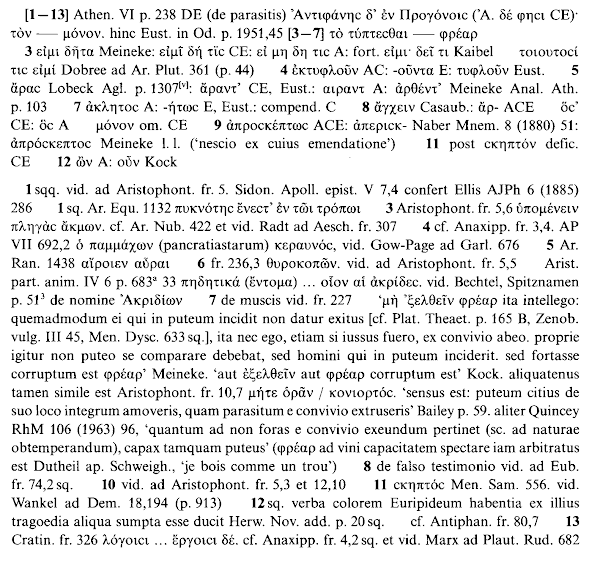
You know what I'm like — there's no nonsense in me, but this is what I am, in fact, where my friends are concerned: for taking blows, I'm red-hot iron; for dealing them out, a thunderbolt; for blinding someone's eyes, a lightning flash; for picking him up and hauling him out, a gust of wind; for throttling him, a noose; for prying doors open, an earthquake; for leaping inside, a grasshopper; for eating dinner without being invited, a fly; for leaving no escape, a well; for strangling, murdering, bearing false witness, or anything else you can name, I'm ready to do any of this on a moment's notice. Because of all these qualities, the young men call me Lighting Bolt. But their poking fun doesn’t bother me; I'm a good friend to my friends — in deeds and not just words!Apparatus from R. Kassel and C. Austin, Poetae Comici Graeci, Vol. II: Aganethor — Aristonymus (Berlin: Walter de Gruyter, 1991), p. 423:
τὸν τρόπον μὲν οἶσθά μου
ὅτι τῦφος οὐκ ἔνεστιν, ἀλλὰ τοῖς φίλοις
τοιοῦτός εἰμι δῆτα· τύπτεσθαι μύδρος,
τύπτειν κεραυνός, ἐκτυφλοῦν τιν᾽ ἀστραπή,
φέρειν τιν᾽ ἄρας ἄνεμος, ἀποπνῖξαι βρόχος, 5
θύρας μοχλεύειν σεισμός, εἰσπηδᾶν ἀκρίς,
δειπνεῖν ἄκλητος μυῖα, μὴ 'ξελθεῖν φρέαρ,
ἄγχειν, φονεύειν, μαρτυρεῖν, ὅσ᾽ ἂν μόνον
τύχῃ τις εἰπών, ταῦτ᾽ ἀπροσκέπτως ποεῖν
ἅπαντα. καὶ καλοῦσί μ᾽ οἱ νεώτεροι 10
διὰ ταῦτα πάντα Σκηπτὸν· ἀλλ᾽ οὐδὲν μέλει
τῶν σκωμμάτων μοι· τῶν φίλων γὰρ ὢν φίλος
ἔργοισι χρηστός, οὐ λόγοις ἔφυν μόνον.
In the forum they are Scythians, in a room they are vipers, at a dinner party they are buffoons, in their exactions harpies, in conversations statues, in investigations brute beasts, in discussions snails, in contracts usurers; in intelligence they are like stones, in judgment wooden, fiery in anger, unforgiving as iron, in their friendship they are panthers, in their witticisms bears, in their deceitfulness foxes, in their arrogance bulls, in their voracity minotaurs.
in foro Scythae, in cubiculo viperae, in convivio scurrae, in exactionibus Harpyiae, in conlocutionibus statuae, in quaestionibus bestiae, in tractatibus cocleae, in contractibus trapezitae; ad intellegendum saxei, ad iudicandum lignei, ad suscensendum flammei, ad ignoscendum ferrei, ad amicitias pardi, ad facetias ursi, ad fallendum vulpes, ad superbiendum tauri, ad consumendum minotauri.
Our Part
J.R.R. Tolkien, The Lord of the Rings, Part 3: The Return of the King (V.9: The Last Debate; Gandalf speaking):
Yet it is not our part to master all the tides of the world, but to do what is in us for the succour of those years wherein we are set, uprooting the evil in the fields that we know, so that those who live after may have clean earth to till. What weather they shall have is not ours to rule.
An Image of Paradise
Salvian, On the Governance of God 7.2.8 (tr. Jeremiah F. O'Sullivan, with his note):
Nobody doubts that the Aquitainians and the Nine Peoples4 possessed the best part of all Gaul. It is a land productive in its fertility, and not only fertility, but pleasantness, beauty, and luxury, which are sometimes preferred to fertility. In that part of Gaul the whole region is, so to say, interwoven with vines. Its meadows are flowered. Its fields are ploughed, or planted with fruit trees, or filled with delighful woods. The land is well watered with fountains, interspread with rivers, and rich in harvests. Truly, the holders and masters of that land seem to have possessed not so much a portion of that soil as an image of paradise.
4 The Nine Peoples inhabited the extreme south-west corner of Gaul, bounded approximately by the Garonne River.
nemini dubium est Aquitanos ac Novempopulos medullam fere omnium Galliarum et uber totius fecunditatis habuisse, nec solum fecunditatis, sed, quae praeponi interdum fecunditati solent, iucunditatis voluptatis pulchritudinis. adeo illic omnis admodum regio aut intertexta vineis aut florulenta pratis aut distincta culturis aut condita pomis aut amoenata lucis aut inrigua fontibus aut interfusa fluminibus aut crinita messibus fuit, ut vere possessores ac domini terrae illius non tam soli istius portionem quam paradisi imaginem possedisse videantur.
Thursday, August 11, 2022
Obeying Orders
A.R. Burn, Persia and the Greeks: The Defense of the West, 546-478 B.C. (1962; rpt. Minerva Press, 1968), p. 350:
No Greek city really liked placing its forces under the command of an ally; indeed, no Greek really liked placing himself under another's orders at all; Athenian discipline, it has been said, was 'such as one might expect in a place where "to obey" was the same as "to be persuaded"'.The Cambridge Greek Lexicon, Vol. II: Κ-Ω (Cambridge: Cambridge University Press, 2021), p. 1098, s.v. πείθω:
1 win over (someone) to an act or course of action (esp. by speech or entreaty, oft. opp. compulsion or deception); win over, prevail upon, persuade —persons, their heart or mind...
[....]
4 || MID.PASS. (also ep.fut.) let oneself be won over (so as to obey); be persuaded, comply ...; comply with, obey...
Mask
Terracotta comic mask from Capua (British Museum, registration number 1873,0820.565):
 The British Museum web site calls this a "satyr mask," but Richard Green and Eric Handley, Images of the Greek Theatre (Austin: University of Texas Press, 1995), pp. 74-75 (number 46), call it the mask of an old man, and
T.B.L. Webster, Monuments Illustrating New Comedy, 3rd ed., vol. 2 (London: Institute of Classical Studies, 1995), p. 18 (1AT 37 4.h), classifies it under the heading "Old man with short beard," with the description (p. 17):
The British Museum web site calls this a "satyr mask," but Richard Green and Eric Handley, Images of the Greek Theatre (Austin: University of Texas Press, 1995), pp. 74-75 (number 46), call it the mask of an old man, and
T.B.L. Webster, Monuments Illustrating New Comedy, 3rd ed., vol. 2 (London: Institute of Classical Studies, 1995), p. 18 (1AT 37 4.h), classifies it under the heading "Old man with short beard," with the description (p. 17):

Short broad nose, triangular beard with slightly curved sides, brows flying up to the sides, wrinkled forehead, full loose hair
Wary of Dogmatism
Cristina Della Coletta, "In Memoriam: Tibor I. Wlassics (1936-1998)," Italica 76.2 (Summer, 1999) 267-269:
Hat tip: Ian Jackson†.
He founded Lectura Dantis, which he appropriately named a "forum for Dante's research and interpretation," wishing to promote scholarly dialogue between young Dante students and renowned critics, and to encourage intellectual exchange between different approaches and schools of thought. The journal's eclecticism and critical range remains unmatched and reflects Tibor's true sense of the "dialogical" as the intellectual practice that fosters debate and relishes subtlety, irony and wit, while shunning crass diatribe and animosity. It is this spirit of Lectura Dantis that he left as his legacy, and it will live on, synthesized in one of his many proverbial sayings: "Let's agree on disagreeing."Wlassics, "Endpaper," Lectura Dantis 7 (Fall, 1990):
[....]
Wary of all forms of dogmatism, Tibor nevertheless advocated what he labeled "philologically correct" scholarship and remained, in life and letters, an independent if solitary thinker and a cultivated apostle of style. Humorously recalling his first meeting with Gianfranco Contini, Tibor described how that "very scholarly-looking scholar" had taken the cue from Tibor's last name to launch into a lecture on the evolution of the indoeuropean phoneme *vlah, which he interpreted as meaning "alien," "foreigner," "the one from elsewhere." Although Tibor had jokingly resisted the finality of Contini's categorization, he often mused about his existence caught, so to speak, between two continents. Asked whether he felt more Continental or American in his approach to Dante, he conjured up the image of a steamer, slowly feeling "its way through the thick vapors of the North Atlantic, foghorn ablaze" with the "shore beyond... too far to reach; too faraway... the old shores too."
It was in New York __ some conference. On the charter bus taking the congressisti to Long Island I found a seat next to this very scholarly-looking scholar in a long gray topcoat. He had no nametag, but I saw him studying mine with interest. __ «Ah but I proprio hoped to meet you... Your name has long puzzled me», he began; and then and there the Unknown Etymologist went on to deliver an hour-long lecture on the Indoeuropean phoneme *vlah (=«allogenous», «alien», «a foreigner») and its vagaries: its straying into the Slavic tongues; its penetration into Hungarian and its permanently assuming there the form olasz and the meaning (guardacaso) of «Italian», first applied to the good monks («people from elsewhere», from Italy in this case) who trekked to the plains of the Danube to convert, willy-nilly, those contented heathens... It was a lecture with paragraphs clearly marked, with clauses skillfully suspended and then caught up with again, with references, reminders, hints, quotes, notes, even footnotes __ a lecture, in sum, admirably conceived and amiably delivered. Truth to tell, I, its subject, felt a little like a rare lepidopter, still alive but already pierced and awaiting final fixing on the Unknown Entomologist's corkboard. I was looking for a lacuna to intervene: perhaps just to say how thrilled I was to know that the thirteen letters of my name will forever define me __ in Sanskrit or in Magyar, on this Earth or on Mars, in the vernacular of this Universe and in all dialects beyond it __ the «one who is from elsewhere», the «stranger», the «outsider». But whimsical Chance gave me no chance. The bus crossed Long Island Sound; we had arrived. __ «Say, who is the tizio there, in the long gray topcoat?», I later asked a friend, a colleague from Ca' Foscari. «But you don't know him?!», my friend quasi exclaimed. «He is Gianfranco Contini».I don't see *vlah in Calvert Watkins, The American Heritage Dictionary of Indo-European Roots (Boston: Houghton Mifflin Company, 1985).
Hat tip: Ian Jackson†.
Tuesday, August 09, 2022
Mon Semblable, Mon Frère
Verses by Bhavabhūti, in An Anthology of
Sanskrit Court Poetry: Vidyākara's "Subhāṣitaratnakoṣa" translated by Daniel H.H. Ingalls (Cambridge: Harvard University Press, 1965 = Harvard Oriental Series, 44), p. 445 (number 1731):
Those who scorn me in this worldHat tip: "Bhavabhuti on finding a reader," The Lumber Room (June 16, 2015)
have doubtless special wisdom,
so my writings are not made for them;
but are rather with the thought that some day will be born,
since time is endless and the world is wide,
one whose nature is the same as mine.
ye nāma kecit iha naḥ prathayanti avajñām
jānanti te kim api tān prati na eṣa yatnaḥ |
utpatsyate tu mama ko api samāna-dharmā
kālo hi ayaṃ niravadhiḥ vipulā ca pṛthvī ||
Decline
Salvian, On the Governance of God 6.18.98-99 (tr. Jeremiah F. O'Sullivan):
We do not have the peace and wealth of former times. All things which were are either gone or changed. Only our vices alone have increased. Nothing is left of our peace and former prosperity except our crimes alone and in full. Our crimes which have ended our prosperity are left. Where are the old resources and dignities of the Romans? Formerly, the Romans were most strong; now they are without strength. The old Romans were feared; we are afraid. The barbarian people paid them tribute; we are tributary to the barbarians. The enemy sells us the enjoyment of daylight. In a way, our entire welfare is at a price. O our misfortunes! To what have we come!
pacem et divitias priorum temporum non habemus, omnia, quae fuerunt, aut ablata aut immutata sunt: sola tantum vitia creverunt. nihil nobis de pace et prosperitate pristina reliquum est nisi sola omnino crimina, quae prosperitatem non esse fecerunt. ubi namque sunt antiquae Romanorum opes ac dignitates? fortissimi quondam Romani erant, nunc sine viribus: timebantur Romani veteres, nos timemus: vectigalia illis solvebant populi barbarorum, nos vectigales barbaris sumus. vendunt nobis hostes lucis usuram, tota admodum salus nostra commercium est. o infelicitates nostras! ad quid devenimus!
War on Two Fronts
Thucydides 7.28.3 (tr. Charles Forster Smith):
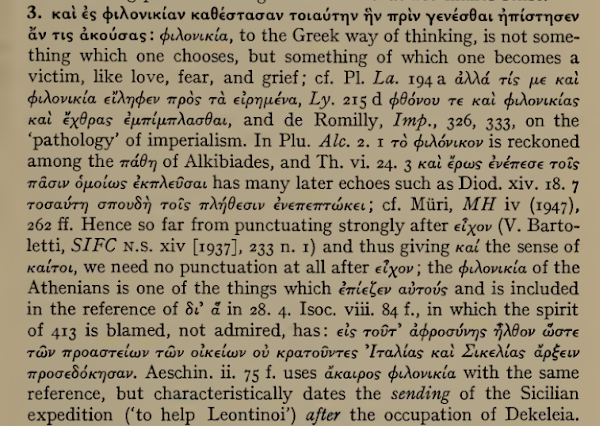
But what most oppressed them was that they had two wars at once, and had thus reached a pitch of frenzy which no one would have believed possible if he had heard of it before it had come to pass.Frenzy doesn't seem quite right for φιλονικίαν. Cf. Jeremy Mynott's translation with his note:
μάλιστα δ᾽ αὐτοὺς ἐπίεζεν ὅτι δύο πολέμους ἅμα εἶχον, καὶ ἐς φιλονικίαν καθέστασαν τοιαύτην ἣν πρὶν γενέσθαι ἠπίστησεν ἄν τις ἀκούσας.
But what put most pressure on the Athenians was that they were conducting two wars at the same time, and they brought to them a competitive spirit1 that had to be seen to be believed.A.W. Gomme et al. ad loc.:
1 Philonikia, literally 'love of victory': a further explanation of the Athenians' motivation in Sicily, this time an authorial one in terms of the Athenian character (see VI 47n).

From the Ashes
Ward Allen, "Donald Davidson," Sewanee Review 78.2 (Spring, 1970) 390-404 (at 403):
 The Latin is ungrammatical — cineris is the genitive of cinis and as such cannot be governed by the preposition in. An ablative is required, either cinere (singular) or cineribus (plural). Also, what is the subject of the verb viget? I suggest that what was in Davidson's mind was the motto on his own (?) family crest, "Viget in cinere virtus." See
Fairbairn's Book of Crests of the Families of Great Britain amd Ireland, 4th ed., Vol. I (London: T.C. & E.C. Jack, 1905), p. 154:
The Latin is ungrammatical — cineris is the genitive of cinis and as such cannot be governed by the preposition in. An ablative is required, either cinere (singular) or cineribus (plural). Also, what is the subject of the verb viget? I suggest that what was in Davidson's mind was the motto on his own (?) family crest, "Viget in cinere virtus." See
Fairbairn's Book of Crests of the Families of Great Britain amd Ireland, 4th ed., Vol. I (London: T.C. & E.C. Jack, 1905), p. 154:
He had dedicated a book once to John Donald Wade and in reaching for a phrase to state his friend's nobility had fallen back on the Latin where commonplace words become monumental, In Cineris Viget, "in the ashes he flourishes." Cinis means literally ashes. It may describe the rubble of a burned city. It means, figuratively, destruction, ruin, annihilation. Especially is it associated with the dead.The book was Donald Davidson, Still Rebels, Still Yankees and Other Essays (1957; rpt. Baton Rouge: Louisiana State University Press, 1972), and here is the dedication:

Davidson, William, Esquire, of Muirhouse, Davidson's Mains, Midlothian, a phoenix in flames ppr. Viget in cinere virtus.
Labels: typographical and other errors
Monday, August 08, 2022
Helluo Librorum
Oxford English Dictionary, entry for helluo librorum:
A helluo is "A person who spends immoderately on eating, etc., a squanderer," and helluor is "To spend immoderately on eating and other luxuries" (Oxford Latin Dictionary). There is no satisfactory etymology.
Hat tip: Eric Thomson, a helluo librorum if ever there was one.
Origin: A borrowing from Latin. Etymon: Latin helluo librorum.The OED's quotation from Cicero is faulty. For videatur read videbatur. The variant helluo doesn't even appear in L.D. Reynolds' OCT edition of De Finibus (1998); here is the text and apparatus from Claudio Moreschini's Teubner edition:
Etymology: < post-classical Latin helluo librorum (in some medieval manuscripts of Cicero) < classical Latin helluō HELLUO n. + librōrum, genitive plural of liber book (see LIBRARY n.1).
In early editions of Cicero De Finibus 3. 7, it is said that Cato 'quasi helluo librorum..videatur' ('appeared like a glutton for books'); the modern reading, restored from manuscript evidence by Jan Gruter in his edition of 1618, is 'quasi helluari libris..videatur' ('appeared as if to devour books').
Quo magis tum in summo otio maximaque copia quasi helluari libris, si hoc verbo in tam clara re utendum est, videbatur.Madvig in his critical apparatus records manuscripts LC as reading helluo librorum.
helluari NV BE: helluaris R, belluari AM, belluaris Pmg., helluo PLSY libri R PLSY, corr. P2
A helluo is "A person who spends immoderately on eating, etc., a squanderer," and helluor is "To spend immoderately on eating and other luxuries" (Oxford Latin Dictionary). There is no satisfactory etymology.
Hat tip: Eric Thomson, a helluo librorum if ever there was one.
Labels: typographical and other errors
Foundation of a New City
Homer, Odyssey 6.9-10 (tr. Peter Green):
He ran a wall round the city, constructed houses,Nicholas Cahill, Household and City Organization at Olynthus (New Haven: Yale University Press, 2001), p. 1:
made shrines for the gods, shared out the arable acres.
ἀμφὶ δὲ τεῖχος ἔλασσε πόλει, καὶ ἐδείματο οἴκους,
καὶ νηοὺς ποίησε θεῶν, καὶ ἐδάσσατ᾽ ἀρούρας.
In this earliest reference to Greek colonization, the basic elements of founding a new polis are already in place: the uninhabited land, the construction of fortifications and the temples of the gods, the division and allotment of agricultural land, and the building of houses, presumably on lots assigned to the colonists like the farmland. In its essence, the process remained basically the same for a thousand years.John-Paul Wilson, "'Ideologies' of Greek Colonization," in Guy Bradley and John-Paul Wilson, edd., Greek and Roman Colonization: Origins, Ideologies and Interactions (Swansea: Classical Press of Wales, 2006), pp. 25-57 (at 37-38, notes omitted):
A number of scholars have treated this passage as a direct reflection of the archaic colonization movement: as, indeed, descriptive of the nature and the practice of this movement. Dougherty (2000, 128), for example, describes it as a 'colonial history' of the Phaeacians. In particular, they have seen in the narration of Nausithous' actions the definitive portrait of the colonial founder. So Graham, for example, in his Colony and Mother-City in Ancient Greece (1964, 29) places the latter part of this passage (ll. 7–11) at the head of his chapter 3, 'The Role of Oikist', emphasizing the importance of this passage to his understanding of the founder’s duties. Meanwhile Dougherty (2000, 129) states that 'the description … captures the essential activities of a colonial founder'.
Demand (1990, 28), however, is surely correct to point out that this passage does not describe colonization at all, but 'urban relocation'. Demand (1986, 28–33) argues that this account of a whole people driven from their homeland by the aggression of their neighbours to settle elsewhere is based on the experience of the east Greeks in the first half of the seventh century BC. She suggests that the Cimmerian offensive in Asia Minor is a possible model for the Cyclopes' treatment of the Phaeacians, and that the ‘happy and successful life attributed to the Phaeacians perhaps bespeaks the hope that preceded actual experience — the immigrant's anticipation of "streets paved with gold"'. This is not chronologically impossible. It does, however, enforce a downwards dating by some fifty years or so of the generally accepted late-eighth-century date for the composition of the poems, i.e. it requires one to accept a date of c. 650 BC for the composition. More problematically it requires one to see the whole Phaeacian episode as a late development in the epic cycle, since the whole story as we have it seems to rest on the opposition drawn between the Phaeacians and the Cyclopes, not just in this passage but also elsewhere in book 6 and book 9. If one argues that the story of the Phaeacian origins is incorporated into the tradition in the mid-seventh century BC, just at the moment the Odyssey is written down, then we must either assume that the whole episode was developed at that same point, or ask difficult questions about how this section worked before the inclusion of the passage.
There are, however, other possible models for this passage. The story seems to have much in common with the myths of 'migration' from the Greek mainland in the wake of Dorian aggression. Indeed, in the brutish, powerful Cyclopes one might even recognize a negative portrait of the Dorians. It is possible, then, that an archaic audience on hearing this story was drawn to think of mythical episodes such as the Ionian migration much more readily than any contemporary colonization movement. It is also worth noting that such myths may have some basis in reality. Although a wholesale 'migration' from the mainland to Asia Minor and the Aegean islands during the Dark Age is not supported by the archaeological evidence, there is some indication of Greek settlement in Ionia in the tenth and ninth centuries BC. It is thus feasible that the 'historical' model for this story is not the contemporary experience but that of Dark Age settlement in Ionia. One might reasonably ask why in constructing this episode the poet would look beyond contemporary events for inspiration. If one accepts Raaflaub's argument that the poet sought to set the poem in some recent past, then the answer might be that a story that recalled the myths of Ionian migration provided the requisite distance. To take this argument to its conclusion, this passage, so frequently brought forward as a guide to the practice of the archaic colonial founder, may in fact reflect more directly on an earlier period of population movements.
Sunday, August 07, 2022
Parnassus on Wheels

Bonum Matutinum
Priscilla Smith Robertson, Revolutions of 1848: A Social History (Princeton: Princeton University Press, 1952), p. 264:
In the period before 1848, the outstanding Hungarian was, undoubtedly, Count Stephen Szechenyi, who spent his handsome fortune and considerable talents to build up modern institutions in his country. He traveled extensively in Western Europe and in England, where he was well-known and got most of his ideas; but it was easier for the west to understand the practical changes he wrought than the psychological ones which were just as important in his eyes. Wishing to force his country to become both proud and rich, he appealed to every motive among his countrymen—public spirit, private gain, patriotism, the wish to be in fashion, the spirit of fun, the sense of noblesse oblige.Hat tip: Eric Thomson.
He first struck the public eye in 1825 by offering to give a year's income to help endow an academy for the Hungarian language. This, interestingly enough, seemed the prime step toward making a modern nation, and it was largely owing to his efforts that Hungarian came back to the lips of his countrymen. The gentry had been gradually forgetting it, talking German in Vienna, often using Slovak to their peasants, and, odd as it seems, Latin in their Diet. In some parts Latin was a general language of communication. Dr. Tkalac remembered his Croatian mother using it in her household (though this was more unusual in a woman than a man) and other observers reported the strange effect of hearing a nineteenth-century peasant greet his landlord, "Bonum matutinum, domine." Szechenyi raged at this decay of his mother tongue. His appeals succeeded so well that in 1847, for the first time in history, the Diet members spoke Hungarian, even though it still came haltingly to some lords' tongues.
Siatoutanda
A.J. Woodman, The Annals of Tacitus, Book 4. Edited with a Commentary (Cambridge: Cambridge University Press, 2018 = Cambridge Classical Texts and Commentaries, 58), p. 330, n. 140 (on 4.73.1 soluto iam castelli obsidio et ad sua tutanda degressis rebellibus):
Woodman refers to Eduard Norden, Die germanische Urgeschichte in Tacitus Germania, 4th ed. (Darmstadt: Wissenschaftliche Buchgesellschaft, 1959).
Woodman's translation of Tacitus, Annals 4.72.2-4.73.1:
Ptolemy, Geography 2.11.12 (tr. Edward Luther Stevenson):
It was observed in the earlier nineteenth century that, in a passage indebted to his predecessor Marinus, the geographer Ptolemy lists side by side two places in Germany called Φληούμ and Σιατουτάνδα (Geog. 2.11.12), of which the latter looks suspiciously like a misguided transliteration of T.'s sua tutanda; for discussion see Norden 284-6.For Φληούμ see Tacitus, Annals 4.72.3 (Olennius infensos fuga praevenit, receptus castello cui nomen Flevum).
Woodman refers to Eduard Norden, Die germanische Urgeschichte in Tacitus Germania, 4th ed. (Darmstadt: Wissenschaftliche Buchgesellschaft, 1959).
Woodman's translation of Tacitus, Annals 4.72.2-4.73.1:
Olennius forestalled their ferocity by flight, being received at a stronghold whose name is Flevum, where a by no means contemptible unit of citizens and allies presided the Ocean's shores.I don't like "presided" as a rendering of "praesidebat"—I prefer "guarded" (Michael Grant's translation).
When all this became known to L. Apronius, the propraetor of Lower Germany, he summoned detachments of the legions from the upper province and chosen men of the auxiliary infantry and cavalry, and, sailing each army down the Rhine, brought them simultaneously against the Frisians—the blockade of the stronghold having already been raised and the rebels withdrawn to protect their own property [ad sua tutanda].
Olennius infensos fuga praevenit receptus castello cui nomen Flevum; et haud spernenda illic civium sociorumque manus litora Oceani praesidebat.
Quod ubi L. Apronio inferioris Germaniae pro praetore cognitum, vexilla legionum e superiore provincia peditumque et equitum auxiliarium delectos accivit ac simul utrumque exercitum Rheno devectum Frisiis intulit, soluto iam castelli obsidio et ad sua tutanda degressis rebellibus.
Ptolemy, Geography 2.11.12 (tr. Edward Luther Stevenson):
The towns located in Germania in the northern clima are
Phleum 28 45 54 45
Siatuanda 29 20 54 20
πόλεις δὲ τίθενται κατὰ τὴν Γερμανίαν ἐν μὲν τῷ ἀρκτικῳ κλίματι αἵδε·
Φληούμ κηʹ ∟ʹʹδʹʹ νδʹ ∟ʹʹδʹʹ
Σιατουτάνδα κθʹ γʹʹ νδʹ γʹʹ
Saturday, August 06, 2022
An Autodidact
Goethe, Den Originalen, I (tr. David Luke):
Newer› ‹Older
A certain So-and-so declares: 'I belong to no school,Ernst Maass, Goethe und die Antike (Berlin, Verlag W. Kohlhammer, 1912), p. 467, compared Xenophon, Memorabilia 4.2.4 (Euthydemus speaking; tr. E.C. Marchant):
I go a-whoring after no living master,
and nothing could be further from me
than to have learnt anything from the dead.'
That is to say (if I have understood him aright):
I am a fool after my own fashion.
Ein Quidam sagt: »Ich bin von keiner Schule!
Kein Meister lebt, mit dem ich buhle;
Auch bin ich weit davon entfernt,
Daß ich von Toten was gelernt.«
Das heißt, wenn ich ihn recht verstand:
»Ich bin ein Narr auf eigne Hand.«
Men of Athens, I have never yet learnt anything from anyone, nor when I have been told of any man's ability in speech and in action, have I sought to meet him, nor have I been at pains to find a teacher among the men who know. On the contrary, I have constantly avoided learning anything of anyone, and even the appearance of it.Thanks to Eric Thomson for drawing my attention to Béla Bartók Jun., "The Private Man," in Malcolm Gillies, ed., The Bartók Companion (London: Faber and Faber, 1993), pp.18-29 (at 21-22):
παρ᾽ οὐδενὸς μὲν πώποτε, ὦ ἄνδρες Ἀθηναῖοι, οὐδὲν ἔμαθον, οὐδ᾽ ἀκούων τινὰς εἶναι λέγειν τε καὶ πράττειν ἱκανοὺς ἐζήτησα τούτοις ἐντυχεῖν, οὐδ᾽ ἐπεμελήθην τοῦ διδάσκαλόν τινά μοι γενέσθαι τῶν ἐπισταμένων, ἀλλὰ καὶ τἀναντία· διατετέλεκα γὰρ φεύγων οὐ μόνον τὸ μανθάνειν τι παρά τινος, ἀλλὰ καὶ τὸ δόξαι.
He held that the study of languages was an important way of gaining a broad education, and showed exemplary application to such study. When he set out to learn a language he bought the best available textbook and dictionary, and some kind of fairly simple reader. He always studied alone — or, perhaps, together with his wife — but never with a teacher or with any other assistance. He prepared a precise and detailed word-list, effecting at the same time a study of comparative linguistics. Frequently he compiled a vocabulary of two foreign languages. While still at secondary school he became acquainted with Latin and Ancient Greek, and then studied German, French, Romanian and Slovakian. (Regarding his Slovakian, there is no question — as some would like us to believe — that he took to studying it because of his mother's coming from Túrócszentmárton (Slovakia). His mother did not even speak the language.) Later, he learnt Italian and English. He took up Spanish, Arabic, Ruthenian, Serbian and Finnish — and Turkish in greater detail — although he could not speak in these languages.

