Tuesday, May 24, 2022
Obesus Etruscus
Ugo Bardi, "The impending global collapse: will it end the obesity epidemic?" The Seneca Effect (May 22, 2022):
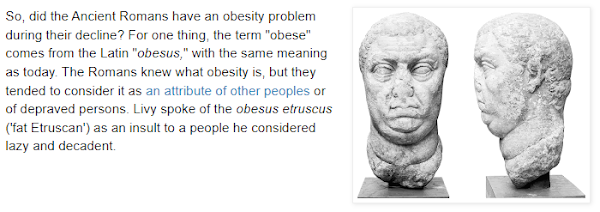 I don't think that Livy said it, but Catullus (39.11) certainly did. I don't have access to David W. Packard, A Concordance to Livy, 4 vols. (Cambridge: Harvard University Press, 1968). Also, obesus in Latin is an auto-antonym, a word that can mean the opposite of itself. It can mean both lean and fat, according to Lewis and Short.
Livy spoke of the obesus etruscus ('fat Etruscan') as an insult to a people he considered lazy and decadent.

Labels: auto-antonyms, typographical and other errors
Saturday, February 02, 2019
An Auto-Antonym?
An auto-antonym is a word that can mean the opposite of itself. Perhaps we have an example in the rare Greek word κοπία. See
Liddell-Scott-Jones, s.v. κοπία:
rest from toil, Hsch. (pl.); but, = Lat. labor, Serv.Dan. ad Virg.G.1.150.Hesychius s.v. κοπίαι (Moritz Schmidt, editio minor, 2nd ed., col. 902):
ἡσυχίαιServius auctus on Vergil, Georgics 1.150 (Georg Thilo, ed., p. 167):
'labor' autem, quam Graeci κοπίαν dicunt.
quam L: quem Pierre Daniel
Labels: auto-antonyms
Tuesday, April 03, 2018
Rave: An Auto-Antonym
Rave is an auto-antonym, a word that can mean the opposite of itself, in this case shout against or in favor of something or someone (either meaning with about and of).
Oxford English Dictionary, s.v. rave, v.1, sense 1.b:
Oxford English Dictionary, s.v. rave, v.1, sense 1.b:
With about, against, at, of (something or someone disliked, distrusted, etc.), or for (something desired).Id., sense 4:
To speak or write about someone or something with great enthusiasm or admiration. In early use with upon; now frequently with about, of, over.
Labels: auto-antonyms
Wednesday, August 16, 2017
Obesus: An Auto-Antonym
An auto-antonym is a word that can mean the opposite of itself. Latin obesus is such a word, meaning either fat or thin, although the evidence for thin is meagre.
Lewis and Short, A Latin Dictionary, s.v. obedo (from an online version; I don't have the book):

Lewis and Short, A Latin Dictionary, s.v. obedo (from an online version; I don't have the book):
ŏb-ĕdo, ēdi, ēsum, ĕre, to eat, eat away, devour (used only in the part. perf. and P. a.).—Trop.: nec obesa cavamine terra est, AUCT. AETN. 344.—Hence, P. a.: ŏbēsus, a, um.Félix Gaffiot, Le Dictionnaire illustré latin-français, s.v. obesus:
I. Wasted away, lean, meagre: corpore pectoreque undique obeso, Laev. ap. GELL. 19, 7, 3; and ap. NON. 361, 17: (obesum hic notavimus proprie magis quam usitate dictum pro exili atque gracilento, Gell. ib.: obesum gracile et exile, Non. l.l.).—
II. Mid., that has eaten itself fat; hence, in gen., fat, stout, plump: obesus pinguis quasi ob edendum factus, Paul. ex FEST. p. 188 Müll. (not in Cic.; perh. not ante-Aug.; syn.: opimus, pinguis): corpus neque gracile, neque obesum, CELS. 2, 1; cf. COL. 6, 2, 15: turdus, HOR. Ep. 1, 15, 40: sus, COL. 7, 10, 6: terga, VERG. G. 3, 80: cervix, SUET. Ner. 51.—Sup.: obesissimus venter, PLIN. 11, 37, 79, 200; SUET. Vit. 17; APP. M. 11, p. 263.—Poet.: fauces obesae, swollen, VERG. G. 3, 497.

Labels: auto-antonyms
Wednesday, September 28, 2016
Is Crudus an Auto-Antonym? Probably Not
Lindsay C. Watson, A Commentary on Horace's Epodes (Oxford: Oxford University Press, 2003), pp. 297-298 (on Epode 8.5-6: hietque turpis inter aridas natis / podex velut crudae bovis):

Discussing crudae bovis, Watson rejects the explanations of Lambinus (quae cibum non concoquit ideoque nec continet, πολυχέσον = which doesn't digest food and so doesn't hold it in, much-defecating) and Müller (quae frustra studet exonerare ventrem = which tries in vain to empty the stomach). Watson used Lambinus' 1561 Lyon edition of Horace, where I don't see the word πολυχέσον on p. 438, nor in Lambinus' 1588 Paris edition, p. 306. The accent seems off in Watson's quotation, wherever he got it (lemma πολύχεσος in Liddell-Scott-Jones) — should it be πολυχέσου? Judging from the explanations of Lambinus and Müller, one would assume that crudus can have two contradictory meanings, viz. afflicted with diarrhea and afflicted with constipation. Neither meaning is recognized in the Oxford Latin Dictionary, s.v. crudus, although constipated could be inferred from sense 3.b: "(of persons or animals) having undigested food in the stomach, dyspeptic," with the citation from Horace's Epodes.

Discussing crudae bovis, Watson rejects the explanations of Lambinus (quae cibum non concoquit ideoque nec continet, πολυχέσον = which doesn't digest food and so doesn't hold it in, much-defecating) and Müller (quae frustra studet exonerare ventrem = which tries in vain to empty the stomach). Watson used Lambinus' 1561 Lyon edition of Horace, where I don't see the word πολυχέσον on p. 438, nor in Lambinus' 1588 Paris edition, p. 306. The accent seems off in Watson's quotation, wherever he got it (lemma πολύχεσος in Liddell-Scott-Jones) — should it be πολυχέσου? Judging from the explanations of Lambinus and Müller, one would assume that crudus can have two contradictory meanings, viz. afflicted with diarrhea and afflicted with constipation. Neither meaning is recognized in the Oxford Latin Dictionary, s.v. crudus, although constipated could be inferred from sense 3.b: "(of persons or animals) having undigested food in the stomach, dyspeptic," with the citation from Horace's Epodes.
Labels: auto-antonyms
Saturday, April 30, 2016
Is Latin Sudus an Auto-Antonym?
An auto-antonym is a word that can mean the opposite of itself. According to Lewis and Short, sudus can mean both dry and damp:
On the other hand, Arnobius isn't the only evidence for the meaning "somewhat moist." See the data collected by Henry Nettleship, "Nonius Marcellinus," Lectures and Essays (Oxford: Clarendon Press, 1885), pp. 277-321 (at 305):

sūdus, a, um, adj. [se-udus; cf.: sudum siccum quasi seudum id est sine udo, Fest. pp. 294 and 295 Müll.], without moisture, dry....But Reifferscheid in his edition of Arnobius' Adversus Nationes (Vienna, 1875 = Corpus Scriptorum Ecclesiasticorum Latinorum, IV), p. 239, adopts Sigismund Gelenius' conjecture uda for the manuscript's suda at 7.3. On the manuscript variants udis and sudis at Apuleius, Metamorphoses 11.2, see Apuleius of Madauros, The Isis-Book (Metamorphoses, Book XI). Edited with an Introduction, Translation and Commentary by J. Gwyn Griffiths (Leiden: E.J. Brill, 1975), pp. 70 (text and apparatus) and 119 (commentary).
II. Somewhat moist = subudus; "ardentia viscera adhuc suda de sanguine", ARN. 7, 3.
On the other hand, Arnobius isn't the only evidence for the meaning "somewhat moist." See the data collected by Henry Nettleship, "Nonius Marcellinus," Lectures and Essays (Oxford: Clarendon Press, 1885), pp. 277-321 (at 305):
Labels: auto-antonyms
Saturday, January 30, 2016
A Spurious Auto-Antonym
P.G.W. Glare, "Liddell-Scott-Jones: Then and Now," Hyperboreus 3.2 (1997) 205–217 (at 211-212):
A more complicated example can be found in the entry under συγχωρέω. The opening definition is come together, meet; the second is get out of the way, make way, which would appear to be the exact opposite of the first. Although there is an old joke which says that in Arabic every word means itself, its opposite, a name of God, and a part of a camel, this is a ludicrous exaggeration, and is no more true of Greek than it is of Arabic. The first example quoted under the second sense comes from Aristophanes Wasps 1516; it runs:Wendy Doniger, The Hindus: An Alternative History (Oxford: Oxford University Press, 2010), p. 44:
φέρε νυν ἡμεῖς αὐτοῖς ὀλίγον ξυγχωρήσωμεν ἅπαντες,One of the characters is certainly telling the others to get out of the way so that the chorus can proceed with its dance; what he actually says is: "Let us all get together in a group (so as to leave room, etc.)". The writer of the article has translated what he supposed to be the sense of the passage, without considering whether the word could possibly have the meaning he assigns to it. He then goes on give way, yield, defer to. These translations again express the general drift of the passages cited to support them, but it would be more accurate to say agree with, fall in with; the dictionary user would then have a much clearer idea of how one sense leads into the other.
ἵν᾽ ἐφ᾽ ἡσυχίας ἡμῶν πρόσθεν βεμβικίζωσιν ἑαυτοῖς.
[I]t used to be said that every Sanskrit word means itself, its opposite, a name of god, and a position in sexual intercourse.†
† This was said at Harvard, when I was there in the sixties, and it seems to have been based on another Orientalist joke sometimes ascribed to Sir Hamilton A.R. Gibb of Oxford and Harvard, that every Arabic word has its primary meaning, then its opposite, then something to do with a camel, and last, something obscene.
Labels: auto-antonyms
Sunday, August 02, 2015
Temperance and Intemperance: A Greek Auto-Antonym
Liddell-Scott-Jones, s.v. ἀκορία:
not eating to satiety, moderation in eating, Hp.Epid.6.4.18.Hat tip: Eric Thomson.
ἀ. ποτοῦ insatiable desire of drink, Aret.CD2.2.
Labels: auto-antonyms
Monday, April 13, 2015
An Auto-Antonym: Crudelis
Richmond Lattimore, Themes in Greek and Latin Epitaphs (1935; rpt. Urbana: University of Illinois Press, 1962), p. 181:
As for scelerata, see Oxford Latin Dictionary, s.v. sceleratus, sense 1.g:
In three inscriptions from Numerus Syrorum, Africa, the dead are called crudelis.62 An odd inversion of the proper sense, apparently, appears in the use of the terms mater (or pater) scelerata;63 mater inpia,64 crudelis inpia mater.65 Evidently the implication is that it is unjust for the parents to survive their children; therefore, though not responsible, they must in some way be guilty; or else the true meaning of the words has been misunderstood. The usage appears to be confined to southern Italy. Even more strange, perhaps, is the language in the following: filiabus male merentibus crudelis pater iscripsit.66I think that Lattimore's second explanation is the correct one—the meaning of crudelis in these inscriptions has been misunderstood. For the meaning in these inscriptions, which is the opposite of the usual meaning, see Oxford Latin Dictionary, s.v. crudelis, sense 3.c:
62 CIL 8, 9970, 21805, 21804. Cf. CE 1228 (Rome).
63 CIL 10, 310 (Tegianum), 361 (Atina), and 507 (Lucania, exact place unknown).
64 CIL 10, 2435 (Puteoli).
65 CIL 6, 1537 (Rome).
66 CIL 11, 1780 (Volaterrae).
(of the dead or bereaved, app.) cruelly treated, unfortunate ... ~ES PARENTES CIL 3.5246; QVINTIVS VICTOR ~IS VICXIT AN(N)IS XXXV 8.9981; 8.21804.This meaning of crudelis is not recognized by Lewis and Short, Latin Dictionary.
As for scelerata, see Oxford Latin Dictionary, s.v. sceleratus, sense 1.g:
(of persons) ill-starred, unfortunate.Dictionaries don't recognize any meaning for impius other than wicked vel sim., but perhaps they should recognize the sense unfortunate, in light of inscriptions such as CIL 6.23123:
Cn. Numisius Valeria|nus vix(it) ann(is) VIII. | Epictesis mater fil(i)o | impio.On the other hand, Christer Henriksén, Sylloge inscriptionum Graecarum et Latinarum Upsaliensis. The Greek and Latin inscriptions in the Collections of Uppsala University (Stockholm: Svenska Institutet i Rome, 2013 = Acta Instituti Romani Regni Sueciae 8˚, no. 23), pp. 34-35 of the "Text, translation, and commentary" (discussing CIL 6.23123), seems to prefer Lattimore's first explanation.
Labels: auto-antonyms, lexicography
Saturday, December 06, 2014
Res Pro Rei Defectu: Some Examples
E. Courtney, Musa Lapidaria (Atlanta: Scholar's Press, 1995), pp. 227-228 (on Carmina Latina Epigraphica 9, line 3: quoiei uita defecit, non | honos, honore(m)):
Courtney, op. cit., p. 305 (on Carmina Latina Epigraphica 949, line 5: quod spes eripuit, spes certe redd[i]t amanti):
Related post: Res Pro Rei Defectu.
We therefore have an elaborate pun, 'whose life-span, not (lack of) respect, denied him office'; honos is an instance of the idiom res pro rei defectu (Madvig on Cic. De Fin. 2.73; C.F.W. Müller in Friedländer's note on Juv. 2.39, Kühner-Gerth, Gr. Gramm., Satzlehre 2.569-70), cf. on 91.5; τιμή at Eur. Hipp. 1402 signifies 'lack of honour'.I can't find anything on this idiom in Madvig's commentary on Cicero, De Finibus 2.73. I've quoted Müller on Juvenal 2.39 here.
Courtney, op. cit., p. 305 (on Carmina Latina Epigraphica 949, line 5: quod spes eripuit, spes certe redd[i]t amanti):
In 5 the first spes means 'lack of hope'...These meanings of honor and spes aren't recognized in the Oxford Latin Dictionary or in Lewis and Short, s.vv. Likewise in Liddell-Scott-Jones, s.v. τιμή, there is no citation of Euripides, Hippolytus 1402 τιμῆς ἐμέμφθη, where W.S. Barrett in his commentary translates "found fault with, was dissatisfied, over the (lack of) honour paid to her".
Related post: Res Pro Rei Defectu.
Labels: auto-antonyms
Thursday, May 29, 2014
Sinister: An Auto-Antonym
An auto-antonym is a word that can mean the opposite of itself. Lewis and Short, Latin Dictionary, s.v. sinister, sense II.B:
Unlucky, injurious, adverse, unfavorable, ill, bad, etc.Id., sense II.C:
With respect to auspices and divination, acc. to the Roman notions, lucky, favorable, auspicious (because the Romans on these occasions turned the face towards the south, and so had the eastern or fortunate side on the left; while the Greeks, turning to the north, had it on their right...)
Labels: auto-antonyms
Sunday, February 02, 2014
A Greek Auto-Antonym
Definitions of ἀπεσθίω in Liddell-Scott-Jones (LSJ):
- eat, gnaw off
- leave off eating
"There you have in full, my noble bursar Ulpian, my account of the kopté; I advise you to bite it off." So he without delay picked it up and began to eat it. They all burst out laughing at this, and Democritus said: "But I did not tell you to eat it, noble word-chaser, I told you rather not to eat it..."The online Diccionario Griego-Español also doesn't cite Athenaeus for this word.
'ἀπέχεις, ὦ καλέ μου λογιστὰ Οὐλπιανέ, τὴν κοπτήν· ἧς συμβουλεύω σοι ἀπεσθίειν.' καὶ ὃς οὐδὲν μελλήσας ἀνελόμενος ἤσθιεν. γελασάντων δὲ πάντων ἔφη ὁ Δημόκριτος· 'ἀλλ᾽ οὐκ ἐσθίειν σοι προσέταξα, καλὲ ὀνοματοθήρα, ἀλλὰ μὴ ἐσθίειν...'
Labels: auto-antonyms
Tuesday, May 07, 2013
Two More Greek Auto-Antonyms
An auto-antonym is a word that can mean the opposite of itself. Liddell-Scott-Jones define ἄβρομος as both "joining in a shout" and "noiseless," αὐίαχος as either "joining in a shout" or "noiseless."
Related posts:
Related posts:
- Res Pro Rei Defectu
- Hrl: An Auto-Antonym
- Valetudo: An Auto-Antonym
- Avocation: An Auto-Antonym?
- Latin Auto-Antonyms: Compounds of In
- Some Latin Auto-Antonyms
- Identity of Opposites
- Snob and Hoi Polloi
- Auto-Antonym: Wan
- Auto-Antonyms (Latin sacer, English wold)
- Auto-Antonym (Urdu lāg)
- An Auto-Antonym? (ἀφυπνόω)
- Snob
- Two Greek Auto-Antonyms (γενέτης and γενέτειρα)
- Auto-Antonym: Agony
Labels: auto-antonyms
Monday, March 26, 2012
Clamor: An Auto-Antonym?
An auto-antonym is a word that can mean the opposite of itself. Some have seen an auto-antonym in Shakespeare, The Winter's Tale 4.4.284:
Clamor your tongues, and not a word more.See, e.g., the Folger Shakespeare Library edition of this play by Barbara A. Mowat and Paul Werstine (1998; rpt. New York: Simon & Schuster, 2009), p. 148:
Clamor: perhaps, silence (though the word usually means just the opposite)The Oxford English Dictionary, s.v. clamour | clamor, v.1, neither recognizes this sense nor cites this line. According to Horace Howard Furness, ed., A New Variorum Edition of Shakespeare, Volume 11: The Winter's Tale, 2nd ed. (Philadelphia: J.B. Lippincott Company, 1898), pp. 216-217, Croft conjectured clam, Hanmer (and independently Gifford) charm.
Labels: auto-antonyms
Saturday, December 24, 2011
An Auto-Antonym: Frugal?
Edward FitzGerald, letter to W.A. Wright (March 7, 1869), in The Letters of Edward FitzGerald, edd. Alfred McKinley Terhune and Annabelle Burdick Terhune, Vol. III: 1867-1876 (Princeton: Princeton University Press, 1980), pp. 130-133 (at 132):
Frugal. Forby notices the Norfolk use of this word (also found in Shakespeare's Merry Wives) in exactly the contrary sense to the modern: sc: lavish, instead of sparing. My nephew Edmund Kerrich was telling me one day an odd instance. His Father's Gamekeeper would say some morning as they went out shooting—"That dog's uncommonly frugal this morning"—meaning, un-costive.Forby is Robert Forby, The Vocabulary of East Anglia, Vol. I (London: J.B. Nichols and Son, 1830), pp. 124-125:
FRUGAL, adj. the reverse of COSTLY, q. v. This word seems quite distinct from frugal in its current sense. Instances may, indeed, be produced in different languages, of the same word bearing even opposite senses, under different circumstances. The word sacer, in Latin is a very familiar one, sometimes meaning hallowed, sometimes accursed; which sense it bears in any particular passage, must be determined by the context or the occasion. But in each case its etymon is the same. On the contrary, our word, now under consideration, is likely to be of an origin very different from that of the common word, with which it agrees in every letter. "Good woman," quoth the village doctress, "is your child costive?" "Costly! Ma'am, no, quite the contrary, sadly frugal indeed!" So much for modern use. But have we any thing like authority for it in O.E.? We will have recourse to SH. In the Merry Wives of Windsor, Mrs. Page, on receiving Falstaff's love letter, ponders "What unweighed behaviour he could have picked out of her conversation." She presently concludes, "I was, then, too frugal of my mirth. Heaven forgive me!" She could not possibly mean too sparing. It would be nonsense; she must mean too free. The commentators are puzzled, and no wonder. Dr. Johnson says, he once thought "not" ought to be inserted before "too." But it seems his second thoughts were better, for he has not inserted it in the text. The puzzling word frugal stands alone in all the old editions. Now, without presuming to unsettle the derivation of the common word frugal, from the Latin frugi or fruges, or whatever may best please Vossius, or whom else it may concern, we may look at home for that of our frugal and Shakspeare's; and feel pretty confident that we find it, with only a very common change of one vowel. To adapt it to its Saxon origin, and to distinguish from a word of meaning so different, it might be spelled frugle. A.s. frig, liber.Samuel Johnson's note on Merry Wives of Windsor 2.1.26 (I was then frugal of my mirth, &c.):
By breaking this speech into exclamations, the text may stand; but I once thought it must be read If I was not then frugal of my mirth.The Oxford English Dictionary doesn't recognize the sense lavish.
Labels: auto-antonyms
Sunday, October 02, 2011
Auto-Antonyms in Newspeak
George Orwell, 1984 (1949; rpt. New York: Penguin Group, 1981), p. 48:
"There is a word in Newspeak" said Syme, "I don't know whether you know it: duckspeak, to quack like a duck. It is one of those interesting words that have two contradictory meanings. Applied to an opponent, it is abuse; applied to someone you agree with, it is praise."p. 175:
The key word here is blackwhite. Like so many Newspeak words, this word has two mutually contradictory meanings. Applied to an opponent, it means the habit of impudently claiming that black is white, in contradiction of the plain facts. Applied to a Party member, it means a loyal willingness to say that black is white when Party discipline demands this. But it means also the ability to believe that black is white, and more, to know that black is white, and to forget that one has ever believed the contrary. This demands a continuous alteration of the past, made possible by the system of thought which really embraces all the rest, and which is known in Newspeak as doublethink.p. 252:
No word in the B vocabulary was ideologically neutral. A great many were euphemisms. Such words, for instance, as joycamp (forced-labour camp) or Minipax (Ministry of Peace, i.e. Ministry of War) meant almost the exact opposite of what they appeared to mean.
Labels: auto-antonyms
Wednesday, April 27, 2011
Wackernagel on Auto-Antonyms
Jacob Wackernagel (1853-1938), Lectures on Syntax, ed. and tr. David Langslow (Oxford: Oxford University Press, 2009) pp. 695-696 (original Vorlesungen über Syntax, II 235-236):
References:
Furthermore, these days we are wont to do more justice again to the theory—earlier discredited by an absurd book by ABEL (1884)—according to which the meaning of a word can shift into its exact opposite, so-called 'enantiosemia;5 cf. NÖLDEKE (1910) on 'words with the opposite meaning'. MEILLET points out (1922b: 99) that you can easily fall into using a word that means the opposite of what you want to say: words with opposite meaning are indeed associated with each other, and hence often assimilated to each other formally, too; cf. SCHUCHARDT (1922: 206), with reference to Goethe's statement that 'every word awakes its opposite meaning'.6 It seems that prepositions also furnish examples of this phenomenon. Very recently Dietrich SCHÄFER has shown (1921: 378-81) that in Medieval Latin cis and citra are often used to mean 'beyond'. One might say that this was a misunderstanding based on the imperfect learning of those for whom Latin was not a living language, but Latin of the Middle Ages really cannot be called a dead language. Moreover, we can show that prepositions have this sort of opposite sense even in the earliest period: Gk ὑπό and Lat. sub, for example, mean 'under', but the corresponding comparative and superlative forms Gk ὕπερος (in ὑπέρα 'yard at the top of the sail', ὕπερος 'pestle'): Lat. superus, Gk ὕπατος: Lat. summus mean 'higher' and 'highest', respectively, which is matched by Gk ὑπέρ, Lat. super ('over'). In Germanic there is an opposition even in the positive grade between Gothic uf 'under' and German ob 'on top'. On Lat. sub meaning 'upwards' in compound verbs, see K. MEISTER (1924/5: 32-5). I recently had the experience in a meeting of hearing a certain Herr Niederer (lit. Mr Lower) constantly referred to by someone there as 'Herr Oberer' (lit. Mr Upper)! (See II, 182-3 above on compound verbs; on the confusion of opposite words in child language, see JESPERSEN (1922: 120 [ = 1925: 99]). Note the important monograph of Hans SPERBER (1915) on the semantic evelopment of the preposition über.)In note 5, Abel's birth date is incorrect—it should be 1837.
5 On Carl Abel (1827-1906), who lived part of his life in England (cf. Abel 1882, in English), and whose ideas influenced Freud, and the notion of enantiosemy, see Morpurgo Davies (1998: 339), with references to a detailed study by Giulio Lepschy.
6 This is from Goethe's novel Die Wahlverwandschaften (Elective Affinities, 1809), part 2, ch. 4, 'Jedes ausgesprochene Wort erregt den Gegensinn'.
References:
- Carl Abel, Linguistic Essays (Boston: Houghton Mifflin, 1882)
- Carl Abel, Über den Gegensinn der Urworte (Leipzig: Friedrich, 1884), rpt. in his Sprachwissenschaftliche Abhandlungen (Leipzig: Friedrich, 1885), pp. 313-367; cf. also his Über Gegensinn und Gegenlaut in den Klassischen, Germanischen und Slavischen Sprachen, 2 vols. (Frankfurt am Main: Moritz Diesterweg, 1905-1906).
- Anna Morpurgo Davies, in Giulio Lepschy, History of Linguistics, Vol. 4 = Nineteenth-Century Linguistics (London: Longmans, 1998)
- Otto Jespersen, Language: Its Nature, Development and Origin (London: Allen & Unwin, 1922)
- A. Meillet, "De quelques fautes," Bulletin de la Société de linguistique de Paris 23 (1922) 98-99
- Karl Meister, "Die Hausschwelle in Sprache und Religion der Römer," Sitzungsberichte der Heidelberger Akademie der Wissenschafter, Philologisch-historische Klasse 15.3 (1924-1925)
- Theodor Nöldeke, "Wörter mit Gegensinn (Addad)," in his Neue Beiträge zur Semitischen Sprachwissenschaft (Strassburg: Trübner, 1910), pp. 67-108
- Dietrich Schäfer, "Honor, citra, cis im mittelalterlichen Latein," Sitzungsberichte der preussischen Akademie der Wissenschaft zu Berlin, Philologisch-historische Klasse 23 (1921) 372-381
- Hugo Schuchardt, "Sprachliche Beziehungen," Sitzungsberichte der preussischen Akademie der Wissenschaft zu Berlin, Philologisch-historische Klasse 24 (1922) 199-209
- Hans Sperber, Studien zur Bedeutungsentwicklung der Präposition über (Uppsala: K.W. Appelberg, 1915)
Labels: auto-antonyms
Sunday, April 17, 2011
A Latin Auto-Antonym: Vegrandis
Lewis & Short, A Latin Dictionary, s.v. vēgrandis, give two opposite meanings: "I. not very large, little, small, diminutive (very rare)....II. very great, = valde grandis...."
Labels: auto-antonyms
Tuesday, March 08, 2011
Enantioseme Etc.
A technical term for auto-antonym (a word that can mean the opposite of itself) is enantioseme. Related words are enantiosemantic, enantiosemantics, enantiosemia, and enantiosemy. For an excellent discussion, see Jordan Finkin, "Enantiodrama: Enantiosemia in Arabic and Beyond," Bulletin of the School of Oriental and African Studies 68 (2005) 369-386.
These words don't appear in the Oxford English Dictionary, although they are in use by scholars. Apparently the first person to use one of these words (enantiosemia) was Johann Arnold Kanne, in his Prolusio Academica de Vocabulorum Enantiosemia, sive Observationum de Confusione in Linguis Babylonicis Specimen (Nuremberg 1819), a book unavailable to me and also not cited by Finkin in his bibliography (pp. 385-386). The roots of the words are the Greek adjective ἐναντίος (enantios = opposite) and the Greek noun σῆμα (sēma = sign).
These words don't appear in the Oxford English Dictionary, although they are in use by scholars. Apparently the first person to use one of these words (enantiosemia) was Johann Arnold Kanne, in his Prolusio Academica de Vocabulorum Enantiosemia, sive Observationum de Confusione in Linguis Babylonicis Specimen (Nuremberg 1819), a book unavailable to me and also not cited by Finkin in his bibliography (pp. 385-386). The roots of the words are the Greek adjective ἐναντίος (enantios = opposite) and the Greek noun σῆμα (sēma = sign).
Labels: auto-antonyms, lexicography
Saturday, February 26, 2011
Phrop
Michael Quinion, World Wide Words (February 26, 2011), discusses the word phrop, coined by Sir Arnold Lunn and popularized by Philip Howard, from "phrase + opposite," i.e. a phrase that means the opposite of its ostensible meaning, thus a variety of auto-antonym.
‹Older
Labels: auto-antonyms

