Saturday, August 29, 2020
Loot
Vicky Osterweil, interviewed by Zoé Samudzi, "Stealing Away in America
," Jewish Currents (June 10, 2020):

More from Vicky Osterweil in the same interview:

The word "loot" was taken from Hindi by [British] colonial officers. It first appears in English in an 1845 colonial officer's handbook.The Oxford English Dictionary gives earlier examples, s.v. loot, n.2:
Etymology: < Hindi lūt, according to some scholars representing Sanskrit lōtra, lōptra booty, spoil, < the root lup = rup to break; others refer it to Sanskrit lunt to rob.Id., s.v. loot, v.:
[....]
[1788 Indian Vocab. 77 Loot, plunder, pillage.]
1839 Blackwood's Edinb. Mag. 45 104 He always found the talismanic gathering-word Loot (plunder), a sufficient bond of union in any part of India.
1842 [implied in: LD. ELLENBOROUGH Let. 17 May in Hist. Indian Admin. (1874) 194 The plunderers are beaten whenever they are caught, but there is a good deal of burning and 'looting' as they call it.Calvert Watkins, The American Heritage Dictionary of Indo-European Roots (Boston: Houghton Mifflin Company, 1985), p. 55, s.v. reup-:

More from Vicky Osterweil in the same interview:
Riots are really emotive, an emotional way of expressing yourself. It is about pleasure and social reproduction. You care for one another by getting rid of the thing that makes that impossible, which is the police and property. You attack the thing that makes caring impossible in order to have things for free, to share pleasure on the street. Obviously, riots are not the revolution in and of themselves. But they gesture toward the world to come, where the streets are spaces where we are free to be happy, and be with each other, and care for each other.

Labels: etymology, lexicography
Monday, August 17, 2020
The Meaning of Continuo in Latin
Oxford Latin Dictionary, s.v. continuo1, adv.:
1 Forthwith, without delay, immediately.Jerzy Linderski, "The Quaestorship of Marcus Antonius," Roman Questions: Selected Papers (Stuttgart: Franz Steiner Verlag, 1995), pp. 251-261 (at 258):
[....]
b immediately from the beginning, from the first.
[....]
c (in an enumeration of places) immediately thereafter.
[....]
2 Without further evidence, without more ado; (esp. w. neg. expressed or implied in qu.) necessarily, in consequence.
[....]
3 Without intermission, continuously.
The word is commonly rendered as "immediately"; Cicero, however, (as is easily seen from the examples in Merguet's dictionary) uses it often to indicate that between two closely connected events no other event occurred bearing upon them.36 Thus the length of time indicated by continuo may vary considerably, as is also true of other similar expressions like mox and nuper.
36 Cf. esp. Cael. 9; Vat. 36: quis legatos umquam audivit sine senatus consulto? Ante te nemo: post (i.e., after 59) continuo (i.e., in 58) fecit idem . . . Clodius.
Labels: lexicography
Friday, June 19, 2020
Grovel
According to the Oxford English Dictionary, grovel first appears in Shakespeare, Henry VI, Part 2, I.ii.9:
S.C. Woodhouse, English-Greek Dictionary: A Vocabulary of the Attic Language (1910; rpt. London: Routledge & Kegan Paul Ltd, 1950), pp. 375-376:


William Smith and Theophilus D. Hall, A Copious and Critical English-Latin Dictionary (New York: American Book Company, 1870), p. 354, seems unsatisfactory:

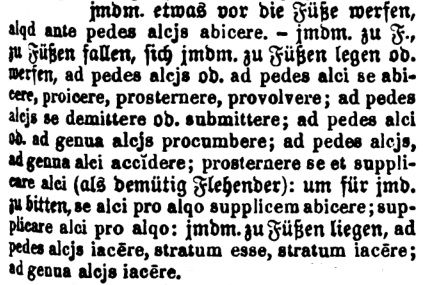
For Latin equivalents I much prefer Karl Ernst Georges, Kleines lateinisch-deutsches und deutsch-lateinisches Handwörterbuch: Deutsch-lateinischer Teil, 5th ed. (Leipzig: Hahn, 1888), col. 885:

If the Oxford English Dictionary were an illustrated dictionary, what better illustration of grovelling than this photograph of Pope Francis taken last year?

Gaze on, and grouell on thy face.It is said to be a back-formation from grovelling, which appears earlier in English. See also Scottish on grufe = face down, in a prone position, derived from Old Norse grúfa, in the phrase á grúfu.
S.C. Woodhouse, English-Greek Dictionary: A Vocabulary of the Attic Language (1910; rpt. London: Routledge & Kegan Paul Ltd, 1950), pp. 375-376:


William Smith and Theophilus D. Hall, A Copious and Critical English-Latin Dictionary (New York: American Book Company, 1870), p. 354, seems unsatisfactory:

For Latin equivalents I much prefer Karl Ernst Georges, Kleines lateinisch-deutsches und deutsch-lateinisches Handwörterbuch: Deutsch-lateinischer Teil, 5th ed. (Leipzig: Hahn, 1888), col. 885:
If the Oxford English Dictionary were an illustrated dictionary, what better illustration of grovelling than this photograph of Pope Francis taken last year?

Labels: lexicography
Tuesday, October 24, 2017
Amoebaeic
The Oxford English Dictionary has an entry for amœbaean, adj. = "Alternately answering, responsive," but not for amoebaeic, a word I first encountered in P. Vergili Maronis Bucolica et Georgica. With Introduction and Notes by T.E. Page (1898; rpt. London: Macmillan, 1968), p. 111 (introduction to Eclogue 3):
Such poetry as verses 60-107 was called Amoebaeic (ἀμοιβαία ἀοιδά Theocr. 8.31) from ἀμοιβή 'interchange,' and Virgil calls it 'alternate song' (alterna line 59). The rule was that the second singer should answer the first in an equal number of verses, on the same or a similar subject, and also if possible show superior force or power of expression, or, as we say, 'cap' what the first had said. The 9th Ode of the Third Book of Horace's Odes is a perfect specimen of this kind of verse.But Page wasn't the first to use amoebaeic in English. The word occurs on ten different pages in Thomas Keightley, Notes on the Bucolics and Georgics of Virgil (London: Whittaker and Co., 1846), always as amœbæic. I see the word in four JSTOR articles (one by Page), and over a hundred times in Google Books.
Labels: lexicography
Saturday, February 27, 2016
Antilabe
Antilabe is a word not found in the Oxford English Dictionary, but it shows up fairly often in scholarly writing about Greek drama. Antilabe is a transcription of Greek ἀντιλαβή. Liddell-Scott-Jones, s.v. ἀντιλαβή, sense 4:
Gramm., in dramatic dialogue, division of a line between two speakers, Hsch.In its English (or rather Roman alphabetic) dress it seems to occur first (as antilabé) in a University of Chicago dissertation by John Leonard Hancock, Studies in Stichomythia (Chicago: University of Chicago Press, 1917), p. 11 and passim. The first occurrence I can locate in a scholarly journal is J.D. Denniston, "Pauses in the Tragic Senarius," Classical Quarterly 30.2 (April, 1936) 73-79 (at 73, n. 1). As might be expected, it occurs in German even earlier, e.g. in Gustav Wolff, Sophokles für den Schulgebrauch erklärt, IV: König Oidipus (Leipzig: B.G. Teubner, 1870), p. 101 (on line 1120). In the same book the word in Greek characters occurs on p. 62 (on line 626). In English antilabe is now so common that dictionaries should probably include it.
Labels: lexicography
Wednesday, February 17, 2016
Rare Words
In Liddell-Scott-Jones (LSJ) there is no entry for the adjective ἀπρόσπταιστος, which occurs in Pseudo-Hippocrates, Letters 17.41, modifying κέλευθος (road, path). See Rudolf Hercher, ed., Epistolographi Graeci (Paris: Didot, 1873), p. 303. However, in LSJ there is an entry for ἀσκανδάλιστος, defined as "gloss on ἀπρόσκοπος and ἀπρόσπταιστος, Hsch." So ἀπρόσπταιστος occurs in both Pseudo-Hippocrates and Hesychius. The word is formed from alpha privative (not) plus πρός (against) plus πταίω (cause to stumble or fall), and therefore means "not causing one to stumble against" something.
In chapter 39 of the same letter by Pseudo-Hippocrates, the noun φιλοψευδία (love of falsehood) occurs. The only citation for φιλοψευδία in LSJ is "Hp. Ep.17," or, to be more exact, 17.39. If φιλοψευδία merits an entry in LSJ, the same courtesy should be extended to ἀπρόσπταιστος.
In chapter 39 of the same letter by Pseudo-Hippocrates, the noun φιλοψευδία (love of falsehood) occurs. The only citation for φιλοψευδία in LSJ is "Hp. Ep.17," or, to be more exact, 17.39. If φιλοψευδία merits an entry in LSJ, the same courtesy should be extended to ἀπρόσπταιστος.
Labels: lexicography
Monday, January 25, 2016
A Misobiblist
D.H. Lawrence (1885-1930), Studies in Classic American Literature, chapter 7 ("Nathaniel Hawthorne and The Scarlet Letter"):
My father hated books, hated the sight of anyone reading or writing.Cf. Charles Dickens (1812-1870), Bleak House, chapter XXI:
"Don't you read, or get read to?"The word misobiblist (hater of books) doesn't occur in the Oxford English Dictionary. Holbrook Jackson (1874-1948) used it in The Fear of Books (1932; rpt. Urbana: University of Illinois Press, 2001), p. 4.
The old man shakes his head with sharp sly triumph. "No, no. We have never been readers in our family. It don't pay. Stuff. Idleness. Folly. No, no!"
Labels: lexicography
Monday, April 13, 2015
An Auto-Antonym: Crudelis
Richmond Lattimore, Themes in Greek and Latin Epitaphs (1935; rpt. Urbana: University of Illinois Press, 1962), p. 181:
As for scelerata, see Oxford Latin Dictionary, s.v. sceleratus, sense 1.g:
In three inscriptions from Numerus Syrorum, Africa, the dead are called crudelis.62 An odd inversion of the proper sense, apparently, appears in the use of the terms mater (or pater) scelerata;63 mater inpia,64 crudelis inpia mater.65 Evidently the implication is that it is unjust for the parents to survive their children; therefore, though not responsible, they must in some way be guilty; or else the true meaning of the words has been misunderstood. The usage appears to be confined to southern Italy. Even more strange, perhaps, is the language in the following: filiabus male merentibus crudelis pater iscripsit.66I think that Lattimore's second explanation is the correct one—the meaning of crudelis in these inscriptions has been misunderstood. For the meaning in these inscriptions, which is the opposite of the usual meaning, see Oxford Latin Dictionary, s.v. crudelis, sense 3.c:
62 CIL 8, 9970, 21805, 21804. Cf. CE 1228 (Rome).
63 CIL 10, 310 (Tegianum), 361 (Atina), and 507 (Lucania, exact place unknown).
64 CIL 10, 2435 (Puteoli).
65 CIL 6, 1537 (Rome).
66 CIL 11, 1780 (Volaterrae).
(of the dead or bereaved, app.) cruelly treated, unfortunate ... ~ES PARENTES CIL 3.5246; QVINTIVS VICTOR ~IS VICXIT AN(N)IS XXXV 8.9981; 8.21804.This meaning of crudelis is not recognized by Lewis and Short, Latin Dictionary.
As for scelerata, see Oxford Latin Dictionary, s.v. sceleratus, sense 1.g:
(of persons) ill-starred, unfortunate.Dictionaries don't recognize any meaning for impius other than wicked vel sim., but perhaps they should recognize the sense unfortunate, in light of inscriptions such as CIL 6.23123:
Cn. Numisius Valeria|nus vix(it) ann(is) VIII. | Epictesis mater fil(i)o | impio.On the other hand, Christer Henriksén, Sylloge inscriptionum Graecarum et Latinarum Upsaliensis. The Greek and Latin inscriptions in the Collections of Uppsala University (Stockholm: Svenska Institutet i Rome, 2013 = Acta Instituti Romani Regni Sueciae 8˚, no. 23), pp. 34-35 of the "Text, translation, and commentary" (discussing CIL 6.23123), seems to prefer Lattimore's first explanation.
Labels: auto-antonyms, lexicography
Tuesday, January 06, 2015
Nuppence
The OED Online Word of the Day for today is nuppence, defined as "No money; nothing." The earliest citations are both from Andrew Lang, dated 1883 and 1886, which might lead one to conclude that Lang coined the word. But it can be found in print nearly twenty years earlier. See D'Arcy W. Thompson (1829-1902), Day Dreams of a Schoolmaster, 2nd ed. (Edinburgh: Edmonston and Douglas, 1864), p. 199:
What could a man do with no pennies or nuppence?Lang was one of Thompson's pupils. He might have heard the word from his schoolmaster's lips, or read it in this book, or both.
Labels: lexicography
Monday, November 24, 2014
Aulos
M.L. West, Ancient Greek Music (Oxford: Clarendon Press, 1992; rpt. 1994), pp. 1-2:
The most pervasive sign of the average classicist's unconcern with the realities of music is the ubiquitous rendering of aulos, a reed-blown instrument, by 'flute'. There was a time when it was legitimate, because the classification of instruments had not been thought out scientifically and it was quite customary to speak of a 'flute family' that included the reed-blown instruments.2 But that tolerant era is long past, and now the only excuse for calling an aulos a flute is that given by Dr Johnson when asked why he defined 'pastern' as the knee of a horse: 'Ignorance, madam, pure ignorance.' Yet countless literary scholars and even archaeologists persist in this deplorable habit, deaf to all protests from the enlightened. One might as well call the sȳrinx a mouth organ. Those who rely on the standard Greek-English lexicon are not well served in this matter: 'flute' appears erroneously in at least seventy articles.Id., p. 81:
2 See Becker, 36-8.
Aulos is a native word meaning basically 'tube' or 'duct'. The musical aulos was a pipe with finger-holes and a reed mouthpiece. The player almost always played two of them at once, one with each hand, so we shall often refer to auloi in the plural.2Id., pp. 84-85:
2 It is curious that Greek writers never seem to use the dual form aulō, as might be expected in the Attic dialect with objects so obviously making a pair.
Under the Hornbostel-Sachs system, therefore, the aulos should be classified as an oboe. Those who regard the form of the bore as the decisive criterion will seek a different term.19Becker is Heinz Becker, Zur Entwicklungsgeschichte der antiken und mittelalterlichen Rohrblattinstrumente (Hamburg: H. Sikorski, 1966), and NG is The New Grove Dictionary of Music & Musicians, ed. Stanley Sadie (London: Macmillan, 1980).
It must be admitted that 'oboe-girl' is less evocative than the 'flute-girl' to which classicists have been accustomed, and that when it is a question of translating Greek poetry 'oboe' is likely to sound odd. For the latter case I favour 'pipe' or 'shawm'.20 I have found no very satisfactory solution to the girl problem.
19 Becker's 'euthyphone' (cylindrical) and 'enclinophone' (conical) cannot be called felicitous.
20 Some musicologists do use 'shawm' in the generic sense of double-reed pipe, while others reserve it for particular species (see NG XV. 665). The word derives from calamus.
Labels: lexicography
Monday, November 25, 2013
Fear of Books
The Oxford English Dictionary defines bibliophobia as "Dread of, or aversion to, books." The only citation in the OED is to Thomas Frognall Dibdin, Bibliophobia. Remarks on the Present Languid and Depressed State of Literature and the Book Trade (London: Henry Bonn, 1832). An earlier example of the word appears in an anonymous article "On the Affectation of the Graces," in The Gentleman's and London Magazine (February, 1778) 92-93:
For librophobia see "Inexhaustibleness of Literature," Waldie's Select Circulating Library (August 7, 1838):
The two famous universities of this land are over-run with the infection. It is attended with a Bibliophobia, which not only prevents the diseased persons from attending to the porter-like language of Homer's Gods, but compels them to convert their libraries into dressing-rooms, to be consulting the looking-glass when they should be consulting the lexicon, and learning the art of pleasing some pretty married woman, when they should be reading the art of logic with their tutors.Two rare words denoting fear of books, librophobia and neolibrophobia, are hybrid derivatives, of mixed Greek and Latin origin. So far as I can tell, they don't appear in any dictionaries.
For librophobia see "Inexhaustibleness of Literature," Waldie's Select Circulating Library (August 7, 1838):
If a literal-minded man, who took for granted everything he heard, were to listen to or read the lamentations of some good gentlemen and ladies concerning the deluge of new publications that are issuing from the press, he would expect to find the streets, roads, hedges, and ditches, as infested with books as the court and palace of Pharaoh, King of Egypt, was once infested with frogs. He would expect to find all sober people labouring under a species of librophobia, and in constant apprehension of being smothered with waste paper or squeezed to death between bulky quartos.For neolibrophobia see Edward North, "Remembered Teachers," in S.N.D. North, Old Greek: An Old-Time Professor in an Old-Fashioned College. A Memoir of Edward North, with Selections from his Lectures (New York: McClure, Philips & Co., 1905), pp. 7-14 (at 13-14):
The same study was taught by him as it always had been, with the same nut-brown textbook, the same illustrations, the same well-worn traditional Joe Millerisms. He had a kind of neolibrophobia. A new text-book was his special abhorrence.Related post: Contempt for Books and Letters.
Labels: lexicography
Sunday, November 24, 2013
Anti-Smellfungusite
I subscribe to the Oxford English Dictionary's Word of the Day. Today's word is smellfungus:
Etymology: The name by which Sterne designated Smollett on account of the captious tone of the latter's Travels through France and Italy (1766).For the aficionado of odd and rare words, the passage from Frances Trollope also contains an unusual coinage derived from smellfungus, apparently a hapax legomenon, viz. anti-smellfungusite (ellipses in original):
A discontented person; a grumbler, faultfinder. Also attrib.
[1768 L. Sterne Sentimental Journey I.86 The learned Smelfungus travelled from Boulogne to Paris,..but he set out with the spleen and jaundice, and every object he pass'd by was discoloured or distorted.]
1807 Salmagundi 24 Jan. 18 Let the grumbling smellfungi..rail at the extravagance of the age.
1842 F. Trollope Visit to Italy II. xxiii. 380 Smellfungus people, who love to torment themselves.
Smellfungus people, who love to torment themselves, will be sure to stand very long before this front; and carefully avoiding to remark the marble richness of its detail, come away at last with the satisfactory conviction that it would be pretty nearly impossible to employ the materials worse....by way of finishing one of the most superb Gothic cathedrals in the world. But the more amiable anti-smellfungusites will turn away, as we did, as soon as they have taken a look at it, and either walk round the church, or into the church, or over the church, whichever way they may choose first, taking good care to do it all in turn....and they will be rewarded for their amiability; for they will behold much that is beautiful, and some points that are really glorious....Any thing, indeed, more noble than a well-chosen view of this dazzling marble structure, it is difficult to conceive.
Labels: lexicography
Saturday, November 16, 2013
Antibody
Arthur Quiller-Couch (1863-1944), On the Art of Writing (Cambridge: At the University Press, 1916), pp. 34-35:
Quiller-Couch misunderstood the meaning of antibody, in calling it "a noxious microbe" and "a poisonous little wretch." Webster's 1913 Dictionary makes it clear that antibodies are generally beneficial and "act in antagonism to harmful foreign bodies."
I was waiting, the other day, in a doctor's anteroom, and picked up one of those books—it was a work on pathology—so thoughtfully left lying in such places; to persuade us, no doubt, to bear the ills we have rather than fly to others capable of being illustrated. I found myself engaged in following the antics of certain bacilli generically described as 'Antibodies.' I do not accuse the author (who seemed to be a learned man) of having invented this abominable term: apparently it passed current among physiologists and he had accepted it for honest coin. I found it, later on, in Webster's invaluable dictionary: Etymology, 'body' (yours or mine), 'anti,' up against it: compound, 'antibody,' a noxious microbe.The earliest example of this word cited by the Oxford English Dictionary is
Now I do not doubt the creature thus named to be a poisonous little wretch. Those who know him may even agree that no word is too bad for him. But I am not thinking of him. I am thinking of us: and I say that for our own self-respect, whilst we retain any sense of intellectual pedigree, 'antibody' is no word to throw even at a bacillus. The man who eats peas with his knife can at least claim a historical throwback to the days when forks had but two prongs and the spoons had been removed with the soup. But 'antibody' has no such respectable derivation. It is, in fact, a barbarism, and a mongrel at that. The man who uses it debases the currency of learning: and I suggest to you that it is one of the many functions of a great University to maintain the standard of that currency, to guard the jus et norma loquendi, to protect us from such hasty fellows or, rather, to suppeditate them in their haste.
1901 L. HEKTOEN & D. RIESMAN Text-bk. Pathol. 231 Substances which appear during spontaneous or artificial infection or intoxication are known as antibodies (Antikörper) and antitoxins.Slightly earlier examples can be found, e.g. Medical Review 35.2 (January 9, 1897) 26:
The experiences with the "antibodies" of cholera and typhoid fever also demonstrate the advisability of caution with reference to this matter.But most of the supposed 19th century examples in Google Books turn out to be bogus on closer examination.
Quiller-Couch misunderstood the meaning of antibody, in calling it "a noxious microbe" and "a poisonous little wretch." Webster's 1913 Dictionary makes it clear that antibodies are generally beneficial and "act in antagonism to harmful foreign bodies."
Labels: lexicography
Saturday, May 18, 2013
Quellenforschung
The earliest citation for "Quellenforschung" in the Oxford English Dictionary (OED) is Bernadotte Perrin, "Lucan as Historical Source for Appian," American Journal of Philology 5.3 (1884) 325-330 (at 325):
It does not increase our confidence in the conclusions of the recent "Quellenforschung" among the Germans to find each of no less than five authors claimed as the main or even the sole source of Dio Cassius in his history of the second Punic war.But there is a slightly earlier example—James Bryce, "John Richard Green. In Memoriam," Macmillan's Magazine 48 (May 1883) 59-74 (at 70-71):
No one could be more keen and penetrating in what the Germans call Quellenforschung—the collection, and investigation, and testing of the sources of history—nor could any one be more painstaking.The OED, discussing the etymology of the word, says "< German Quellenforschung (1834 or earlier)..." It's possible to go further back here as well. The word appears in the Jenaische allgemeine Literatur-Zeitung, no. 284 (December 12, 1811), col. 482.
Labels: lexicography
Thursday, December 27, 2012
A Wanawizzi World
Dear Mike,
'Wan-' is a curmudgeon's prefix par excellence, just as 'wane' must be one of the guild's pet verbs. Hardly surprising then in this wanawizzi world that it's all but gone by the board. 'Wannabe' is an open invitation to Heideggerian etymologizing.
Oxford English Dictionary, s.v. WAN-, prefix:
Pronunciation: /ˈwɒnəbɪ/
Forms: Also wannabee.
Etymology: WAN- prefix + epenthetic a + BE v.
A. n.
= WAN-A-BE n.; an inadequate individual with a defective sense of his or her identity.
Season's greetings,
Eric Thomson
'Wan-' is a curmudgeon's prefix par excellence, just as 'wane' must be one of the guild's pet verbs. Hardly surprising then in this wanawizzi world that it's all but gone by the board. 'Wannabe' is an open invitation to Heideggerian etymologizing.
Oxford English Dictionary, s.v. WAN-, prefix:
a prefix expressing privation or negation (approximately equivalent to UN- prefix1 or MIS- prefix1), repr. Old English wan-, wǫn-, corresponding to Old Frisian. wan-, won-, Old Saxon wan- (only in wanskefti misfortune = Old English wansceaft), Middle Low German, Middle Dutch wan- (modern Dutch in many new formations, esp. in the sense 'wrong', 'mis-', as in wanbestuur misgovernment, wanluid discordant sound), Old High German wan-, wana (only in wanwâfan unarmed, wanaheil unhealthy, infirm, wanawizzi lacking wit, insane), Middle High German wan- (only in wanwitze inherited from Old High German), modern German wahn- (in wahnwitz, wahnsinn insanity, commonly apprehended as compounds of wahn n., delusion; also in some dialect words, chiefly adopted from Low German); ON., Swedish, Danish van- (in many old formations, to which modern Swedish and Danish have added many more, chiefly adopted from Low German). The prefix is in origin identical with WANE adj.wannabe, n. and adj.
In Old English the number of words formed with the prefix is considerable, but none of them has survived into modern English, and only one (wanspéd, ill-success) into Middle English. Of the many new formations that arose in Middle English, only wantoȝen, undisciplined, WANTON adj. and n., still survives in use (with no consciousness of its etymological meaning); wanhope and wantrust may have been suggested by the equivalent Middle Dutch forms. It was in the north that the prefix was most prolific, and it probably continued to be productive far into the modern period. The following words, peculiar to the Scottish and northern dialects, are recorded in the Eng. Dial. Dict., mostly with examples (or references to glossaries etc.) from the 18th c., but few if any of them are now in current use:—wancanny adj., WANCHANCY adj., wancheer grief, sadness, wancouth adj. = uncouth, wandeidy adj., mischievous, WANDOUGHT n. and adj., wanearthly adj., WANEASE n., WANFORTUNE n., wanfortunate, adj. WANHAP n., WANLIESUM adj., wanlit adj., wanluck, wanown't adj. = unowned, wanreck 'mischance, ruin', WANREST n., WANTHRIVEN adj., wanuse misuse, waste, WANWEIRD n., WANWORTH adj. and n.
Pronunciation: /ˈwɒnəbɪ/
Forms: Also wannabee.
Etymology: WAN- prefix + epenthetic a + BE v.
A. n.
= WAN-A-BE n.; an inadequate individual with a defective sense of his or her identity.
Season's greetings,
Eric Thomson
Labels: etymology, lexicography
Tuesday, October 30, 2012
More on Aurum ex Stercore
This is an update on Aurum ex Stercore, with help from readers of this blog.
Jane Seeber notes that the proverb aurum ex stercore is embedded in the title of a work by Sir Thomas Urquhart (1611–1660), his Ekskybalauron. Urquhart's coinage is derived from Greek ἐκ (ek) = "out of", σκύβαλον (skybalon) = "dung", and Latin aurum = "gold". The full title is Ekskybalauron: or, The discovery of a most exquisite jewel, more precious then diamonds inchased in gold, the like whereof was never seen in any age; found in the kennel of Worcester-streets, the day after the fight, and six before the autumnal aequinox, anno 1651. Serving in this place, to frontal a vindication of the honour of Scotland, from that infamy, whereinto the rigid Presbyterian party of that nation, out of their coveteousness and ambition, most dissembledly hath involved it.
Alistair Ian Blyth points out that Henry Fielding (1707-1754) alludes to the proverb in The History of Tom Jones, a Foundling, Book VI, Chapter I:
Ian Jackson sent me a copy of Georges Folliet, "La fortuna du dit de Virgile Aurum colligere de stercore dans la littérature chrétienne," Sacris Erudiri. A Journal on the Inheritance of Ancient and Medieval Christianity 41 (2002) 31-53. Folliet lists 50 occurrences of the proverb (with slight adaptations) among 36 writers from the 4th to the 19th centuries. He also carefully analyzes the uses to which the proverb has been put.
Two of the authors cited by Folliet are Greek—Theophilus of Alexandria and John Chrysostom. The use of the proverb by Theophilus of Alexandria occurs in a letter extant only in a Latin translation by St. Jerome, quoted in my earlier post. Here are the examples from John Chrysostom:
On Matthew, Homily 39.3 (Patrologia Graeca 57.437, tr. "by members of the English Church"):
Jane Seeber notes that the proverb aurum ex stercore is embedded in the title of a work by Sir Thomas Urquhart (1611–1660), his Ekskybalauron. Urquhart's coinage is derived from Greek ἐκ (ek) = "out of", σκύβαλον (skybalon) = "dung", and Latin aurum = "gold". The full title is Ekskybalauron: or, The discovery of a most exquisite jewel, more precious then diamonds inchased in gold, the like whereof was never seen in any age; found in the kennel of Worcester-streets, the day after the fight, and six before the autumnal aequinox, anno 1651. Serving in this place, to frontal a vindication of the honour of Scotland, from that infamy, whereinto the rigid Presbyterian party of that nation, out of their coveteousness and ambition, most dissembledly hath involved it.
Alistair Ian Blyth points out that Henry Fielding (1707-1754) alludes to the proverb in The History of Tom Jones, a Foundling, Book VI, Chapter I:
In reality, I am inclined to suspect, that all these several Finders of Truth are the very identical Men, who are by others called the Finders of Gold. The Method used in both these Searches after Truth and after Gold, being, indeed, one and the same, viz. the searching, rummaging, and examining into a nasty Place; indeed, in the former Instances, into the nastiest of all Places, A BAD MIND.The Oxford English Dictionary (OED) cites this passage under gold-finder, sense 1 ("One whose occupation it is to find gold"), but Fielding's mention of jakes makes it more likely that the word is meant in OED's sense 2 ("A scavenger"). "Scavenger" here is a euphemism—all five of the OED's citations for sense 2 evidently refer to "one who empties privies" (The Century Dictionary, s.v. gold-finder). The last OED citation for sense 2 is G.F. Northall, Warwickshire Word-Book (London: English Dialect Society, 1896), p. 94:
But though, in this Particular, and perhaps in their Success, the Truth-finder, and the Gold-finder, may very properly be compared together; yet in Modesty, surely, there can be no Comparison between the two; for who ever heard of a Gold-finder that had the Impudence or Folly to assert, from the ill Success of his Search, that there was no such thing as Gold in the World? Whereas the Truth-finder, having raked out that Jakes his own Mind, and being there capable of tracing no Ray of Divinity, nor any thing virtuous, or good, or lovely, or loving, very fairly, honestly, and logically concludes, that no such things exist in the whole Creation.
Gold-dust, sb. Ordure. Wright, Uriconium, 1872, footnote, p. 146, remarks that the Anglo-Saxon Vocabularies have preserved the name gold-hord-hus, a gold treasure-house or gold treasury, for a Jakes; and remarks on its connexion with the name gold-finder or gold-farmer, given as late as the seventeenth century to the cleaners of privies, and which still lingers in Shrewsbury.
Ian Jackson sent me a copy of Georges Folliet, "La fortuna du dit de Virgile Aurum colligere de stercore dans la littérature chrétienne," Sacris Erudiri. A Journal on the Inheritance of Ancient and Medieval Christianity 41 (2002) 31-53. Folliet lists 50 occurrences of the proverb (with slight adaptations) among 36 writers from the 4th to the 19th centuries. He also carefully analyzes the uses to which the proverb has been put.
Two of the authors cited by Folliet are Greek—Theophilus of Alexandria and John Chrysostom. The use of the proverb by Theophilus of Alexandria occurs in a letter extant only in a Latin translation by St. Jerome, quoted in my earlier post. Here are the examples from John Chrysostom:
On Matthew, Homily 39.3 (Patrologia Graeca 57.437, tr. "by members of the English Church"):
Let us keep the feast then continually, and do no evil thing; for this is a feast: and let our spiritual things be made intense, while our earthly things give place: and let us rest a spiritual rest, refraining our hands from covetousness; withdrawing our body from our superfluous and unprofitable toils, from such as the people of the Hebrews did of old endure in Egypt. For there is no difference between us who are gathering gold, and those that were bound in the mire, working at those bricks, and gathering stubble, and being beaten. Yea, for now too the devil bids us make bricks, as Pharaoh did then. For what else is gold, than mire? And what else is silver, than stubble? Like stubble, at least, it kindles the flame of desire; like mire, so does gold defile him that possesses it.Homily on the Canaanite woman (Patrologia Graeca 52.451, sometimes attributed to Eusebius, my translation):
Ἑορτάζωμεν τοίνυν διηνεκῶς, καὶ μηδὲν πονηρὸν πράττωμεν· τοῦτο γὰρ ἑορτή· ἀλλ' ἐπιτεινέσθω μὲν τὰ πνευματικά, καὶ παραχωρείτω τὰ ἐπίγεια, καὶ ἀργῶμεν ἀργίαν πνευματικήν, τὰς χεῖρας πλεονεξίας ἀφιστῶντες, τὸ σῶμα τῶν περιττῶν καὶ ἀνονήτων ἀπαλλάττοντες καμάτων, καὶ ὧν ἐν Αἰγύπτῳ ὑπέμεινε τότε ὁ τῶν Ἑβραίων δῆμος. Οὐδὲν γὰρ διαφέρομεν οἱ χρυσίον συνάγοντες τῶν τῷ πηλῷ προσδεδεμένων, καὶ τὴν πλίνθον ἐκείνην ἐργαζομένων, καὶ ἄχυρα συλλεγόντων, καὶ μαστιζομένων. Καὶ γὰρ καὶ νῦν ὁ διάβολος ἐπιτάττει πλινθουργεῖν, καθάπερ τότε ὁ Φαραώ. Τί γάρ ἐστιν ἄλλο τὸ χρυσίον ἢ πηλός; τί δὲ ἄλλο τὸ ἀργύριον ἢ ἄχυρον; Ὡς ἄχυρα γοῦν ἀνάπτει τῆς ἐπιθυμίας τὴν φλόγα, ὡς πηλὸς οὕτω ῥυποῖ τὸν ἔχοντα ὁ χρυσός.
"And as Jesus passed forth from thence, He saw a man, named Matthew, sitting at the receipt of custom: and He saith unto him, Follow me." [Matthew 9:9] O power of speech! The fish-hook went in, and He made the prisoner of war a soldier, He made mud into gold. The fish-hook went in, and at once he stood up and followed Him.
"Παράγων, φησὶν, ὁ Ἰησοῦς, εἶδε Ματθαῖον ἐπὶ τὸ τελώνιον καθήμενον, καὶ λέγει αὐτῷ· Ἀκολούθει μοι." [Matthew 9:9] Ὢ λόγου δύναμις· εἰσῆλθε τὸ ἄγκιστρον, καὶ τὸν αἰχμάλωτον στρατιώτην ἐποίησε, τὸν πηλὸν χρυσὸν εἰργάσατο· εἰσῆλθε τὸ ἄγκιστρον, καὶ εὐθέως ἀναστὰς ἠκολούθησεν αὐτῷ.
Labels: lexicography, noctes scatologicae
Thursday, March 29, 2012
Quotations in Dictionaries
To the passages quoted and cited in Starved and Well-Fed Lexicons, I should have added these comments by Samuel Johnson, from the Preface to his Dictionary (1755):
There is more danger of censure from the multiplicity than paucity of examples; authorities will sometimes seem to have been accumulated without necessity or use, and perhaps some will be found, which might, without loss, have been omitted. But a work of this kind is not hastily to be charged with superfluities: those quotations which to careless or unskilful perusers appear only to repeat the same sense, will often exhibit, to a more accurate examiner, diversities of signification, or, at least, afford different shades of the same meaning: one will shew the word applied to persons, another to things; one will express an ill, another a good, and a third a neutral sense; one will prove the expression genuine from an ancient authour; another will shew it elegant from a modern: a doubtful authority is corroborated by another of more credit; an ambiguous sentence is ascertained by a passage clear and determinate; the word, how often soever repeated, appears with new associates and in different combinations, and every quotation contributes something to the stability or enlargement of the language.For a devastating criticism of the omission of a quotation from a dictionary, see A.E. Housman, The Confines of Criticism: Cambridge Inaugural 1911, ed. John Carter (Cambridge: Cambridge University Press, 1969), pp. 41-43:
Who was the first and chief Latin writer to use the Greek word for a cat, αἴλουρος? The answer to this question can be found in many Latin dictionaries, but not in the latest and most elaborate. The five greatest universities of Germany have combined their resources to produce a thesaurus linguae Latinae, whose instalments, published during the last twelve years, run to 6,000 pages, and have brought it down to the letter D. The part containing aelurus appeared in 1902; it cites the word from Gellius, from Pelagius, and from the so-called Hyginus; but it does not cite it from the fifteenth satire of Juvenal. Here we find illustrated a theme on which historians and economists have often dwelt, the disadvantage of employing slave-labour.See also Tom Keeline, "Vir in uoluendis lexicis satis diligens: A.E. Housman and the Thesaurus Linguae Latinae," Housman Society Journal 36 (December 2010) 64-76.
In Germany in 1902 the inspired text of Juvenal was the text of Buecheler's second edition. That edition was published in the last decade of the nineteenth century, when the tide of obscurantism, now much abated, was at its height, and when the cheapest way to win applause was to reject emendations which everyone had hitherto accepted and to adopt lections from the MSS which no one had yet been able to endure. Buecheler, riding on the crest of the wave, had expelled from the text the conjecture, as it then was, aeluros, and restored the caeruleos of the MSS. That was enough for the chain-gangs working at the dictionary in the ergastulum at Munich: theirs not to reason why. That every other editor for the last three centuries, and that Buecheler himself in his former edition, had printed aeluros, they consigned to oblivion; they provided this vast and expensive lexicon with an article on aelurus in which Juvenal's name did not occur.
Nine years, only nine, have elapsed. aeluros in Juvenal's fifteenth satire is now no longer a conjecture but the reading of an important MS. Buecheler is dead, his Juvenal has been re-edited by his most eminent pupil, who happens to be an independent thinker, and aeluros is back again in the text. The thesaurus linguae Latinae, not yet arrived at the letter E, is thus already antiquated. Now it is the common lot of such works of reference that they begin to be obsolete the day after they are published; but that damage, inflicted by the mere progress of knowledge, is inevitable: what is not inevitable is this additional and superabundant damage, inflicted by the mental habits of the slave.
Everyone can figure to himself the mild inward glow of pleasure and pride which the author of this unlucky article felt while he was writing it; and the peace of mind with which he said to himself, when he went to bed that night, 'Well done, thou good and faithful servant.' This is the felicity of the house of bondage, and of the soul which is so fast in prison that it cannot get forth; which commands no outlook upon the past or the future, but believes that the fashion of the present, unlike all fashions heretofore, will endure perpetually, and that its own flimsy tabernacle of second-hand opinions is a habitation for everlasting. And not content with believing these improbable things it despises those who do not believe them, and displays to the world that stiff and self-righteous arrogance of the unthinking man which ages ago provoked this sentence from Solomon: 'the sluggard is wiser in his own conceit than seven men that can render a reason.'
Labels: lexicography
Friday, August 05, 2011
Knuckle-Head
Among compounds of knuckle, the Oxford English Dictionary includes knuckle-head, which it defines as "a slow-witted or stupid person." The OED's earliest citation is dated 1944, relying on Harold Wentworth and Stuart Berg Flexner, Dictionary of American Slang (New York: Thomas B. Crowell, 1960), p. 310, col. 2: "You knuckle-heads." The quotation in Wentworth and Flexner comes from a 1944 movie, Marine Raiders. Wentworth and Flexner remark, "Common, but most popular in Marine Corps and USN."
My memory might be playing tricks on me, but I seem to remember my father, a United States Navy veteran, calling someone a knuckle-head. Come to think of it, maybe he called me a knuckle-head. I certainly gave him reason enough.
There is a knuckle-head entry in the Dictionary of American Regional English, but that book is unavailable to me. Thanks to Google Books, however, it is possible to find an example of knuckle-head that antedates the Marine Raiders quotation by more than fifty years, viz. Charles Howard Shinn, "The Quicksands of Toro," Belford's Magazine Vol. V, No. 29 (October 1890) 735-739 (at 736):
Knuckle-head also appears in another sense, as a mechanical or engineering term, meaning a metal part shaped like the rounded portion of a bent knuckle, perhaps for the first time in United States patent 75,282, granted on March 10, 1868 to James B. Lobdell of Centre Lisle, New York, for an "Improvement in Horse Hay-Forks." Here is part of the description:

My memory might be playing tricks on me, but I seem to remember my father, a United States Navy veteran, calling someone a knuckle-head. Come to think of it, maybe he called me a knuckle-head. I certainly gave him reason enough.
There is a knuckle-head entry in the Dictionary of American Regional English, but that book is unavailable to me. Thanks to Google Books, however, it is possible to find an example of knuckle-head that antedates the Marine Raiders quotation by more than fifty years, viz. Charles Howard Shinn, "The Quicksands of Toro," Belford's Magazine Vol. V, No. 29 (October 1890) 735-739 (at 736):
"That infernal knuckle-head at the camp ought to have reported before now," he thought as he smoked.Charles Howard Shinn (1852-1924) was a forest ranger and writer.
Knuckle-head also appears in another sense, as a mechanical or engineering term, meaning a metal part shaped like the rounded portion of a bent knuckle, perhaps for the first time in United States patent 75,282, granted on March 10, 1868 to James B. Lobdell of Centre Lisle, New York, for an "Improvement in Horse Hay-Forks." Here is part of the description:
B is the slide-bar, having the slots e e and knuckle-head f, which operates the cutters d d....The hooks or cutters d d are pivoted to the blade a so as to fit the knucle-head [sic] f, and are so formed as to serve as knives or shears to cut the hay....The lower edge of the knuckle-head f is also bevelled on the outside.Here is an illustration of part of Lobdell's hay-fork, showing the knuckle-head, labelled f and located between the cutters d d:

Labels: lexicography
Tuesday, May 03, 2011
Troubling Man
John Clare, May, lines 73-104 (from The Shepherd's Calendar):
But woodmen still on Spring intrude,Oliver Rackham, The History of the Countryside (1986; rpt. London: Phoenix Press, 2000), p. 92:
And thin the shadow's solitude;
With sharpen'd axes felling down 75
The oak-trees budding into brown,
Which, as they crash upon the ground,
A crowd of labourers gather round.
These, mixing 'mong the shadows dark,
Rip off the crackling, staining bark; 80
Depriving yearly, when they come,
The green woodpecker of his home,
Who early in the Spring began,
Far from the sight of troubling man,
To bore his round holes in each tree 85
In fancy's sweet security;
Now, startled by the woodman's noise,
He wakes from all his dreary joys.
The blue-bells too, that thickly bloom
Where man was never known to come; 90
And stooping lilies of the valley,
That love with shades and dews to dally,
And bending droop on slender threads,
With broad hood-leaves above their heads,
Like white-robed maids, in summer hours, 95
Beneath umbrellas shunning showers;—
These, from the bark-men's crushing treads,
Oft perish in their blooming beds.
Stripp'd of its boughs and bark, in white
The trunk shines in the mellow light 100
Beneath the green surviving trees,
That wave above it in the breeze,
And, waking whispers, slowly bend,
As if they mourn'd their fallen friend.
Throughout history the bark of oak — other trees will not do — has been used for tanning leather. Medieval accounts record sales of bark as a by-product of felling timber; an unimportant by-product, since the timbers of many pre-1600 buildings still have some of their bark left on. The trade went on quietly until 1780, when there was a sudden boom in leather which followed the same course as the contemporary boom in shipping. From 1780 to 1850 the tanyards were no mere users-up of by-products but a gigantic industry, a much bigger consumer of oak-trees than the naval dockyards and almost certainly a bigger consumer than the merchant shipyards.The Oxford English Dictionary doesn't seem to recognize the compound "bark-man" (line 97), meaning a laborer who removes bark from trees.
Labels: arboricide, lexicography
Tuesday, March 08, 2011
Enantioseme Etc.
A technical term for auto-antonym (a word that can mean the opposite of itself) is enantioseme. Related words are enantiosemantic, enantiosemantics, enantiosemia, and enantiosemy. For an excellent discussion, see Jordan Finkin, "Enantiodrama: Enantiosemia in Arabic and Beyond," Bulletin of the School of Oriental and African Studies 68 (2005) 369-386.
These words don't appear in the Oxford English Dictionary, although they are in use by scholars. Apparently the first person to use one of these words (enantiosemia) was Johann Arnold Kanne, in his Prolusio Academica de Vocabulorum Enantiosemia, sive Observationum de Confusione in Linguis Babylonicis Specimen (Nuremberg 1819), a book unavailable to me and also not cited by Finkin in his bibliography (pp. 385-386). The roots of the words are the Greek adjective ἐναντίος (enantios = opposite) and the Greek noun σῆμα (sēma = sign).
‹Older
These words don't appear in the Oxford English Dictionary, although they are in use by scholars. Apparently the first person to use one of these words (enantiosemia) was Johann Arnold Kanne, in his Prolusio Academica de Vocabulorum Enantiosemia, sive Observationum de Confusione in Linguis Babylonicis Specimen (Nuremberg 1819), a book unavailable to me and also not cited by Finkin in his bibliography (pp. 385-386). The roots of the words are the Greek adjective ἐναντίος (enantios = opposite) and the Greek noun σῆμα (sēma = sign).
Labels: auto-antonyms, lexicography

