Sunday, July 18, 2021
Eye-Philologists
W.B. Stanford, The Sound of Greek: Studies in the Greek Theory and Practice of Euphony (Berkeley: University of California Press, 1967 = Sather Classical Lectures, 38), p. 1, with notes on pp. 19-20:
In our world of printed books we mostly study and enjoy literature in silence. We do sometimes hear the sound of poetry and of good prose in the classroom and in the theatre, and when we listen to the radio. But most of our literary experience, as adults at any rate, is silent. We sit in a library or at home; our eyes move quickly over black marks on a white page; and our mind takes in an author's thoughts and images. When we were children at school, our teachers taught us to aim at rapid reading: the sooner we got through the elementary stage of sounding the words as we went along, the better, they said. In any educational book on the psychology of reading you will probably find a section called something like "Training to Decrease Vocalization."1Jespersen is Otto Jespersen, Language: Its Nature, Development, and Origin (London: George Allen & Unwin Ltd., 1922), p. 24:
We take all this for granted, and undoubtedly we gain great benefits from this silent, rapid reading. So when we are studying the classical literatures of Greece and Rome we generally aim at reading them in just the same way. We use our eyes, but not our ears and our voices.2 We are what has been aptly called "eye-philologists," not "ear-philologists."3
1 See, e.g., John Anthony O'Brien, Silent Reading (New York, 1921).
2 Cf. A.W. Verrall, The Bacchants of Euripides and Other Essays (Cambridge, 1910) 246: "The habit of silent reading has made us slow to catch the sound of what is written. And moreover, used to language and poetry constructed on principles not merely different from the Greek, but diametrically opposed, our attention, even if given to the sound, brings us no natural and instinctive report. To logic, rhetoric, pathos we are alive; and upon these heads the tragic poets are criticised; but as to noise we will not notice it, not even if we are bidden and bidden again."
3 I take the terms "eye-philologists" and "ear-philologists" from Jespersen 23 f. How little the ear counts among modern rhetoricians is exemplified in the neglect of all matters of verbal sound except rhythm in so full a manual as Cleanth Brooks and Robert Penn Warren, Modern Rhetoric (New York, 1949).
But there can be no doubt that the way in which Latin has been for centuries made the basis of all linguistic instruction is largely responsible for the preponderance of eye-philology to ear-philology in the history of our science.
One Life Only
Epicurus, Sententiae Vaticanae 14 = fragment 204 Usener (tr. Brad Inwood and L.P. Gerson):
 Cf. Jürgen Hammerstaedt and Martin Ferguson Smith, "Diogenes of Oinoanda: New Discoveries of 2012 (NF 206–212) and New Light on 'Old' Fragments," Epigraphica Anatolica 45 (2012) 1–37 (at 21 = NF 209 II, lines 3-6):
We are born only once, and we cannot be born twice; and one must for all eternity exist no more. You are not in control of tomorrow and yet you delay your [opportunity to] rejoice. Life is ruined by delay and each and every one of us dies without enjoying leisure.Text and apparatus from P. von der Mühll, ed., Epicuri Epistulae Tres et Ratae Sententiae a Laertio Diogene Servatae...Accedit Gnomologium Epicureum Vaticanum (Leipzig: B.G. Teubner, 1922), p. 61:
γεγόναμεν ἅπαξ, δὶς δὲ οὐκ ἔστι γενέσθαι· δεῖ δὲ τὸν αἰῶνα μηκέτι εἶναι· σὺ δὲ οὐκ ὢν τῆς αὔριον <κύριος> ἀναβάλλῃ τὸν χαῖρον· ὁ δὲ βίος μελλησμῷ παραπόλλυται καὶ εἷς ἕκαστος ἡμῶν ἀσχολούμενος ἀποθνῄσκει.

ὡϲ οὐκ ἔϲτιν
δὶϲ ἀποθανεῖν,
οὕτωϲ οὐδὲ δὶϲ
ζῆϲαι.
As it is not possible to die twice, so it is not possible to live twice either.
Saturday, July 17, 2021
A Greek Vase
5th century BC kantharos from Nola, attributed to the Amphitrite Painter (London, British Museum, Museum number 1865,0103.23, Catalogue number E155):
 Some think this represents Death and Heracles fighting over Alcestis. See e.g. Herbert González Zymla, "La iconografía de Thanatos, el dios muerte en el arte griego, y la percepción de
lo macabro desde la sensibilidad clásica," Eikón Imago 10 (2021) 107-128 (at 122). But the vase isn't listed in T.B.L. Webster, Monuments Illustrating Tragedy and Satyr Play, 2nd ed. (London: University of London, Institute of Classical Studies, 1967), p. 154, under the entry for Euripides' Alcestis.

Your Thoughts and Dreams
Richard Kannicht and Bruno Snell, edd., Tragicorum Graecorum Fragmenta, Vol. 2: Fragmenta Adespota, rev. ed. (Göttingen: Vandenhoeck & Ruprecht, 2007), p. 53 (Adespota fr. 127, here without the lunate sigmas, followed by apparatus, testimonial and critical, from TrGF; tr. C. Bradford Welles):
 In line 6 Welles translates Burges' conjecture ταχύπουν (accusative), rather than the manuscript reading ταχύπους (nominative).
Your thoughts reach higher than the air;
You dream of wide fields' cultivation,
The homes you plan surpass the homes
That men have known, but you do err,
Guiding your life afar.
But one there is who'll catch the swift,
Who goes a way obscured in gloom,
And sudden, unseen, overtakes
And robs us of our distant hopes—
Death, mortals' source of many woes.
φρονεῖτε νῦν αἰθέρος ὑψηλότερον
καὶ μεγάλων πεδίων ἀρούρας,
φρονεῖθ᾿ ὑπερβαλλόμενοι
†δόμων† δόμους, ἀφροσύνᾳ
πρόσω βιοτὰν τεκμαιρόμενοι. 5
ὁ δ᾿ ἀμφιβάλλει ταχύπους
κέλευθον ἕρπων σκοτίαν,
ἄφνω δ᾿ ἄφαντος προσέβα
μακρὰς ἀφαιρούμενος ἐλ-
πίδας θνατῶν πολύμοχθος Ἅιδας 10

Friday, July 16, 2021
Extremism
Barry Baldwin, Studies in Aulus Gellius (Lawrence: Coronado Press, 1975), p. 2:
[E]xtremism in the pursuit of literacy is no vice.
Civility Pledge
Aristophanes, Lysistrata 1043-1049 (tr. Alan H. Sommerstein):
We are not preparing, gentlemen,Manfred Landfester ad loc.:
to say anything slanderous at all
about any of our fellow-citizens,
but, quite the contrary,
to say and do nothing
but good; for you've quite enough troubles
on your plates already.
οὐ παρασκευαζόμεσθα τῶν πολιτῶν οὐδέν᾽, ὦνδρες,
φλαῦρον εἰπεῖν οὐδὲ ἕν,
ἀλλὰ πολὺ τοὔμπαλιν πάντ᾽ ἀγαθὰ καὶ λέγειν
καὶ δρᾶν· ἱκανὰ γὰρ τὰ κακὰ καὶ τὰ παρακείμενα.
1043–1045 „Wir haben nicht vor, […] etwas Schlechtes (griech. phlaúron) über einen Bürger zu sagen“: Der Chor spricht im Folgenden nicht als Chor der alten Männer und Frauen der Handlung, sondern vor allem auktorial als der Dichter Aristophanes. Damit hat dieses Stasimon Elemente einer Parabase übernommen. Mit dem „nichts Schlechtes über einen Bürger sagen“ zeigt der Chor den Verzicht auf das „namentliche Verspotten“ (griech. onomastí kōmōdeín), das Markenzeichen der Alten Komödie, an.
1048f. „Schlimmes (griech. kaká) gibt es schon genug“: Es ist nicht etwas „Schlimmes“ in der Handlung der Komödie für den Chor, sondern entspre- chendt dem parabasenartigen Charakter des Liedes der „schlimme“ Zustand der Stadt Athen vor allem nach der Katastrophe der Sizilischen Expedition, den Thukydides (8,1,2) lapidar und zugleich eindrucksvoll als eine Art Schockstarre wegen des Verlustes vieler Bürger beschrieben hat.
Thursday, July 15, 2021
An Unseemly Gesture?
Herodotus 2.162.3 (tr. A.D. Godley):
Alan B. Lloyd, Herodotus, Book II, Commentary 99-182 (Leiden: E.J. Brill, 1993), pp. 176-177: N.G. Wilson, Herodotea: Studies on the Text of Herodotus (Oxford: Oxford University Press, 2015), p. 45:
 Favorino di Arelate, Opere. Introduzione, Testo Critico e Commento a cura di Adelmo Barigazzi (Florence: Felice Le Monnier, 1966), pp. 159-160 (fragment 15):
 My translation of Favorinus, fragment 15 Barigazzi:
On the root of ἀποματαΐζω see Pierre Chantraine, Dictionnaire étymologique de la langue grecque, III (Paris: Klincksieck, 1974), p. 672 (s.v. μάτη):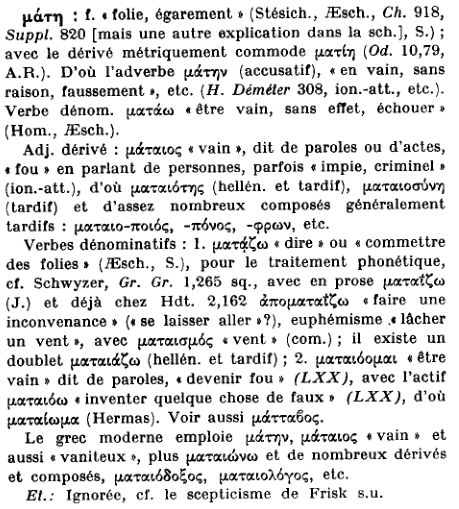
When Apries heard of it, he sent against Amasis an esteemed Egyptian named Patarbemis, one of his own court, instructing him to take the rebel alive and bring him into his presence. Patarbemis came, and summoned Amasis, who lifted his leg with an unseemly gesture (being then on horseback) and bade the messenger take that token back to Apries.J. Enoch Powell, A Lexicon to Herodotus (Cambridge: At the University Press, 1938), p. 41, renders ἀποματαΐζω as "break wind". Similarly Franco Montanari, The Brill Dictionary of Ancient Greek (Leiden: Brill, 2015), p. 260, s.v. ἀποματαΐζω: "to break wind (euphem. for ἀποπέρδω)". Cf. The Cambridge Greek Lexicon, Vol. I: A-I (Cambridge: Cambridge University Press, 2021), p. 190, s.v. ἀποματαΐζω: "respond in an insulting way (app. w. a fart)".
πυθόμενος δὲ ταῦτα ὁ Ἀπρίης ἔπεμπε ἐπ᾽ Ἄμασιν ἄνδρα δόκιμον τῶν περὶ ἑωυτὸν Αἰγυπτίων, τῷ οὔνομα ἦν Πατάρβημις, ἐντειλάμενος αὐτῷ ζῶντα Ἄμασιν ἀγαγεῖν παρ᾽ ἑωυτόν. ὡς δὲ ἀπικόμενος τὸν Ἄμασιν ἐκάλεε ὁ Πατάρβημις, ὁ Ἄμασις, ἔτυχε γὰρ ἐπ᾽ ἵππου κατήμενος, ἐπάρας ἀπεματάϊσε, καὶ τοῦτό μιν ἐκέλευε Ἀπρίῃ ἀπάγειν.
Alan B. Lloyd, Herodotus, Book II, Commentary 99-182 (Leiden: E.J. Brill, 1993), pp. 176-177:


A man from Boeotia, seventy years old, happening upon a treasure, lifted his leg, farted, and passed by, as if it no longer meant anything to him. So it is that old age puts an end at the same time to both avarice and curiosity.Text and translation of the fragment of Favorinus can also be found in Denis M. Searby, The Corpus Parisinum. A Critical Edition of the Greek Text with Commentary and English Translation. A Medieval Anthology of Greek Texts from the Pre-Socratics to the Church Fathers, 600 B.C. - 700 A.D. (Lewiston: The Edwin Mellen Press, 2007), pp. 288 and 671.
Ὁ Βοιωτὸς ἐντυχὼν θησαυρῷ µετὰ ἑβδοµήκοντα ἔτη ἐπάρας τὸ σκέλος ἀπεµατάισε καὶ παρῆλθεν, ὡς οὐκέτι οὐδὲν ὄντα πρὸς αὐτόν. ὥστε καὶ πολυχρηματίας ἅµα παύει τὸ γῆρας καὶ πολυπραγµοσύνης.
On the root of ἀποματαΐζω see Pierre Chantraine, Dictionnaire étymologique de la langue grecque, III (Paris: Klincksieck, 1974), p. 672 (s.v. μάτη):

Labels: noctes scatologicae
A Fine Number
Robert E. Lee, letter to his son George Washington Custis Lee, then a cadet at West Point (February 1, 1852), concerning upcoming examinations in June, quoted in Douglas Southall Freeman, R.E. Lee: A Biography, Vol. I (New York: Charles Scribner's Sons, 1943), p. 312:
Removal of the statue of Robert E. Lee and his horse Traveller from Market Street Park (formerly Lee Park) in Charlottesville, Virginia, on July 10, 2021:
You must be No. 1. It is a fine number. Easily found and remembered. Simple and unique. Jump to it fellow.This reminds me of Homer's αἰὲν ἀριστεύειν καὶ ὑπείροχον ἔμμεναι ἄλλων (Iliad 6.208 and 11.784), translated by Peter Green as "always to be the best, preeminent over others."
Removal of the statue of Robert E. Lee and his horse Traveller from Market Street Park (formerly Lee Park) in Charlottesville, Virginia, on July 10, 2021:

Inconveniences
Thomas Jefferson, letter to Archibald Stuart (December 23. 1791):
I would rather be exposed to the inconveniences attending too much liberty than to those attending too small a degree of it.
Stopgap
Friedrich Nietzsche, Unpublished Fragments from the Period of Thus Spoke Zarathustra (Summer 1882-Winter 1883/84), tr. Paul S. Loeb and David F. Tinsley (Stanford: Stanford University Press, 2019 = The Complete Works of Friedrich Nietzsche, vol. 14), p. 382 (Notebook 13, number 1):
And there, where your understanding has sprung a leak, you quickly stick the poorest of all plugs: his name is "God."Friedrich Nietzsche, Nachgelassene Fragmente 1882-1884, edd. Giorgio Colli and Mazzino Montinari, 2. Aufl. (Munich: Deutscher Taschenbuch Verlag, 1988 = Kritische Studienausgabe, Bd. 10), p. 427:
Und wo euer Verstand eine Lücke hat, da stellt ihr flugs den ärmsten aller Lückenbüßer hinein: „Gott“ ist sein Name.
Wednesday, July 14, 2021
Error Prevails
Goethe, Conversations with Eckermann, December 16, 1828 (Goethe speaking; tr. John Oxenford):
The truth must be repeated over and over again, because error is repeatedly preached among us, not only by individuals, but by the masses. In periodicals and cyclopædias, in schools and universities; everywhere, in fact, error prevails, and is quite easy in the feeling that it has a decided majority on its side.
Und denn, man muß das Wahre immer wiederholen, weil auch der Irrtum um uns her immer wieder geprediget wird, und zwar nicht von einzelnen, sondern von der Masse. In Zeitungen und Enzyklopädien, auf Schulen und Universitäten, überall ist der Irrtum obenauf, und es ist ihm wohl und behaglich, im Gefühl der Majorität, die auf seiner Seite ist.
The Nature of the Gods
Lucretius 1.44-49 = 2.646-651 (tr. W.H.D. Rouse):
For the very nature of divinity must necessarilyEpicurus, Principal Doctrines 1 (tr. Cyril Bailey):
enjoy immortal life in the deepest peace,
far removed and separated from our troubles;
for without any pain, without danger,
itself mighty by its own resources, needing us not at all,
it is neither propitiated with services nor touched by wrath.
omnis enim per se divum natura necessest
immortali aevo summa cum pace fruatur
semota ab nostris rebus seiunctaque longe;
nam privata dolore omni, privata periclis,
ipsa suis pollens opibus, nihil indiga nostri,
nec bene promeritis capitur nec tangitur ira.
The blessed and immortal nature knows no trouble itself nor causes trouble to any other, so that it is never constrained by anger or favour. For such things exist only in the weak.Cicero, On the Nature of the Gods 1.17.45a (tr. H. Rackham):
τὸ μακάριον καὶ ἄφθαρτον οὔτε αὐτὸ πράγματα ἔχει οὔτε ἄλλῳ παρέχει· ὥστε οὔτε ὀργαῖς οὔτε χάρισι συνέχεται· ἐν ἀσθενεῖ γὰρ πᾶν τὸ τοιοῦτον.
If this is so, the famous maxim of Epicurus truthfully enunciates that 'that which is blessed and eternal can neither know trouble itself nor cause trouble to another, and accordingly cannot feel either anger or favour, since all such things belong only to the weak.'See Cyril Bailey, The Greek Atomists and Epicurus: A Study (1928; rpt. New York: Russell & Russell, 1964), pp. 472-473.
quod si ita est, vere exposita illa sententia est ab Epicuro, quod beatum aeternumque sit id nec habere ipsum negotii quicquam nec exhibere alteri, itaque neque ira neque gratia teneri, quod, quae talia essent, inbecilla essent omnia.
Personal Investigation
Polybius 12.27.4-6 (tr. Ian Scott-Kilvert):

[4] You can busy yourself among books with very little danger or hardship, provided only that you have taken care to have access to a city which is well supplied with records or to have a library close at hand. [5] After that you need only pursue your researches while reclining on your couch, and you can compare the mistakes of earlier historians without undergoing any hardship. [6] Personal investigation, on the other hand, demands much greater exertion and expense, but it is of prime importance and makes the greatest contribution of all to history.Günter Glockmann and Hadwig Helms, Polybios-Lexikon, Bd. II, Lieferung 2 (Berlin: Akademie Verlag, 2005), col. 501 (s.v. πολυπραγμοσύνη):
[4] τὰ μὲν ἐκ τῶν βυβλίων δύναται πολυπραγμονεῖσθαι χωρὶς κινδύνου καὶ κακοπαθείας, ἐάν τις αὐτὸ τοῦτο προνοηθῇ μόνον ὥστε λαβεῖν ἢ πόλιν ἔχουσαν ὑπομνημάτων πλῆθος ἢ βυβλιοθήκην που γειτνιῶσαν. [5] λοιπὸν κατακείμενον ἐρευνᾶν δεῖ τὸ ζητούμενον καὶ συγκρίνειν τὰς τῶν προγεγονότων συγγραφέων ἀγνοίας ἄνευ πάσης κακοπαθείας. [6] ἡ δὲ πολυπραγμοσύνη πολλῆς μὲν προσδεῖται ταλαιπωρίας καὶ δαπάνης, μέγα δέ τι συμβάλλεται καὶ μέγιστόν ἐστι μέρος τῆς ἱστορίας.

Tuesday, July 13, 2021
Can't Live With 'Em or Without 'Em
Aristophanes, Lysistrata 1038-1039 (tr. Jeffrey Henderson):

 See also S. Douglas Olson, Broken Laughter. Select Fragments of Greek Comedy. Edited with Introduction, Commentary, and Translation (Oxford: Oxford University Press, 2007), pp. 321, 328-330, 458.
That ancient adage is right on the mark and no mistake:Commentators cite [Susarion], fragment 1 (tr. Ian C. Storey):
"Can't live with the pests or without the pests either."
κἄστ᾿ ἐκεῖνο τοὔπος ὀρθῶς κοὐ κακῶς εἰρημένον,
οὔτε σὺν πανωλέθροισιν οὔτ᾿ ἄνευ πανωλέθρων.
Listen, people, Susarion has this to say,R. Kassel and C. Austin, edd., Poetae Comici Graeci, Vol. VII: Menecrates — Xenophon (Berlin: Walter de Gruyter, 1989), pp. 664-665:
the son of Philinus, from Tripodisce in Megara:
women are a bad thing, but nevertheless, my townsfolk,
you cannot have a home without a bad thing.
Both to marry and not to marry is a bad thing.
ἀκούετε λεῴ· Σουσαρίων λέγει τάδε
υἱὸς Φιλίνου Μεγαρόθεν Τριποδίσκιος.
κακὸν γυναῖκες· ἀλλ᾿ ὅμως, ὦ δημόται,
οὐκ ἔστιν οἰκεῖν οἰκίαν ἄνευ κακοῦ.
καὶ γὰρ τὸ γῆμαι καὶ τὸ μὴ γῆμαι κακόν.


Monday, July 12, 2021
Are We Defenseless?
Friedrich Schiller, William Tell, lines 644-646 (from Act I, Scene 4; my translation):
Are we then defenseless? To what purpose did we learn
The crossbow to draw and the heavy weight
Of the battle axe to swing?
Sind wir denn wehrlos? Wozu lernten wir
Die Armbrust spannen und die schwere Wucht
Der Streitaxt schwingen?
Akin and Alike
Aristotle, Rhetoric 1.11.25 (1371 b 12-17; tr. John Henry Freese, with his notes):
 Related posts:
And since that which is in accordance with nature is pleasant, and things which are akin are akin in accordance with nature, all things akin and like are for the most part pleasant to each other, as man to man, horse to horse, youth to youth. This is the origin of the proverbs:William M.A. Grimaldi ad loc.:The old have charms for the old, the young for the young,and all similar sayings.
Like to like,a
Beast knows beast,
Birds of a feather flock together,b
a Odyssey, xvii.218 ὡς αἰεὶ τὸν ὁμοῖον ἄγει θεὸς ὡς τὸν ὁμοῖον.
b Literally, “ever jackdaw to jackdaw.”
καὶ ἐπεὶ τὸ κατὰ φύσιν ἡδύ, τὰ συγγενῆ δὲ κατὰ φύσιν ἀλλήλοις ἐστίν, πάντα τὰ συγγενῆ καὶ ὅμοια ἡδέα ὡς ἐπὶ τὸ πολύ, οἷον ἄνθρωπος ἀνθρώπῳ καὶ ἵππος ἵππῳ καὶ νέος νέῳ, ὅθεν καὶ αἱ παροιμίαι εἴρηνται, ὡς "ἧλιξ ἥλικα τέρπει", καὶ "ὡς αἰεὶ τὸν ὁμοῖον", καὶ "ἔγνω δὲ θὴρ θῆρα", "καὶ γὰρ κολοιὸς παρὰ κολοιόν", καὶ ὅσα ἄλλα τοιαῦτα.

Every One Can Draw
Douglas Southall Freeman, R.E. Lee: A Biography, Vol. I (New York: Charles Scribner's Sons, 1943), p. 63 (on the curriculum at West Point; footnote omitted):
The one added academic study was free-hand drawing of the human figure. This was under the tutelage of Thomas Gimbrede, an amiable Frenchman, a good miniaturist, and a competent engraver, who was not altogether without the blessed quality of humor. It was Mr. Gimbrede's custom to give each class of beginners an introductory lecture, in the course of which he endeavored to prove to unbelieving third-classmen that every one could learn to draw. His proof was: "There are only two lines in drawing, the straight line and the curve line. Every one can draw a straight line and every one can draw a curve line — therefore, every one can draw."
Sunday, July 11, 2021
A Great Corrupter
Andrew Robert Burn (1902-1991), Persia and the Greeks: The Defence of the West, 546-478 B.C. (1962; rpt. Totowa: Minerva Press, 1968), pp. 6-7:
Tradition is a great corrupter. It may preserve important facts, though even then the preservation may take the form of seizing on one important or merely picturesque fact and embroidering it. Einhard tells us that Hrodland, Count of the Breton Marches, was killed by the Basques in an attack on the rearguard of Charlemagne's army returning from Spain; three hundred years later, Roland is the hero of a mighty epic, falling after tremendous slaughter before a huge host of Saracens, and avenged by the destruction of all the hosts of Babylon by his lord (who a few weeks earlier, with Roland to help him, had been unable to capture Pampeluna). Why Roland became the hero of the great poem, we may perhaps guess when we remember what was Roland's most famous attribute: a horn; and what was famous about the horn: that, at the crisis of his fortunes, he refused to blow it. Did the real Count Hrodland refuse to call for help and stop the main column in a defile, for an attack by these barbarians? If so, for his gallantry and pride he paid with his life. This is exactly the kind of thing that seizes the imagination of mankind; but it constitutes a warning against expecting popular tradition to preserve reliable history for long periods.
Compassion
Friedrich Nietzsche, Unpublished Fragments from the Period of Thus Spoke Zarathustra (Summer 1882-Winter 1883/84), tr. Paul S. Loeb and David F. Tinsley (Stanford: Stanford University Press, 2019 = The Complete Works of Friedrich Nietzsche, vol. 14), p. 374 (Notebook 13, number 1):
See him, how he swells and overflows with compassion for everything that is called human: his mind is already completely drunk with compassion; soon he will be doing incredibly foolish things.Friedrich Nietzsche, Nachgelassene Fragmente 1882-1884, edd. Giorgio Colli and Mazzino Montinari, 2. Aufl. (Munich: Deutscher Taschenbuch Verlag, 1988 = Kritische Studienausgabe, Bd. 10), p. 419:
Seht ihn, wie er schwillt und überschwillt von Mitleiden mit allem, was Mensch heißt: ganz schon ist sein Geist ertrunken in seinem Mitleiden; bald wird er große Thorheiten thun.
Sine Qua Non
Maximianus, Elegies 5.111-116 (tr. A.M. Juster):
Related post: The Best Part of a Man.
It makes the human race, the herds, the birds, the beastsThe antecedent of the pronouns haec and hac is mentula (prick).
and everything that breathes throughout the world.
Without it there's no union of the different sexes;
the highest grace of marriage dies without it.
It brings together coupled minds with its strong bond
so that the pair combine to be one flesh.
haec genus humanum, pecudum, volucrumque, ferarum
et quicquid toto spirat in orbe, creat
hac sine diversi nulla est concordia sexus,
hac sine coniugii gratia summa perit.
haec geminas tanto constringit foedere mentes,
unius ut faciat corporis esse duo.
Related post: The Best Part of a Man.
Saturday, July 10, 2021
Enlightenment
Lucretius 1.1114-1117 (tr. Cyril Bailey):
These things you will learn thus, led on with little trouble; for one thing after another shall grow clear, nor will blind night snatch away your path from you, but that you shall see all the utmost truths of nature: so shall things kindle a light for others.H.A.J. Munro, ed., Titi Lucreti Cari De Rerum Natura Libri Sex, Vol. II (1864; rpt. Cambridge: Cambridge University Press, 2009), p. 37:
haec sic pernosces parva perductus opella;
namque alid ex alio clarescet nec tibi caeca 1115
nox iter eripiet, quin ultima naturai
pervideas: ita res accendent lumina rebus.
1114 sic codd.: sei Munro
cetera iam poteris per te tute ipse videre post 1114 add. Munro
1114 sei Ed. after Nic. Nicc. Flor. 31 Camb. etc. for sic: a verse is here lost which I feel sure was of this kind, Cetera iam poteris per te tute ipse videre, with which the preceding words parva perductus opella must be joined. Lucr. says it is hard to master his principles, but when that is thoroughly done, then led on with little trouble you may learn the rest yourself. Comp. especially I 400—417, and see Camb. Journ. of phil. i p. 374. Lach. for sic reads scio and perdoctus for perductus, and then gets no satisfactory sense: Junt. reads non for nec in 1115 : Lamb. perfunctus for perdoctus: Bern. sis, and perdoctus after Lach.
Friday, July 09, 2021
Country and City
Varro, De Re Rustica 3.1.4 (tr. William Davis Hooper, rev. Harrison Boyd Ash):
It was divine nature which gave us the country, and man's skill that built the cities.
divina natura dedit agros, ars humana aedificavit urbes.
How Did Things Get Like This?
Andrew Robert Burn (1902-1991), Persia and the Greeks: The Defence of the West, 546-478 B.C. (1962; rpt. Totowa: Minerva Press, 1968), p. 3:
History represents an attempt to answer the question, 'How did things get like this?' — and the question is often stimulated by a sense that the world has gone wrong.
Thursday, July 08, 2021
Like Is Dear to Like
Theocritus, Idylls 9.31-32 (tr. A.F.S. Gow):
Cicada is dear to cicada, ant to ant, hawk to hawk...Related posts:
τέττιξ μὲν τέττιγι φίλος, μύρμακι δὲ μύρμαξ,
ἴρηκες δ᾿ ἴρηξιν...
Firsthand Experience
Polybius 12.25g.1-3 (tr. Ian Scott-Kilvert):
It is in fact equally impossible for a man who has had no experience of action in the field to write well about military operations as it is for a man who has never engaged in political affairs and their attendant circumstances to write well on those topics. And since the writings of mere book-worms lack both firsthand experience and any vividness of presentation, their work is completely without value for its readers. For if you remove from history the element of practical instruction, what is left is insignificant and without any benefit to them. Again, when writers try to provide details about cities and places without possessing firsthand experience of this kind, the result is bound to be very similar, since they will leave out many things which ought to be mentioned and deal at great length with other details which are not worth the trouble.Id., 12.25h.5-6:
For this reason the writers of the past believed that historical memoirs should possess such vividness that they would make the reader exclaim whenever the narrative dealt with political events that the author must have taken part in politics and had experience of public affairs; or when he dealt with war that he had known active service and risked his life; or when he turned to domestic matters that he had lived with a wife and brought up children, and similarly with the various other aspects of life. Now this quality can only be found in the writing of those who have played some part in affairs themselves and made this aspect of history their own. Of course it is diffcult to have been personally involved and played an active role in every kind of event, but it is certainly necessary to have had experience of the most important and those of most frequent occurrence.
Searching After Treasures
Henry Fielding, "The Covent-Garden Journal," No. 10 (February 4, 1752), in his Works, Vol. 12 (London: J.M. Dent & Co., 1902), pp. 220-225 (at 222-223):
When we are employed in reading a great and good author, we ought to consider ourselves as searching after treasures, which, if well and regularly laid up in the mind, will be of use to us on sundry occasions in our lives. If a man, for instance, should be overloaded with prosperity or adversity (both of which cases are liable to happen to us), who is there so very wise, or so very foolish, that, if he was a master of Seneca and Plutarch, could not find great matter of comfort and utility from their doctrines?
Wednesday, July 07, 2021
Country versus City Life
Martial 1.55 (tr. Walter C.A. Ker):


If you wish briefly to learn your Marcus' wishes, Fronto, bright ornament of war and of the gown, he seeks this — to be tiller of land that is his own, though not large; and rough ease he delights in amid small means. Does any man court halls gaudy and chill with Spartan stone, and bring with him — O fool! —the morning salute, who, blest with spoils of wood and field, can before his hearth open his crowded nets, and draw with trembling line the leaping fish, and bring forth from the red jar his golden honey? For whom the bailiff's portly dame loads his rickety table, and charcoal unbought cooks his home-laid eggs? May he, I pray, who loves not me love not this, and live, pale-faced, amid the duties of the town.Ludwig Friedlaender ad loc. (SG = his Sittengeschichte Roms):
Vota tui breviter si vis cognoscere Marci,
clarum militiae, Fronto, togaeque decus,
hoc petit, esse sui nec magni ruris arator,
sordidaque in parvis otia rebus amat.
quisquam picta colit Spartani frigora saxi 5
et matutinum portat ineptus have,
cui licet exuviis nemoris rurisque beato
ante focum plenas explicuisse plagas
et piscem tremula salientem ducere saeta
flavaque de rubro promere mella cado? 10
pinguis inaequales onerat cui vilica mensas
et sua non emptus praeparat ova cinis?
non amet hanc vitam quisquis me non amat, opto,
vivat et urbanis albus in officiis.
2. Fronto. Welcher Fronto hier gemeint ist, lässt sieh nicht bestimmen. Borghesi hielt ihn für S. Octavius Fronto, cos. 86, Statthalter von Mösien 92, oder für Q. Pactumeius Fronto, cos. 80. Oeuvres III 3S2, SG III 432. Mommsen (Ind. Plin.) hat an T. Catius (Caesius) Fronto, cos. 96 (10. Oktober) gedacht.On the identity of Fronto here see Juan Fernández Valverde in Rosario Moreno Soldevila et al., A Prosopography to Martial's Epigrams (Berlin: De Gruyter, 2019), pp. 239-240:
3. M. besass jedoch damals bereits sein Nomentanum (XIII 42 XIII 119). Aber es war zu dürftig, um ihn zu ernähren, SG III 397, 4.
4. Sordida. Zu I 49, 28.
5. picta Spartani frigora saxi d. h. ein mit Säulen und Wänden von grünem lakonischen Marmor (Serpentin, Marquardt Prl. 603, 13) prangendes vornehmes Atrium.
6. d. h. stattet als Client den vorgeschriebenen Morgenbesuch (salutatio) bei dem Patron ab.
ineptus. Weil diese Bemühungen für die Patrone lästig waren, überdies meist erfolglos blieben. SG I 3H8 ff.
9. tremula — saeta. Saeta für Angelschnur auch X 30, 16. Tremula linea III 58, 27.
14. albus. Von der ungesunden Blässe der Städter. SG I 32 und zu III 58, 24. Bei urbana officia ist vorzugsweise au Clientendienste zu denken.


The Vandal Epigram
D.R. Shackleton Bailey, ed., Anthologia Latina, I: Carmina in Codicibus Scripta, Fasc. 1: Libri Salmasiani Aliorumque Carmina (Stuttgart: B.G. Teubner, 1982), p. 201 (number 279):
Eric Thomson suggests (via email):
De conviviis barbarisId., p. 202 (number 280):
Inter 'eils' Goticum 'scapia matzia ia drincan'
non audet quisquam dignos edicere versus.
1 'Massmannus in Hauptii annal. german. I, p. 379 sqq. eils salutem, skapja procuratorem peni vel skap "procura, praebe", jah matjan jah drigkan "et cibum et potum" interpretatur Riese
2 audit A educere sched. : anne ded- ? uersos A
Calliope madido trepidat se iungere Baccho,Magnús Snædal, "The 'Vandal' Epigram," Filologia Germanica/Germanic Philology 1 (2009) 181-213, regards 279-280 as one poem and translates the Latin thus (at 184):
ne pedibus non stet ebria Musa suis.
Separavit L. Mueller 2 sobria idem : deb- Peiper
On foreign guests.Snædal identifies the foreign words as Vandal and interprets them as follows (at 205):
Among the Gothic 'eils scapia matzia ia drincan'
No one ventures to recite decent verses.
Calliope hurries to depart from the wet Bacchus,
So it does not happen that a drunken muse doesn't stand on her feet.
eils! scapia! matzia ia drincan!Snædal on the Sitz im Leben (at 210):
Hails! *Skapja! *Matja jah *drigkan!
'Hail! Waiter! Food and drink!'
The simplest assumption is that the author had himself tried — with limited success — to recite poetry among drunken Vandals, had witnessed such an attempt, or had been told about one. He composed the epigram about this and, although it is presented as a general truth, most likely he had a certain incident in mind. He is not making fun of Vandal poetry but only saying that dignified verses cannot been [sic, i.e. be] read while they are always ordering food and drink because Calliope flees from there. This is indeed all we can say with some certainty about the occasion of the epigram.See also Yuri Kleiner, "Another hypothesis concerning the grammar and meaning of Inter eils goticum," NOWELE: North-Western European Language Evolution 71.2 (2018) 236–248, who glosses scapia as the 1st person singular of the verb corresponding to Gothic skapjan 'make'.
Eric Thomson suggests (via email):
...the 'pedes' are both anatomical and metrical. Alcohol plays havoc with the diction, making 'dignos edicere versus' impossible (cf. Martial's tipsy Terpsichore: quid dicta nescit saucia Terpsichore, 3.68.6), so I would take 'non quisquam' as 'no one' among those doing the 'drincan'...
Tuesday, July 06, 2021
Saviors?
Friedrich Nietzsche, Unpublished Fragments from the Period of Thus Spoke Zarathustra (Summer 1882-Winter 1883/84), tr. Paul S. Loeb and David F. Tinsley (Stanford: Stanford University Press, 2019 = The Complete Works of Friedrich Nietzsche, vol. 14), p. 333 (Notebook 10, number 34):
Redeemers? I call you the ones who bind and tame!Friedrich Nietzsche, Nachgelassene Fragmente 1882-1884, edd. Giorgio Colli and Mazzino Montinari, 2. Aufl. (Munich: Deutscher Taschenbuch Verlag, 1988 = Kritische Studienausgabe, Bd. 10), p. 374:
Erlöser? Binder und Bändiger nenne ich euch!
Martial 5.20
Martial 5.20 (tr. D.R. Shackleton Bailey, with his notes):
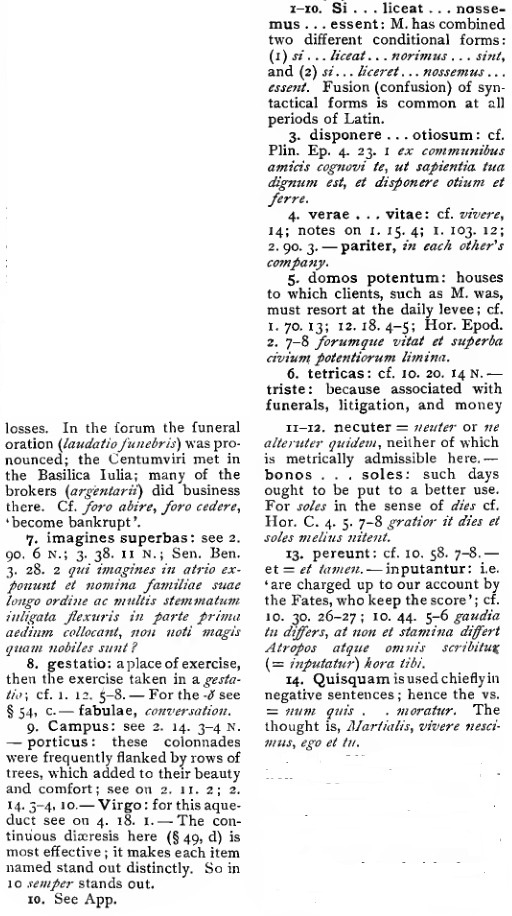 Peter Howell ad loc.:

Could but you and I, dear Martialis, enjoy carefree days and dispose our time in idleness, and both alike have leisure for true living, we should know nothing of the halls and mansions of the mighty, nor sour lawsuits and the gloomy Forum, nor haughty deathmasks: but riding,a chatting, books, the Field, the colonnade,b the shade, the Virgin,c the baths — these should be our daily haunts, these our labors. As things are, neither of us lives for himself. We feel our good days slip away and leave us; they are wasted, and put to our account. Does any man, knowing the way to live, defer it?Edwin Post ad loc.:
a Gestatio also covers conveyance in a carriage or litter.
b There were several; cf. 11.1.9-12.
c Aqueduct.
Si tecum mihi, care Martialis,
securis liceat frui diebus,
si disponere tempus otiosum
et verae pariter vacare vitae,
nec nos atria nec domos potentum 5
nec litis tetricas forumque triste
nossemus nec imagines superbas;
sed gestatio, fabulae, libelli,
campus, porticus, umbra, Virgo, thermae,
haec essent loca semper, hi labores. 10
nunc vivit necuter sibi, bonosque
soles effugere atque abire sentit,
qui nobis pereunt et imputantur.
quisquam vivere cum sciat, moratur?
11 necuter sibi Schneidewin: nec ut eius ibo γ: neuter sibi β
A Renegade to the True Muse
Robert Graves, "The Virgil Cult," Virginia Quarterly Review 38.1 (Winter 1962) 13-35
(at 14):
Why Virgil's poems have for the last two thousand years exercised so great an influence on our Western culture is, paradoxically, because he was a renegade to the true Muse. His pliability; his subservience; his narrowness; his denial of that stubborn imaginative freedom which the true poets who preceded him had prized; his perfect lack of originality, courage, humour, or even animal spirits: these were the negative qualities which first commended him to government circles, and have kept him in favour ever since.
Solidarity
Cicero, De Finibus 5.23.65 (tr. H. Rackham):
But in the whole moral sphere of which we are speaking there is nothing more glorious nor of wider range than the solidarity of mankind, that species of alliance and partnership of interests and that actual affection which exists between man and man, which, coming into existence immediately upon our birth, owing to the fact that children are loved by their parents and the family as a whole is bound together by the ties of marriage and parenthood, gradually spreads its influence beyond the home, first by blood relationships, then by connections through marriage, later by friendships, afterwards by the bonds of neighbourhood, then to fellow-citizens and political allies and friends, and lastly by embracing the whole of the human race.
in omni autem honesto de quo loquimur nihil est tam illustre nec quod latius pateat quam coniunctio inter homines hominum et quasi quaedam societas et communicatio utilitatum et ipsa caritas generis humani, quae nata a primo satu, quod a procreatoribus nati diliguntur et tota domus coniugio et stirpe coniungitur, serpit sensim foras, cognationibus primum, tum affinitatibus, deinde amicitiis, post vicinitatibus, tum civibus et iis qui publice socii atque amici sunt, deinde totius complexu gentis humanae.
Monday, July 05, 2021
The Study of Doctor X
Jean-Charles Cazin (1840-1901), Interieur du Cabinet du Docteur X (Arras, Musée des beaux-arts):


The Wretchedness of Our Age
Goethe, Conversations with Eckermann, March 12, 1828 (Goethe speaking; tr. John Oxenford):
If in a depressed mood one reflects deeply upon the wretchedness of our age, it often occurs to one that the world is gradually approaching the last day. And the evil accumulates from generation to generation! For it is not enough that we have to suffer for the sins of our fathers, but we hand down to posterity these inherited vices increased by our own.
Denkt man sich bei deprimierter Stimmung recht tief in das Elend unserer Zeit hinein, so kommt es einem oft vor, als wäre die Welt nach und nach zum Jüngsten Tage reif. Und das Übel häuft sich von Generation zu Generation! Denn nicht genug, daß wir an den Sünden unserer Väter zu leiden haben, sondern wir überliefern auch diese geerbten Gebrechen, mit unseren eigenen vermehrt, unsern Nachkommen.
Children as Mirrors of Nature
Cicero, De Finibus 5.22.61 (tr. H. Rackham):
A hint of this is given by children, in whom nature is discerned as in a mirror. How hotly they pursue their rivalries! how fierce their contests and competitions! what exultation they feel when they win, and what shame when they are beaten! How they dislike blame! how they covet praise! what toils do they not undergo to stand first among their companions! how good their memory is for those who have shown them kindness, and how eager they are to repay it!Related post: Childhood.
indicant pueri, in quibus ut in speculis natura cernitur. quanta studia decertantium sunt! quanta ipsa certamina! ut illi efferuntur laetitia cum vicerunt! ut pudet victos! ut se accusari nolunt! quam cupiunt laudari! quos illi labores non perferunt ut aequalium principes sint! quae memoria est in iis bene merentium, quae referendae gratiae cupiditas!
Sunday, July 04, 2021
Falsus in Uno, Falsus in Omnibus
Polybius 12.25a.1-2 (tr. Ian Scott-Kilvert):
There is a proverb which tells us that a single drop, taken from even the largest vessel, is enough to reveal to us the nature of the whole contents, and the same principle may be applied to the subject we are now discussing. Accordingly when we find one or two false statements in a book and they prove to have been deliberately made, we know that we can no longer treat anything that is said by such an author as reliable or trustworthy.
καθάπερ γὰρ ἐκ τῶν παροιμιῶν ἱκανὸν εἶναί φασι σταλαγμὸν ἕνα τοῦ μεγίστου τεύχους εἰς τὸ γνῶναι τὸ πᾶν ἔγχυμα, τὸν αὐτὸν τρόπον καὶ περὶ τῶν ὑποκειμένων χρὴ διαλαμβάνειν· ἐπειδὰν γὰρ ἓν ἢ δεύτερον εὑρεθῇ ψεῦδος ἐν τοῖς συγγράμμασι, καὶ τοῦτο γεγονὸς ᾖ κατὰ προαίρεσιν, δῆλον ὡς οὐδὲν ἂν ἔτι βέβαιον οὐδ᾽ ἀσφαλὲς γένοιτο τῶν ὑπὸ τοῦ τοιούτου συγγραφέως λεγομένων.
Head of Pan
Gold stater from Panticapaeum, 4th century B.C. (Münzkabinett der Staatlichen Museen zu Berlin, Accession
number 1882/13, Object number
18203032):


Childhood
Cicero, De Finibus 5.15.42 (tr. H. Rackham):
Infants just born lie helpless, as if absolutely inanimate; when they have acquired a little more strength, they exercise their mind and their senses; they strive to stand erect, they use their hands, they recognize their nurses; then they take pleasure in the society of other children, and enjoy meeting them, they take part in games and love to hear stories; they desire to bestow of their own abundance in bounty to others; they take an inquisitive interest in what goes on in their homes; they begin to reflect and to learn, and want to know the names of the people they see; in their contests with their companions they are elated by victory, discouraged and disheartened by defeat.
parvi enim primo ortu sic iacent, tamquam omnino sine animo sint; cum autem paulum firmitatis accessit, et animo utuntur et sensibus, conitunturque sese ut erigant, et manibus utuntur, et eos agnoscunt a quibus educantur; deinde aequalibus delectantur libenterque se cum iis congregant dantque se ad ludendum fabellarumque auditione ducuntur, deque eo quod ipsis superat aliis gratificari volunt, animadvertuntque ea quae domi fiunt curiosius, incipiuntque commentari aliquid et discere, et eorum quos vident volunt non ignorare nomina, quibusque rebus cum aequalibus decertant si vicerunt efferunt se laetitia, victi debilitantur animosque demittunt.
An Insult
Friedrich Nietzsche, Unpublished Fragments from the Period of Thus Spoke Zarathustra (Summer 1882-Winter 1883/84), tr. Paul S. Loeb and David F. Tinsley (Stanford: Stanford University Press, 2019 = The Complete Works of Friedrich Nietzsche, vol. 14), p. 308 (Notebook 9, number 6):
"Party liner" — I want to turn this into an insult.Friedrich Nietzsche, Nachgelassene Fragmente 1882-1884, edd. Giorgio Colli and Mazzino Montinari, 2. Aufl. (Munich: Deutscher Taschenbuch Verlag, 1988 = Kritische Studienausgabe, Bd. 10), p. 347:
„Mensch der Partei“ — will ich zum Schimpfe machen.
Saturday, July 03, 2021
Filled Up With Rubbish
G.M. Trevelyan (1876-1952), An Autobiography & Other Essays (London: Longmans, Green and Co, 1949), pp. 57-58:
Literature and history are twin sisters, inseparable. In the days of our own grandfathers, and for many generations before them, the basis of education was the Greek and Roman classics for the educated, and the Bible for all. In the classical authors and in the Bible, history and literature were closely intervolved, and it is that circumstance which made the old form of education so stimulating to the thought and imagination of our ancestors. To read the classical authors and to read the Bible was to read at once the history and the literature of the three greatest races of the ancient world. No doubt the Classics and the Bible were read in a manner we now consider uncritical, but they were read according to the best lights of the time and formed a great humanistic education. To-day the study both of the Classics and of the Bible has dwindled to small proportions. What has taken their place? To some extent the vacuum has been filled by a more correct knowledge of history and a wider range of literature. But I fear that the greater part of it has been filled up with rubbish.
Before You Came
Friedrich Schiller, William Tell, lines 456-457 (from Act I, Scene 3; my translation):
We were happy men, before you came:
With you, despair moved in.
Wir waren frohe Menschen, eh' ihr kamt,
Mit euch ist die Verzweiflung eingezogen.
Love of Learning and Knowledge
Cicero, De Finibus 5.18.48 (tr. H. Rackham):
So great is our innate love of learning and of knowledge, that no one can doubt that man's nature is strongly attracted to these things even without the lure of any profit. Do we notice how children cannot be deterred even by punishment from studying and inquiring into the world around them? Drive them away, and back they come. They delight in knowing things; they are eager to impart their knowledge to others; pageants, games and shows of that sort hold them spell-bound, and they will even endure hunger and thirst so as to be able to see them. Again, take persons who delight in the liberal arts and studies; do we not see them careless of health or business, patiently enduring any inconvenience when under the spell of learning and of science, and repaid for endless toil and trouble by the pleasure they derive from acquiring knowledge?
tantus est igitur innatus in nobis cognitionis amor et scientiae ut nemo dubitare possit quin ad eas res hominum natura nullo emolumento invitata rapiatur. videmusne ut pueri ne verberibus quidem a contemplandis rebus perquirendisque deterreantur? ut pulsi recurrant? ut aliquid scire se gaudeant? ut id aliis narrare gestiant? ut pompa, ludis atque eiusmodi spectaculis teneantur ob eamque rem vel famem et sitim perferant? quid vero? qui ingenuis studiis atque artibus delectantur, nonne videmus eos nec valetudinis nec rei familiaris habere rationem omniaque perpeti ipsa cognitione et scientia captos et cum maximis curis et laboribus compensare eam quam ex discendo capiant voluptatem?
Friday, July 02, 2021
I Write For Myself
Friedrich Nietzsche, Unpublished Fragments from the Period of Thus Spoke Zarathustra (Summer 1882-Winter 1883/84), tr. Paul S. Loeb and David F. Tinsley (Stanford: Stanford University Press, 2019 = The Complete Works of Friedrich Nietzsche, vol. 14), p. 303 (Notebook 8, number 20):
I write for myself: and what's the point of writing in this age that has been written to death? little: for, apart from scholars, no one knows how to read anymore, and even scholars — — —Friedrich Nietzsche, Nachgelassene Fragmente 1882-1884, edd. Giorgio Colli and Mazzino Montinari, 2. Aufl. (Munich: Deutscher Taschenbuch Verlag, 1988 = Kritische Studienausgabe, Bd. 10), p. 341:
Ich schreibe für mich selber: und welchen Sinn hätte Schreiben in diesem zerschriebenen Zeitalter? wenig: denn abgesehen von den Gelehrten versteht Niemand mehr zu lesen, und auch die Gelehrten — — —Related posts:
- Few versus Many Readers
- Singing to Myself
- Gómez Dávila on Writing for Oneself
- Dishonest and Lying Narcissists
- Few, One, or None
- Few, One, or None Revisited
- Write the Book You Want To Read
- An Audience of One
- Tolkien on Writing for Oneself
- To Write for Oneself
- Soliloquies
- Mihi et Musis
- Says I to Myself
To Bacchus
Aristophanes, Thesmophoriazusae 986-1000 (tr. Jeffrey Henderson):
This way, Lord Bacchus crowned with ivy,The text is a mess, but the beauty shines through. See:
do personally be our leader:
and with revels I will hymn you,
who love the dance!
Euius, you Noisemaker,
son of Zeus and Semele,
who enjoy the dances
of Nymphs at their charming songs
as you ramble over the mountains—
Euius, Euius, euoi!—
striking up the dances all night long;
and all around you their cries
echo on Cithaeron,
and the mountains shady
with dark leaves and the rocky
valleys reverberate.
And all around you ivy tendrils
twine in lovely bloom.
ἡγοῦ δέ γ᾽ ὧδ᾽ αὐτὸς σὺ
κισσοφόρε Βάκχειε
δέσποτ᾽· ἐγὼ δὲ κώμοις
σὲ φιλοχόροισι μέλψω.
Εὔιε, ὦ Διὸς σὺ 990
Βρόμιε, καὶ Σεμέλας παῖ,
χοροῖς τερπόμενος
κατ᾽ ὄρεα Νυμ-
φᾶν ἐρατοῖς ἐν ὕμνοις,
ὦ Εὔι᾿ Εὔι᾿, εὐοῖ,
<παννύχιος> ἀναχορεύων.
ἀμφὶ δὲ σοὶ κτυπεῖται 995
Κιθαιρώνιος ἠχώ,
μελάμφυλλά τ᾽ ὄρη
δάσκια πετρώ-
δεις τε νάπαι βρέμονται·
κύκλῳ δὲ περὶ σε κισσὸς
εὐπέταλος ἕλικι θάλλει. 1000
990 Εὔιε, ὦ Διὸς σὺ Enger: εὔιον ὦ Διόνυσε R
994 ὦ Εὔι᾿ Εὔι᾿ Hermann: εὔιον εὔιον R
παννύχιος suppl. Coulon: ἡδόμενος Austin
995 σοὶ Divus: συὶ R
998 τε νάπαι hic Enger: καὶ νάπαι ante πετρώδεις R
999 σε Blaydes: σὲ R
- L.P.E. Parker, The Songs of Aristophanes (Oxford: Oxford University Press, 1997), pp. 434-437
- Aristophanes, Thesmophoriazusae. Edited with Introduction and Commentary by Colin Austin and S. Douglas Olson (Oxford: Oxford University Press, 2004), pp. 305-308
- N.G. Wilson, Aristophanea: Studies on the Text of Aristophanes (Oxford: Oxford University Press, 2007), pp. 159-160
- Anton Bierl, Ritual and Performativity: The Chorus in Old Comedy, tr. Alexander Hollmann (Washington: Center for Hellenic Studies, 2009 = Hellenic Studies Series, 20), chapter 1 (The Comic Chorus in the Thesmophoriazusae of Aristophanes), passage on "Second, Hymnodic Section (Thesmophoriazusae 969–1000)—Danced Praise of the Gods," page numbers unknown
Wednesday, June 30, 2021
United or Alone?
Friedrich Schiller, William Tell, lines 432-437 (from Act I, Scene 3; my translation):
STAUFFACHER.
We could do much if we stood together.
TELL.
In a shipwreck the individual helps himself more easily.
STAUFFACHER.
So coldly do you abandon our common cause?
TELL.
Everyone reckons only for sure on himself.
STAUFFACHER.
United even the weak become powerful.
TELL.
The strong man is at his most powerful alone.
STAUFFACHER.
Wir könnten viel, wenn wir zusammen stünden.
TELL.
Beim Schiffbruch hilft der Einzelne sich leichter.
STAUFFACHER.
So kalt verlaßt ihr die gemeine Sache?
TELL.
Ein jeder zählt nur sicher auf sich selbst.
STAUFFACHER.
Verbunden werden auch die Schwachen mächtig.
TELL.
Der Starke ist am mächtigsten allein.
Gladly Wolde He Lerne and Gladly Teche
Cicero, De Finibus 3.20.66 (tr. H. Rackham):
Hence it would be hard to discover anyone who will not impart to another any knowledge that he may himself possess; so strong is our propensity not only to learn but also to teach.
non facile est invenire qui, quod sciat ipse, non tradat alteri; ita non solum ad discendum propensi sumus, verum etiam ad docendum.
Advice from Aristophanes
Aristophanes, Thesmophoriazusae 571 (tr. Jeffrey Henderson):
Stop abusing each other!But λοιδορούμεναι is feminine. More general is Aristophanes, Clouds 934:
παύσασθε λοιδορούμεναι.
Stop your scrapping and name calling.
παύσασθε μάχης καὶ λοιδορίας.
Taking Notes
David Pryde, The Highways of Literature; or, What to Read and How to Read (New York: Funk & Wagnalls, [1883]), pp. 20-21:
Cf. Captain Cuttle in Dickens' Dombey and Son: "When found, make a note of."
Note-taking may thus be done in various ways, but done in some way it must be. Without it you cannot be intelligent readers. For how can you be intelligent without being discriminating; and how can you be discriminating without distinguishing between the good and the bad, the remarkable and the commonplace; and how can you distinguish between these without affixing some distinctive marks! You will find, too, that all great scholars have been great note-takers. They have proved themselves in their reading as well as in other things men of mark. Locke, Southey, Sir William Hamilton, never read without having their note-books and commonplace books beside them, into which they put, for future use, all the valuable facts and ideas upon which they alighted.I owe the reference to H.J. Jackson, Marginalia: Readers Writing in Books (New Haven: Yale University Press, 2001), p. 49, who cites a different edition with different pagination however.
Cf. Captain Cuttle in Dickens' Dombey and Son: "When found, make a note of."
Tuesday, June 29, 2021
One Book
Jules Michelet (1798-1874), The People, tr. C. Cocks (London: Longman, Brown, Green, and Longmans, 1846), p. 45:
A single book read through and through, ruminated on and pondered over, is often more fruitful than a vast mass of indigested reading. I lived for whole years on a Virgil, and found myself well off.Related post: Multum Legendum, Non Multa.
Un livre unique qu'on lit et qu'on relit, qu'on rumine et digère, développe souvent mieux qu'une vaste lecture indigeste. J'ai vécu des années d'un Virgile, et m'en suis bien trouvé.
An Obstacle to My Salvation
John Cassian, Conferences 14.12 (tr. Colm Luibhéid):
Leaving aside those things in general which imprison the soul, leaving aside the distractions which come battering from without against souls that are weak, I feel that a particular obstacle to my salvation is the very slight knowledge I seem to have of literature. The insistence of my teacher and my own urge for continuous reading have so softened me that at this point my mind is, as it were, infected by those poetic works, worthless stories, tales of war in which I was steeped from the beginning of my basic studies when I was very young. I think of them even when I am praying. When I am singing the psalms or else begging pardon for my sins the shameful memory of poems slips in or the image of warring heroes turns before my eyes. And the conjuring up of such fantasies makes such a sport of me that my mind is unable to aspire to the contemplation of heavenly things, and my daily tears are unable to drive them out.
quippe cui praeter illas generales animae captivitates, quibus non dubito infirmos quosque pulsari extrinsecus, speciale impedimentum salutis accedit per illam quam tenuiter videor attigisse notitia litterarum, in qua me ita vel instantia paedagogi vel continuae lectionis maceravit intentio, ut nunc mens mea poeticis velut infecta carminibus illas fabularum nugas historiasque bellorum, quibus a parvulo primis studiorum imbuta est rudimentis, orationis etiam tempore meditetur, psallentique vel pro peccatorum indulgentia supplicanti aut impudens poematum memoria suggeratur, aut quasi bellantium heroum ante oculos imago versetur, taliumque me phantasmatum imaginatio semper inludens ita mentem meam ad supernos intuitus aspirare non patitur, ut cotidianis fletibus non possit expelli.
Unreliability of Eyewitnesses
Polybius 12.24.6 (tr. Ian Scott-Kilvert):
...many men, although they may be present at an event, might just as well not be there, and likewise may be eye-witnesses yet actually see nothing; this fact arises from their ignorance and defective judgement...F.W. Walbank in his commentary compares Matthew 13.13 (here in the New International Version):
...συμβαίνει διὰ τὴν ἀπειρίαν καὶ κακοκρισίαν πολλοὺς ἐνίοτε καθάπερ εἰ παρόντας τρόπον τινὰ μὴ παρεῖναι καὶ βλέποντας μὴ βλέπειν...
Though seeing, they do not see; though hearing, they do not hear or understand.
βλέποντες οὐ βλέπουσιν καὶ ἀκούοντες οὐκ ἀκούουσιν οὐδὲ συνίουσιν.
A Relief
G.M. Trevelyan (1876-1952), An Autobiography & Other Essays (London: Longmans, Green and Co, 1949), p. 60:
It is a relief to escape from our own mechanical age into a world when the craftsman was more and the machine less, when imagination was more and science was less. Nor is this mere hedonistic escapism. It enlarges the mind and imagination, otherwise imprisoned in the present. We get glimpses of other worlds, human and faulty like ours, but different from our own, and suggesting many things, some of great value, that man has thought, experienced and forgotten. Indeed, I know of no greater triumph of the modern intellect than the truthful reconstruction of past states of society that have been long forgotten or misunderstood, recovered now by the patient work of archaeologists, antiquarians and historians. To discover in detail what the life of man on earth was like a hundred, a thousand, ten thousand years ago is just as great an achievement as to make ships sail under the sea or through the air.
How wonderful a thing it is to look back into the past as it actually was, to get a glimpse through the curtain of old night into some brilliantly lighted scene of living men and women, not mere creatures of fiction and imagination, but warm-blooded realities even as we are.
Forgiving One's Enemies
Scintillations from the Prose Works of Heinrich Heine, tr. Simon Adler Stern (New York: Holt & Williams, 1873), p. 83:
I have the most peaceable disposition. My desires are a modest cottage with thatched roof — but a good bed, good fare, fresh milk and butter, flowers by my window, and a few fine trees before the door. And if the Lord wished to fill my cup of happiness, he would grant me the pleasure of seeing some six or seven of my enemies hanged on those trees. With a heart moved to pity, I would, before their death, forgive the injury they had done me during their lives. Yes, we ought to forgive our enemies, — but not until they are hanged.The German, from Heinrich Heine, "Gedanken und Einfälle," in his Gesammelte Werke, ed. Gustav Karpeles, 8. Bd., 2. Aufl., (Berlin: G. Grote, 1893), pp. 275-326 (at 275):
Ich habe die friedlichste Gesinnung. Meine Wünsche sind: eine bescheidene Hütte, ein Strohdach, aber ein gutes Bett, gutes Essen, Milch und Butter, sehr frisch, vor dem Fenster Blumen, vor der Thür einige schöne Bäume, und wenn der liebe Gott mich ganz glüdlich machen will, lässt er mich die Freude erleben, dass an diesen Bäumen etwa sechs bis sieben meiner Feinde aufgehängt werden. Mit gerührtem Herzen werde ich ihnen vor ihrem Tode alle Unbill verzeihen, die sie mir im Leben zugefügt — Ja, man muß seinen Feinden verzeihen, aber nicht früher, als bis sie gehenkt worden.Hat tip: Paul Wood.
Monday, June 28, 2021
All We Can Do Right Now
Friedrich Schiller, William Tell, lines 417-420 (from Act I, Scene 3; my translation):
STAUFFACHER.
My heart is bursting to speak with you.
TELL.
The heavy heart doesn't become light through words.
STAUFFACHER.
Yet words might lead us to deeds.
TELL.
The only deed now is patience and silence.
STAUFFACHER.
Mir ist das Herz so voll, mit Euch zu reden.
TELL.
Das schwere Herz wird nicht durch Worte leicht.
STAUFFACHER.
Doch könnten Worte uns zu Thaten führen.
TELL.
Die einz'ge That ist jezt Geduld und Schweigen.
An Open Mind
Marcus Aurelius, Meditations 6.21 (tr. Robin Waterfield):
If someone can prove me wrong and show me that something I thought or did was mistaken, I'll gladly change, because my goal is the truth and the truth has never harmed anyone. The man who's harmed is the one who persists in his own self-deception and ignorance.Christopher Gill ad loc.:
εἴ τίς με ἐλέγξαι καὶ παραστῆσαί μοι, ὅτι οὐκ ὀρθῶς ὑπολαμβάνω ἢ πράσσω, δύναται, χαίρων μεταθήσομαι· ζητῶ γὰρ τὴν ἀλήθειαν, ὑφ᾿ ἧς οὐδεὶς πώποτε ἐβλάβη. βλάπτεται δὲ ὁ ἐπιμένων ἐπὶ τῆς ἑαυτοῦ ἀπάτης καὶ ἀγνοίας.
This chapter has strong Socratic echoes. These include the idea the need for continuing search ('I am looking for', zēteō) for knowledge of truth on which to base one's life. The echoes also include the idea that since people go wrong by mistake, it is advantageous 'if someone can prove me wrong (elenchein, a favourite Socratic term)', and that people are harmed not by truth but by persisting in ignorance. See e.g. Apol. 21b–22e (on Socrates' search for truth); 30b–30d (on what constitutes 'harm') and 38a (for the idea that 'the unexamined life is not worth living'); also Pl. Grg. 458a, 470c (on readiness to be corrected to avoid error). On the significance of Socratic ideas of this type for Epictetus, see Long 2002: ch. 3, also note on 2.1. On readiness to change one's mind if shown wrong, compare 4.12, also 6.30.
Giants
Edward E. Bowen (1836-1901), "Giants," Harrow Songs and Other Verses (London: Longmans, Green and Co., 1886), pp. 19-21 (first and third stanzas only):
There were wonderful giants of old, you know,I think that Blayds is a misprint for Blaydes, i.e. Frederick Blaydes (1818-1908).
There were wonderful giants of old;
They grew more mightily, all of a row,
Than ever was heard or told;
All of them stood their six feet four,
And they threw to a hundred yards or more,
And never were lame, or stiff, or sore;
And we, compared with the days of yore,
Are cast in a pigmy mould.
For all of we,
Whoever we be,
Come short of the giants of old, you see.
[....]
There were scholars of marvellous force, you know,
There were scholars of marvellous force;
They never put μὴ when they should put οὺ,
And the circle they squared, of course.
With Blayds and Merivale, Hope, Monro,
Ridley and Hawkins, years ago,—
And one that I rather think I know—
But we are heavy and dull and slow,
And growing duller and worse;
For all of we,
Whoever we be,
Come short of the giants of old, you see.
Labels: typographical and other errors
Hail to Dryasdust!
G.M. Trevelyan (1876-1952), An Autobiography & Other Essays (London: Longmans, Green and Co, 1949), p. 13:
More generally, I take delight in history, even its most prosaic details, because they become poetical as they recede into the past. The poetry of history lies in the quasi-miraculous fact that once, on this earth, once, on this familiar spot of ground, walked other men and women, as actual as we are to-day, thinking their own thoughts, swayed by their own passions, but now all gone, one generation vanishing after another, gone as utterly as we ourselves shall shortly be gone like ghost at cock-crow. This is the most familiar and certain fact about life, but it is also the most poetical, and the knowledge of it has never ceased to entrance me, and to throw a halo of poetry round the dustiest record that Dryasdust can bring to light. Hail to Dryasdust, the true purveyor of poetry!
Sunday, June 27, 2021
King of Fools
Plautus, Bacchides 1087-1089 (tr. Paul Nixon):
 J. M'Cosh ad loc. (with slightly different line numbering):
 I don't have access to John Barsby's commentary (1986).
Of all the silly, stupid, fatuous, fungus-grown, doddering, drivelling dolts anywhere, past or future, I alone am far and away ahead of the whole lot of 'em in silliness and absurd behaviour!J.L. Ussing ad loc. (with slightly different line numbering):
quiquomque ubi sunt, qui fuerunt quique futuri sunt posthac
stulti, stolidi, fatui, fungi, bardi, blenni, buccones,
solus ego omnis longe antideo
stultitia et moribus indoctis.


Family Resemblance
Livy 26.41.24-25 (speech attributed to Publius Cornelius Scipio, later Africanus; tr. J.C. Yardley):
You now see in me a face and expression resembling those of my father and uncle, and you recognize in me their physical features. Soon I shall see to it that I exemplify and reflect also their character, loyalty, and valour, making every one of you say that Scipio, his general, has come back to life, or has been born again.Related posts:
brevi faciam ut, quemadmodum nunc noscitatis in me patris patruique similitudinem oris voltusque et lineamenta corporis, ita ingenii fidei virtutisque effigiem vobis reddam ut revixisse aut renatum sibi quisque Scipionem imperatorem dicat.
- Children Who Resemble Their Fathers
- Like Father, Like Son
- Consequences of Keeping or Breaking an Oath
Instability
Friedrich Schiller, William Tell, line 387 (from Act I, Scene 3; my translation):
What hands built, hands can overthrow.Thanks to Alan Crease for a correction.
Was Hände bauten, können Hände stürzen.
Two Kinds of Falsehood
Polybius 12.12 (tr. Ian Scott-Kilvert):
I have also remarked, however, that there are two kinds of falsehood, the one being the result of ignorance and the other intentional, and that we should pardon those who depart from the truth through ignorance, but unreservedly condemn those who lie deliberately.
δύο μέντοι τρόπους ἔφαμεν εἶναι ψεύδους, ἕνα μὲν τὸν κατ᾿ ἄγνοιαν, ἕτερον δὲ τὸν κατὰ προαίρεσιν, καὶ τούτων δεῖν τοῖς μὲν κατ᾿ ἄγνοιαν παραπαίουσι τῆς ἀληθείας διδόναι συγγνώμην, τοῖς δὲ κατὰ προαίρεσιν ἀκαταλλάκτως ἔχειν.
You'll Get Like the Later Romans
G.M. Trevelyan (1876-1952), An Autobiography & Other Essays (London: Longmans, Green and Co, 1949), pp. 10-11:
My own house master was Edward Bowen himself, my father's old Trinity friend, author of the first and most famous group of Harrow songs, an eccentric genius with a gift for stirring up the latent spark of intellect in a boy by his own welling eagerness and fun. He was a great walker and battle-field hunter, and I owed my love of walking and of battle-fields, partly at least, to emulation of him. I remember his saying to me, 'O boy, you can never walk less than 25 miles on an off day!' He was the first of the very few who have walked the eighty miles from Cambridge to Oxford in the twenty-four hours. He was a bachelor of somewhat ascetic habits: he once said to me, some years after I had left the school, 'O boy, you oughn't to have a hot bath twice a week; you’ll get like the later Romans, boy.'On Edward Bowen (1836-1901) see W.E. Bowen, Edward Bowen: A Memoir (London: Longmans, Green and Co., 1902), and J.A. Mangan, "Philathlete Extraordinary: A Portrait of the Victorian Moralist Edward Bowen," Journal of Sport History 9.3 (Winter, 1982) 23-40.
Saturday, June 26, 2021
It's Just Interesting
"World-renowned linguist and expert in ancient Chinese script: Daniel Kane 1948-1921," Sydney Morning Herald (June 18, 2021):
Asked why study dead languages, Kane said they had different ways of seeing things but came back to: "It's just interesting."
An Act of Vandalism
Giusto Traina, 428 AD: An Ordinary Year at the End of the Roman Empire, tr. Allan Cameron (Princeton: Princeton University Press, 2009; rpt. 2011), pp. 22-23 with note on p. 146:
 Transcription of the Greek, without breaks:
Meanwhile, the industrious Christians set about systematically destroying the pagan images of "false gods" or daímones. One of these zealots, called Demeas, commemorated her [sic, read his] act with an inscription in verse on a stone base that probably held up a cross:Margherita Guarducci, Epigrafia Greca, IV: Epigrafi Sacre Pagane e Cristiane (Rome: Istituto Poligrafico dello Stato, 1978), pp. 400-401:Having destroyed the misguided image of Artemis the false goddess,Such events occurred with the blessings of bishops and the consent of the civil authorities. A little later, in 435, an edict was issued that condoned the destruction of pagan temples and images, and most significantly, it was signed by the two Roman emperors of the East and West (Code of Theodosius, 16, 10, 25).
Demeas wished to dedicate this symbol of Truth,
Thus to honor God, who is the enemy of all idols,
And the Cross, which is Christ's immortal and triumphant symbol.25
25. M. Guarducci, Epigrafia Greca IV, Rome: Poligrafico dello Stato, 1978, pp. 401ff. [sic, read 400f.]

[δαίμ]ονος Ἀρτέμιδος καθελὼν ἀπατήλιον εἶδοςRelated posts:
Δημέας ἀτρεκίης ἄνθετο σῆμα τόδε,
εἰδώλων ἐλατῆρα Θεὸν σταυρόν τε γερέρων,
νικοφόρον Χριστοῦ σύνβολον ἀθάνατον.
A List of Evils
Hans Dieter Betz, ed., The Greek Magical Papyri in Translation, Including the Demotic Spells, 2nd ed. (Chicago: University of Chicago Press, 1986), p. 316:
 The text is found in Milan, Università Cattolica, P.Med. inv. 71.58. Here is the Greek, from Giovanni Geraci, "Un'actio magica contro afflizioni fisiche e morali,"
Aegyptus 59.1/2 (gennaio-dicembre 1979) 63-72 (at 65):
 Bibliography here, to which add John G. Gager, ed., Curse Tablets and Binding Spells from the Ancient World (New York: Oxford University Press, 1992), pp. 236-237 (number 128).
On virtue and vice lists (Tugendkataloge, Lasterkataloge) see David E. Aune, "Catalogues of vices and virtues," The Westminster Dictionary of New Testament and Early Christian Literature and Rhetoric (Louisville: Westminster John Knox Press, 2003), pp. 89-91.


On virtue and vice lists (Tugendkataloge, Lasterkataloge) see David E. Aune, "Catalogues of vices and virtues," The Westminster Dictionary of New Testament and Early Christian Literature and Rhetoric (Louisville: Westminster John Knox Press, 2003), pp. 89-91.
Friday, June 25, 2021
Sacrilege
Friedrich Nietzsche, Unpublished Fragments from the Period of Thus Spoke Zarathustra (Summer 1882-Winter 1883/84), tr. Paul S. Loeb and David F. Tinsley (Stanford: Stanford University Press, 2019 = The Complete Works of Friedrich Nietzsche, vol. 14), p. 201 (Notebook 5, number 30):
Sacrilege against the body is for me a sacrilege against the earth and against the meaning of the earth. Pity those unhappy people for whom the body seems evil and beauty diabolical!Friedrich Nietzsche, Nachgelassene Fragmente 1882-1884, edd. Giorgio Colli and Mazzino Montinari, 2. Aufl. (Munich: Deutscher Taschenbuch Verlag, 1988 = Kritische Studienausgabe, Bd. 10), p. 225:
Am Leibe zu freveln das gilt mir als ein Freveln an der Erde und am Sinn der Erde. Wehe dem Unseligen, dem der Leib böse und die Schönheit teuflisch scheint!
Man Makes the Land
Jules Michelet (1798-1874), The People, tr. C. Cocks (London: Longman, Brown, Green, and Longmans, 1846), pp. 21-22:
In more than one province of France the cultivator has a right, which is certainly the first of all, that of having created the land. I speak not metaphorically. Behold those parched rocks, those arid hills in the south. I ask you where would the land be there without man? Property there is entirely in the proprietor. It lies in the indefatigable arm that breaks the flint-stones all day long, and mixes the dust with a little earth. It lies in the strong back of the vine-dresser, who, from the bottom of the hill, is ever banking up his field that is always wasting away. It lies in the docility, the patient ardour of the wife and child, who draw the plough with an ass. A painful sight! and Nature herself sympathises with them. The little vine takes root between the rocks: the chesnut—sober and courageous tree—flourishes without soil, by grasping the pure flint with its roots; it seems to live on air, and, like its master, to produce even fasting.
Yes, man makes the land: this may be said even of the least barren countries. Let us never forget this, if we wish to know how much and how passionately he loves it. Reflect that for centuries generations have devoted to it the sweat of their brow, the bones of the dead, their savings, and their food. That land, where man has so long deposited the best part of man, his sap and his substance, his efforts, and his virtue: that land he feels is human, and he loves it like a human being.
Il est plus d'un pays en France où le cultivateur a sur la terre un droit qui certes est le premier de tous, celui de l'avoir faite. Je parle sans figure. Voyez ces rocs brûlés, ces arides sommets du midi; là, je vous prie, où serait la terre sans l'homme? La propriété y est toute dans le propriétaire. Elle est dans le bras infatigable qui brise le caillou tout le jour, et mêle celte poussière d'un peu d'humus. Elle est dans la forte échine du vigneron qui, du bas de la côte, remonte toujours son champ qui s'écoule toujours. Elle est dans la docilité, dans l'ardeur patiente de la femme et de l'enfant qui tirent à la charrue avec un âne...Chose pénible à voir...Et la nature y compâtit elle-même. Entre le roc et le roc, s'accroche la petite vigne. Le châtaignier, sans terre, se tient en serrant le pur caillou de ses racines, sobre et courageux végétal; il semble vivre de l'air, et comme son maître, produire tout en jeûnant.
Oui l'homme fait la terre; on peut le dire, même des pays moins pauvres. Ne l'oublions jamais, si nous voulons comprendre combien il l'aime et de quelle passion. Songeons que, des siècles durant, les générations ont mis là la sueur des vivants, les os des morts, leur épargne, leur nourriture...Cette terre, où l'homme a si longtemps déposé le meilleur de l'homme, son suc et sa substance, son effort, sa vertu, il sent bien que c'est une terre humaine, et il l'aime comme une personne.
Everything That Happens
Marcus Aurelius, Meditations 4.44 (tr. Robin Hard):
Everything which happens is as familiar and well known as the rose in spring and the fruit in summer; for such is disease, and death, and calumny, and treachery, and whatever else delights fools or vexes them.
πᾶν τὸ συμβαῖνον οὕτως σύνηθες καὶ γνώριμον, ὡς τὸ ῥόδον ἐν τῷ ἔαρι καὶ ὀπώρα ἐν τῷ θέρει· τοιοῦτον γὰρ καὶ νόσος καὶ θάνατος καὶ βλασφημία καὶ ἐπιβουλὴ καὶ ὅσα τοὺς μωροὺς εὐφραίνει ἢ λυπεῖ.
Thursday, June 24, 2021
Our Last Removal
Epistolæ Ho-elianæ: The Familiar Letters of James Howell, ed. Joseph Jacobs (London: David Nutt, 1890), pp. 645-646 (from Book IV, Letter L, to T. Harris):
The Times continue still untoward and troublesome; therefore now, that you and I carry above a hundred years upon our backs, and that those few grains of Sand which remain in the brittle glasses of our lives are still running out, it is time, my dear Tom, for us to think on that which of all future things is the most certain, I mean our last removal, and emigration hence to another World: 'Tis time to think on that little hole of earth which shall hold us at last. The time was, that you and I had all the fair Continent of Europe before us to range in; we have been since confin'd to an Island, and now Lincoln holds you, and London me: We must expect the day that sickness will confine us to our Chambers, then to our Beds, and so to our Graves, the dark silent Grave, which will put a period to our pilgrimage in this World.
Two Types of Poetry
Goethe, Conversations with Eckermann, September 24, 1827 (tr. John Oxenford):
A well-known German poet had lately passed through Weimar, and shown Goethe his album.
"You cannot imagine what stuff it contains," said Goethe. "All the poets write as if they were ill, and the whole world were a lazaretto. They all speak of the woe and the misery of this earth, and of the joys of a hereafter; all are discontented, and one draws the other into a state of still greater discontent. This is a real abuse of poetry, which was given to us to hide the little discords of life, and to make man contented with the world and his condition. But the present generation is afraid of all such strength, and only feels poetical when it has weakness to deal with.
"I have hit on a good word," continued Goethe, "to tease these gentlemen. I will call their poetry 'Lazaretto-poetry,' and I will give the name of Tyrtæan-poetry to that which not only sings war-songs, but also arms men with courage to undergo the conflicts of life."
Ein bekannter deutscher Dichter war dieser Tage durch Weimar gegangen und hatte Goethen sein Stammbuch gegeben.
»Was darin für schwaches Zeug steht, glauben Sie nicht«, sagte Goethe. »Die Poeten schreiben alle, als wären sie krank und die ganze Welt ein Lazarett. Alle sprechen sie von dem Leiden und dem Jammer der Erde und von den Freuden des Jenseits und unzufrieden, wie schon alle sind, hetzt einer den andern in noch größere Unzufriedenheit hinein. Das ist ein wahrer Mißbrauch der Poesie, die uns doch eigentlich dazu gegeben ist, um die kleinen Zwiste des Lebens auszugleichen und den Menschen mit der Welt und seinem Zustand zufrieden zu machen. Aber die jetzige Generation fürchtet sich vor aller echten Kraft, und nur bei der Schwäche ist es ihr gemütlich und poetisch zu Sinne.
Ich habe ein gutes Wort gefunden,« fuhr Goethe fort, »um diese Herren zu ärgern. Ich will ihre Poesie die ›Lazarett-Poesie‹ nennen; dagegen die echt ›tyrtäische‹ diejenige, die nicht bloß Schlachtlieder singt, sondern auch den Menschen mit Mut ausrüstet, die Kämpfe des Lebens zu bestehen.«
Rome
Lucan, Pharsalia 7.404-405 (tr. J.D. Duff):
Newer› ‹Older
Rome is not peopled by her own citizens but swarms with the refuse of mankind.
...nulloque frequentem
cive suo Romam, sed mundi faece repletam...

