Friday, October 15, 2021
Mores Maiorum
Paul Zanker, The Power of Images in the Age of Augustus, tr. Alan Shapiro (Ann Arbor: University of Michigan Press, 1990), p. 156:

Simplicity and self-sufficiency, a strict upbringing and moral code, order and subservience within the family, diligence, bravery, and self-sacrifice: these were the virtues that had continually been evoked in Rome with the slogan "mores maiorum," ever since the process of Hellenization began. Yet in reality this archaic society and its values were receding ever more rapidly. Nevertheless, the belief in the necessity of a moral renewal was firmly rooted. Without a return to the ancestral virtues there could be no internal healing of the body politic.
Such dramatic appeals had surely been heard many times before, and, inevitably, they are vague, short-lived, and out of touch with reality. But despite this, their emotional impact can often be amazingly deep. They are an indispensable element in the eternal longing for a "brave new world."

Peace and Continuity
Wilfred Thesiger, The Marsh Arabs (1964; rpt. London: Penguin Books, 2007), p. 23:
As I came out into the dawn, I saw, far away across a great sheet of water, the silhouette of a distant land, black against the sunrise. For a moment I had a vision of Hufaidh, the legendary island, which no man may look on and keep his senses; then I realized that I was looking at great reedbeds. A slim, black, high-prowed craft lay beached at my feet — the sheikh's war canoe, waiting to take me into the Marshes. Before the first palaces were built at Ur, men had stepped out into the dawn from such a house, launched a canoe like this, and gone hunting here. Woolley had unearthed their dwellings and models of their boats buried deep under the relics of Sumeria, deeper even than evidence of the Flood. Five thousand years of history were here and the pattern was still unchanged.
Memories of that first visit to the Marshes have never left me: firelight on a half-turned face, the crying of geese, duck flighting in to feed, a boy’s voice singing somewhere in the dark, canoes moving in procession down a waterway, the setting sun seen crimson through the smoke of burning reedbeds, narrow waterways that wound still deeper into the Marshes. A naked man in a canoe with a trident in his hand, reed houses built upon water, black, dripping buffaloes that looked as if they had calved from the swamp with the first dry land. Stars reflected in dark water, the croaking of frogs, canoes coming home at evening, peace and continuity, the stillness of a world that never knew an engine. Once again I experienced the longing to share this life, and to be more than a mere spectator.
You Won't Get Away With It
Plautus, Asinaria 489–490 (tr. Paul Nixon):
Do you want to insult another man and not get it back?
I'm as much of a man as you are!
tu contumeliam alteri facias, tibi non dicatur?
tam ego homo sum quam tu.
An Hour a Day
Martin Buber, Tales of the Hasidim, Vol. II: The Later Masters, tr. Olga Marx (New York: Schocken Books, 1948), p. 92:
Rabbi Moshe Leib said:
"A human being who has not a single hour for his own every day is no human being."
A Higher Revelation
Beethoven, quoted in Bettina Brentano, letter to Goethe (May 28, 1810), from O.G. Sonneck, ed., Beethoven: Impressions by His Contemporaries (New York: Dover Publications, Inc., 1967), p. 80:
When I open my eyes I must sigh, for what I see is contrary to my religion, and I must despise the world which does not know that music is a higher revelation than all wisdom and philosophy, the wine which inspires one to new generative processes, and I am the Bacchus who presses out this glorious wine for mankind and makes them spiritually drunken. When they are again become sober they have drawn from the sea all that they brought with them, all that they can bring with them to dry land. I have not a single friend; I must live alone. But well I know that God is nearer to me than to other artists; I associate with him without fear; I have always recognized and understood him and have no fear for my music — it can meet no evil fate. Those who understand it must be freed by it from all the miseries which the others drag about with themselves.Did Beethoven really say that, or did Bettina Brentano make it up to impress Goethe?
Wenn ich die Augen aufschlage, so muß ich seufzen; denn, was ich sehe, ist gegen meine Religion, und die Welt muß ich verachten, die nicht ahnt, daß Musik höhere Offenbarung ist als alle Weisheit und Philosophie, sie ist der Wein, der zu neuen Erzeugungen begeistert, und ich bin der Bacchus, der für die Menschen diesen herrlichen Wein keltert und sie geistestrunken macht, wenn sie dann wieder nüchtern sind, dann haben sie allerlei gefischt, was sie mit aufs Trockne bringen. — Keinen Freund hab ich, ich muß mit mir allein leben; ich weiß aber wohl, daß Gott mir näher ist wie den andern in meiner Kunst, ich gehe ohne Furcht mit ihm um, ich hab ihn jedesmal erkannt und verstanden, mir ist auch gar nicht bange um meine Musik, die kann kein bös Schicksal haben, wem sie sich verständlich macht, der muß frei werden von all dem Elend, womit sich die andern schleppen.
Thursday, October 14, 2021
Everybody Needs A Friend
Cicero, On Friendship 23.87 (tr. J.G.F. Powell):
Even if one be of so rude and savage a nature as to shun and hate the society of men, as we have learned was the case with that Timon of Athens, if there ever was such a man, he yet cannot help seeking some one in whose presence he may vomit the venom of his bitterness.
quin etiam si quis asperitate ea est et immanitate naturae, congressus ut hominum fugiat atque oderit, qualem fuisse Athenis Timonem nescio quem accepimus, tamen is pati non possit, ut non anquirat aliquem, apud quem evomat virus acerbitatis suae.
Decrepit
Wallace M. Lindsay, ed., Sexti Pompei Festi De verborum significatu quae supersunt cum Pauli epitome (Leipzig: B.G. Teubner, 1913), p. 62:
Decrepitus est desperatus crepera iam vita, ut crepusculum extremum diei tempus. Sive decrepitus dictus, quia propter senectutem nec movere se, nec ullum facere potest crepitum.Thesaurus Linguae Latinae (TLL), s.v. crepitus, cites this passage under the heading de ventre (4:1170, 79-80), i.e., here crepitum = crepitum ventris. TLL, s.v. decrepitus (5,1:217, 82), derives the adjective from de + crepare. For crepo with the meaning break wind, see TLL 4:1172, 42-48. If we accept Festus' explanation of decrepitus, describing someone who can't break wind because of old age, then I'm not decrepit yet.
Labels: noctes scatologicae
Wednesday, October 13, 2021
Gallows Humor
Antonin J. Obrdlik, "'Gallows Humor'—A Sociological Phenomenon,"
American Journal of Sociology 47.5 (March, 1942) 709-716 (at 712-713):
People who live in absolute uncertainty as to their lives and property find a refuge in inventing, repeating, and spreading through the channels of whispering counterpropaganda, anecdotes and jokes about their oppressors. This is gallows humor at its best because it originates and functions among people who literally face death at any moment. Some of them even dare to collect the jokes as philatelists collect stamps. One young man whom I knew was very proud of having a collection of more than two hundred pieces which he kept safe in a jar interred in the corner of his father's garden. These people simply have to persuade themselves as well as others that their present suffering is only temporary, that it will soon be all over, that once again they will live as they used to live before they were crushed. In a word, they have to strengthen their hope because otherwise they could not bear the strains to which their nerves are exposed. Gallows humor, full of invectives and irony, is their psychological escape, and it is in this sense that I call gallows humor a psychological compensation. Its social influence is enormous. On many an occasion I have observed how one good anecdote changed completely the mood of persons who have heard it—pessimists changed into optimists. Relying on my observations, I may go so far as to say that gallows humor is an unmistakable index of good morale and of the spirit of resistance of the oppressed peoples. Its decline or disappearance reveals either indifference or a breakdown of the will to resist evil. I can remember that those who accepted the New Order as something final and unalterable refused to listen to anecdotes and usually attacked those who repeated them in their presence with sarcastic remarks like this: "You'd better stop making fun of yourself. This is no time to live on jokes." They did not lose their ardent nationalism, but their morale disintegrated—there was no will-power left to resist.
The Triumph of Death
Manilius 4.16 (tr. G.P. Goold):
 The illustration above comes from the Art Institute of Chicago, which recently fired all 122 of its docents.
At birth our death is sealed, and our end is consequent upon our beginning.Propertius 2.28.58 (tr. H.E. Butler):
nascentes morimur, finisque ab origine pendet.
Sooner or later death awaiteth all.These quotations appear at the bottom of The Triumph of Death, by Georg Pencz (1500-1550):
longius aut propius mors sua quemque manet.

Persistence in Error
Lactantius, Divine Institutes 3.24.10 (tr. Mary Francis McDonald):
I do not know what to say about those who, when once they have gone astray, constantly remain in their foolishness and defend their empty theses with empty prattling, except that sometimes I think that they philosophize for the sake of a joke, or that cleverly and knowingly they take up lies to defend them, so that they might, as it were, exercise or demonstrate their abilities in evil things.
quid dicam de his nescio, qui cum semel aberraverint, constanter in stultitia perseverant et vanis vana defendunt, nisi quod eos interdum puto aut ioci causa philosophari aut prudentes et scios mendacia defendenda suscipere, quasi ut ingenia sua in malis rebus exerceant vel ostendant.
Tuesday, October 12, 2021
Our Task
Ulrich von Wilamowitz-Moellendorff, letter to Hermann Usener (February, 1883; tr. Robert E. Norton), in Usener und Wilamowitz. Ein Briefwechsel 1870-1905 (Leipzig: B.G. Teubner, 1934), p. 28:
Ancient poetry (and naturally law and belief and history) is dead: our task is to enliven it.Related post: Blood for the Ghosts.
Die alte Poesie (und natürlich ebenso Recht und Glaube und Geschichte) ist tot: unsere Aufgabe ist, sie zu beleben.
This Fearful Country
William Shakespeare, The Tempest 5.1.104-106:
All torment, trouble, wonder and amazement
Inhabits here. Some heavenly power guide us
Out of this fearful country!
Ohe, Iam Satis Est!
Horace, Satires 1.5.12-13 (tr. Emily Gowers):
I find it a useful expression these days, when so many things disgust me. To translate Donatus (quoted above by Moreno Soldevila), "Ohe is an interjection signifying surfeit to the point of disgust."
Whoa, that's quite enough!Martial, 4.89.1 (tr. Rosario Moreno Soldevila):
ohe,
iam satis est!
Whoa, that's enough, whoa...Moreno Soldevila ad loc.:
ohe, iam satis est, ohe...
cf. Hor. S. 1.5.12–13. The interjection ohe (Gr. ὠή or ὠῆ) roughly means 'stop it' (OLD s.v. 1a), although it can simply imply impatience or tiresomeness (OLD s.v. 1b): cf. Don. ad Ter. Ph. 377 ohe interiectio est satietatem usque ad fastidium designans. It belongs to oral language; it is, therefore, highly common in comedy: Pl. As. 384; Bac. 1065; Ter. Ph. 418; 1001; cf. Pers. 1.23. It is normally reinforced by the adverb iam (Ter. Ad. 723; 769 [cf. Hau. 879]; Hor. S. 2.5.96), or even by iam satis (Pl. Cas. 248; St. 734). For its prosody, see TLL s.v. 536.36–43 (W.). Both here and in line 9, the first ohe has two long vowels, whereas the second has a short /o/ (cf. 1.31.1, for the different prosody of tibi: tĭbī and tĭbĭ). Martial further uses iam satis est in 7.51.14 et cum 'Iam satis est' dixeris, ille leget (Galán ad loc.); 9.6.4; cf. Pl. As. 329 iam satis est mihi; Hor. S. 1.1.120 iam satis est; Ep. 1.7.16; [Quint.] Decl. 6.7.The sentence is in A. Otto, Die Sprichwörter und sprichwörtlichen Redensarten der Römer (Leipzig: B.G. Teubner, 1890), p. 309 (#1591), but not in Renzo Tosi, Dictionnaire des sentences latines et grecques, tr. Rebecca Lenoir (Grenoble: Jérôme Millon, 2010).
I find it a useful expression these days, when so many things disgust me. To translate Donatus (quoted above by Moreno Soldevila), "Ohe is an interjection signifying surfeit to the point of disgust."
Monday, October 11, 2021
Medieval
Nicolás Gómez Dávila (1913-1994), Escolios a un Texto Implicito, II (Bogotá: Instituto Colombiano de Cultura, 1977), p. 159 (my translation):
To discover the fool, there is no better reagent than the word: medieval. Immediately he sees red.
Para descubrir al tonto no hay mejor reactivo que la palabra: medieval. Inmediatamente ve rojo.
Not a Game
K.J. Dover, "On Writing for the General Reader," The Greeks and their Legacy: Collected Papers, Vol. II (Oxford: Basil Blackwell, 1988), pp. 304-313 (at 312):
In the past, many a good grammarian has disastrously misinterpreted many a passage of Greek literature because the evidence most relevant to its interpretation was not the kind of evidence he understood, and if Classics were a leisurely game we might be content to say that for the next couple of generations it is someone else's turn. But Classics is not a game; it is an enquiry into what real people actually said and thought and felt and did.
Refutation
Plato, Gorgias 458a (Socrates speaking; tr. Walter Hamilton, rev. Chris Emlyn-Jones):
And what sort of man am I? I am one of those people who are glad to have their own mistakes pointed out and glad to point out the mistakes of others, but who would just as soon have the first experience as the second; in fact I consider being refuted a greater good, inasmuch as it is better to be relieved of a very bad evil oneself than to relieve another.Paul A. Rahe, "Donald Kagan, 1932–2021," New Criterion (October 2021):
ἐγὼ δὲ τίνων εἰμί; τῶν ἡδέως μὲν ἂν ἐλεγχθέντων εἴ τι μὴ ἀληθὲς λέγω, ἡδέως δ᾽ ἂν ἐλεγξάντων εἴ τίς τι μὴ ἀληθὲς λέγοι, οὐκ ἀηδέστερον μεντἂν ἐλεγχθέντων ἢ ἐλεγξάντων· μεῖζον γὰρ αὐτὸ ἀγαθὸν ἡγοῦμαι, ὅσῳπερ μεῖζον ἀγαθόν ἐστιν αὐτὸν ἀπαλλαγῆναι κακοῦ τοῦ μεγίστου ἢ ἄλλον ἀπαλλάξαι.
Working with Don Kagan was a delight. One could argue with the man. He was less attached to his own opinions than to the process of probing and sifting the evidence, and he was open to changing his mind.
Alternative
Cesare Pavese, Diaries (December 20, 1935; my translation):
Either cops or criminals.
O poliziotti o delinquenti.
Sunday, October 10, 2021
Arguments
Plato, Gorgias 457c-e (Socrates speaking; tr. Walter Hamilton, rev. Chris Emlyn-Jones):
I suppose, Gorgias, that like me you have had experience of many arguments, and have observed how difficult the parties find it to define exactly the subject which they have taken in hand and to come away from their discussion mutually enlightened; what usually happens is that, as soon as they disagree and one declares the other to be mistaken or obscure in what he says, they lose their tempers and accuse one another of speaking from motives of personal spite and in an endeavour to score a victory rather than to investigate the question at issue; and sometimes they part on the worst possible terms, after such an exchange of abuse that the bystanders feel annoyed on their own account that they ever thought it worth their while to listen to such people.
οἶμαι, ὦ Γοργία, καὶ σὲ ἔμπειρον εἶναι πολλῶν λόγων καὶ καθεωρακέναι ἐν αὐτοῖς τὸ τοιόνδε, ὅτι οὐ ῥᾳδίως δύνανται περὶ ὧν ἂν ἐπιχειρήσωσιν διαλέγεσθαι διορισάμενοι πρὸς ἀλλήλους καὶ μαθόντες καὶ διδάξαντες ἑαυτούς, οὕτω διαλύεσθαι τὰς συνουσίας, ἀλλ᾽ ἐὰν περί του ἀμφισβητήσωσιν καὶ μὴ φῇ ὁ ἕτερος τὸν ἕτερον ὀρθῶς λέγειν ἢ μὴ σαφῶς, χαλεπαίνουσί τε καὶ κατὰ φθόνον οἴονται τὸν ἑαυτῶν λέγειν, φιλονικοῦντας ἀλλ᾽ οὐ ζητοῦντας τὸ προκείμενον ἐν τῷ λόγῳ· καὶ ἔνιοί γε τελευτῶντες αἴσχιστα ἀπαλλάττονται, λοιδορηθέντες τε καὶ εἰπόντες καὶ ἀκούσαντες περὶ σφῶν αὐτῶν τοιαῦτα οἷα καὶ τοὺς παρόντας ἄχθεσθαι ὑπὲρ σφῶν αὐτῶν, ὅτι τοιούτων ἀνθρώπων ἠξίωσαν ἀκροαταὶ γενέσθαι.
Civil War
Vergil, Eclogues 1.71-72 (tr. H. Musgrave Wilkins):
See to what a pitch of woe civil war has brought our wretched fellow-countrymen!Wendell Clausen ad loc.:
en quo discordia civis
produxit miseros!
discordia: domestic strife, civil war; cf. G. 2.496 'infidos agitans discordia fratres', Cic. Phil. 7.25 'omnia . . . plena odiorum, plena discordiarum, ex quibus oriuntur bella ciuilia'. The collocation 'discordia ciuis' is striking; repeated in A. 12.583 'trepidos inter discordia ciuis' and imitated by Propertius 1.22.5 'cum Romana suos egit discordia ciuis'.
A Quotation About Hebrew
Joseph L. Baron, ed., A Treasury of Jewish Quotations (New York: Aronson, 1985), p. 176 (373.18):
It is worth studying the Hebrew language for ten years in order to read Psalm 104 in the original.The asterisk indicates a non-Jewish author, and DPB stands for Daily Prayer Book (New York: Bloch Publishing Co., 1948). I only have access to Joseph H. Hertz, The Authorised Daily Prayer Book, rev. ed. (New York: Bloch Publishing Company, 1961), where the following appears on p. 582:
*Herder. q Hertz, DPB, 582.
Herder, a pioneer of the appreciation of the Bible as literature, declared, "It is worth while studying the Hebrew language for ten years, in order to read Psalm 104 in the original".No source is given, and I can't find the original quotation. Some German versions of the sentence are floating around on the World Wide Web, but I suspect that they are all translations from the English. One would expect to find the quotation in Herder's Vom Geist der ebräischen Poesie, but it escapes me.
Question
William Shakespeare, The Tempest 5.1.281:
How cam'st thou in this pickle?
Saturday, October 09, 2021
Malleus Maurorum
From a friend:
Greetings from Ourique, close to the site of the battle thereof.Click the photograph once or twice to enlarge it.
I thought I'd photograph this statue of Portugal's first king before it's spray-painted or toppled.

The Wisdom of the Man on the Street
Ernst Jünger (1895–1998), Der Waldgang, § 16, tr. Thomas Friese:
It is rather the case that the ordinary man on the street, whom we meet everywhere, everyday, grasps the situation better than any regime and any theoretician. This ability stems from the surviving traces in him of a knowledge reaching deeper than all the platitudes of the times. It also explains why resolutions can be made at conferences and congresses that are much stupider and more dangerous than the candid opinion of the first random person stepping out of the next streetcar.
Es ist vielmehr so, daß der einfache Mensch, der Mann auf der Straße, dem wir täglich und überall begegnen, die Lage besser erfaßt hat als alle Regierungen und alle Theoretiker. Das beruht darauf, daß in ihm immer noch die Spuren eines Wissens leben, das tiefer reicht als die Gemeinplätze der Zeit. Daher kommt es, daß auf Konferenzen und Kongressen Beschlüsse gefaßt werden, die viel dümmer und gefährlicher sind, als es der Schiedsspruch des Nächsten, Besten wäre, den man aus einer Straßenbahn herauszöge.
Welcome
Seneca, Letters to Lucilius 21.10 (tr. Richard M. Gummere):
Go to his [Epicurus'] Garden and read the motto carved there: "Stranger, here you will do well to tarry; here our highest good is pleasure." The care-taker of that abode, a kindly host, will be ready for you; he will welcome you with barley-meal and serve you water also in abundance, with these words: "Have you not been well entertained?"There is an incorrect citation ("Ep. 79.15") of this motto in Diskin Clay, "The Athenian Garden," in James Warren, ed., The Cambridge Companion to Epicureanism (Cambridge: Cambridge University Press, 2009), pp. 9-28 (at 9).
cum adieris eius hortulos et inscriptum hortulis legerishospes, hic bene manebis, hic summum bonum voluptas est,paratus erit istius domicilii custos hospitalis, humanus, et te polenta excipiet et aquam quoque large ministrabit et dicet: "ecquid bene acceptus es?"
Labels: typographical and other errors
Attraction
Lucretius 2.258 (tr. W.H.D. Rouse):
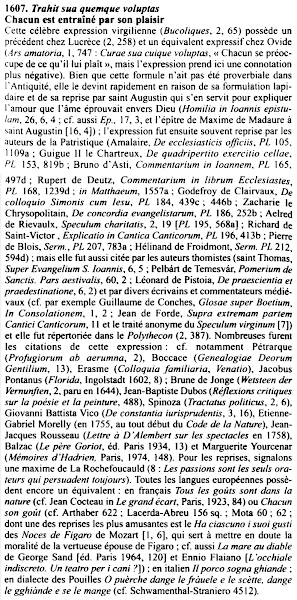
We proceed whither pleasure leads each.Vergil, Eclogues 2.65 (tr. H. Musgrave Wilkins):
progredimur quo ducit quemque voluptas.
voluptas α-RFC: voluntas Ω
Every man is attracted by his favourite pleasure.Thanks to Alan Crease for drawing my attention to a similar German proverb:
trahit sua quemque voluptas.
Jedem Tierchen sein Pläsierchen.Renzo Tosi, Dictionnaire des sentences latines et grecques, tr. Rebecca Lenoir (Grenoble: Jérôme Millon, 2010), #1607, pp. 1185-1186:

Friday, October 08, 2021
A Waste of Time
Nicolás Gómez Dávila (1913-1994), Escolios a un Texto Implicito, II (Bogotá: Instituto Colombiano de Cultura, 1977), p. 158 (my translation):
To engage in discussion with those who do not share our postulates is nothing more than a foolish way to kill time.
Dialogar con quienes no comparten nuestros postulados no es más que una manera tonta de matar el tiempo.
College Students
Grant Showerman (1870-1935), With the Professor (New York: Henry Holt and Company, 1910), pp. 84-85:
Could it be, after all, that his faith had been misplaced—that the value of education was overestimated, and greatly so? He remembered having read the assertion of an English observer to the effect that education was the great national fetich of the United States. He thought of the motley crowd in his own and other institutions with which he was acquainted—of the thousands of aimless young men and women floating along in the current of the college course simply because report had it that education was a good thing; of the thousands more who worked hard first to gain entrance and then to remain, and whose case was hopeless because of natural dullness and deficiency; of the throngs—some stupid and some talented—who were unambitious; of the idlers who came to get culture through being in the college atmosphere, and whose joys and sorrows were almost all inseparably connected with fraternity and sorority life.
Defenceless
Plato, Gorgias 486a-d (Callicles speaking; tr. Walter Hamilton, rev. Chris Emlyn-Jones):
Fragment 186:
Do not be offended, Socrates — I am speaking out of the kindness of my heart to you — aren't you ashamed to be in this plight, which I believe you to share with all those who plunge deeper and deeper into philosophy?The quotations/paraphrases are from Euripides' Antiope, here in the translation of Christopher Collard and Martin Cropp.
As things are now, if anyone were to arrest you or one of your sort and drag you off to prison on a charge of which you were innocent, you would be quite helpless — you can be sure of that; you would be in a daze and gape and have nothing to say, and when you got into court, however unprincipled a rascal the prosecutor might be, you would be condemned to death, if he chose to ask for the death penalty.
But what kind of wisdom can we call it, Socrates, this art that 'takes a man of talent and spoils his gifts', so that he cannot defend himself or another from mortal danger, but lets his enemies rob him of all his goods, and lives to all intents and purposes the life of an outlaw in his own city? A man like that, if you will pardon a rather blunt expression, can be slapped on the face with complete impunity.
Take my advice then, my good friend; 'abandon argument, practise the accomplishments of active life', which will give you the reputation of a prudent man. 'Leave others to split hairs' of what I don't know whether to call folly or nonsense; 'their only outcome is that you will inhabit a barren house.' Take for your models not the men who spend their time on these petty quibbles, but those who have a livelihood and reputation and many other good things.
καίτοι, ὦ φίλε Σώκρατες — καί μοι μηδὲν ἀχθεσθῇς· εὐνοίᾳ γὰρ ἐρῶ τῇ σῇ — οὐκ αἰσχρὸν δοκεῖ σοι εἶναι οὕτως ἔχειν ὡς ἐγὼ σὲ οἶμαι ἔχειν καὶ τοὺς ἄλλους τοὺς πόρρω ἀεὶ φιλοσοφίας ἐλαύνοντας;
νῦν γὰρ εἴ τις σοῦ λαβόμενος ἢ ἄλλου ὁτουοῦν τῶν τοιούτων εἰς τὸ δεσμωτήριον ἀπάγοι, φάσκων ἀδικεῖν μηδὲν ἀδικοῦντα, οἶσθ᾽ ὅτι οὐκ ἂν ἔχοις ὅτι χρήσαιο σαυτῷ, ἀλλ᾽ ἰλιγγιῴης ἂν καὶ χασμῷο οὐκ ἔχων ὅτι εἴποις, καὶ εἰς τὸ δικαστήριον ἀναβάς, κατηγόρου τυχὼν πάνυ φαύλου καὶ μοχθηροῦ, ἀποθάνοις ἄν, εἰ βούλοιτο θανάτου σοι τιμᾶσθαι.
καίτοι πῶς σοφὸν τοῦτό ἐστιν, ὦ Σώκρατες, “ἥτις εὐφυῆ λαβοῦσα τέχνη φῶτα ἔθηκε χείρονα”, μήτε αὐτὸν αὑτῷ δυνάμενον βοηθεῖν μηδ᾽ ἐκσῶσαι ἐκ τῶν μεγίστων κινδύνων μήτε ἑαυτὸν μήτε ἄλλον μηδένα, ὑπὸ δὲ τῶν ἐχθρῶν περισυλᾶσθαι πᾶσαν τὴν οὐσίαν, ἀτεχνῶς δὲ ἄτιμον ζῆν ἐν τῇ πόλει; τὸν δὲ τοιοῦτον, εἴ τι καὶ ἀγροικότερον εἰρῆσθαι, ἔξεστιν ἐπὶ κόρρης τύπτοντα μὴ διδόναι δίκην.
ἀλλ᾽ ὠγαθέ, ἐμοὶ πείθου, “παῦσαι δὲ ἐλέγχων, πραγμάτων δ᾽ εὐμουσίαν ἄσκει”, καὶ ἄσκει ὁπόθεν δόξεις φρονεῖν, “ἄλλοις τὰ κομψὰ ταῦτα ἀφείς”, εἴτε ληρήματα χρὴ φάναι εἶναι εἴτε φλυαρίας, “ἐξ ὧν κενοῖσιν ἐγκατοικήσεις δόμοις”· ζηλῶν οὐκ ἐλέγχοντας ἄνδρας τὰ μικρὰ ταῦτα, ἀλλ᾽ οἷς ἔστιν καὶ βίος καὶ δόξα καὶ ἄλλα πολλὰ ἀγαθά.
Fragment 186:
And how is this wise—an art that takes a naturally robust man and makes him inferior?Fragment 188:
καὶ πῶς σοφὸν τοῦτ᾿ ἐστίν, ἥτις εὐφυᾶ
λαβοῦσα τέχνη φῶτ᾿ ἔθηκε χείρονα;
No, let me persuade you! Cease this idle folly, and practise the fine music of hard work! Make this your song, and you will seem sensible, digging, ploughing the land, watching over flocks, leaving to others these pretty arts of yours which will have you keeping house in a bare home.
ἀλλ᾿ ἐμοὶ πιθοῦ·
παῦσαι ματᾴζων καὶ πόνων εὐμουσίαν
ἄσκει· τοιαῦτ᾿ ἄειδε καὶ δόξεις φρονεῖν,
σκάπτων, ἀρῶν γῆν, ποιμνίοις ἐπιστατῶν,
ἄλλοις τὰ κομψὰ ταῦτ᾿ ἀφεὶς σοφίσματα,
ἐξ ὧν κενοῖσιν ἐγκατοικήσεις δόμοις.
R
Ernst Jünger (1895–1998), Der Waldgang, § 6, tr. Thomas Friese:
 Nicolas de Chamfort (1741-1794), Maximes et Pensées:
On the other hand, through the pressure they themselves create, dictatorships open up a series of weak points that simplify and condense the possibilities for attack. Sticking with our example, even the whole sentence above ["I said no"] would not be necessary. A short "No" would suffice, because everyone whose eye it caught would know exactly what was meant. It would be a sign that the oppression had not entirely succeeded.
Symbols stand out particularly well on monotoned backgrounds. The gray expanses correlate with a concentration into a minimized space. The signs can manifest as colors, figures, or objects. Where they have an alphabetic character, the script is transformed into pictography. In the process, it gains immediate life, becomes hieroglyphic, and now, rather than explaining, it offers subject matter requiring explanation. One could further abbreviate and, in the place of "No," simply use a single letter — say, an R. This could indicate: Reflect, Reject, React, Rearm, Resist. It could also mean: Rebel.
This would be a first step out of the world of statistical surveillance and control. Yet the question at once arises if the individual is strong enough for such a venture.
Andererseits eröffnen die Diktaturen durch ihren eigenen Druck eine Reihe von Blößen, die den Angriff vereinfachen und abkürzen. So braucht man, um bei unserem Beispiel zu bleiben, nicht einmal den oben erwähnten Satz [»Ich habe Nein gesagt«]. Auch das Wörtchen »Nein« würde ausreichen, und jeder, dessen Augen darauf fielen, würde genau wissen, was es zu bedeuten hat. Das ist ein Zeichen dafür, daß die Unterdrückung nicht völlig gelungen ist.
Gerade auf eintönigen Unterlagen leuchten die Symbole besonders auf. Den grauen Flächen entspricht Verdichtung auf engstem Raum. Die Zeichen können als Farben, Figuren oder Gegenstände auftreten. Wo sie Buchstabencharakter tragen, verwandelt sich die Schrift in Bilderschrift zurück. Damit gewinnt sie unmittelbares Leben, wird hieroglyphisch und bietet nun, statt zu erklären, Stoff für Erklärungen. Man könnte noch weiter abkürzen und statt des »Nein« einen einzigen Buchstaben setzen — nehmen wir an, das W. Das könnte dann etwa heißen: Wir, Wachsam, Waffen, Wölfe, Widerstand. Es könnte auch heißen: Waldgänger.
Das wäre ein erster Schritt aus der statistisch überwachten und beherrschten Welt. Und sogleich erhebt sich die Frage, ob denn der Einzelne auch stark genug zu solchem Wagnis ist.
Almost all men are slaves, for the reason the Spartans gave to explain the servitude of the Persians, the inability to pronounce the syllable "No." Knowing how to pronounce this word and knowing how to live by oneself are the only two ways to preserve one's freedom and individuality.
Presque tous les hommes sont esclaves par la raison que les Spartiates donnaient de la servitude des Perses, faute de savoir prononcer la syllabe non. Savoir prononcer ce mot et savoir vivre seul sont les deux seuls moyens de conserver sa liberté et son caractère.
Thursday, October 07, 2021
Too Hard for the American Brain
John Jay Chapman (1862-1933), "A New Menace to Education: The Growing Contempt for Culture and the Classics in American Universities," Meredith College, Quarterly Bulletin 1919-1920: Special Education Number, pp. 1-6 (at 1, footnote omitted):
In the Year of Our Lord 2021 you can now major in Classics at Princeton University without learning bonus bona bonum.
Well, Yale has followed her sisters and dropped Latin from her entrance exams. You can get stamped as an educated Yale man without knowing bonus bona bonum.Id. (at 5-6):
And how much Latin did the American colleges ever teach? Any boy with good teaching could learn enough Latin in six months to get into an American college. And just this amount, this little smattering of Latin, is enough to make the whole difference in any man's outlook upon civilization. This bonus bona bonum makes French and Spanish and Italian easy to him. It puts him at home in half the words of the English language. It acclimates him in literature, in European travel, in South America. Almost everything an educated man has to do with is tinged with bonus bona bonum.
The tincture of Latinity which the Roman Empire left upon Europe is to modern cultivation what Christianity is to modern religion,—it pervades everything. These two elements—Latin and Christianity—taken together, make up the unity of the modern world. They form the common inheritance of modern Europe,—a sort of deep inter-racial bond, which, so far as human reason can see, is the most important thing in the life of the western world.
And now our Universities have decided that the Latin phrase-book is too hard for the American brain. It is difficult and unnecessary.
There has never been a literature in the world which did not spring from the worship of old forms, and a digging into the roots of language. It is not merely because Latin is dropped that we must grieve, but because the dropping of Latin shows that our educators do not know what learning is. They do not understand the relation which exists between language and mind. They have inherited the fruits of a whole army of American saints who planted our colleges large and small,—religious pioneers, for the most part,—but all of them students, scholars and prophets of scholarship. It was these men who gave the light to democracy. It is they who made us. They are the pit out of which we are digged. It is they who have united us to Europe and made possible the future union of mankind. For it is by our literacy we stand.The essay was originally printed in Vanity Fair (June, 1919), but Vanity Fair's owner Condé Nast now wants $8 in exchange for viewing the article. The entire issue originally cost 35 cents.
And now the successors of these spiritual Fathers of America discard the rudiments of literacy. The next generation of American college presidents will not themselves have known bonus bona bonum. If you speak to them of Rome they will be dumb.
In the Year of Our Lord 2021 you can now major in Classics at Princeton University without learning bonus bona bonum.
Wednesday, October 06, 2021
Vapula Papiria
Amy Richlin, Slave Theater in the Roman Republic: Plautus and Popular Comedy (Cambridge: Cambridge University Press, 2017), pp. 40-41 (footnote omitted):
How could a troupe of low-class actors voice a critique of the state? Or of the treatment of slaves by owners? Many have felt such a critique to be out of the question, and certainly not what was going on in the palliata. The state paid for the performances at the ludi, it is argued, and so the content of the palliata must be pro-state; the ludi served the purposes of the "elite"; the audience was restricted to slave-owning Roman citizens (an instance of dogmatic drag). A short answer is provided by an important fragment of the comedy Faeneratrix, attributed to Plautus by the first-century-BCE scholar Sinnius Capito (Festus 512L = Plautus fr. 71–3):Erasmus, Adages IV iii 1 to V ii 51. Translated and Annotated by John N. Grant and Betty I. Knott (Toronto: University of Toronto Press, 2006), pp. 111-112 (IV iv 75):"Vapula Papiria" in proverbio fuit antiquis, de quo Sinnius Capito sic refert: tum dici solitum est, cum vellent minantibus significare se eos negligere et non curare, fretos iure libertatis. Plautus in Feneratrice: "Heus tu! in barbaria quod fecisse dicitur libertus suae patronae, ideo dico <tibi>: 'Libertas salve, vapula Papiria.'" in barbaria est in Italia.Apart from what Sinnius Capito thought this meant: Plautus here expresses the idea of snapping your fingers in the face of power, but at a triple remove. A masked character says the line; he compares himself (or herself) to a freedman speaking to his patrona; the freedman is in barbaria. The character speaks the freedman's line to "you": first "Hello, liberty," then the enigmatic vapula Papiria. Whoever or whatever Papiria was, she/it is vehemently disrespected in this catchphrase. The expression libertas salve is a meta-expression of the greeting to the newly freed slave (chapter 8); vapula Papiria, satisfyingly onomatopoeic, adapts a verb that, in the first person, means "I get beat up" (so Sosia in Amphitruo), but which, as an imperative, means something like "Fuck you!" For a freedman to say it to a patrona is a marked reversal of roles; we do not know what character was addressed as "you," but it seems safe to assume the speaker is expressing defiance. The shift in person is a protective device, just like the shift in place that turns Italy into barbaria: here, but not here.
"Get beat up, Papiria" was a saying they had in the old days, on which Sinnius Capito reports as follows: "They used to say this, when they wanted to convey to people threatening them that they held them of no account and did not care, relying on the rights of liberty. So Plautus in She Charged Interest: 'Hey you! Like they say the freedman in barbarian-land did to the lady who used to own him, so I say to you: "Hello liberty; get beat up, Papiria."' 'In barbarian-land' is in Italy."
75 Vapula PapiriaSee also Marcus Deufert, Textgeschichte und Rezeption der plautinischen Komödien im Altertum (Berlin: Walter de Gruyter, 2002), pp. 109-110.
You be hanged, Papiria
'You be flogged, Papiria.' Sisinius Capito writes that this was a proverb frequently used whenever persons wanted to show that they did not pay any attention to someone else's threats. We find this only in the fragments of Festus Pompeius.1 I suspect that it originated with Papirius Praetextatus, whose mother tried to extract from him what had happened in the senate, in vain, even though she threatened a flogging.2 Therefore one should read Papiri,3 not Papiria, unless one prefers to understand lege 'law,' so that the words are a threat to inflict the punishment of the lex Papiria.4 Unless you prefer to understand it as referring to Papiria, the wife of Paulus Aemilius, who was divorced by her husband although no one could find the reason for it.5 What can one do? We must engage in conjecture when no sources can help us.
75 Pompeius Festus (see n1). Otto 1846. Added in 1515
1 Pompeius Festus 512.15-19 Lindsay. On the fragments of Festus see Adagia iv iv 52 n3 (96 above). The proverb was not preserved in Paul the Deacon's excerpts of Festus. 'Sisinius' (for 'Sinnius') is the reading in Erasmus' immediate source, the 1513 Aldine edition. Sinnius Capito was a grammarian of the late 1st century BC; see Funaioli 457-66.
2 The story is told in Aulus Gellius Noctes Atticae 1.23. While still a boy (and thus wearing the toga praetexta) the young Papirius was taken to the senate by his father. Because he refused to divulge to his mother what he had heard, he was honoured by being given the nickname 'Praetextatus.' Gellius does not say anything of the mother threatening to flog her son; it is an embellishment of Erasmus.
3 The vocative of Papirius. The proverb would then reflect what the mother allegedly said to her son.
4 The translation would be 'be flogged under the lex Papiria.' The lex Papiria, introduced by Caius Papirius Carbo in 131 or 130 BC, extended the use of the secret ballot to legislative assemblies. See T.R.S. Broughton The Magistrates of the Roman Republic (New York 1951-2) 1.502.
5 See Plutarch Aemilius 5.1-3.
Feeding the Soul of Man
John Jay Chapman (1862-1933), Learning and Other Essays (New York: Moffat, Yard and Company, 1910), pp. 20-22:
There are, then, in the modern world these two influences which are hostile to education, the influence of business and the influence of uninspired science. In Europe these influences are qualified by the vigor of the old learning. In America they dominate remorselessly, and make the path of education doubly hard. Consider how they meet us in ordinary social life. We have all heard men bemoan the time they have spent over Latin and Greek on the ground that these studies did not fit them for business,—as if a thing must be worthless if it can be neither eaten nor drunk. It is hard to explain the value of education to men who have forgotten the meaning of education: its symbols convey nothing to them.
The situation is very similar in dealing with scientific men,—at least with that large class of them who have little learning and no religion, and who are thus obliged to use the formulae of modern science as their only vehicle of thought. These men regard humanity as something which started up in Darwin's time. They do not listen when the humanities are mentioned; and if they did they would not understand. When Darwin confessed that poetry had no meaning for him, and that nothing significant was left to him in the whole artistic life of the past, he did not know how many of his brethren his words were destined to describe.
We can forgive the business man for the loss of his birthright: he knows no better. But we have it against a scientist if he undervalues education. Surely, the Latin classics are as valuable a deposit as the crustacean fossils, or the implements of the Stone Age. When science shall have assumed her true relation to the field of human culture we shall all be happier. To-day science knows that the silkworm must be fed on the leaves of the mulberry tree, but does not know that the soul of man must be fed on the Bible and the Greek classics. Science knows that a queen bee can be produced by care and feeding, but does not as yet know that every man who has had a little Greek and Latin in his youth belongs to a different species from the ignorant man. No matter how little it may have been, it reclassifies him. There is more kinship between that man and a great scholar than there is between the same man and some one who has had no classics at all: he breathes from a different part of his anatomy. Drop the classics from education? Ask rather, Why not drop education? For the classics are education. We cannot draw a line and say, 'Here we start.' The facts are the other way. We started long ago, and our very life depends upon keeping alive all that we have thought and felt during our history. If the continuity is taken from us, we shall relapse.
When we discover that these two tremendous interests—business and commerical science have arisen in the modern world and are muffling the voice of man, we tremble for the future. If these giants shall continue their subjugation of the gods, the whole race, we fear, way relapse into dumbness.
Unripe
Grant Showerman (1870-1935), With the Professor (New York: Henry Holt and Company, 1910), p. 70 (Mr. Homo to Dr. Scholarship):
You may be a scholar yet, but don't think that you must do it right away. You are not ripe for it now. What are you about, anyway, trying to write books at thirty? One might think you had some great message for the world! Bless your heart, you don't know enough yet to write anything worth putting into print! You haven't lived enough or thought enough to possess real knowledge.Related post: Forty.
Tuesday, October 05, 2021
Scholarly Fantasies
D.W. Lucas, review of Wolf H. Friedrich, Euripides und Diphilos (Munich: Beck, 1953 = Zetemata, 5), in Classical Review 5.1 (March, 1955), pp. 41-43 (at 43):
Yet in the long run it is bad for classical studies to take refuge in the convenient fallacies that nothing is ever thought of for the first time, and that things which are similar must be derived one from another....There is always a danger that scholars, baffled by the difficulties of working from inadequate data, may suit their standards of probability to their convenience and come really to think that their fantasies are scientific deductions.
Diphilus, Fragment 4
Diphilus, fragment 4 (from his comedy The Brothers; my translation):
Another translation (better than mine), from Joel Eidsath:
My dear sir, being mortal understand how to fail,J.M. Edmonds' unhelpful version:
so that you may only be unfortunate to the extent necessary,
and not receive more in addition through ignorance.
ὦ μακάρι', ἀτυχεῖν θνητὸς ὢν ἐπίστασο
ἵν' ἀυτὰ τἀναγκαῖα δυστυχῇς μόνον,
πλείω δὲ διὰ τὴν ἀμαθίαν μὴ προσλάβῃς.
Being human, learn to suffer, or you'll addAlan Sommerstein on Menander, Samia 111:
What might be better to what must be bad.
ἀυτὰ τἀναγκαῖ' 'just to the extent that was unavoidable', i.e. 'as little as possible'; cf. Diphilus fr. 4.
Another translation (better than mine), from Joel Eidsath:
Good sir, know how to take your lumps like a man, so that you'll just suffer the unavoidable, and not get more for being stupid.
Monday, October 04, 2021
Family and Hearth
Jack Kerouac, "Private Philologies," The Unknown Kerouac: Rare, Unpublished & Newly Translated Writings (New York: The Library of America, 2016), page number unknown:
 Greek θυμέλη (place of burning, hearth, altar) is related to θύω (sacrifice by burning).
Dear Mike,
Sorry I can't write more; I’ve got a class shortly, but this may be Arnold's source, since he mentions Bergmann's monograph in his footnotes. The passage is from p. 46.
 Best wishes,
Eric [Thomson]
The Latin "familia" (family) is understood to derive from "thymele"— the sacred center of fire. We learn from this everything we want to know about the origin of the family—not only the word, the sacred center of the fire, the hearth, and the family there assembled:—in raw darknesses.Kerouac got this bogus etymology from Matthew Arnold, On the Study of Celtic Literature and Other Essays (London: J.M. Dent & Sons, Ltd., 1916), p. 65:
[T]he hearth, the centre of the family, becomes the family itself, just our word family, the Latin familia, is from thymelé, the sacred centre of fire.Where Arnold got it, I don't know. See Alfred Ernout and Alfred Meillet, Dictionnaire étymologique de la langue latine, 4th ed. rev. Jacques André (Paris: Klincksieck, 2001), p. 215, s.v. famulus (whence familia):
Mots uniquement attestés dans les dialectes italiques et sans étymologie...See also Roger Henrion, "Des origines du mot familia," L'Antiquité Classique 19 (1941) 37-69 and 11.2 (1942) 253-287, and Michiel de Vaan, Etymological Dictionary of Latin and the Other Italic Languages (Leiden: Brill, 2008), pp. 200-201 (famulus):

Dear Mike,
Sorry I can't write more; I’ve got a class shortly, but this may be Arnold's source, since he mentions Bergmann's monograph in his footnotes. The passage is from p. 46.


Eric [Thomson]
No Complaining
Paul, Letter to the Philippians 2.14 (KJV):
Do all things without murmurings and disputings...
πάντα ποιεῖτε χωρὶς γογγυσμῶν καὶ διαλογισμῶν...
Prosperity Gospel
Papyri Graecae Magicae IV 2171-2177 (tr. Hubert Martin, Jr.):
Everyone will fear you; in war you will be invulnerable; when you ask you will receive; you will enjoy favor; your life will change; and you will be loved by any woman or man you have contact with. You will have honor, happiness; you will receive inheritances, have good fortune, be unaffected by potions and poison; you will break spells and conquer your enemies.
φοβηθήσεταί σε πᾶς, ἐν πολέμῳ ἄτρωτος ἔσῃ, αἰτήσας λήμψει, ἐπιχαρὴς ἔσῃ, ἀλλαχθήσῃ, ἧς δ᾽ ἂν παράψῃ γυναικὸς ἢ ἀνδρός, φιληθήσει· ἔνδοξος, μακάριος ἔσει, κληρονομίας ἕξεις, εὐτυχήσεις, φάρμακα νικήσεις, καταδέσμους ἀναλύσεις καὶ ἐχθροὺς νικήσεις.
Augustine Against Linguistic Nitpickers
Augustine, De Doctrina Christiana 2.44-46 (tr. R.P.H. Green):
[44] Translators often meet not only individual words, but also whole phrases which simply cannot be expressed in the idioms of the Latin language, at least not if one wants to maintain the usage of ancient speakers of Latin. Sometimes these translations lose nothing in intelligibility but trouble those people who take more delight in things when correct usage is observed in expressing the corresponding signs. What is called a solecism is simply what results when words are not combined according to the rules by which our predecessors, who spoke with some authority, combined them. Whether you say inter homines or inter hominibus does not matter to a student intent upon things. [45] Likewise, what is a barbarism but a word articulated with letters or sounds that are not the same as those with which it was normally articulated by those who spoke Latin before us? Whether one says ignoscere with a long or short third syllable is of little concern to someone beseeching God to forgive his sins, however he may have managed to utter the word. What, then, is correctness of speech but the maintenance of the practice of others, as established by the authority of ancient speakers? [46] But the weaker men are, the more they are troubled by such matters. Their weakness stems from a desire to appear learned, not with a knowledge of things, by which we are edified, but with a knowledge of signs, by which it is difficult not to be puffed up in some way; even a knowledge of things often makes people boastful, unless their necks are held down by the Lord's yoke.
[44] Nam non solum verba singula sed etiam locutiones saepe transferuntur quae omnino in latinae linguae usum, si quis consuetudinem veterum qui latine locuti sunt tenere voluerit, transire non possint. Quae aliquando intellectui nihil adimunt, sed offendunt tamen eos qui plus delectantur rebus cum etiam in earum signis sua quaedam servatur integritas. Nam soloecismus qui dicitur nihil est aliud quam cum verba non ea lege sibi coaptantur qua coaptaverunt qui priores nobis non sine auctoritate aliqua locuti sunt. Utrum enim inter homines an inter hominibus dicatur ad rerum non pertinet cognitorem. [45] Item barbarismus quid aliud est nisi verbum non eis litteris vel sono enuntiatum, quo ab eis qui ante nos latine locuti sunt enuntiari solet? Utrum autem ignoscere producta an correpta tertia syllaba dicatur, non multum curat qui peccatis suis deus ut ignoscat petit, quolibet modo illud verbum sonare potuerit. Quid est ergo integritas locutionis nisi alienae consuetudinis conservatio, loquentium veterum auctoritate firmatae? [46] Sed tamen eo magis inde offenduntur homines quo infirmiores sunt, et eo sunt infirmiores quo doctiores videri volunt, non rerum scientia qua aedificamur, sed signorum, qua non inflari omnino difficile est, cum et ipsa rerum scientia saepe cervicem erigat nisi dominico reprimatur iugo.
Sunday, October 03, 2021
Politics
Nicolás Gómez Dávila (1913-1994), Escolios a un Texto Implicito, II (Bogotá: Instituto Colombiano de Cultura, 1977), p. 145 (my translation):
"Politics" is the business of empty souls.
La "política" es la ocupación de las almas vacías.
Hail!
Vergil, Georgics 2.173-174 (tr. C. Day Lewis):
 Richard Jenkyns, Virgil's Experience. Nature and History: Times, Names, and Places (Oxford: Oxford University Press, 1998), pp. 367-368:
Hail, great mother of harvests! O land of Saturn, hail!The Latin words appear on this medal in honor of the bimillenary of Vergil's birth:
Mother of men!
salve, magna parens frugum, Saturnia tellus,
magna virum...

'magna parens frugum, ... magna [parens] virum'—in the parallelism between these two phrases the way that a people's identity is rooted in its native soil is more firmly than ever proclaimed. In this context 'Saturnia' is profoundly and multiply suggestive. Virgil is not asserting that the miraculous world of the golden age survives in Italy; for an Italian, after all, Saturn was a genuine native deity, not a moral or poetical symbol. He is at moments almost a 'patron saint' of Italy: Ennius already uses 'Saturnia terra' as a synonym for Italy, and when Evander in the eighth Aeneid says that 'Saturnia tellus' has often changed its name, he means that Italy has changed its name not that paradise has.75 Saturn will have suggested several things to Virgil's contemporaries. His name appears to be of Etruscan derivation; he was an agricultural deity, invoked against blight. Antiquarians (wrongly) drew the name's etymology from the root which produces 'sata' (crops). He became identified with the Greek Kronos, ruler of the gods until he was overthrown by his son Zeus, and in the Eclogues Virgil has already had him reigning in that golden age which Zeus or Jupiter destroyed; hence too the story in the Aeneid that when defeated by Jupiter he fled to Italy, establishing another kind of 'golden age' there.76
Bearing all this in mind, we can see how rich in associations his name is here. It evokes a complex of ideas: fecundity, moral virtue, national glory, numinousness, the immemorial depths of Italian history, the blessedness and changelessness of country life. Sundry phrases in lines 173-5 bring out the various aspects of the complex emotion contained within the words 'Saturnia tellus'. 'Frugum' stresses fertility, `virum' patriotic pride; the idea of motherhood in 'parens frugum' and 'parens virum' seems to suggest both the intimacy of man's link with nature, which nurtures him, and, more particularly, the strength of the tie that binds his loyalty and affections to one especial spot of earth.
75 Enn. Ann. 21 Sk; Aen. 8.329
76 Ecl. 4.6 (cf. 6.41); Aen. 8.319 ff.
Banish Vexation
Sirach 30.21-25 (tr. G.H. Box and W.O.E. Oesterley):
[21] Give not thy soul to sorrow,The same, tr. Patrick W. Skehan (with slightly different numbering):
And let not thyself become unsteadied with care.
[22] Heart-joy is life for a man,
And human gladness prolongeth days.
[23] Entice thyself and soothe thine heart,
And banish vexation from thee:
For sorrow hath slain many,
And there is no profit in vexation.
[24] Envy and anger shorten days,
And anxiety maketh old untimely.
[25] The sleep of a cheerful heart is like dainties,
And his food is agreeable unto him.
[21] Do not give in to grief
or afflict yourself with brooding;
[22] Gladness of heart is the very life of a person,
and cheerfulness prolongs his days.
[23] Distract yourself, renew your courage,
drive resentment far away from you;
For grief has brought death to many,
nor is there aught to be gained from resentment.
[24] Envy and anger shorten one's life;
anxiety brings on premature old age.
[27] One who is bright and cheery at table
benefits from his food.
Stay Put
Pseudo-Aristeas, Letter to Philocrates 249 (tr. Benjamin G. Wright III):
After declaring that he had spoken well, he asked another, "How is one a lover of his country?" "By setting as a goal," he said, "that it is good to live and die in one's own country. Being an alien brings contempt to the poor and shame to the rich, as though they were exiled due to a crime. Therefore, showing kindness to all, just as you always do — God granting you favor before all — you will appear as a lover of your country."
φήσας δὲ εὐλογεῖν ἄλλον ἠρώτα πῶς ἂν φιλόπατρις εἴη; προτιθέμενος, εἶπεν, ὅτι καλὸν ἐν ἰδίᾳ καὶ ζῇν καὶ τελευτᾷν. ἡ δὲ ξενία τοῖς μὲν πένησι καταφρόνησιν ἐργάζεται, τοῖς δὲ πλουσίοις ὄνειδος, ὡς διὰ κακίαν ἐκπεπτωκόσιν. εὐεργετῶν οὖν ἅπαντας, καθὼς συνεχῶς τοῦτ᾽ ἐπιτελεῖς, θεοῦ διδόντος σοὶ πρὸς πάντα χάριν, φιλόπατρις φανήσῃ.
Saturday, October 02, 2021
A Blessed Death
Pliny the Elder, Natural History 7.53.184 (tr. H. Rackham):
Cf. Philodemus, On Death, column 4, lines 10-11 (tr. W. Benjamin Henry):
Cornelius Gallus, ex-praetor, and Titus Hetereius Knight of Rome died while with women.Rackham's translation verges on euphemism. What were the men doing with the women? There is a more accurate rendering in The Elder Pliny on the Human Animal: Natural History, Book 7. Translated with Introduction and Historical Commentary by Mary Beagon (Oxford: Clarendon Press, 2005), p. 99:
Cornelius Gallus praetorius et T. Hetereius Eques Romanus in venere obiere.
The ex-praetor Cornelius Gallus died while making love, as did T. Hetereius, a Roman knight.Beagon's note on p. 409:
Ovid's ideal end, according to Am. 2.10.29–36. Montaigne added to Pliny's list at this point 'Tigillinus, Captaine of the Romans Watch, Lodowicke, sonne of Guido Gonzaga, Marquis of Mantua. . . . And of a farre worse example, Speusippus the Platonian philosopher and one of our Popes . . .' (Essays 1.xix, trans. J. Florio). Tigellinus' death was in fact a forced suicide rather than a sudden collapse (Tac. Hist. 1.72), but committed 'in the midst of his concubines' embraces and kisses'. Montaigne's version of Speusippus' death seems to go back no further than a polemical passage of Tertullian attacking pagan philosophers (Apol. 46).M.A. Screech says that the lecherous Pope was Clement V, but Pierre Michel in the Gallimard edition of Montaigne says it was John XXII (a mistake for John XII?).
Cf. Philodemus, On Death, column 4, lines 10-11 (tr. W. Benjamin Henry):
...as dying with pleasure those expiring during sexual intercourse...Related post: Planting Cabbages.
...ὡς μεθ' ἡδονῆς τελευτῶντας τοὺς ἐν τῷ συνουσιάζειν...
Friday, October 01, 2021
Incapable of Enjoyment
Philodemus, On Anger, column 25, lines 22-35 (tr. David Armstrong and Michael McOsker; the Greek simplified by the removal of brackets etc.):
They cannot even enjoy a public spectacle because of their anger, or a bath or drinking party or a trip with any sort of people whatever or any of the things considered pleasurable, but in everything their irritations are mixed in because of a nod, a whisper, a laugh, or a reminder of the things over which they were enraged by someone...
ἡδεῖα δ' αὐτοῖς οὐδὲ θέα γίνεται διὰ τὴν ὀργήν, οὔτε λουτρὸν οὔτε συμπόσιον οὔτε ἀποδημία μεθ' ὡνδήποτε ἀνθρώπων οὔτε ἄλλο τῶν ἐπιτερπῶν εἶναι δοκούντων οὐδέν, ἀλλὰ πάντα παραμισγομένων τῶν ἐρεθισμῶν διὰ νεῦμα καὶ ψιθυρισμὸν καὶ γέλωτα καὶ τῶν ἐφ' οἷς ἐθυμώθησαν ὑπό τινος ἀνάμνησιν...
Kinship
Arrian, Discourses of Epictetus 3.3.5 (tr. W.A. Oldfather):
That is why the good is preferred above every form of kinship. My father is nothing to me, but only the good.A repellent doctrine, to place an abstraction above one's own flesh and blood. Cf. Plato, Euthyphro, Matthew 12.46-49, Mark 3.31-35, Luke 8.19-21, etc.
διὰ τοῦτο πάσης οἰκειότητος προκρίνεται τὸ ἀγαθόν. οὐδὲν ἐμοὶ καὶ τῷ πατρί, ἀλλὰ τῷ ἀγαθῷ.
Excuse for Lying
Sophocles, Philoctetes 108-109 (tr. David Grene):
NEOPTOLEMUS
Do you not find it shameful to tell lies?
ODYSSEUS
Not if the lying brings our rescue with it.
ΝΕΟΠΤΟΛΕΜΟΣ
οὐκ αἰσχρὸν ἡγῇ δῆτα τὸ ψευδῆ λέγειν;
ΟΔΥΣΣΕΥΣ
οὔκ, εἰ τὸ σωθῆναί γε τὸ ψεῦδος φέρει.
108 δῆτα τὸ Vauvilliers: δὴ τάδε vel δῆτα τὰ codd.
Thursday, September 30, 2021
The Insurrection
Charles Nicholl, The Reckoning: The Murder of Christopher Marlowe (New York: Harcourt Brace & Company, 1992), p. 147 (on the Babington Plot):
It is hard to say exactly when the 'plot' took shape. In a sense it never did. There was a lot of wild talk — heads filled with wine, with dreams of Catholic rebellion, with an overheated, cultish devotion to the imprisoned Queen Mary — but what shape it had in terms of real action was largely provided by the government itself, whose agents infiltrated the conspiracy not so much to destroy it, as to encourage it. In the words of a priest named Davis, who was with Babington on the night before his capture, the plot was a 'tragedy', in which 'the chief actor and contriver' was Sir Francis Walsingham. This is a partisan view, but on the evidence it is true enough. The Babington affair was a classic piece of Walsingham 'projection': a piece of political theatre, conjured up for reasons of cynical expediency.
The Future Revisited
[Update on The Future.]
Dear Mike,
Carlo Levi, Christ Stopped at Eboli, tr. Frances Frenaye (New York: Time Incorporated, 1964), p. 215:
I’d like to be able to say, to paraphrase Housman, that I knew at once that Levi had not written prescrai and in another moment I had found the true word. In fact it’s in reading the following two words in the series, pescrille and pescruflo, that the doubt arises, as the root prefix post in post + cras would be likely to evolve into poscrai or pescrai rather than prescrai.
My copy of Cristo si è fermato a Eboli (Torino: Enaudi, 1945, 1963, 1990), pp. 184-185, does print pescrai (‘Crai è domani, e sempre; ma il giorno dopo domani è pescrai e il giorno dopo ancora é pescrille; poi viene pescruflo, e poi maruflo e maruflone; ed il settimo giorno è maruflicchio’) but the misprint prescrai, if that’s what it is, and not a dialectal variant, must have occurred in the first printing, that used perhaps by Frenaye, since the [sic!] in the following otherwise makes little sense.
After a reprint of his essay ‘Crai e Poscrai o Poscrilla Posquaccherra’ in Romanische Literaturstudien: 1936–1956 (Tübingen: Max Niemeyer Verlag, 1959), pp. 597-612, Leo Spitzer supplies an Addition (pp. 612-13):
Eric [Thomson]
Dear Mike,
Carlo Levi, Christ Stopped at Eboli, tr. Frances Frenaye (New York: Time Incorporated, 1964), p. 215:
Crai meant tomorrow and forever; the day after tomorrow was prescrai and the day after that pescrille; then came pescruflo, maruflo, maruflone; the seventh day was maruflicchio.Frances Frenaye's translation was first published by Farrar, Straus and Company in 1947. I have it as republished by Penguin in 1982, where the sentence appears exactly as above on p. 200.
I’d like to be able to say, to paraphrase Housman, that I knew at once that Levi had not written prescrai and in another moment I had found the true word. In fact it’s in reading the following two words in the series, pescrille and pescruflo, that the doubt arises, as the root prefix post in post + cras would be likely to evolve into poscrai or pescrai rather than prescrai.
My copy of Cristo si è fermato a Eboli (Torino: Enaudi, 1945, 1963, 1990), pp. 184-185, does print pescrai (‘Crai è domani, e sempre; ma il giorno dopo domani è pescrai e il giorno dopo ancora é pescrille; poi viene pescruflo, e poi maruflo e maruflone; ed il settimo giorno è maruflicchio’) but the misprint prescrai, if that’s what it is, and not a dialectal variant, must have occurred in the first printing, that used perhaps by Frenaye, since the [sic!] in the following otherwise makes little sense.
After a reprint of his essay ‘Crai e Poscrai o Poscrilla Posquaccherra’ in Romanische Literaturstudien: 1936–1956 (Tübingen: Max Niemeyer Verlag, 1959), pp. 597-612, Leo Spitzer supplies an Addition (pp. 612-13):
My former pupil A.F. Engel brings to my attention the following passage in Carlo Levi's book Cristo si e fermato a Eboli (Torino 1946), p. 190: “Tutto il domani [... ]. Crai e domani, e sempre ; ma il giorno dopo domani prescrai [sic!] e il giorno dopo ancora [...]."Best wishes,
This passage may have a double interest for us: not only because the particular series of terms chosen by the community (Gagliano in Lucania) to list the seven days that constitute the 'eternal morrow,' offers variations of the standard pattern (notice the predominance of formations with the -uflo suffix), but mainly because the Italian novelist is testifying to that very stylistic nuance I have postulated in my article for this series of nonce-words ("a thrust into the void . . . a thrust of whose phantastic superfluity the coiner [of the terms] remains conscious"; a "world-world" etc.). The author would give us to understand that in that particular region of Lucania which is 'severed from Time and History' it is in language alone that distinctions exist which have no corresponding reality in the actual lives of the speakers.
Eric [Thomson]
Wednesday, September 29, 2021
I Was Just Following Orders
Sophocles, Philoctetes 6 (Odysseus speaking; tr. Hugh-Lloyd-Jones):

...on the orders of those in command...Lloyd-Jones omitted τόδ᾽ ἔρδειν in his translation, as he was perfectly entitled to do, but because I value a literal translation above all:
...ταχθεὶς τόδ᾽ ἔρδειν τῶν ἀνασσόντων ὕπο...
...ordered to do this by those in command...Or, in Jebb's translation:
...having charge from my chiefs so to do...Jean-Baptiste Carpeaux (1827-1875), Philoctète dans l'île de Lemnos (Musée des Beaux-Arts de Valenciennes):

Profusio
J.M.C. Toynbee (1897-1985), Death and Burial in the Roman World (1971; rpt. Baltimore: The Johns Hopkins University Press, 1996), pp. 51-52, with notes on p. 292:
 Maureen Carroll, Spirits of the Dead: Roman Funerary Commemoration in Western
Europe (Oxford: Oxford University Press, 2006), p. 72, figure 24:
Related post: The Thirsty Dead.
Throughout the year there were occasions on which the dead were commemorated by funerary meals eaten at the tomb by their relatives and friends—on their birthdays and when the annual festivals of the dead were celebrated (see pp. 61-4). The mausolea of the well-to-do often contained chambers for this purpose, sometimes equipped with kitchens (see Chapter V(G), p. 136). At all of these banquets, as at those held at the time of a death, the departed had their share set apart for them. Their disembodied spirits, it was thought, could somehow partake of the fare with which they were thus provided and, indeed, be nourished through the medium of their bones or ashes (cf. p. 37). Hence the fact that graves, whether for inhumation or for cremation, with holes or pipes through which food and drink could be poured down directly on to the burial (profusio), so as to reach the remains, are a not uncommon feature of cemeteries in very diverse areas of the Roman world. For example, in the necropolis excavated under St Peter's in Rome several instances have come to light. In Tomb F, inset into the border of a mosaic pavement, is a series of small, square marble slabs each pierced with a hole for pouring sustenance down on to the dead beneath; and there are similar holes in the mosaic pavement of Tomb C.183 In the floor of Tomb O there is a marble roundel pierced by four holes;184 and Grave γ, a child's inhumation burial of Hadrianic date, near the reputed tomb of St Peter, contained a terracotta coffin, partly encased in a rectangular block of masonry, which was penetrated by a vertical tube for pouring.185 Another child's inhumation burial, this time at Syracuse and with the bones laid directly in the earth under tiles set gable-wise, was connected with the surface by a vertical terracotta pipe, closed at the top by a movable stone stopper.186 A small stone, oblong chest from Faleroni, in Italy, containing a cremation burial and grave-goods in the form of glass vessels, ornaments, and so forth, bears in the centre of its lid a vertical leaden pipe.187 Among provincial examples are a lead sarcophagus for inhumation found at Colchester, near one end of the lid of which is a lead pipe passing down into the interior, where vessels of glass and pottery accompanied the bones;188 and a cremation burial from Caerleon in Monmouthshire.189 In the latter case the tomb consists of a horizontal slab of stone carrying a packing of rammed earth, on which stands a circular lead canister that contained the remains. The canister is walled round by slabs of stone; and between one wall and the slab that covers the canister is a lead pipe that leads down from the surface into the inside of the vessel (cf. pp. 37, 41, 101, 123). (Pl. 14)Id., plate 14 on p. 32:
183 J.M.C. Toynbee and J.B. Ward Perkins, The Shrine of St Peter and the Vatican Excavations, 1956, p. 61, n. 30
184 Ibid., pp. 118-19, n. 2, xviii
185 Ibid., pp. 145-6 and fig. 13
186 Notizie degli Scavi di Antichità, 1913, pp. 272-3, fig. 5; Antiquaries Journal, ix, 1929, pp. 4-6, fig. 5
187 Notizie degli Scavi di Antichità, 1921, pp. 191-5, fig. 8; Antiquaries Journal, ix, 1929, p. 4 and pl. 1, fig. 2. For examples of this practice in the cemeteries of Pompeii, see H. Mau-F.W. Kelsey, Pompeii, its Life and Art, 1899, pp. 417, 421-2, 427
188 Antiquaries Journal, ix, 1929, pp. 4, s, fig. 4
189 Ibid., pp. 1-3, fig. 3 and pl. 1, fig. 1. For further examples, see R. Cagnat and U. Chapot, Manuel d'archéologie romaine, i, 1916, pp. 340-1; Festschrift August Oxé, 1938, pp. 197-204
The Oxford Latin Dictionary, s.v. profusio, sense 1 ("The pouring out [of wine, etc.] in religious ceremonies, libation") cites only inscriptions for this meaning (CIL 5.4990; 10.107). Thanks to Kevin Muse for sending the relevant definition of the word from the Thesaurus Linguae Latinae:Above, cremation burial from Caerleon. The ashes are in a lead canister, walled and roofed by stone slabs, into which a lead libation pipe leads down from the surface (p. 52).


Libation tube made of a recycled box tile and covered with a flat tile above a cremation burial of the 2nd century ad at Vindolanda at three stages of excavation. The Vindolanda Trust
Related post: The Thirsty Dead.
Tuesday, September 28, 2021
The Future
Carlo Levi, Christ Stopped at Eboli, tr. Frances Frenaye (New York: Time Incorporated, 1964), p. 215:
The entire future, as far as the end of the world, was merging for me too into the vague crai of the peasants, with its implications of futile endurance, remote from history and time. How deceiving are the contradictions of language! In this timeless land the dialect was richer in words with which to measure time than any other language; beyond the motionless and everlasting crai every day in the future had a name of its own. Crai meant tomorrow and forever; the day after tomorrow was prescrai and the day after that pescrille; then came pescruflo, maruflo, maruflone; the seventh day was maruflicchio. But these precise terms had an undertone of irony. They were used less often to indicate this or that day than they were said all together in a string, one after the other; their very sound was grotesque and they were like a reflection of the futility of trying to make anything clear out of the cloudiness of crai. I, too, began to lose hope that anything new might come forth from maruflo or maruflone or maruflicchio.See update here.
A Rule of Thumb
Nicolás Gómez Dávila (1913-1994), Escolios a un Texto Implicito, II (Bogotá: Instituto Colombiano de Cultura, 1977), p. 140 (my translation):
The importance of an event is inversely proportional to the space the newspapers devote to it.The more space, the less importance.
La importancia de un acontecimiento es inversamente proporcional al espacio que le dedican los periódicos.
A Parallel?
Philodemus, On Anger, column 20, lines 21-24 (tr. David Armstrong and Michael McOsker; the Greek simplified by the removal of brackets):
...and make up things that have not happened and magnify things not worthy of any mention...This seems similar to Seneca, On Anger 3.12.1 (tr. John W. Basore):
...καὶ πλάττειν τὰ μὴ γεγονότα καὶ τὰ μηδενὸς ἄξια λόγου μεγαλύνειν...
A great many manufacture grievances either by suspecting the untrue or by exaggerating the trivial.The similarity isn't mentioned in Philodemus, On Anger. Introduction, Greek Text, and Translation by David Armstrong and Michael McOsker (Atlanta: SBL Press, 2020), p. 227.
magna pars querellas manu fecit aut falsa suspicando aut levia adgravando.
Monday, September 27, 2021
The Age of Wisdom
Greek Anthology 5.112 (by Philodemus; tr. David Sider):
 For τί in the first line read τίς.
I fell in love. Who hasn't? I reveled. Who is not an initiate of revels? But whose fault is it I went mad? A god's, isn't it?I noticed a misprint in the Greek for this poem in David Sider, ed., The Epigrams of Philodemos: Introduction, Text, and Commentary (New York: Oxford University Press, 1997), p. 78 (page scan):
Let it go, for already grey hair rushes in to take the place of black—grey hair the proclaimer of the age of wisdom.
And when it was right to play we played; and since it is right no longer, we shall lay hold of loftier thoughts.
ἠράσθην. τίς δ᾽ οὐχί; κεκώμακα. τίς δ᾽ ἀμύητος
κώμων; ἀλλ᾽ ἐμάνην ἐκ τίνος; οὐχὶ θεοῦ;
ἐρρίφθω, πολιὴ γὰρ ἐπείγεται ἀντὶ μελαίνης
θρὶξ ἤδη, συνετῆς ἄγγελος ἡλικίης.
καὶ παίζειν ὅτε καιρός, ἐπαίξαμεν· ἡνίκα καὶ νῦν 5
οὐκέτι, λωϊτέρης φροντίδος ἁψόμεθα.

Labels: typographical and other errors
A Mark of the Wise Man
Epicurus, fragment 570 Usener (from Diogenes Laertius 10.120; tr. R.D. Hicks):
He will be fond of the country.Usener ad loc.:
φιλαγρήσειν [sc. τὸν σοφὸν Ἐπικούρῳ δοκεῖ].
amabat Ep. rusticationem aeque atque Horatius (cf. praecipue ep. I 10, 12 sqq.) et Vergilius (georg. II 458 sqq.), uide etiam fr. 571Here is fragment 571 Usener (from Lactantius, Divine Institutes 3.17.5; tr. Mary Francis McDonald):
For one fleeing the crowd solitude is praised.
fugienti turbam solitudo laudatur [sc. ab Epicuro].
Anti-Immigrant Sentiment
Charles Nicholl, The Reckoning: The Murder of Christopher Marlowe (New York: Harcourt Brace & Company, 1992), pp. 39-40:
In these times people look for a scapegoat, and chief among these were the city's immigrant traders — Dutch, Belgian, French: Protestant refugees from the battle-grounds of Europe. 'The common people do rage against them,' wrote one observer, 'as though for their sakes so many taxes, such decay of traffic, and their being embrandled in so many wars, did ensue.' London's traders and shop-keepers felt particularly threatened. The foreigners, they protested, 'contented not themselves with manufactures and warehouses, but would keep shops, and retail all manner of goods.' As well as taking business from the locals, the immigrants had a reputation for stinginess. Thirty years ago, wrote John Stow, the parish of Billingsgate levied £27 per annum 'for the help of the poor'. Now the area is full of 'Netherlanders', and 'since they came so plentifully thither, there cannot be gathered above £11, for the stranger will not contribute to such charges as other citizens do'.
Several petitions were signed against the 'strangers', but these seem to have been ignored. The official line was that the immigrants were bona fide refugees and Protestant allies, and that they benefited the economy. On 21 March 1593 the House of Commons voted to extend the privileges of resident aliens. A lone voice of dissent came from Sir Walter Ralegh. 'I see no reason that so much respect should be given unto them,' he said. 'In the whole cause I see no matter of honour, no matter of charity, no profit in relieving them.'
On the streets, more militant action began. Some time shortly before Easter Day, 15 April 1593, a 'placard' was nailed up, threatening that the apprentices of London would soon 'attempt some violence on the strangers'. On Easter Monday, the Privy Council met at St James's Palace, and drew up a letter to the Lord Mayor of London, Sir Cuthbert Buckle, expressing their concern about this 'vile ticket or placard'. They understood that an arrest had already been made. The suspect should be examined about his 'meaning and purpose' in the writing. He should be 'punished by torture', if necessary, to make him talk.
The Council feared that more was to come — 'oftentimes it doth fall out of such lewd beginnings that further mischief doth ensue' — and so it proved. During the following week, further 'libels' were posted up. One of these was addressed to the 'beastly brutes the Belgians', the 'faint-hearted Flemings', and the 'fraudulent Father Frenchmen'. It accuses them of 'cowardly flight' from their home countries, of 'hypocrisy and counterfeit shew of religion'. It complains that the Queen allows them 'to live here in better case and more freedom than her own people'. It demands that they quit the country within three months. If not,There shall be many a sore stripe. Apprentices will rise to the number of 2336, and all the apprentices and journeymen will down with the Flemings and Strangers.The Queen was informed, and on 22 April the Council set up a special five-man commission under Dr Julius Caesar. Caesar, the son of an Italian physician, was Master of the Court of Requests: a trusted legal figure. The commission's brief was to 'examine by secret means who may be authors of the said libels'. The emphasis was on a more covert, 'secret' approach. Two of the commissioners — William Waad and Thomas Phelippes — were old hands from the Walsingham intelligence service.
The authorities also ordered a 'strict account' to be taken of the immigrant population in London. The certificates, returned on 4 May, show the number of foreigners in London, including children and servants, to be 4,300. Of these 237 were 'denizens' (property-owning foreigners granted certain rights). Overall the immigrants represented little more than 2 per cent of the city's population, though in some areas considerably more. Many were now planning to leave, terrified by this violent 'commotion' against them.
Sunday, September 26, 2021
Vergil the Prophet
Vergil, Eclogues 1.71 (tr. Guy Lee):
These cornfields a barbarian [sc. will own].
barbarus has segetes [sc. habebit].
Saturday, September 25, 2021
The Complete Man
Michel Onfray, A Hedonist Manifesto, tr. Joseph McClellan (New York: Columbia University Press, 2015), page number unknown (from the Preface):
The complete man not only shows that he can distinguish between an accusative and an ablative, he also excels at the lathe and the jointer.
L'homme parachevé montre qu'il distingue un accusatif d'un ablatif, mais en même temps il excelle au tour ou à la varlope.
Behold, I Stand at the Door and Knock

Manufacturing Grievances
Seneca, On Anger 3.12.1 (tr. John W. Basore):
A great many manufacture grievances either by suspecting the untrue or by exaggerating the trivial.
magna pars querellas manu fecit aut falsa suspicando aut levia adgravando.
Understanding Current Events
William Shakespeare, The Tempest I.ii.214-215:
Hell is empty,
And all the devils are here!
Friday, September 24, 2021
More on the Etymology of Anthropos
Dear Mike,
"I don't know where Durrell came across the etymology."
One possibility might be Benjamin Jowett's translation of Plato's Cratylus 399c (Socrates speaking, Greek transliterated):
 Best wishes,
Eric [Thomson]
Cf. also Isidore of Seville, Etymologies 11.1.5 (tr. Stephen A. Barney et al.):
"I don't know where Durrell came across the etymology."
One possibility might be Benjamin Jowett's translation of Plato's Cratylus 399c (Socrates speaking, Greek transliterated):
I mean to say that the word 'man' implies that other animals never examine, or consider, or look up at what they see, but that man not only sees (opope) but considers and looks up at that which he sees, and hence he alone of all animals is rightly anthropos, meaning anathron a opopen.Here's another suggestion for the etymology, whether outlandish or not, from Gregory Nagy (Greek Mythology and Poetics, pp. 151-152, n. 30):
ὧδε. σημαίνει τοῦτο τὸ ὄνομα ὁ 'ἄνθρωπος' ὅτι τὰ μὲν ἄλλαθηρία ὧν ὁρᾷ οὐδὲν ἐπισκοπεῖ οὐδὲ ἀναλογίζεται οὐδὲ ἀναθρεῖ, ὁ δὲ ἄνθρωπος ἅμα ἑώρακεν — τοῦτο δ᾽ ἐστὶ τὸ 'ὄπωπε' — καὶ ἀναθρεῖ καὶ λογίζεται τοῦτο ὃ ὄπωπεν. ἐντεῦθεν δὴ μόνον τῶνθηρίων ὀρθῶς ὁ ἄνθρωπος 'ἄνθρωπος' ὠνομάσθη, ἀναθρῶν ἃ ὄπωπε.


Eric [Thomson]
Cf. also Isidore of Seville, Etymologies 11.1.5 (tr. Stephen A. Barney et al.):
The Greeks called the human being ἄνθρωπος because he has been raised upright from the soil and looks upward in contemplation of his Creator (perhaps cf. ὦψ, "eye, face, countenance"). The poet Ovid describes this when he says (Met. 1.84):The parenthetical remark about ὦψ is an interpolation of the translators. Here is the original, from W.M. Lindsay's edition:While the rest of the stooping animals look at the ground, he gave the human an uplifted countenance, and ordered him to see the sky, and to raise his upturned face to the stars.
Graeci autem hominem ἄνθρωπον appellaverunt, eo quod sursum spectet sublevatus ab humo ad contemplationem artificis sui. Quod Ovidius poeta designat, cum dicit (Metam. 1,84):Pronaque cum spectent animalia cetera terram,
os homini sublime dedit caelumque videre
iussit et erectos ad sidera tollere vultus.
To a Wine-Jar
Horace, Odes 3.21 (tr. Robert J.M. Lindsay):
 Greek Anthology 5.134 (by Posidippus; tr. W.R. Paton):
Newer› ‹Older
O wine-jar, born — like me — when ManliusAnother translation, by Anthony Hecht:
Was consul, whether plaints you bring or jest
Or quarreling or insane love-affairs
Or else (kind-hearted jar) just easy rest:
Under whatever name you guard choice Massic
Fit to be broached upon some day benign —
Out of the store! Corvinus gives the order
To bring forth draughts of longer-standing wine.
Although he's soaked in Socrates' discourses,
A cup from you he'll not rudely disdain:
It's said that many a time old Cato's valour
By unslaked cups was heated into flame.
You gently coax the unresponsive spirit;
Unseal the problems of philosophy
And all the wise men's arcane speculations
With drink that sets the human spirit free!
You bring back hope and strength to human hearts,
And on the poor bestow the horns of power;
No longer now before kings' angry crowns
Nor before soldiers' weapons does he cower.
Bacchus shall hold you here, jar; Venus, too,
If she her joyful presence will display;
The graces, slow to break their knot; bright torches;
Till dawn, when Phoebus drives the stars away.
O nata mecum consule Manlio,
seu tu querelas sive geris iocos
seu rixam et insanos amores
seu facilem, pia testa, somnum,
quocumque lectum nomine Massicum 5
servas, moveri digna bono die,
descende, Corvino iubente
promere languidiora vina.
non ille, quamquam Socraticis madet
sermonibus, te negleget horridus: 10
narratur et prisci Catonis
saepe mero caluisse virtus.
tu lene tormentum ingenio admoves
plerumque duro; tu sapientium
curas et arcanum iocoso 15
consilium retegis Lyaeo;
tu spem reducis mentibus anxiis,
virisque et addis cornua pauperi
post te neque iratos trementi
regum apices neque militum arma. 20
te Liber et, si laeta aderit, Venus
segnesque nodum solvere Gratiae
vivaeque producent lucernae,
dum rediens fugat astra Phoebus.
O mise-en-bouteille in the very year of my birthWine from Horace's birthplace, Venusia:
And Manlius' consulship, celestial spirits,
Instinct with ardors, slugfests, the sighs of lovers,
Hilarity and effortless sleep, whatever,
Campanian harvest, well-sealed special reserve
For some fine and festive holiday, descend
From your high cellarage, since my friend, Corvinus,
A connoisseur, has called for a more mature wine.
Soaked though he be in vintage Socratic wisdom,
He's not going to snub you. For even Cato the Elder,
All Roman rectitude, would warm to a drink.
You limber the dullard's faculties with your proddings;
With Bacchus the Trickster you break through careful discretion,
Making even the politic say what they mean.
You resurrect hope in the most dejected of minds;
To the poor and weak you lend such measure of courage
As after a single gulp allays their palsy
When faced with the wrath of monarchs, or unsheathed weapons.
Bacchus and Venus (if she will condescend),
The arm-linked Graces in unclad sorority,
And vigil lamps will honor you all night long
Till Phoebus, with punctual bustle, banishes starlight.

Shower on us, O Attic jug, the dewy rain of Bacchus; shower it and refresh our merry picnic. Let Zeno, the learned swan, be kept silent, and Cleanthes' Muse, and let our converse be of Love the bitter-sweet.
Κεκροπί, ῥαῖνε, λάγυνε, πολύδροσον ἰκμάδα Βάκχου,
ῥαῖνε· δροσιζέσθω συμβολικὴ πρόποσις.
σιγάσθω Ζήνων, ὁ σοφὸς κύκνος, ἅ τε Κλεάνθους
Μοῦσα· μέλοι δ᾽ ἡμῖν ὁ γλυκύπικρος Ἔρως.

