Tuesday, May 17, 2022
Eyewitness
Dio Cassius 73.18.3-4 (on Commodus; tr. Earnest Cary):
And let no one feel that I am sullying the dignity of history by recording such occurrences. On most accounts, to be sure, I should not have mentioned this exhibition; but since it was given by the emperor himself, and since I was present myself and took part in everything seen, heard and spoken, I have thought proper to suppress none of the details, but to hand them down, trivial as they are, just like any events of the greatest weight and importance. And, indeed, all the other events that took place in my lifetime I shall describe with more exactness and detail than earlier occurrences, for the reason that I was present when they happened and know no one else, among those who have any ability at writing a worthy record of events, who has so accurate a knowledge of them as I.
καὶ μή μέ τις κηλιδοῦν τὸν τῆς ἱστορίας ὄγκον, ὅτι καὶ τὰ τοιαῦτα συγγράφω, νομίσῃ. ἄλλως μὲν γὰρ οὐκ ἂν εἶπον αὐτά· ἐπειδὴ δὲ πρός τε τοῦ αὐτοκράτορος ἐγένετο καὶ παρὼν αὐτὸς ἐγὼ καὶ εἶδον ἕκαστα καὶ ἤκουσα καὶ ἐλάλησα, δίκαιον ἡγησάμην μηδὲν αὐτῶν ἀποκρύψασθαι, ἀλλὰ καὶ αὐτά, ὥσπερ τι ἄλλο τῶν μεγίστων καὶ ἀναγκαιοτάτων, τῇ μνήμῃ τῶν ἐσέπειτα ἐσομένων παραδοῦναι. καὶ μέντοι καὶ τἆλλα πάντα τὰ ἐπ᾽ ἐμοῦ πραχθέντα καὶ λεπτουργήσω καὶ λεπτολογήσω μᾶλλον ἢ τὰ πρότερα, ὅτι τε συνεγενόμην αὐτοῖς, καὶ ὅτι μηδένα ἄλλον οἶδα τῶν τι δυναμένων ἐς συγγραφὴν ἀξίαν λόγου καταθέσθαι διηκριβωκότα αὐτὰ ὁμοίως ἐμοί.
The Secret of Happiness
The Diaries of Evelyn Waugh, ed. Michael Davie (1976; rpt. Harmondsworth: Penguin, 1979), p. 787 (March 9, 1962):
Abjuring the realm. To make an interior act of renunication and to become a stranger in the world; to watch one's fellow-countrymen, as one used to watch foreigners, curious of their habits, patient of their absurdities, indifferent to their animosities—that is the secret of happiness in this century of the common man.
Monday, May 16, 2022
Hymn to Rome
Melinno, Hymn to Rome (tr. Andrew Erskine):
Hail, Roma, daughter of Ares, warlike mistress with a girdle of gold, who has as a dwelling place on earth holy Olympus forever unshaken.Another translation, by Matthew Dillon and Lynda Garland:
To you alone, most esteemed one, Fate has given the royal glory of everlasting rule so that you may govern with lordly might.
By your yoke with its strong straps the breasts of the earth and the grey sea are bound fast. With a sure hand you steer the cities of men.
Almighty time overturns everything and moulds life this way and that. It is only in your case that it does not change the favourable wind which maintains your rule.
Certainly, out of all people you alone bring forth the strongest men, great warriors as they are, just as if producing the crop of Demeter from the land.
χαῖρέ μοι, ῾Ρώμα, θυγάτηρ Ἄρηος,
χρυσεομίτρα δαΐφρων ἄνασσα,
σεμνὸν ἃ ναίεις ἐπὶ γᾶς ῎Ολυμπον
αἰὲν ἄθραυστον.
σοὶ μόνᾳ, πρέσβιστα, δέδωκε Μοῖρα 5
κῦδος ἀρρήκτω βασιλῇον ἀρχᾶς,
ὄφρα κοιρανῇον ἔχοισα κάρτος
ἀγεμονεύῃς.
σᾷ δ' ὐπὰ σδεύγλᾳ κρατερῶν λεπάδνων
στέρνα γαίας καὶ πολιᾶς θαλάσσας 10
σφίγγεται· σὺ δ' ἀσφαλέως κυβερνᾷς
ἄστεα λαῶν.
πάντα δὲ σφάλλων ὁ μέγιστος αἰὼν
καὶ μεταπλάσσων βίον ἄλλοτ' ἄλλως
σοὶ μόνᾳ πλησίστιον οὖρον ἀρχᾶς 15
οὐ μεταβάλλει.
ἦ γὰρ ἐκ πάντων σὺ μόνα κρατίστους
ἄνδρας αἰχματὰς μεγάλους λοχεύεις
εὔσταχυν Δάματρος ὅπως ἀνεῖσα
καρπὸν †ἀπ' ἀνδρῶν. 20
20 ἀπ' ἀγρῶν Bergk: ἄρουρα Bücheler
Hail, Roma, daughter of Ares,Scholars differ about the hymn's literary worth. Contrast W.A. Oldfather, "Melinno," in RE XV/1 (1931) 521-523 (at 522):
Golden-crowned warrior queen
You who live on earth on holy Olympus,
For ever indestructible.
To you alone, most revered one, has Fate 5
Granted royal glory of unbreakable dominion,
So that, with your sovereign power,
You might lead the way.
Under your yoke of strong leather straps,
The chests of earth and grey sea 10
Are tightly bound together; with firm hand you govern
The cities of your peoples.
The longest eternity, which overthrows everything
And shapes the course of life first in this way, then in that,
For you alone does not change the wind 15
Which fills the sails of empire.
Indeed, out of all, you alone give birth to
Strong men, wielders of spears,
Sending forth a well-aiming crop of men
Like the fruits of Demeter. 20
Mir scheint es genau so gut als der grössere Teil von Horaz' Liedern, besonders Carmen Saeculare und die politischen Oden überhaupt, und der gewönliche Poeta Laureatus dürfte stolz auf eine ebenso gelungene Leistung sein.with Hugh Lloyd-Jones and Peter Parsons, Supplementum Hellenisticum (Berlin: Walter de Gruyter, 1983), p. 269:
nobis quidem turgidus iste stilus et inanium iterationum strepitus aetatem Hadriani sapere videntur.See
- C.M. Bowra, "Melinno's Hymn to Rome," Journal of Roman Studies 47.1/2 (1957) 21-28, rpt. in his On Greek Margins (Oxford: Clarendon Press, 1970), pp. 199-212
- Ronald Mellor, ΘΕΑ ΡΩΜΗ: The Worship of the Goddess Roma in the Greek World (Göttingen: Vandenhoeck & Ruprecht, 1975), pp. 121-124
- Carles Garriga, "Hegemonia i imperi a l'Himne a Roma de Melinnó," Ítaca. Quaderns Catalans de Cultura Clàssica 35-36 (2019-2020) 131-141
- Bartolo A. Natoli et al., edd., Ancient Women Writers of Greece and Rome (London: Routledge, 2022), pp. 193-200
No Tittering
G.G. Coulton, Ten Medieval Studies With Four Appendices (1930; rpt. Cambridge: Cambridge University Press, 2010), p. 45:
"Let not novices be easily moved to laughter," writes Bernard [of Besse], "...tittering in general is a great disgrace to the gravity of a Religious. It is utterly despicable for a man of Religion to titter like a boy. No man of Religion should utter laughter with undisciplined lips, but show with a glad face the gladness of his heart."Related posts:
- Against Monastic Laughter
- Now Hear About Laughter
- No More Laughing, No More Fun
- Stop Laughing
- Don't Laugh
- Crassus Agelastus
- Did Adam Laugh Before the Fall?
- Against Laughter
- Agelasts
- Did Christ Ever Laugh?
War and Peace
Apollodorus of Carystus, fragment 5 Kassel and Austin, lines 1-14 (tr. Charles Burton Gulick):
O world of men! Why do ye give up the happy life, and devote all your thought to injuring one another by making war? Can it be that some boorish fate to‑day presides over our lives — a fate which knows no culture at all, is completely ignorant of what is bad or what is good, and in some random way tosses us about as chance decrees? I think so indeed. For what fate, were she really a Greek, would prefer to see men thrashed by one another and lying prone as corpses, when they might be jolly, playful, just a bit tipsy, enjoying the sound of music as they should? Tell me, yourself, sweetest lady, say that our fate is indeed a boor.
ὦ πάντες ἄνθρωποι, τί τὸ ζῆν ἡδέως
παρέντες ἐπιμελεῖσθε τοῦ κακῶς ποιεῖν
πολεμοῦντες ἀλλήλους; πότερα πρὸς τῶν θεῶν
ἐπιστατεῖ τις τοῦ βίου νυνὶ Τύχη
ἄγροικος ἡμῶν, οὔτε παιδείαν ὅλως 5
εἰδυῖα, τί τὸ κακόν ποτ᾽ ἢ τί τἀγαθὸν
ἔστ᾽ ἀγνοοῦσα παντελῶς εἰκῆ τέ πως
ἡμᾶς κυλίνδουσ᾽ ὅντιν᾽ ἂν τύχῃ τρόπον;
οἶμαί γε· τίς γὰρ μᾶλλον ἂν προείλετο
Ἕλλην ἀληθῶς οὖσα λεπομένους ὁρᾶν 10
αὐτοὺς ὑφ᾽ αὑτῶν καὶ καταπίπτοντας νεκρούς,
ἐξὸν ἱλαρούς παίζοντας ὑποπεπωκότας
αὐλουμένους. † ωδει † λέγ᾽ αὐτή, γλυκυτάτη,
ἔλεγχ᾽ ἄγροικον οὖσαν ἡμῶν τὴν Τύχην.
13 ωδει codd.: ᾠδῇ Grotius (unde κηλούμενος ᾠδῇ Meineke): ὡδί Morel: σποδεῖν Kock: ὡς δεῖ Lumb: σὺ δὴ Kaibel: ἰδεῖν Palmer
Sunday, May 15, 2022
Incredible
Dio Cassius 72.26.3 (speech of Marcus Aurelius; tr. Earnest Cary):
Perhaps all this seems incredible to you, but you ought not to disbelieve it; for surely all goodness has not yet entirely perished from among men, but there is still in us a remnant of the ancient virtue.
παράδοξα μὲν ἴσως ταῦθ᾽ ὑμῖν φαίνεται, ἀλλ᾽ οὐκ ἀπιστεῖν ὑμᾶς αὐτοῖς δεῖ· οὐ γάρ που καὶ ἁπλῶς πάντα τὰ ἀγαθὰ ἐκ τῶν ἀνθρώπων ἀπόλωλεν, ἀλλ᾽ ἔστι καὶ παρ᾽ ἡμῖν ἔτι τῆς ἀρχαίας ἀρετῆς λείψανον.
Preposterous
Yüan Tsung-tao (1560–1600), in Vignettes from the Late Ming: A Hsiao-p'in Anthology. Translated with Annotations and an Introduction by Yang Ye (Seattle: University of Washington Press, 1999), p. 44 (notes omitted):
If you have not yet reached a comprehensive and thorough understanding of things in learning, then you are likely to say yes to those who agree with you, and say no to those who don't. It is like a southerner in a boat sneering at a northerner in a carriage, or the long-legged crane spurning the short-legged duck. Not to reprove yourself for holding a prejudice, but to reprove others for holding a different opinion—isn't that preposterous?
Different Linguistic Habits
Victor Klemperer (1881-1960), The Language of the Third Reich. LTI – Lingua Tertii Imperii: A Philologist's Notebook, tr. Martin Brady (2000; rpt. London: Continuum, 2006), p. 172:
The variations in speech dependent on class are by no means merely of aesthetic significance. Rather, I am convinced that the unfortunate mistrust between intellectuals and proletarians is largely a result of their different linguistic habits. There were so many occasions during these years when I said to myself: how on earth shall I put it? Workers like to use fruity expressions relating to digestion in every sentence. If I did the same he would notice it didn't come naturally and regard me as a hypocrite trying to ingratiate myself; however, if I talk naturally, or as I was taught in the nursery and at school, he will think me arrogant or a jumped-up so-and-so.
Die Verschiedenartigkeit des Sprechens je nach der Sozialschicht ist ja keineswegs nur von ästhetischer Bedeutsamkeit. Vielmehr bin ich überzeugt davon, daß das unselige Mißtrauen zwischen den Gebildeten und den Proletariern zu einem sehr großen Teil gerade auf den Unterschieden der Sprachgewohnheit beruht. Wie oft in diesen Jahren habe ich mir gesagt : Wie soll ich's nur anstellen? Der Arbeiter liebt es, in jedem Satz die saftigen Ausdrücke der Verdauung zu verwenden. Tu ich desgleichen, so merkt er, daß mir das nicht vom Herzen kommt, und hält mich für einen Heuchler, der sich anschmieren will; red' ich aber, wie mir der Schnabel gewachsen oder in Kinderstube und Schule geformt worden ist, dann hält er mich für hochmütig, für einen feinen Pinsel.
Fierce Anne
Enid Blyton (1897-1968), Five Go To Billycock Hill, chapter 10:
'I know what we'll do now! We'll get out our portable radio and turn it on. If there's some decent music, it will sound glorious up here!'Hat tip: Mrs. Laudator, who told me about this passage when we heard loud music while hiking at Schaar's Bluff yesterday.
'All right. But for goodness' sake have it on softly,' said Anne. 'I loathe people who take radios out into the country with them, and switch them on loudly, so that it spoils the peace and quiet for everyone else. I could go and kick their radios to pieces!'
'Gracious, Anne — you do sound fierce!' said George, looking at her cousin in surprise.
'You don't know our quiet sister Anne quite as well as we do, George,' said Julian, with a twinkle in his eyes. 'She can be really fierce if she thinks anyone is spoiling things for others. I had to stop her once from going up to scold people at a picnic — they actually had a gramophone going full-pelt, in spite of the angry looks from people all round. I do believe she meant to take off the gramophone record and break it over somebody's head!'
'Oh, Julian! How can you say such a thing!' said Anne. 'I did feel like it — but I didn't do it.'
England Hath Need of Thee
Leslie Mitchell, Maurice Bowra: A Life (Oxford: Oxford University Press, 2009), pp. 71-72, with note on p. 328:
As he put it, 'It is to be hoped that some Aristophanic satirist will arise and mock the bores and bullies of today. In the meantime we can get considerable comfort from the incorrigible and high-minded satirist, who cared little for good taste or respectability, and flung fine handfuls of mud at a number of unpleasantly self-righteous people.' Sadly, England honoured the wrong people: 'English education has taught us to attribute nobility of character to those who would repress and deny. To Aristophanes these men were crooks and cranks.'22
22. Oxford Magazine, 4 May 1933, 612.
Saturday, May 14, 2022
Inflation
Revelation 6:6 (tr. Richmond Lattimore):
And I heard as it were a voice in the midst of the four animals, saying: A measure of grain for a denarius, and three measures of barley for a denarius...David E. Aune, Revelation 6–16 (1998; rpt. Grand Rapids: Zondervan, 2014 = Word Biblical Commentary, Vol. 52B), p. 397:
καὶ ἤκουσα ὡς φωνὴν ἐν μέσῳ τῶν τεσσάρων ζῴων λέγουσαν, Χοῖνιξ σίτου δηναρίου, καὶ τρεῖς χοίνικες κριθῶν δηναρίου...
χοῖνιξ σίτου δηναρίου, καὶ τρεῖς χοίνικες κριθῶν δηναρίου, "A liter of wheat for a denarius, and three liters of barley for a denarius." This statement suggests an exorbitant price for basic commodities during a period of famine caused either by drought or by war (about eight times the normal price for wheat and five-and-one-third times the normal price for barley) and indicates the relative value of wheat and barley. According to b. Sotạ 49b, produce will soar in price with the advent of the Messiah. One liter of wheat and three liters of barley are mentioned together here because it is the appropriate ration for a cavalryman and his mount, or for an individual and his domestic animals. Here the term "liter" is used as an equivalent to the Greek dry measure called a χοῖνιξ (choinix, pl. choinikes), roughly equal to a day's ration of wheat for one person (Herodotus 7.187; Xenophon Anabasis 7.3.23; Athenaeus Deipn. 3.98e; Diogenes Laertius 8.18; Livy 4.15.6). Three choinikes of barley was the approximate amount of daily fodder necessary to feed a horse (Polybius 6.39.13; see Stolle, Der römische Legionar, 59), while the ration of wheat for a Roman soldier was thirty-two choinikes per month (Polybius 6.39.13–15; two-thirds of a medimnos, which was forty-eight choinikes). 8 χοίνικες = 1 ἑκτεύς; 6 ἑκτεῖς = 1 μέδιμνος, i.e., a χοῖνιξ is 1/48 of a μέδιμνος. A choinix of barley or a half choinix of wheat per day was regarded as the normal ration for a slave (Thucydides 4.16.1; Athenaeus Deipn. 6.272c).
[....]
According to the Romans, a shortage in the grain supply could be considered a prodigium, i.e., a divinely sent sign foreshadowing coming disasters (Tacitus Annals 12.43; see Excursus 6A: Ancient Prodigies and the Plagues of Revelation).
The author's emphasis on a denarius as the cost of a liter of wheat and three liters of barley presupposes that this amount represents a daily wage for an average worker (Matt 20:1–16; Tob 5:14). The normal cost for a choinix of wheat was about one-eighth of a Greek denarius or two Roman asses, while barley was about half the cost of wheat, i.e., one-sixteenth of a Greek denarius or one Roman as (2 Kgs 7:1, 16; Polybius 2.15.1; Cicero Verrine Orations 3.81.188). During times of famine, grain prices could rise steeply. The prices mentioned in Xenophon Anabasis 1.5.5–6, for example, are fifty times the normal rates.
Friday, May 13, 2022
Quintessentially English
Norman Douglas (1868-1952), Some Limericks.
Collected for the use of Students,
& ensplendour'd with Introduction,
Geographical Index, and with Notes
Explanatory and Critical (© 1928; rpt. Boston: Nicholson and Whitney, 1942), pp. 24-26:
Thanks to John O'Toole for sending me a limerick about Ezra Pound by Robert Conquest:
Whatever may be thought of speculations such as these, there is no denying that limericks are a yea-saying to life in a world that has grown grey. That alone justifies their existence. They are also English—English to the core. Of how many things can that be said? Take only our other poets: can it be said that Milton, or Keats, is English? They may have been born in England, and they certainly write the language of that country—quite readable stuff, some of it. But how full of classical allusions, what a surfeit of airs and graces! Open their pages, where you will, and you find them permeated by a cloying academic flavour; one would think they were written for the delectation of college professors. The bodies of these men were English, but their souls lived abroad; and the worst of it is, they carry their readers' souls abroad with them—abroad, into old Greece and God knows where, into the company of Virgil and Ariosto and Plato and other foreigners.Quintilian said "Satura quidem tota nostra est." An Englishman might say, "Limericks at least are completely ours."
There is none of that continental nonsense here. Limericks are as English as roast beef; they, and they alone, possess that harmonious homely ring which warms our hearts when we hear them repeated round the camp-fire. Wherever two or three of our countrymen are gathered together in rough parts of the world, there you will find these verses; it is limericks that keep the flag flying, that fill you with a breath of old England in strange lands, and constitute one of the strongest sentimental links binding our Colonies to the mother country. Indeed, I should say that their political value is hardly appreciated at home, and that the Colonial Office might do worse than instal a special department for the production and export of ever-fresh material of this kind (I have reason to think that such a department is already in existence). These planters and Civil servants, the cream of our youth, might often suffer from the irritation produced by living lonely lives in lonely places; they might often be at loggerheads with each other, but for the healing and convivial influence of limericks that remind them of common ties and common duties and a common ancestry, and make them forget their separate little troubles. Or do you fancy they discuss art and politics in their leisure moments? If so, you have never lived among them. Can you hear one of them reciting cosmopolitan effusions like the Ode to a Nightingale or Paradise Regained? Let him try it on!
Thanks to John O'Toole for sending me a limerick about Ezra Pound by Robert Conquest:
Said Pound, "If one's writing a Canto
It should be a sort of portmanteau
Full of any old crap
That occurs to a chap
With patches of pig Esperanto."
Three Classes
Aristotle, Politics 4.11.4-7 (1295b; tr. Carnes Lord):
[4] Now in all cities there are three parts of the city, the very well off, the very poor, and third, those in the middle between these. Since, however, it is agreed that what is moderate and middling is best, it is evident that in the case of the goods of fortune as well a middling possession is the best of all.
[5] For it is readiest to obey reason, while for one who is overly handsome, overly strong, overly well born, or overly wealthy—or the reverse of these things, overly indigent, overly weak, or very lacking in honor—it is difficult to follow reason. The former sort tend to become arrogant and base on a grand scale, the latter malicious and base in petty ways; and acts of injustice are committed either through arrogance or through malice. Moreover, these are least inclined either to avoid ruling or to wish to rule, both of which things are injurious to cities.
[6] In addition, those who are preeminent in the goods of fortune—strength, wealth, friends, and the other things of this sort—neither wish to be ruled nor know how to be. This is something that marks them from the time they are children at home, for the effect of living in luxury is that they do not become habituated to being ruled even at school; but those who are excessively needy with respect to these things are too humble.
[7] So the ones do not know how to rule but only how to be ruled, and then only to be ruled like a slave, and the others do not know how to be ruled by any sort of rule, but only to rule like a master.
[4] ἐν ἁπάσαις δὴ ταῖς πόλεσιν ἔστι τρία μέρη τῆς πόλεως, οἱ μὲν εὔποροι σφόδρα, οἱ δὲ ἄποροι σφόδρα, οἱ δὲ τρίτοι οἱ μέσοι τούτων. ἐπεὶ τοίνυν ὁμολογεῖται τὸ μέτριον ἄριστον καὶ τὸ μέσον, φανερὸν ὅτι καὶ τῶν εὐτυχημάτων ἡ κτῆσις ἡ μέση βελτίστη πάντων.
[5] ῥᾴστη γὰρ τῷ λόγῳ πειθαρχεῖν, ὑπέρκαλον δὲ ἢ ὑπερίσχυρον ἢ ὑπερευγενῆ ἢ ὑπερπλούσιον ὄντα, ἢ τἀναντία τούτοις, ὑπέρπτωχον ἢ ὑπερασθενῆ ἢ σφόδρα ἄτιμον, χαλεπὸν τῷ λόγῳ ἀκολουθεῖν· γίγνονται γὰρ οἱ μὲν ὑβρισταὶ καὶ μεγαλοπόνηροι μᾶλλον, οἱ δὲ κακοῦργοι καὶ μικροπόνηροι λίαν, τῶν δ᾽ ἀδικημάτων τὰ μὲν γίγνεται δι᾽ ὕβριν τὰ δὲ διὰ κακουργίαν. ἔτι δὲ ἥκισθ᾽ οὗτοι φυγαρχοῦσι καὶ σπουδαρχοῦσιν, ταῦτα δ᾽ ἀμφότερα βλαβερὰ ταῖς πόλεσιν.
[6] πρὸς δὲ τούτοις οἱ μὲν ἐν ὑπεροχαῖς εὐτυχημάτων ὄντες, ἰσχύος καὶ πλούτου καὶ φίλων καὶ τῶν ἄλλων τῶν τοιούτων, ἄρχεσθαι οὔτε βούλονται οὔτε ἐπίστανται (καὶ τοῦτ᾽ εὐθὺς οἴκοθεν ὑπάρχει παισὶν οὖσιν: διὰ γὰρ τὴν τρυφὴν οὐδ᾽ ἐν τοῖς διδασκαλείοις ἄρχεσθαι σύνηθες αὐτοῖς), οἱ δὲ καθ᾽ ὑπερβολὴν ἐν ἐνδείᾳ τούτων ταπεινοὶ λίαν.
[7] ὥσθ᾽ οἱ μὲν ἄρχειν οὐκ ἐπίστανται, ἀλλ᾽ ἄρχεσθαι δουλικὴν ἀρχήν, οἱ δ᾽ ἄρχεσθαι μὲν οὐδεμίαν ἀρχήν, ἄρχειν δὲ δεσποτικὴν ἀρχήν.
Unclean Linen
The Book of Margery Kempe, chapter 76 (tr. Anthony Bale):
Then she took her husband home with her and looked after him for years afterwards, as long as he lived. She had a great deal of labour with him, for in his last days he turned childish and lost his reason, so that he could not (or else he would not) go to the toilet to relieve himself, but like a child he voided his bowels in his linen as he sat by the fire or at the table, wherever it was, he would spare nowhere.
Than sche take hom hir husband to hir and kept hym yerys aftyr as long as he levyd and had ful mech labowr wyth hym, for in hys last days he turnyd childisch agen and lakkyd reson that he cowd not don hys owyn esement to gon to a sege, er ellys he wolde not, but as a childe voydyd his natural digestyon in hys lynyn clothys ther he sat be the fyre er at the tabil, whethyr it wer, he wolde sparyn no place.
Labels: noctes scatologicae
The Gods
C.M. Bowra, The Greek Experience (London: Weidenfeld and Nicholson, 1957), p. 45:
If the Greeks thought of their gods as possessing human shape and a nature like that of men, they recognized that between gods and men there are enormous differences. The first is that the gods suffer from neither old age nor death. They are able to live as men would like to live if they were not continually dogged by care for the morrow and the consciousness that at any moment they may pass into nothingness. In their undecaying strength and beauty the gods have something denied to men, which makes them objects of awe and wonder. The Greek sense of the holy was based much less on a feeling of the goodness of the gods than on a devout respect for their incorruptible beauty and unfailing strength. If this was a price which the Greeks paid for seeing the gods in human shape, it had vast compensations; for it both made the gods more real than many religions can and gave to men an increased self-respect because they resembled them. It presented an ideal which was indeed not possible to rival but which by its fascinating challenge made men feel that it was good to possess, even in the humblest degree, qualities shared with the gods, and when they saw an unusual manifestation of these in their fellows, it was a matter for delight and pride.
Thursday, May 12, 2022
The Labour Is Enormous
Leslie Mitchell, Maurice Bowra: A Life (Oxford: Oxford University Press, 2009), p. 55:
In 1927, he told a close friend that he wondered whether he was a true scholar at all, and feared that he had nothing new to contribute:Cf. Jerome, Commentary on Ecclesiastes 1.9.1 (tr. Robin McGregor, modified by me):I have been trying to work and been signally unsuccessful. I should like to be a very good man of letters and find myself only a parodist. It might even be fun to be a very good scholar, but it is so damned difficult to say what has been said many times before by good Germans, and the labour is enormous for the smallest result.
And the comic poet [Terence] said something similar to this: "Nothing has been said, which has not been said before" [Eunuch 41], whence my teacher Donatus, when he was lecturing about this verse, said: "Let them perish, who have said our words before us."See Fabio Gasti, "Fortuna e varia ricezione di un motto terenziano (Eun. 41)", in Silvia Condorelli and Marco Onorato, edd., Verborum violis multicoloribus. Studi in onore di Giovanni Cupaiuolo (Naples: Paolo Loffredo Editore, 2019), pp. 363-378.
huic quid simile sententiae et comicus ait 'nihil est dictum , quod non sit dictum prius.' unde praeceptor meus Donatus, cum istum versiculum exponeret, 'pereant,' inquit, 'qui ante nos nostra dixerunt!'
The Correct Drill
C.M. Bowra, Memories 1898-1939 (London: Weidenfeld and Nicholson, 1966), p. 75:
He knew all the tricks of military life and enjoyed the role of an old soldier. Once, we had fallen in and were standing at attention, when Bourne smartly stepped three steps forward, broke wind loudly, and stepped smartly back. This was the correct drill for such a need, but he alone knew it. The sergeant in control was on the point of explosion but not sure enough of himself to say anything.
Labels: noctes scatologicae
The King and His Subjects
Demosthenes 2.15-16 (tr. J.H. Vince, slightly modified):
[15] You must not imagine, men of Athens, that Philip's subjects share his tastes. No: glory is his sole object and ambition; in action and in danger he has elected to suffer whatever may befall him, putting before a life of safety the distinction of achieving what no other king of Macedonia ever achieved.
[16] But his subjects have no share in the glory that results. They are perpetually buffeted and wearied and distressed by these expeditions north and south, never suffered to give their time to their business or their private affairs, never able to dispose of such produce as they can raise, because the war has closed all the markets in their land.
[15] μὴ γὰρ οἴεσθ᾽, ὦ ἄνδρες Ἀθηναῖοι, τοῖς αὐτοῖς Φίλιππόν τε χαίρειν καὶ τοὺς ἀρχομένους, ἀλλ᾽ ὁ μὲν δόξης ἐπιθυμεῖ καὶ τοῦτ᾽ ἐζήλωκε, καὶ προῄρηται πράττων καὶ κινδυνεύων, ἂν συμβῇ τι, παθεῖν, τὴν τοῦ διαπράξασθαι ταῦθ᾽ ἃ μηδεὶς πώποτ᾽ ἄλλος Μακεδόνων βασιλεὺς δόξαν ἀντὶ τοῦ ζῆν ἀσφαλῶς ᾑρημένος·
[16] τοῖς δὲ τῆς μὲν φιλοτιμίας τῆς ἀπὸ τούτων οὐ μέτεστι, κοπτόμενοι δ᾽ ἀεὶ ταῖς στρατείαις ταύταις ταῖς ἄνω κάτω λυποῦνται καὶ συνεχῶς ταλαιπωροῦσιν, οὔτ᾽ ἐπὶ τοῖς ἔργοις οὔτ᾽ ἐπὶ τοῖς αὑτῶν ἰδίοις ἐώμενοι διατρίβειν, οὔθ᾽ ὅσ᾽ ἂν ποιήσωσιν οὕτως ὅπως ἂν δύνωνται, ταῦτ᾽ ἔχοντες διαθέσθαι κεκλειμένων τῶν ἐμπορίων τῶν ἐν τῇ χώρᾳ διὰ τὸν πόλεμον.
An Obsession
Lu Shu-sheng (1509-1605), in Vignettes from the Late Ming: A Hsiao-p'in Anthology. Translated with
Annotations and an Introduction by Yang Ye (Seattle: University of Washington Press, 1999), pp. 12-13 (notes omitted):
I have few hobbies. All my life, except for books, I have not collected any "superfluous thing." When I served as an imperial historian, I obtained a Tuan inkslab. When I was an official at Nan-yung, I obtained another inkslab, made of She stone. In a number of years I got several kinds of inkstone. Having instructed some craftsmen to work on them, I acquired ten inkslabs altogether. I told myself, "These are quite enough for a collection. I should not get any more than ten." So I gave myself a cognomen, Master of Ten Inkslabs. I put them in a cabinet, which I named Inkslab Den. From time to time I would take them out, place them on the table, and sit there, facing them, in great pride. A friend of mine reproved me for my obsession with them. I responded, "Isn’t such an obsession better than one with some other things?"
One day a friend who had an eye for inkslabs examined them and found that none was of superb quality. I said, "My friend, you know I am obsessed with inkslabs. Why should I be obsessed with superb ones only? Besides, there has already been much discussion of inkslabs. Ou-yang Hsiu, Ts'ai Hsiang, and Hung Kuo believed that some of the good ones among the Dragon-tail are superior to the Tuan inkstone. But Su Shih argued to the contrary, and even elaborated on it in his writings. Perhaps there is simply no fixed value for things, and their worth is to be decided only through the mouths of the literati? In that case, how can anyone know whether those in my collection are superb or not? If, in my hobby of collecting inkslabs, I'll take nothing but the very best ones, then among rare antiques in the world, aren't there a myriad things other than inkslabs? As for rare antiques, men in power can surely acquire them, but often they have to snatch them from the possession of others. Therefore I will not give up my preference for any other hobby. Lacking in both talent and refinement, I do take a fancy to inkslabs, and yet have no idea how to treasure them. I am indeed not worthy of treasuring inkslabs, so how am I supposed to be able to consider the superiority or inferiority of their quality? However, I will not replace my hobby of collecting inkslabs with one of collecting rare antiques. Thus, by staying in my favor, perhaps these inkslabs have indeed been treasured accordingly? So, my obsession will stay unchanged."
Two Tendencies
Victor Klemperer (1881-1960), The Language of the Third Reich. LTI – Lingua Tertii Imperii: A Philologist's Notebook, tr. Martin Brady (2000; rpt. London: Continuum, 2006), pp. 69-70:
In every revolution, be it political, social, artistic or literary in nature, there are always two principles at work: on the one hand the appetite for the new, whereby the total contrast with what was previously valid is swiftly stressed, and on the other the need to connect with the past, to use tradition as a defence. What one is doing isn't absolutely new, rather it is a return to those things which the foregoing age had shamefully rejected, a return to humanity, the nation, morality or the true nature of art, and so on. Both tendencies are manifest in naming and renaming.
In jeder Revolution, ob sie nun Politisches und Soziales betrifft oder die Kunst oder die Literatur, sind immer zwei Tendenzen wirksam: einmal der Wille zum völlig Neuen, wobei der Gegensatz zu dem bisher Gültigen schroff betont wird, sodann aber auch das Bedürfnis nach Anknüpfung, nach rechtfertigender Tradition. Man ist nicht absolut neu, man kehrt zurück zu dem, wogegen die abzulösende Epoche gesündigt hat, zurück zur Menschheit oder zur Nation oder zur Sittlichkeit oder zum wahren Wesen der Kunst, usw., usw. Beide Tendenzen zeigen sich deutlich in Namengebungen und Umbenennungen.
Wednesday, May 11, 2022
The Seeker
Novalis, Das Allgemeine Brouillon § 686 (tr. David W. Wood, with his note):
Whoever is unhappy in our present world, and does not find here what he seeks — delves into the world of books and art — into Nature — that eternal antiquity and modernity — and resides in this ecclesia pressa302 of a better world. He certainly finds here a lover and a friend — a fatherland, and a God.
302. Translation: oppressed Church; a reference to a small suppressed or persecuted community.
Wer unglücklich in der jetzigen Welt ist, wer nicht findet, was er sucht — der gehe in die Bücher- und Künstlerwelt — in die Natur — diese ewige Antike und Moderne zugleich — und lebe in dieser Ecclesia pressa der bessern Welt. Eine Geliebte und einen Freund — ein Vaterland und einen Gott findet er hier gewiß.
Hybris
Isocrates, Against Lochites 9-10 (tr. Larue Van Hook):
[9] I think that you would be as indignant as the circumstances merit if you should reflect how much more reprehensible this misdemeanor is than any others. For you will find that while the other unjust acts impair life only partially, malicious assault vitiates all our concerns, since it has destroyed many households and rendered desolate many cities.
[10] And yet why need I waste time in speaking of the calamities of the other states? For we ourselves have twice seen the democracy overthrown and twice we have been deprived of freedom, not by those who were guilty of other crimes, but by persons who contemned the laws and were willing to be slaves of the enemy while wantonly outraging their fellow-citizens.
[9] ἡγοῦμαι δ᾽ ὑμᾶς οὕτως ἂν ἀξίως ὀργισθῆναι τοῦ πράγματος, εἰ διεξέλθοιτε πρὸς ὑμᾶς αὐτοὺς ὅσῳ μεῖζόν ἐστι τοῦτο τῶν ἄλλων ἁμαρτημάτων. εὑρήσετε γὰρ τὰς μὲν ἄλλας ἀδικίας μέρος τι τοῦ βίου βλαπτούσας, τὴν δ᾽ ὕβριν ὅλοις τοῖς πράγμασι λυμαινομένην, καὶ πολλοὺς μὲν οἴκους δι᾽ αὐτὴν διαφθαρέντας, πολλὰς δὲ πόλεις ἀναστάτους γεγενημένας.
[10] καὶ τί δεῖ τὰς τῶν ἄλλων συμφορὰς λέγοντα διατρίβειν; αὐτοὶ γὰρ ἡμεῖς δὶς ἤδη τὴν δημοκρατίαν ἐπείδομεν καταλυθεῖσαν καὶ δὶς τῆς ἐλευθερίας ἀπεστερήθημεν, οὐχ ὑπὸ τῶν ταῖς ἄλλαις πονηρίαις ἐνόχων ὄντων, ἀλλὰ διὰ τοὺς καταφρονοῦντας τῶν νόμων καὶ βουλομένους τοῖς μὲν πολεμίοις δουλεύειν, τοὺς δὲ πολίτας ὑβρίζειν.
To Satisfy a Fool's Desire
C.M. Bowra, excerpts from "Gold Dancing in the Air," quoted in Leslie Mitchell, Maurice Bowra: A Life (Oxford: Oxford University Press, 2009), pp. 40-42:
Bell-beat of wild duck overhead
Vultures wheeling to pick the dead.
A pile of peat to feed the fire
Carcasses pinned on shell-shot wire.
Siesta on a grassy mound
Gas crawling over blood-drenched ground.
Parapets stacked with mouldy dead
To keep the wine in the wine glass red.
Boys bayoneted in the night
To keep official buttons bright.
Death on the ramparts, black with cold
Death in the squelching, watery mould.
Death dizzying in the riddled sky,—
Torn bodies left alone to die.
A people lashed to a wheel of fire
To satisfy a fool's desire.
Fields sliced to shreds and cities sacked
To keep a mothy creed intact.
Lithe bodies full of sap shot down
To gild the glory on a crown.
To slaughter pits the victims go
Gorging a ghastly triumph-show.
Bronze amour on the evening clouds
Shines in the face of muttering crowds.
Cold blasts that freeze the speaker's breath
Blow sharp as vengeance, cold as death.
Snow settling on the pavement stones
Wraps the flesh closer round the bones,
Freezes the vagrant, watery mood
Into an iron certitude,
Chilling the tongue that calls on Christ
For honour to be sacrificed.
[....]
A king sits in a golden crown—
Pull the man down, pull the man down.
Obsequious lackeys hang around—
Lock them in cellars underground.
Women with jewels in their hair,
Throw their pearls for swine to wear.
A sleek financier clothed in fur—
Hang him for a murderer.
Bird-like youths upon the wing—
Cage them up and make them sing.
Powdered girls with ruby lips
Learn to come to closer grips.
Parsons bent on knees to pray
Cheer Barabbas home today.
Soldiers shooting with God's will
Make game for other men to kill.
Schoolmasters who trade in lies
Tongueless try to moralize.
Philanderers who dream and dope—
The sharp kiss of the hangman's rope.
Marionettes who dream and sup
Machine-guns quickly fold you up.
Dirty Linen
Aldous Huxley, Eyeless in Gaza, chapter II:
There ought to be some way of dry-cleaning and disinfecting words. Love, purity, goodness, spirit—a pile of dirty linen waiting for the laundress.
Tuesday, May 10, 2022
Invaders
Thucydides 7.68.2 (tr. Jeremy Mynott):
That they are our enemies, and the worst of enemies, you all know: they came to our land to enslave us; and had they succeeded they would have inflicted the most terrible suffering on our men, gross indignities on our women and children, and on the city as a whole the ultimate brand of shame.A.W. Gomme et al. ad loc.:
ὡς δὲ ἐχθροὶ καὶ ἔχθιστοι, πάντες ἴστε, οἵ γε ἐπὶ τὴν ἡμετέραν ἦλθον δουλωσόμενοι, ἐν ᾧ, εἰ κατώρθωσαν, ἀνδράσι μὲν ἂν τἄλγιστα προσέθεσαν, παισὶ δὲ καὶ γυναιξὶ τὰ ἀπρεπέστατα, πόλει δὲ τῇ πάσῃ τὴν αἰσχίστην ἐπίκλησιν.
he means that, as happened at Melos (v.116.4), the men would have been killed, the women and children enslaved, and the site of the city would have passed into alien hands (cf. 64.1 n.); the αἰσχίστη ἐπίκλησις is probably ἀνάστατος (cf. vi.76.2).ἀνάστατος is an adjective, meaning "removed, driven out, ruined...devastated, destroyed...emptied, left bare" (Franco Montanari, The Brill Dictionary of Ancient Greek).
Fond of Legends
Aristotle, fragment 668 Rose (tr. Aaron J. Kachuck):
The more of a solitary and lonely man I am, the more I become a lover of myths.
ὅσῳ γὰρ αὐτίτης καὶ μονώτης εἰμί, φιλομυθότερος γέγονα.
Monday, May 09, 2022
Disinformation
J. Michael Waller, "The Biden Administration’s 'Disinformation' Board Is A Tool Straight From Soviet Russia's KGB," The Federalist (May 9, 2022):
If you search for "disinformation" in Google Books with a custom date range (e.g. 1500-1900, or 1900-1950), you will get dozens of hits. But a spot check of these Google Books hits indicates that they are all bogus. I could not verify a single genuine example within those date ranges. By the way, I wish Google Books would bring back its "Sort by Date" feature.
Update: To Wikipedia, s.v. Disinformation, I owe this example from a Kansas newspaper, the Medicine Lodge Cresset (February 17, 1887), p. 3: Thanks to Mike Zim for drawing my attention to a yet earlier example, from
The Clarion-Ledger (Jackson, Mississippi, March 25, 1875), p. 4:
 Related post: First Occurrence.
"Disinformation" is not a word from the English language. It is a direct translation of the Russian word dezinformatsiya.The Oxford English Dictionary (OED) seems to support Waller's claim (mismatched parentheses in online original):
perhaps < Russian dezinformacija (1949, in S. I. Ožegov Slovar' russkogo jazyka, allegedly < French, although French désinformation is not recorded until 1954 (Quemada, Matériaux (1971) II. 53)The earliest English example cited in the OED is dated 1955.
If you search for "disinformation" in Google Books with a custom date range (e.g. 1500-1900, or 1900-1950), you will get dozens of hits. But a spot check of these Google Books hits indicates that they are all bogus. I could not verify a single genuine example within those date ranges. By the way, I wish Google Books would bring back its "Sort by Date" feature.
Update: To Wikipedia, s.v. Disinformation, I owe this example from a Kansas newspaper, the Medicine Lodge Cresset (February 17, 1887), p. 3:


Mother to Son
Homer, Iliad 24.128-132 (Thetis to Achilles; tr. Peter Green):
My child, how long will you go on eating your heart out
with weeping and lamentation, thinking neither of food
nor of bed? A good thing it is to lie with a woman,
to make love: for you've not long to live—even now, already,
death and all-mastering destiny are there beside you.
τέκνον ἐμὸν τέο μέχρις ὀδυρόμενος καὶ ἀχεύων
σὴν ἔδεαι κραδίην μεμνημένος οὔτέ τι σίτου
οὔτ᾽ εὐνῆς; ἀγαθὸν δὲ γυναικί περ ἐν φιλότητι 130
μίσγεσθ᾽· οὐ γάρ μοι δηρὸν βέῃ, ἀλλά τοι ἤδη
ἄγχι παρέστηκεν θάνατος καὶ μοῖρα κραταιή.
128 ἐμὸν - 131 μίσγεσθ᾽ om. Y
130-132 ath. Aristarchus
Science
Henry Adams, letter to Charles Francis Adams, Jr. (April 11, 1862):
I firmly believe that before many centuries more, science will be the master of man. The engines he will have invented will be beyond his strength to control. Some day science may have the existence of mankind in its power, and the human race commit suicide by blowing up the world.
Sunday, May 08, 2022
Ghosts Who Deserve Their Sip of Blood
M.L. West, The Making of
the Odyssey (Oxford: Oxford University Press, 2014), pp. vii-viii:
I make more reference to nineteenth- and early twentieth-century scholarship, and less to more recent work, than is fashionable. Many contemporary writers on Homer seem to cite nearly everything they have read, but to have read little that is more than thirty or forty years old. There is much intelligent and valuable criticism to be found in the older literature, and I have tried to seek it out and to give credit for significant insights where it is due. These are ghosts who deserve their sip of blood (or ink) so that their voice can be heard again. Or as Friedrich Hebbel put it in his Requiem,Translation of Hebbel, by Richard Stokes:Seele, vergiß sie nicht,
Seele, vergiß nicht die Toten!
Sieh, sie umschweben dich,
Schauernd, verlassen,
Und in den heiligen Gluten,
Die den Armen die Liebe schürt,
Atmen sie auf und erwarmen,
Und genießen zum letzten Mal
Ihr verglimmendes Leben.
Soul, forget them not!Related post: Blood for the Ghosts.
forget not the dead!
See, they hover around you,
Shuddering, forsaken,
And in the holy ardour
Which love rouses in the poor,
They breathe once more and take on warmth
And enjoy for one last time
Their fading life.
Acclamation
Aristophanes, Birds 1271-1273 (tr. Stephen Halliwell):
 There is no discussion of this passage in N.G. Wilson, Aristophanea: Studies on the Text of Aristophanes (Oxford: Oxford University Press, 2007).
Nan Dunbar (student edition) ad loc.:
O Peisetairos! Blessed! O wisest of men!Critical apparatus from N.G. Wilson's edition in the Oxford Classical Texts series:
Illustrious! Most wise! Most brilliant too!
O three-times-blessed! [faltering] What's next?
ὦ Πισθέταιρ᾽ ὦ μακάρι᾽ ὦ σοφώτατε,
ὦ κλεινότατ᾽ ὦ σοφώτατ᾽ ὦ γλαφυρώτατε,
ὦ τρισμακάρι᾽ ὦ — κατακέλευσον.

Nan Dunbar (student edition) ad loc.:
This string of vocatives has (not surprisingly) caused confusion in the paradosis, and edd. disagree whether the repetition of ὦ σοφώτατ᾽ (1271, 1272) is a scribal error, having in one or other line ousted something else from the text, or Ar.'s device to make the herald's greeting sound too excited and spontaneous to be polished. The question is complicated by uncertainty over the meaning of imper. κατακέλευσον in 1273; in Σ it is variously glossed by σιωπὴν κήρυξον, 'call for silence', and παύσασθαι παρακέλευσαί μοι, 'tell me to stop', implying that the herald himself cannot think how to end his stream of ὦ + voc., although running out of superlatives. Both explanations see a reference to orders given by boatswains to rowers. As the only other ex. of the verb in class. Gr., at Ra. 207 κατακέλευε δή (Dionysos to Charon when beginning to row), seems from Charon's response to mean give the tempo to rowers, the herald here could be appealing to Peis. either to steady his (already faltering) rhythm by providing more vocatives, or helpfully to give him the cue to end the greetings and begin his message. On either interpretation Ar. himself probably indicated the herald's limited resources by the inelegant repetition of ὦ σοφώτατ᾽ in 1271-2. Alternatively the herald may be asking Peis. to order silence from the excited Chorus, who have begun to flutter about and utter cries when the herald carrying a golden crown begins to pour out praises of Peis.; in that case Peis. does so by a wordless gesture while asking the herald for his message. But even then the repeated ὦ σοφώτατ᾽, although comically artless, would not be strange: his σοφία (cf. 1274-5) is the stated reason for mankind's honouring Peis. With ὦ τρισμακ. beginning 1273, not 1272, its reinforcement of the initial ὦ μακάρι᾽ aptly shows the herald's effort to create a climax just before he decides that he must stop. The encomiastic vocatives piled up here mix congratulation of Peis. on his triumph (over the Olympians) with praise of the mental powers which have produced it. ὦ μακάρι᾽ . . . ὦ τρισμακάρι᾽. 'Blessedness' is normally reserved for the gods, and exceptionally predicated of humans at some peak of good fortune, e.g. on marrying (1721-2n.), winning an athletic victory (Pi. P. 5.20-1), or having outstanding offspring (Nu. 1206-8). The congratulation on his σοφία (cf. Nu. 1206-7) prepares for the citation explaining the award of the golden crown (1274-5n.). ὦ γλαφυρώτατε. The adj., lit. smooth, occurs first here of mental qualities, presumably = subtle, astute, from its regular association with σοφός vel sim. ὦ κατακέλευσον. For ὦ + imper. cf. 661 n.; for ὦ κατακέλευσον see above on 1271-3.
Do Not Weep
Søren Kierkegaard, "Short and Sharp," no. 5, The Instant, no. 6 (August 23, 1855), tr. Walter Lowrie, in Kierkegaard's Attack upon "Christendom" 1854-1855 (1944; rpt. Princeton: Princeton University Press, 1972), p. 183, with note on p. 298:
It is related of a Swedish priest35 that, profoundly disturbed by the sight of the effect his address produced upon the auditors, who were dissolved in tears, he said soothingly, "Children, do not weep; the whole thing might be a lie."
35 In the fifteenth century this story was told of a friar at Naples, who on Good Friday had harrowed the congregation by his description of the Lord's Passion, and seeing them in tears had tried to comfort them by the reflection that "all this was a long time ago, so let us hope it is not true."
Saturday, May 07, 2022
Better
Isocrates, Helen 5 (tr. David Mirhady, slightly modified):
It is much better to conjecture reasonably about useful things than to have precise knowledge of what is useless, and to be a little ahead in important matters is better than to excel in small matters that are no help in life.
πολὺ κρεῖττόν ἐστι περὶ τῶν χρησίμων ἐπιεικῶς δοξάζειν ἢ περὶ τῶν ἀχρήστων ἀκριβῶς ἐπίστασθαι, καὶ μικρὸν προέχειν ἐν τοῖς μεγάλοις μᾶλλον ἢ πολὺ διαφέρειν ἐν τοῖς μικροῖς καὶ τοῖς μηδὲν πρὸς τὸν βίον ὠφελοῦσιν.
Nothing In It
Leslie Mitchell, Maurice Bowra: A Life (Oxford: Oxford University Press, 2009), p. 9, with note on p. 321:
He told Paddy Leigh Fermor that he would always be grateful that his parents had raised no objection to his learning Latin and Greek, 'though they themselves had seen nothing in it'.32Related post: Appalling and Horrifying.
32. C.M. Bowra to P. Leigh Fermor, 15 Nov. [?]; Bowra MSS.
An Abominable and Detestable Time
Lactantius, Divine Institutes 7.16.5-8 (tr. Mary Francis McDonald):
[5] That, in truth, will be an abominable and detestable time, when life will be pleasant for no man. Cities shall be torn up from their foundations, and men will perish, not only by fire and sword, but also by the constant earthquakes and floods, frequent sicknesses, and prevailing hunger.
[6] The air will be vitiated and become corrupt and pestilential; now from unseasonable rains, again from unusual dryness. At one time it will be too hot, at another too cold. Nor will the earth give any profit to man: no plant, no tree, no vine will bear anything, and although they will have given very great hope in flower, they will deceive in fruit.
[7] The springs also, along with rivers, will grow dry, so that there will not even be a supply of drinking water on hand, and the waters will be changed into blood or bitterness.
[8] On account of this, the animals on the land will fail and so will the birds in the air and the fish in the sea.
[5] tum vero detestabile atque abominandum tempus existet, quo nulli hominum sit vita iucunda. eruentur funditus civitates atque interibunt non modo ferro atque igni, verum etiam terrae motibus adsiduis et eluvie aquarum et morbis frequentibus et fame crebra.
[6] aer enim vitiabitur et corruptus ac pestilens fiet modo importunis imbribus modo inutili siccitate, nunc frigoribus nunc aestibus nimiis, nec terra homini dabit fructum; non seges quidquam, non arbor, non vitis feret, sed cum in flore spem maximam dederint, in fruge decipient.
[7] fontes quoque cum fluminibus arescent, ut ne potus quidem suppetat, et aquae in sanguinem aut amaritudinem mutabuntur.
[8] propter haec deficient et in terra quadrupedes et in aere volucres et in mari pisces.
Joke
Victor Klemperer (1881-1960), The Language of the Third Reich. LTI – Lingua Tertii Imperii: A Philologist's Notebook, tr. Martin Brady (2000; rpt. London: Continuum, 2006), p. 69:
There was an old grammar school joke which was handed down from generation to generation; now that Greek is taught in only a handful of secondary schools it has probably died out. The joke ran as follows: how did the German word Fuchs (fox) evolve from the Greek word for fox, alopex ( ἀλώπηξ)? Through the sequence alopex, lopex, pex, pix, pax, pucks, Fuchs.
Es gab einen alten Gymnasialwitz, der sich von Generation zu Generation forterbte; jetzt, da nur noch in den wenig- sten Mittelschulen Griechisch gelehrt wird, dürfte er ausgestorben sein. Der Witz hieß: Wie ist das deutsche Wort Fuchs aus dem gleichbedeutenden griechischen alopex ( ἀλώπηξ) entstanden? In dieser Entwicklungsreihe: alopex, lopex, pex, pix, pax, pucks, Fuchs.
Eight
Georg Christoph Lichtenberg (1742-1799), Waste Books D.173 (tr. Clare Haworth-Maden):
He has written eight volumes. He would surely have done better to plant eight trees, or produce eight children.
Acht Bände hat er geschrieben. Er hätte gewiß besser getan, er hätte 8 Bäume gepflanzt oder 8 Kinder erzeugt.
Friday, May 06, 2022
Criticism
Robert Conquest, "The Abomination of Moab,"
Encounter (May 1970) 56-64 (at 58):
Criticism nowadays all too often tends to resemble phrenology—a sophisticated methodology with an erudite jargon, dealing with material on the face of it closely connected with the subject, but in reality almost totally irrelevant to the main questions. This would not matter, perhaps, were it not usually in the service of the vicious or absurd. As Housman remarked in another context:Hat tip: John O'Toole.The old unscientific days are everlasting; they are here and now; they are renewed perennially by the ear which takes formulas in, and the tongue which gives them out again....
Favorites
Euripides, Hippolytus 104 (tr. W.S. Barrett):
Each has his likes, in gods and men alike.F.A. Paley ad loc.:
ἄλλοισιν ἄλλος θεῶν τε κἀνθρώπων μέλει.
The sense is, 'As some care for one person and not for another, so it is with men's feelings towards the gods.' Schol. οὐ πάντες τοὺς αὐτοὺς θεοὺς σέβομεν, οὐδὲ τοὺς αὐτοὺς ἀνθρώπους ἀγαπῶμεν. ἀλλ᾿ ἄλλοι μὲν τόνδε, ἄλλοι δὲ τόνδε. ὁμοίως δὲ κἀγὼ τὴν Ἄρτεμιν σέβω, ἄλλοι δὲ τὴν Ἀφροδίτην.My translation of the scholium:
We don't all worship the same gods, nor do we all love the same men. But some this one, others that one. In the same way, I worship Artemis, others Aphrodite.
They Have Their Hate to Keep Them Warm
Patrick Leigh Fermor, The Broken Road: From the Iron Gates to Mount Athos, edd. Colin Thubron and Artemis Cooper (New York: New York Review Books, 2013), p. 82:
How the Bulgars hated the Byzantines, just as their descendants abominate the modern Greeks today — and how abundantly the hatred is returned! With what relish, in the Church of the Forty Martyrs, Gatcho translated the inscriptions commemorating the victory of Ivan Asen over the Byzantine host and the capture of Theodore Comnene! The hatred is epitomized on either side by the act of one Byzantine emperor, Basil the Bulgar-slayer, who totally blinded a captured Bulgarian army of ten thousand men, leaving a single eye to each hundredth soldier so that the rest might grope their way home to the czar: a spectacle so atrocious that the czar, when the pathetic procession arrived, died of grief and shock. This dark mediaeval deed is still a source of sombre pride to fierce rustic enemies of Bulgaria in Greece and, to judge by history, the Bulgars have been attempting to redress the balance ever since. For one reason or another, the Bulgars have always detested all their neighbours. They have their hate to keep them warm.
Freedom of Speech
C.M. Bowra, The Greek Experience (London: Weidenfeld and Nicholson, 1957), pp. 76-77, with note on p. 204:
A third characteristic of Athenian democracy was freedom of speech. This was regarded as fundamental and interpreted in a generous manner. The Athenians had almost no laws of libel or slander, and their political debates were as candid and vituperative as their private and forensic quarrels. They seem to have welcomed a remarkable degree of outspokenness, and to have felt that it was part of the game to vilify one's opponents. In politics, of course, this had its dangers, when demagogues like Cleon and Hyperbolus carried the assembly of citizens with them by the crude violence of their words, and we can understand why they provoked answers in a like spirit, as when Andocides says of Hyperbolus: 'I am ashamed to mention the name of Hyperbolus; his father is a branded slave, who up to the present day works in the public mint; he himself is a foreigner, a barbarian, and a lampmaker.'28 More surprising is the unlimited licence allowed to comedy, which stuck at nothing in deriding public characters. Aristophanes makes unbridled fun of philosophers like Socrates, generals like Lamachus, politicians like Cleon, and poets like Euripides. This fun is reckless, scurrilous, and often ill-natured. His Socrates is a verminous charlatan, his Lamachus a preposterous fire-eater, his Cleon a violent and revengeful crook, his Euripides a conceited and touchy exhibitionist. In these caricatures there must be an element of truth, since otherwise they would fail to make their full effect. Aristophanes was not frightened by any influence or reputation and knew exactly where to plant a wound. No modern society, however democratic, would allow such licence, and it is a notable tribute to the self-assurance of the Athenians, that even in anxious times of war they were able to tolerate and enjoy it. It had of course the virtue that it was a safety-valve for emotions which might otherwise have taken more violent forms than mere words. Athenian democracy may sometimes have suffered from it, but the assumption that it was indispensable to a civilized community was in the main a source of strength. A people which can laugh at itself is well armed against many catastrophes.The fragment from Andocides:
28. Fr. 5 Blass.
Περὶ Ὑπερβόλου λέγειν αἰσχύνομαι, οὗ ὁ μὲν πατὴρ ἐστιγμένος ἔτι καὶ νῦν ἐν τῷ ἀργυροκοπείῳ δουλεύει τῷ δημοσίῳ, αὐτὸς δὲ ξένος ὢν καὶ βάρβαρος λυχνοποιεῖ.
Thursday, May 05, 2022
Principles
Artemis Cooper, Writing at the Kitchen Table: The Authorized Biography of Elizabeth David (1999; rpt. London: Faber and Faber, 2011), chapter 5 (page number unknown):
In later life she often admitted, quite simply, that she had been in love with Norman Douglas. This was hardly surprising, for one of the strongest loves is that of a disciple for a teacher, and Norman was the best teacher Elizabeth ever had. She admired his rigorous scholarship and broad learning, and everything he said or did struck a chord in her. Much of what he taught her she already knew, on an instinctive level: what Norman did was to express, develop and refine the principles which she wanted to guide her life. Look for what is true and authentic; see things as they are; be constantly vigilant against the pretentious and the sham; above all, please yourself and take the consequences.Id. (note omitted):
He was also, to the core of his being, a Darwinist and an atheist. He did not believe in loving one's neighbour, and loathed any system of thought that advocated either complete equality, or complete submission. Fascism and Communism both wanted to turn people into termites, and were therefore to be abhorred. Democracy was also dangerous because he believed it to be based on a fallacy — to him, people were anything but equal.
Shortly before they were due to leave, Norman gave Elizabeth a copy of Old Calabria. 'Old-fashioned stuff, my dear,' he said as he presented it. 'Heavy going. I don't know whether you'll be able to get through it.' On the flyleaf he wrote 'Always do as you please, and send everybody to Hell, and take the consequences. Damned good Rule of Life. N.'
War
C.M. Bowra, The Greek Experience (London: Weidenfeld and Nicholson, 1957), pp. 23-24:
The heroic outlook of the Greeks confirmed them in their taste for war, and was itself confirmed by it. It was in this that the famous heroes of the past had proved their superiority, and their descendants wished to rival them. Greek states went to war with each other almost as part of political routine, and it is significant that neither Plato nor Aristotle thought it unusual or undesirable or suggested any means to avoid it. No doubt mixed motives were at work: lust for loot, territory, or markets; desire for excitement, fear of domination from without, envy of prestige or wealth or influence. The Greeks fought each other for the same reasons that other men do, and their attitude towards war was no less ambivalent. Just as Homer calls it 'hateful', 'tearful', 'baleful', and the like, but also speaks of 'battle which brings glory to men' and 'the joy of the fight', so other Greeks both deplore and praise war. They complain that it takes the best men and leaves the worst, that it creates unprecedented situations, that it promotes violence, that it lowers the level of decency and morals, that it destroys the grace of life and brings disease and starvation, that it robs the defeated of their liberty and their happiness. If we wish to see how well they understood the horrors of defeat, we have only to look at the Trojan Women of Euripides, which was produced in 415 BC, when, in a reckless passion for conquest, Athens was embarking on the fatal expedition to Sicily, and shows how even at such a time the frenzy for war was countered by a horror of its insensate brutality. In the Peloponnesian War, Aristophanes, whom nobody could call a crank, spoke out boldly for peace and poked satirical gibes at generals and politicians who did well out of war. The Greeks were well acquainted with its horrors but none the less felt that it had its recompenses and its consolations. They enjoyed its appalling thrills; they regarded victory as the greatest of all possible glories and honourable defeat as only less glorious. In it they were able to display to an unexampled degree that harmonious collaboration of mind and body in which they delighted and to escape from the deadening routine of daily effort into something more exciting, more varied, and in some ways more rewarding. In their attitude towards war the Greeks maintained the old heroic spirit, which frets at the limitations set on human effort and strives to break through them by some prodigious exertion and achievement.Leslie Mitchell, Maurice Bowra: A Life (Oxford: Oxford University Press, 2009), pp. 38-39 (notes omitted):
He came near to being killed on two occasions. In the battle of Cambrai, he was buried alive when a trench collapsed. By a bizarre twist of fate, he was saved, as he explained to an American friend, by the efficiency of German equipment:In the battle of Cambrai I was buried in a deep dug-out, and saw the end near. However, there was a telephone there; so I rang it, and in due course it was answered from above. I naturally said 'Bowra speaking', and my old friend Humphrey Campbell-Jones, killed in the second war, then dug me out, but not before I had passed into a heavy coma. It took time, as I was some twenty feet below the surface—the dug out, needless to say, was a highly efficient German one, which we had captured.The story was also confided to John Betjeman. He had survived only by showing great presence of mind and by having astonishing luck.
His good fortune held in March 1918. He arrived back at the Front from leave a matter of hours before the Germans unleashed their last, great offensive of the War. As his father recorded, the onslaught brought hand-to-hand fighting, with Maurice dressed in not much more than pyjamas:His mess and quarters in the dug-out were destroyed by a direct hit from a 9′ shell and he lost everything but what he stood up in—his pyjamas and a 'British warm.' The Germans were upon them in the fog before they knew what was happening and there was hand to hand fighting around the guns. Happily, somehow or other, they were able to limber up and get away; and we had a letter from him, written just after the battle, in which he said he had been thirty-six hours in the saddle before he finally came to rest in a French farmhouse in the rear, where he had the sleep of his life on the kitchen table, and that he would not have missed it all for worlds.Somewhere in all this, he was wounded in the knee, and he carried 'His old (war) trouble' for the rest of his life. The bravado in his letter home was no doubt sincerely felt. To have fought and survived was exhilarating. But he must also have known that he was lucky to be alive. Even as a child, Maurice had always entertained an attacking view of life. To have cheated death twice enhanced the zest for living.
Wednesday, May 04, 2022
Lessons
Isocrates, To Demonicus 19 (tr. David Mirhady):
Believe that many lessons are better than many possessions, for possessions disappear quickly, but lessons remain for all time.See Paul Wendland, Anaximenes von Lampsakos: Studien zur ältesten Geschichte der Rhetorik (Berlin: Weidmannsche Buchhandlung, 1905), p. 93, n. 3.
ἡγοῦ τῶν ἀκουσμάτων πολλὰ πολλῶν εἶναι χρημάτων κρείττω· τὰ μὲν γὰρ ταχέως ἀπολείπει, τὰ δὲ πάντα τὸν χρόνον παραμένει.
Useful Phrases
Patrick Leigh Fermor, The Broken Road: From the Iron Gates to Mount Athos, edd. Colin Thubron and
Artemis Cooper (New York: New York Review Books, 2013), pp. 36-37 (footnote omitted):
In the back of my notebook Nadejda filled about three pages with phrases in Bulgarian that might come in useful on my travels, printing them in neat Cyrillic capitals which, unlike the cabbalistic tangle of the common script, I could decipher by now. The list began with 'Sir, I am an Englishman and I am walking on foot from London to Constantinople': 'Gospodine, az sum Anglitchanin i az hodya pesha ot London za Tzarigrad.' Tzarigrad? Yes, Nadejda said, that's what Constantinople was called in Bulgarian, the City of the Czars, the Byzantine emperors: Caesartown, in fact. Kolko ban? How much money? Mnogo losho, very bad; tchudesno, marvellous; Cherno Moré, the Black Sea; 'How much does that melon weigh?’ 'My bed's full of insects, you scoundrel!', and so on. I read them slowly out loud and she corrected the pronunciation. They ended up with some splendidly extravagant compliments. 'You never know when they'll come in handy,' she said: 'Your eyes shine like stars!' 'Your hair and your eyes make me weak at the knees.' 'You are the most beautiful girl in the world' and 'Fly with me!'
Why?
Callimachus, Iambics 9 = fragment 199 Pfeiffer (tr. C.A. Trypanis):
 Rudolf Pfeiffer, ed., Callimachus, Vol. I: Fragmenta (Oxford: Clarendon Press, 1949), p. 196 (click once or twice to enlarge):
 See Enrico Livrea, "Il giambo IX di Callimaco,"
Zeitschrift für Papyrologie und Epigraphik 179 (2011) 84-88.
Long-bearded Hermes, why is your penis (pointing ?) to your beard and not to your feet ... ?I would translate (taking ποττὰν as an adjective modifying ὑπήναν and adopting Maas' supplement βλέπει as the main verb):
Ἑρμᾶ, τί τοι τὸ νεῦρον, ὦ Γενειόλα,
ποττὰν ὑπήναν κοὐ ποτ᾿ ἴχνι[ον;
in fine fort. βλέπει Maas
Bearded Hermes, why does your penis look towards your long beard and not towards your feet?Pan Painter, red-figure krater (480-460 BC), side A (Berlin, Staatliche Museen, Antikensammlungen, inv. V.I.3206):


Tuesday, May 03, 2022
So-Called Phonemic Translation
Peter Green, Classical Bearings (1989; rpt. Berkeley: University of California Press, 1998), p. 260, with note on p. 310:
No translator, however ingenious, can reproduce the sound-patterns of an alien tongue: attempts at so-called 'phonemic translation', of which the Zukofsky Catullus remains the most notorious example, are mere grotesque curiosities. 'Et qui sis, fama loquetur anus', Catullus wrote: 'And that old woman Rumour will tell what you are.' What does the phonemic version give us? 'Wait queer, Sis Fame'll liquidate your anus.'29
29 Catullus 78.10; Celia and Louis Zukofsky, Catullus (1969) 78. Lefevere (n. 3 above) concedes the near-impossibility of phonemic translation.
Unwise
Euripides, Children of Heracles 881-882 (tr. Edward P. Coleridge):
But tell me ... for to my mind this is no wisdom,
to catch a foe and wreak no vengeance on him.
λέξον· παρ᾽ ἡμῖν μὲν γὰρ οὐ σοφὸν τόδε,
ἐχθροὺς λαβόντα μὴ ἀποτείσασθαι δίκην.
Inner Barbarian
Themistius, Orations 10.131c (tr. David Moncur):
There is in each of us a barbarian tribe, extremely overbearing and intractable — I mean the temper and the insatiate desires, which stand opposed to the rational elements as the Scythians and Germans do to the Romans.
εἶναι γάρ τι καὶ ἐν ἑκάστῳ βάρβαρον φῦλον, λίαν αὔθαδες καὶ δυσπειθές, τὸν θυµὸν λέγω καὶ τὰς ἀπλήστους ἐπιθυµίας, ἀντικαθήµενα γένη τῷ λογισµῷ, καθάπερ Ῥωμαίοις Σκύθαι καὶ Γερμανοί.
Monday, May 02, 2022
Passive, Not Active
Euripides, Children of Heracles 944 (tr. David Kovacs):
You are the ruled now, no longer the ruler.
κρατῇ γὰρ νῦν γε κοὐ κρατεῖς ἔτι.
Prediction
Song of Roland 972-973 (Margariz of Seville speaking to the Saracen king Marsilie; tr. Simon Gaunt and Karen Pratt):
Within a year we shall have captured France;
We shall be able to sleep in the town of Saint-Denis.
Jusqu'a un an avrum France saisie,
Gesir porrum el burc de seint Denise.
Saturday, April 30, 2022
Apprehensions of Doom
J[ohan] Huizinga (1872-1945), In The Shadow of Tomorrow, tr. J[acob] H[erman] Huizinga (1936; rpt. New York: W.W. Norton & Company Inc., 1964), pp. 15-16:
We are living in a demented world. And we know it. It would not come as a surprise to anyone if tomorrow the madness gave way to a frenzy which would leave our poor Europe in a state of distracted stupor, with engines still turning and flags streaming in the breeze, but with the spirit gone.Hat tip: Eric Thomson.
Everywhere there are doubts as to the solidity of our social structure, vague fears of the imminent future, a feeling that our civilization is on the way to ruin. They are not merely the shapeless anxieties which beset us in the small hours of the night when the flame of life burns low. They are considered expectations founded on observation and judgment of an overwhelming multitude of facts. How to avoid the recognition that almost all things which once seemed sacred and immutable have now become unsettled, truth and humanity, justice and reason? We see forms of government no longer capable of functioning, production systems on the verge of collapse, social forces gone wild with power. The roaring engine of this tremendous time seems to be heading for a breakdown.
Prayer to a Goddess
Euripides, Children of Heracles 770-783 (tr. David Kovacs):
Wilkins in his commentary doesn't mention that lines 773-775 ("divert ... army") are an example of epipompē. "[T]he man who is unjustly bringing here from Argos the spear-hurling army" is of course Eurystheus, persecutor of the children of Heracles.
But, lady Athena, since yours is the land and the city, and you are its mother, its mistress, and its guardian, divert to some other land the man who is unjustly bringing here from Argos the spear-hurling army! For by our valor we do not deserve to be cast from our homes.The name Athena doesn't occur in the Greek (as Kovacs was well aware). Wilamowitz, "Excurse zu Euripides Herakliden," Hermes 17.3 (1882) 337-364, 496 (at 356-359), argued that the goddess here isn't the virgin Athena, but Ge, Mother Earth. I owe the Wilamowitz reference to John Wilkins, Euripides, Heraclidae. Edited with Introduction and Commentary (Oxford: Clarendon Press, 1993; rpt. 1995), p. 150. Kovacs in his bibliography also mentions the article by Wilamowitz.
For the honor of rich sacrifice is always offered to you, nor is the last day of the month forgotten nor the songs of young men or the choral chants. On a windy hill loud shouts of gladness resound to the beat of maiden dance-steps the whole night long.
ἀλλ᾽, ὦ πότνια, σὸν γὰρ οὖ- 770
δας γᾶς, καὶ πόλις, ἇς σὺ μά-
τηρ δέσποινά τε καὶ φύλαξ
πόρευσον ἄλλᾳ τὸν οὐ δικαίως
τᾷδ᾽ ἐπάγοντα δορυσσοῦν
στρατὸν Ἀργόθεν· οὐ γὰρ ἐμᾷ γ᾽ ἀρετᾷ 775
δίκαιός εἰμ᾽ ἐκπεσεῖν μελάθρων.
ἐπεί σοι πολύθυτος ἀεὶ
τιμὰ κραίνεται, οὐδὲ λά-
θει μηνῶν φθινὰς ἁμέρα,
νέων τ᾽ ἀοιδαὶ χορῶν τε μολπαί. 780
ἀνεμόεντι δ᾽ ἐπ᾽ ὄχθῳ
ὀλολύγματα παννυχίοις ὑπὸ παρ-
θένων ἰαχεῖ ποδῶν κρότοισιν.
Wilkins in his commentary doesn't mention that lines 773-775 ("divert ... army") are an example of epipompē. "[T]he man who is unjustly bringing here from Argos the spear-hurling army" is of course Eurystheus, persecutor of the children of Heracles.
Friday, April 29, 2022
Through the Fault of One Man
Hesiod, Works and Days 240-247 (tr. Hugh G. Evelyn-White):
Often even a whole city suffers for a bad man who sins and devises presumptuous deeds, and the son of Cronos lays great trouble upon the people, famine and plague together, so that the men perish away, and their women do not bear children, and their houses become few, through the contriving of Olympian Zeus. And again, at another time, the son of Cronos either destroys their wide army, or their walls, or else makes an end of their ships on the sea.The same (tr. A.E. Stallings):
πολλάκι καὶ ξύμπασα πόλις κακοῦ ἀνδρὸς ἀπηύρα, 240
ὅς κεν ἀλιτραίνῃ καὶ ἀτάσθαλα μηχανάαται.
τοῖσιν δ᾽ οὐρανόθεν μέγ᾽ ἐπήγαγε πῆμα Κρονίων
λιμὸν ὁμοῦ καὶ λοιμόν· ἀποφθινύθουσι δὲ λαοί.
οὐδὲ γυναῖκες τίκτουσιν, μινύθουσι δὲ οἶκοι
Ζηνὸς φραδμοσύνῃσιν Ὀλυμπίου· ἄλλοτε δ᾽ αὖτε 245
ἢ τῶν γε στρατὸν εὐρὺν ἀπώλεσεν ἢ ὅ γε τεῖχος
ἢ νέας ἐν πόντῳ Κρονίδης ἀποαίνυται αὐτῶν.
And often a whole city pays the price
For one bad man's outrageousness and vice.
Zeus son of Kronos rains down woe like weather
Out of the sky, hunger and plague together.
Men die. Wives don't give birth. Households reduce
According to the will of Olympian Zeus.
At other times, he mows broad armies down,
Or levels walls, or makes armadas drown.
Thought Crime
Benedict Spinoza (1632-1677), Tractatus Theologico-Politicus, XVIII (tr. R.H.M. Elwes):
The most tyrannical governments are those which make crimes of opinions, for everyone has an inalienable right over his thoughts...Related posts:
ibi enim violentissime regnatur, ubi opiniones, quae uniuscujusque juris sunt, quo nemo cedere potest, pro crimine habentur...
- Thoughts are Free
- Die Gedanken Sind Frei (Froude)
- Die Gedanken Sind Frei (Seneca)
- Die Gedanken Sind Frei (Schiller)
Philology Defined
Tom Shippey, The Road to Middle-Earth, rev. ed. (Boston: Houghton Mifflin Company, 2003), pp. 8-9, with notes on p. 362:
Dictionary definitions are, symptomatically, unhelpful. The OED, though conceived and created by philologists and borne along by the subject’s nineteenth-century prestige, has almost nothing useful to offer. ‘Philology’ it suggests, is: ‘I. Love of learning and literature; the study of literature in a wide sense, including grammar, literary criticism and interpretation … polite learning. Now rare in general sense.’ Under 2 it offers ‘love of talk, speech or argument’ (this is an offensive sense in which philology is mere logic-chopping, the opposite of true philosophy); while 3 recovers any ground abandoned in 1 by saying it is ‘The study of the structure and development of language; the science of language; linguistics. (Really one branch of sense 1.)’ So ‘philology’ is ‘lang.’ and ‘lit.’ too, all very charitable but too vague to be any use. The Deutsches Wörterbuch set in motion by Jacob Grimm (himself perhaps the greatest of all philologists and responsible in true philological style for both ‘Grimm’s Law of Consonants’ and Grimms’ Fairy Tales) could do little better, defining philologie with similar inclusiveness as ‘the learned study of the (especially Classical) languages and literatures’. The illustrative quotation from Grimm’s own work is more interesting in its declaration that ‘none among all the sciences is prouder, nobler, more disputatious than philology, or less merciful to error’; this at least indicates the expectations the study had aroused. Still, if you didn’t know what ‘philology’ was already, the Grimm definition would not enlighten you.Related posts:
The matter is not cleared up by Holger Pedersen’s assertion of 1924 that philology is ‘a study whose task is the interpretation of the literary monuments in which the spiritual life of a given period has found expression’6 (for this leaves you wondering why ‘spiritual’ has been put in and ‘language’ for once left out); nor by Leonard Bloomfield’s aside a year later, when, proposing the foundation of a Linguistic Society for America, he explicitly rejected the term ‘philological’ and noted that while British scholars tended to use it to mean ‘linguistic’, Americans would prefer to keep the latter term and to revere philology rather more from a distance as ‘that noblest of sciences … the study of national culture … something much greater than a misfit combination of language plus literature’.7 Anyway some Britons were very far removed from his position. John Churton Collins, nineteenth-century man of letters and candidate for an Oxford Chair, had written in 1891 (it was part of his campaign to keep men like Joseph Wright, Tolkien’s tutor, out of any prospective English School at Oxford):it [i.e. philology] too often induces or con rms that peculiar woodenness and opacity, that singular coarseness of feeling and purblindness of moral and intellectual vision, which has in all ages been the characteristic of mere philologists … [it] too often resembles that rustic who, after listening for several hours to Cicero’s most brilliant conversation, noticed nothing and remembered nothing but the wart on the great orator’s nose.8Opinions such as this clung on a long time in England. Tolkien wrote in 1924 ‘“Philology” is in some quarters treated as though it were one of the things that the late war was fought to end’ (YWES 4, p. 37). When I first read this I took it to be a joke. However just three years before the British Board of Education had printed a Report on The Teaching of English in England which declared, among much else, that philology ought not to be taught to undergraduates, that it was a ‘German-made’ science, and (this comes in a footnote on p. 286) that by contributing to German arrogance it had led in a direct way to the outbreak of World War I.
6 Holger Pedersen, The Discovery of Language: Linguistic Science in the Nineteenth Century, trans. J.W. Spargo, 1931 (reprinted ed. Bloomington: Indiana U.P., 1962), p. 79.
7 L. Bloomfield, ‘Why a Linguistic Society?’, Language vol. 1 (1925), p. 1.
8 J.C. Collins, The Study of English Literature, 1891, but quoted here from D.J. Palmer, The Rise of English Studies (London: Oxford U.P., 1965), pp. 83–4.
Punctuation Marks
Victor Klemperer (1881-1960), The Language of the Third Reich. LTI – Lingua Tertii Imperii: A Philologist's Notebook, tr. Martin Brady (2000; rpt. London: Continuum, 2006), p. 67:
From time to time it is possible to detect, both amongst individuals and groups, a characteristic preference for one particular punctuation mark. Academics love the semicolon; their hankering after logic demands a division which is more emphatic than a comma, but not quite as absolute a demarcation as a full stop. Renan the sceptic declares that it is impossible to overuse the question mark. The Sturm und Drang needed an unusually large number of exclamation marks. The early naturalists in Germany were fond of the dash: the sentences and lines of argument are not set down with bureaucratic precision, instead they break off, go off at tangents, remain incomplete and are, in keeping with the spirit of their inception, intrinsically fleeting, unstable and associative, akin both to an inner monologue and the kind of heated discussion that often takes place between people who are not used to systematic thinking.
Bei einzelnen und bei Gruppen läßt sich bisweilen eine gewisse charakteristische Vorliebe für dies oder jenes Interpunktionszeichen beobachten. Gelehrte lieben das Semikolon ; ihr logisches Bedürfnis verlangt nach einem Trennzeichen, das entschiedener als das Komma und doch nicht ganz so absolut abgrenzt wie der Punkt. Der Skeptiker Renan erklärt, man könne das Fragezeichen niemals zu oft anwenden. Der Sturm und Drang hat einen ungemeinen Bedarf an Ausrufezeichen. Der frühe Naturalismus in Deutschland bedient sich gern der Gedankenstriche: die Sätze, die Gedankenreihen sind nicht mit sorgfältiger Schreibtischlogik durchgeführt, sondern reißen ab, deuten an, bleiben unvollständig, haben ein flüchtiges, springendes, assoziatives Wesen, wie das dem Zustand ihres Entstehens, wie es einem inneren Monolog und auch einem erregten Gespräch, insbesondere zwischen denkungewohnten Menschen, entspricht.
Thursday, April 28, 2022
Prejudice
George Augustus Sala, The Thorough Good Cook: A Series of Chats on the Culinary Art, and Nine Hundred Recipes (London: Cassell and Company, Limited, 1895), p. 175:
Some people are prejudiced against eels. Combat the prejudice; subdue it.
Path to Power
Demosthenes 2.7 (tr. Arthur Wallace Pickard-Cambridge):
There is absolutely no one who has ever had dealings with him that he has not deluded; and it is by deceiving and winning over, one after another, those who in their blindness did not realize what he was, that he has risen as he has done.
ὅλως δ᾽ οὐδεὶς ἔστιν ὅντιν᾽ οὐ πεφενάκικ᾽ ἐκεῖνος τῶν αὐτῷ χρησαμένων· τὴν γὰρ ἑκάστων ἄνοιαν ἀεὶ τῶν ἀγνοούντων αὐτὸν ἐξαπατῶν καὶ προσλαμβάνων οὕτως ηὐξήθη.
Flies in Milk
François Villon (1431-c. 1463), "Ballade des menus propos" (tr. Galway Kinnell):
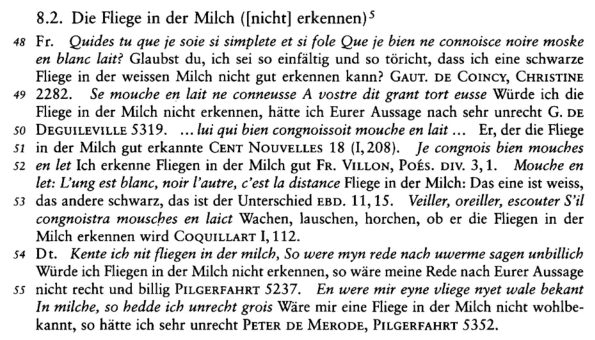 G. DE DEGUILEVILLE 5319 is Guillaume De Guileville (c. 1295-1380), Le Pèlerinage de la Vie Humaine, line 5319. Cf. the very loose translation of De Guileville by John Lydgate (1370-1451), The Pilgrimage of the Life of Man, ed. F.J. Furnivall (London: Kegan Paul, Trench, Trübner & Co., Limited, 1899, 1901, 1904 = Early English Text Society: Extra Series, LXXVII, LXXXIII, XCII),
pp. 292-293 (lines 10677-10688):
I know flies in milkOn the first line see Samuel Singer, ed., Thesaurus Proverbiorum Medii Aevi. Lexikon der Sprichwörter des romanisch-germanischen Mittelalters, Band 3: Erbe — freuen (Berlin: Walter de Gruyter, 1996), p. 296 (under FLIEGE / mouche / fly):
I know the man by his clothes
I know fair weather from foul
I know the apple by the tree
I know the tree when I see the sap 5
I know when all is one
I know who labors and who loafs
I know everything but myself
I know the coat by the collar
I know the monk by the cowl 10
I know the master by the servant
I know the nun by the veil
I know when a hustler rattles on
I know fools raised on whipped cream
I know the wine by the barrel 15
I know everything but myself
I know the horse and the mule
I know their loads and their limits
I know Beatrice and Belle
I know the beads that count and add 20
I know nightmare and sleep
I know the Bohemians' error
I know the power of Rome
I know everything but myself
Prince I know all things 25
I know the rosy-cheeked and the pale
I know death who devours all
I know everything but myself
Je congnois bien mouches en let,
Je congnois a la robe l'homme,
Je congnois le beau temps du let,
Je congnois au pommier la pomme,
Je congnois l'arbre a veoir la gomme, 5
Je congnois quant tout est de mesmes,
Je congnois qui besongne ou chomme,
Je congnois tout, fors que moy mesmes.
Je congnois pourpoint au colet,
Je congnois le moyne a la gonne, 10
Je congnois le maistre au varlet,
Je congnois au voille la nonne,
Je congnois quant pipeur jargonne,
Je congnois fols nourris de cresmes,
Je congnois le vin a la tonne, 15
Je congnois tout, fors que moy mesmes.
Je congnois cheval et mulet,
Je congnois leur charge et leur somme,
Je congnois Bietris et Belet,
Je congnois get qui nombre et somme, 20
Je congnois vision et somme,
Je congnois la faulte des Boesmes,
Je congnois le povoir de Romme,
Je congnois tout, fors que moy mesmes.
Prince, je congnois tout en somme, 25
Je congnois coulourez et blesmes,
Je congnois Mort qui tout consomme,
Je congnois tout, fors que moy mesmes.

I knowe kanvas, I knowe sylk,Stephanie A. Viereck Gibbs Kamath, Authorship and First-Person Allegory in Late Medieval France and England (Cambridge: D.S. Brewer, 2012), pp. 173 ff., juxtaposed the passages from Villon and Lydgate. On Villon's ballad see Gertrude Schoepperle, "Pour le commentaire de Villon: note sur la Ballade des menus propos," Romania 49 (1923) 113-117.
I knowe the flye dreynt in the mylk,
I knowe A mesour, fful & halff,
I knowe the kowh & ek the kalff, 10680
Affter that men by name hem calle,
And dyfference off bestys alle.
I knowe the name off thys & that,
I knowe an hound, I knowe a caat,
And off bothe I knowë how, 10685
That nouther off hem ys calff nor kow:
I knowe ther namys eterychon:
Ther namys & they ben al on.
Wednesday, April 27, 2022
An Occupational Disease
Victor Klemperer (1881-1960), The Language of the Third Reich. LTI – Lingua Tertii Imperii: A Philologist's Notebook, tr. Martin Brady (2000; rpt. London: Continuum, 2006), p. 57:
Although matters relating to my field of expertise were not uppermost in my mind during those terrible years, I did on occasion see before me the intelligent mocking face of Joseph Bédier. It is part of the job of the literary historian to discover the origins of motifs, fables and legends, and sometimes this branch of the discipline can develop into an occupational disease, a mania: everything must have an origin which is remote both geographically and historically — the more remote, the more erudite the researcher who locates the distant source — nothing is allowed to have its roots in the very place where one runs across it. I can still hear the irony in Bédier's voice as he elucidated ex cathedra in the Collège de France the supposedly oriental or supposedly 'druidic' origin of some comic or pious fairy-tale or of some literary curiosity. Bédier repeatedly demonstrated how certain situations and impressions can, at different times and in different places, provoke the same responses, because in certain things human nature proves itself to be extremely consistent over time and space.
So fern mir auch in den furchtbaren Jahren die Dinge meiner Fachwissenschaft lagen, ein paarmal habe ich doch das geistvoll spöttische Gesicht Joseph Bédiers vor mir gesehen. Es gehört zum Beruf des Literarhistorikers, den Quellen eines Motivs, einer Fabel, einer Legende nachzugehen, und manchmal wird aus diesem Berufszweig eine Berufskrankheit, eine Manie: alles muß räumlich und zeitlich weither kommen — je weiter her, um so gelehrter ist der Forscher, der den fernen Ursprung konstatiert —, nichts darf ebendort wurzeln, wo man ihm gerade begegnet. Ich höre noch die Ironie in Bédiers Stimme, wenn er vom Katheder des Collège de France herab über den vermeintlich orientalischen oder den vermeintlich „druidischen“ Ursprung eines komischen oder frommen Märchens oder irgendeines literarischen Einzelzuges sprach. Bédier wies immer darauf hin, wie gewisse Situationen und Eindrücke in den verschiedensten Zeiten und Zonen die gleichen Äußerungen hervorrufen können, weil sich in manchen Dingen die Gleichheit der menschlichen Natur über Zeit und Raum hinweg erweist.
Honor
James M. McPherson, For Cause and Comrades: Why Men Fought in the Civil War (New York: Oxford University Press, 1997), pp. 23-24 (note omitted):
Newer› ‹Older
Honor was primarily a masculine concept, not always appreciated by wives who sometimes felt that a man's duty to his family was more important than pride in his reputation. Several married Confederate volunteers therefore found it necessary to lecture their wives and daughters on the finer points of the male code of honor. Even though he was thirty-nine years old and father of several daughters, a South Carolina planter felt compelled to enlist after the Union capture of the South Carolina sea islands in November 1861. "I would be disgraced if I staid at home, and unworthy of my revolutionary ancestors," he explained to one daughter. "I stand alone in my family. There is no one bearing my name left to fight for our freedom. The honor of our family is involved....A man who will not offer up his life...does dishonor to his wife and children." An Arkansas planter, also in his late thirties, told his wife that "on your account & that of my children I could not bear the idea of not being in this war. I would feel that my children would be ashamed of me when in after times this war is spoken of & I should not have figured in it."

