Sunday, June 05, 2022
Editio Princeps of the Ten Commandments?
Maurice Bowra, "Marcus Niebuhr Tod," New Bats in Old Belfries, or Some Loose Tiles (Oxford: Robert Dugdale, 2005), pp. 3-5:
Related post: Parodies of the Decalogue.
I sing of Marcus Niebuhr TodI don't have access to New Bats in Old Belfries. The text above comes from https://kantor.livejournal.com/96457.html, with a few minor changes from Google Books' snippet view. The verses have been incorrectly attributed to Ronald Syme.
Who found the autograph of God.
Carved on a Sinaitic cliff
He found Jehovah's hieroglyph.
A casual glance assured the date
As BC 1698.
Convinced that no epigraphist
Has entered it on any list,
The worthy Marcus looked around
And found in fragments on the ground
An interesting Hebrew text
Concerning this world and the next.
With scrupulous and loving care
He joined the pieces lying there,
And with a scholar's zeal restored
Words written by the living Lord:
"Go, worship other gods than me:
I feel the need of company.
"And copy bird or beast or fish
In wood or stone, if that's your wish.
"Rightly or wrongly, take my name:
To me it's very much the same.
"If toil of week-days you must shirk,
Then keep the Sabbath for your work.
"If what you want's a good long life,
With parents keep continual strife.
"Kill anyone who worries you:
It's easier and safer too.
"And if your neighbour's wife is free,
Of course commit adultery.
"If others have what you have not,
Why not take steps to steal the lot?
"False evidence against a friend
Brings much advantage in the end.
"If someone has what takes your eye,
Ask, and you'll get it by-and-by."
These mystic words did Marcus find,
And laid them carefully to mind,
But not before, upon his knees,
He knelt and took a loving squeeze.
When in the "Epigraphic Year"
The learned saw his work appear,
They pressed the ill-considered view
That here at last was found the true
Editio princeps of the Ten
Commandments given to the men,
Which Moses cast upon the ground.
This text, they claimed, had Marcus found.
But Marcus did not welcome this
Improbable hypothesis,
And thought that it was far too bold
For any prudent man to hold...
Perambulating Oriel Quad
I thought of Marcus Niebuhr Tod.
Related post: Parodies of the Decalogue.
Keeping Up
Mortimer Wheeler, Still Digging: Interleaves from an Antiquary's Notebook (London: Michael Joseph, 1955), p. 15 (on his father):
His mind was a map of the by-ways of literature, a scholarly map full of exciting discovery. On wet afternoons I would curl up and he would extract dusty books from the backs of his double-stacked shelves, reading and expounding a multitude of things, some of which I did not understand and others which I understood better than he knew. From my earliest years he treated me as an adult mind, and I mentally hopped and skipped alongside his talk as I hopped and skipped beside his long striding legs on our frequent walks together. As to the latter, he never abated his pace for my little steps, and I learned to walk in an abnormally fast and ungainly fashion.
The Cry of Celebration
Homer, Odyssey 22.407-416 (tr. A.T. Murray, rev. George E. Dimock; she = Eurycleia):
But she, when she beheld the corpses and the great welter of blood, made ready to raise the cry of celebration, seeing what a deed had been done. But Odysseus stayed and checked her in her eagerness, and spoke and addressed her addressed her with winged word: "In your own heart rejoice, old woman, but refrain yourself and do not cry out aloud: an unholy thing is it to boast over slain men. These men here has the fate of the gods destroyed and their own reckless deeds, for they honored no one of men upon the earth, high or low, whoever came among them; therefore by their wanton folly they brought on themselves a shameful death."Manuel Fernández-Galiano on line 408:
ἡ δ᾽ ὡς οὖν νέκυάς τε καὶ ἄσπετον εἴσιδεν αἷμα,
ἴθυσέν ῥ᾽ ὀλολύξαι, ἐπεὶ μέγα εἴσιδεν ἔργον·
ἀλλ᾽ Ὀδυσεὺς κατέρυκε καὶ ἔσχεθεν ἱεμένην περ,
καί μιν φωνήσας ἔπεα πτερόεντα προσηύδα· 410
"ἐν θυμῷ, γρηῦ, χαῖρε καὶ ἴσχεο μηδ᾽ ὀλόλυζε·
οὐχ ὁσίη κταμένοισιν ἐπ᾽ ἀνδράσιν εὐχετάασθαι.
τούσδε δὲ μοῖρ᾽ ἐδάμασσε θεῶν καὶ σχέτλια ἔργα·
οὔ τινα γὰρ τίεσκον ἐπιχθονίων ἀνθρώπων,
οὐ κακὸν οὐδὲ μὲν ἐσθλόν, ὅτις σφέας εἰσαφίκοιτο· 415
τῷ καὶ ἀτασθαλίῃσιν ἀεικέα πότμον ἐπέσπον."
ὀλολυγή (with the long -υ- which led Cobet to suggest accentuating this word with the circumflex, ὀλολῦξαι) refers to the ritual ululation of women, as of the Trojan women in the temple in Il. vi 301, whereas the deeper male equivalent, used as a war cry in xxiv 463, was called ἀλαλητός; the verb ὀλολύζω occurs here, in 411, and in iii 450 (Nestor's womenfolk at a sacrifice), iv 767 (Penelope sacrificing to Athena and entreating her help against the suitors).Id. on lines 411-416:
The authenticity of Odysseus' humane and compassionate speech, apparently so out of tune with the archaic ferocity of the rest of the Book, has been much disputed: see, for example, Heubeck, Dichter, 83, Erbse, Beiträge, 130—1, Eisenberger, Studien, 142. The deluge of deletions has been swollen, in addition, by the fact that this is a cento of Homeric passages from elsewhere: 414-15 = xxiii 65-6, a speech by Penelope; the beginning of 415 = Il. vi 489, and is similar to Od. viii 553; its ending, almost identical to xx 188; 416, a calque of 317 with an opening similar to that of xxiii 67. To the general condemnation, Blass adds his vote, somewhat irrelevantly alleging in reference to 414-16 that Odysseus' speeches to Eurycleia are otherwise (431-2, 481-4, 491) short and to the point (Interpolationen, 209-10). But Odysseus' sentiments can be paralleled elsewhere in Homer, in passages which condemn hybris and warn of its consequences: thus ii 168—9, Halitherses' prophecy and warning to the suitors to moderate their actions; ix 270—1, Odysseus calls to mind Zeus' protection of suppliants and strangers; xiv 83—4, Eumaeus states that the gods dislike σχέτλια ἔργα, honouring justice and αἴσιμ' ἔργα; xviii 141-2, Odysseus demands that no one be ἀθεμίστιος, and that all enjoy in silence the δῶρα θεῶν ... ὅττι διδοῖεν; xxi 28-9, the poet comments on Iphitus, σχέτλιος, and his lack of respect for the θεῶν ὄπιν and the table of hospitality; and so on. On the lofty tolerance and respect for the dead shown, for example, in 412, it has been objected (E.T. Vermeule, Archaeologia V, 125) that the adj. ὅσιος is nowhere used in Homer, and that there is only one other occurrence of the noun ὁσίη, formed from the adj. with the abstract suffix -ια *ὁσιιᾱ, and preceded by οὐχ in a parallel to the Lat. non fas est (xvi 423, where Penelope reproaches Antinous for the plot against Telemachus, οὐδ᾽ ὁσίη κακὰ ῥάπτειν ἀλλήλοισιν). Scholars have often adduced the parallel of Archilochus fr. 134 W οὐ γὰρ ἐσθλὰ κατθανοῦσι κερτομεῖν ἐπ᾿ ἀνδράσιν cited by the sch. on 412 (see also the apophthegm of Cheilon τὸν τεθνηκότα μὴ κακολογεῖν, and Cratinus fr. 102 φοβερὸν ἀνθρώποις τόδ᾿ αὖ | κταμένοις ἐπ᾿ αἰζηοῖσι καυχᾶσθαι μέγα); the Archilochean passage has even been proposed as the source of the supposed interpolation here (whereas Merkelbach, Untersuchungen, 129 n. 2 and 231, argues the exact contrary, asserting that the Archilochean passage is derivative and hence provides a terminus ante quem for these lines). The most illuminating parallel, however, is to be found in Odysseus' humane and sympathetic words on Socus, whom he has just killed, in Il. xi 450-5.
Leadership
Herodian 2.11.2 (tr. Edward C. Echols; he = Severus):
He shared personally in their hardships, sleeping in an ordinary army tent and eating and drinking whatever was available to all; on no occasion did he make use of imperial luxuries or comforts. As a result, he enjoyed even greater popularity among the troops; respecting him not only for sharing their hardships but also for overcoming all difficulties, they carried out his orders with enthusiasm.Plutarch, Life of Marius 7.5-6 (tr. Rex Warner, rev. Robin Seager):
ἐκοινώνει δὲ τῶν καμάτων αὐτοῖς, σκηνῇ τε χρώμενος εὐτελεῖ, καὶ σιτία καὶ ποτὰ προσφερόμενος οἷα καὶ πᾶσιν ὑπάρχειν ἠπίστατο· οὐδαμοῦ δὲ τρυφὴν ἐνεδείκνυτο βασιλικήν. ὅθεν καὶ μείζονα παρὰ τῶν στρατιωτῶν εὔνοιαν ἐπιστώσατο· οὐ γὰρ μόνον αὐτὸν συμπονοῦντα ἀλλὰ καὶ τῶν καμάτων ἄρχοντα οἱ στρατιῶται αἰδούμενοι μετὰ προθυμίας πάντα ἔπραττον.
Indeed it seems generally to be the case that our labours are eased when someone goes out of his way to share them with us; it has the effect of making the labour not seem forced. And what a Roman soldier likes most to see is his general eating his ration of bread with the rest, or sleeping on an ordinary bed, or joining in the work of digging a trench or raising a palisade. The commanders whom they admire are not so much those who distribute honours and riches as those who take a share in their hardships and their dangers; they have more affection for those who are willing to join in their work than for those who allow them to take it easy.
ὅλως μὲν γὰρ ἔοικε τοῦ κάμνειν ἑκάστῳ παραμυθία τὸ συγκάμνον ἑκουσίως εἶναι· δοκεῖ γὰρ ἀφαιρεῖν τὴν ἀνάγκην· ἥδιστον δὲ Ῥωμαίῳ θέαμα στρατιώτῃ στρατηγὸς ἐσθίων ἐν ὄψει κοινὸν ἄρτον ἢ κατακείμενος ἐπὶ στιβάδος εὐτελοῦς ἢ περὶ ταφρείαν τινὰ καὶ χαράκωσιν ἔργου συνεφαπτόμενος. οὐ γὰρ οὕτως τοὺς τιμῆς καὶ χρημάτων μεταδιδόντας, ὡς τοὺς πόνου καὶ κινδύνου μεταλαμβάνοντας ἡγεμόνας θαυμάζουσιν, ἀλλὰ μᾶλλον ἀγαπῶσι τῶν ῥᾳθυμεῖν ἐπιτρεπόντων τοὺς συμπονεῖν ἐθέλοντας.
War Must Be
J.R.R. Tolkien, The Lord of the Rings, Part II: The Two Towers, 2nd ed. (Boston: Houghton Mifflin Company, ©1982), p. 280 (Book IV, Chapter 5; Faramir speaking):
War must be, while we defend our lives against a destroyer who would devour all; but I do not love the bright sword for its sharpness, nor the arrow for its swiftness, nor the warrior for his glory. I love only that which they defend: the city of the Men of Númenor; and I would have her loved for her memory, her ancientry, her beauty, and her present wisdom.
Saturday, June 04, 2022
A Doubtful Choice
Edward de Vere, "Were I a King," in The Oxford Book of Short Poems (Oxford: Oxford University Press, 1987), p. 11:
Were I a king, I might command content,
Were I obscure, unknown should be my cares,
And were I dead, no thoughts should me torment,
Nor words, nor wrongs, nor loves, nor hate, nor fears.
A doubtful choice for me, of three things one to crave:
A kingdom, or a cottage, or a grave.
Leti Mille Repente Viae
Herodian 2.2.6 (tr. Edward C. Echols):
As you are aware, the cause of death is not one and the same for all men. The most diverse causes bring us to life's inevitable outcome.
οὐδὲ γὰρ μία οὐδ' ἡ αὐτὴ πᾶσιν ἀνθρώποις θανάτου αἰτία, διάφοροι δὲ οὖσαι ἐς ἓν τέρμα βίου συντελοῦσιν.
Husks
Cicero, Letters to Atticus 4.19.1 (Rome, end of November 54; tr. D.R. Shackleton Bailey, with his commentary):
Hurry back to Rome, come and look at the empty husks of the real old Roman Republic we used to know.Id.:
quin tu huc advolas et invisis illius nostrae rei publicae germanae puta<mina>?
puta<mina> Tucker
On the one hand we need a noun to govern the genitive rei publicae; on the other, we have puta, a vox nihili. The deficiency is supplied by Wesenberg's umbram or simulacrum after invisis, but 'entia non sunt multiplicanda praeter necessitatem'; it is from the corrupt puta that the missing substantive should be sought. So Constans reasoned, but found nothing better than γῦπα. For putamina (to be found in an otherwise extravagant paper of T.G. Tucker's, Hermath. 15 (1909), p. 290) cf. Nonius, 232 putamina non solum arborum sunt verum omnium rerum purgamenta. nam quicquid ex quacumque re proicitur putamen appellatur. Plautus in Captivis (655) nucleum amisi, reliqui pigneri putamina. All of virtue in the free constitution has departed, leaving only the husks, the lifeless trappings.
... get the smell of a Dictatorship in your nostrils ...Cf. 4.18.3:
... olface dictaturam ...
... there is some whiff of a Dictatorship in the air ...
... non nullus odor dictaturae ...
Consolations
Cicero, Letters to Atticus 4.18.2 (Rome, between 24 October and 2 November 54; tr. D.R. Shackleton Bailey):
I have many consolations. All the same, I do not move away from my position, but turn back to the life that is most congenial, to my books and studies.
multa mihi dant solacia, nec tamen ego de meo statu demigro, quaeque vita maxime est ad naturam ad eam me refero, ad litteras et studia nostra.
Friday, June 03, 2022
The Minds of the Young
Herodian 1.3.1 (tr. Edward C. Echols):
For the minds of the young, prone to pleasures, are turned very easily from the virtues of education.
ῥᾷστα γὰρ αἱ τῶν νέων ψυχαὶ ἐς ἡδονὰς ἐξολισθαίνουσαι ἀπὸ τῶν παιδείας καλῶν μετοχετεύονται.
Nothing in Common
Herodian 4.10.5 (tr. C.R. Whittaker; the letter was from Caracalla to Artabanus V):
On the receipt of this letter the initial Parthian reaction was to say that a Roman marriage to a barbarian was not suitable since they had nothing in common, they did not understand each other's language and had different habits of food and dress. The Romans had plenty of patrician families (like the Arsacids in Persia) from whom Antoninus could choose a daughter. The racial purity of neither should be contaminated.The same (tr. Edward C. Echols):
τοιούτοις αὐτοῦ γράμμασιν ἐντυχὼν ὁ Παρθυαῖος τὰ μὲν πρῶτα ἀντέλεγε, φάσκων οὐχ ἁρμόζειν Ῥωμαίῳ γάμον βάρβαρον. τίνα γὰρ ἔσεσθαι συμφωνίαν ἐν αὐτοῖς, μήτε τῆς ἀλλήλων φωνῆς συνιεῖσιν, ἔν τε διαίτῃ καὶ σκευῇ διαφέρουσιν ἀλλήλων; εἶναι δὲ παρὰ Ῥωμαίοις εὐπατρίδας πολλούς, ὧν τινὸς ἐπιλέξασθαι δύναιτ᾿ ἂν θυγατέρα, παρά τε αὑτῷ Ἀρσακίδας· καὶ μὴ δεῖν μηδέτερον γένος νοθεύεσθαι.
μὴ δεῖν: δεῖν O
At first the Parthian king did not approve of the proposals in Antoninus'’s letters, saying that it was not proper for a barbarian to marry a Roman. What accord could there be when they did not understand each other's language and differed so radically in diet and dress? Surely, the king said, there are many distinguished Romans, one of whose daughters he could marry, just as for him there were the Arsacids; it was not fitting that either race be bastardized.Related posts:
Oats, Peas, Beans and Barley Grow
Calvert Watkins (1933-2013), "Aspects of Indo-European Poetics," in his Selected Writings, ed. Lisi Oliver, Vol. II: Culture and Poetics (Innsbruck: Institut für Sprachwissenschaft der Universität Innsbruck, 1994 = Innsbrucker Beiträge zur Sprachwissenschaft, 80), pp. 673-690 (at 688-689):
Consider the traditional English round:Related post: The Law of the Increasing Members.Oats, peas, beans and barley growI am not being facetious when I claim that this is an ideal illustration of the Indo-European poet's formulaic verbal art. Consider the order of the elements, which is anything but random. The two cereals oats and barley are distracted, transposed to frame the two legumes peas and beans. The latter are linked by the indexical labial stop and identical vowel /pi-/, /bi-/. Beans must follow peas in order to alliterate with barley. Barley as the only disyllable comes last, in accord with Behagel's [sic, read Behaghel's] law of increasing members, the Gesetz der wachsenden Glieder. And oats must come first, to form a perfect phonetic ring-composition; the whole utterance begins and ends with the vowel /o/: oats, grow.
This particular utterance now functions only to amuse children; its surface linguistic expression is of no great antiquity, though doubtless of many generations, perhaps some centuries older than the present day. But in its essential semantics, formulaics, and poetics it could perfectly well have been periodically re-created on the same model, over the course of the past seven thousand years. We could have before our eyes the transformation of the central merism of an Indo-European agricultural prayer, harvest song, or the like.
Radical Surgery Is Needed
Claudian, Against Eutropius 2.11-19 (tr. Maurice Platnauer, modified):
When the body is overwhelmed by long-standing disease, 'tis all in vain that thou makest use of healing medicines. When an ulcer has penetrated to the marrow of the bones, the touch of a hand is useless; steel and fire must repair the place, that the wound heal not on the surface, apt to re-open at any moment. The flame must penetrate to the quick to make a way for the foul humours to escape; in order that, once the veins are emptied of corrupted blood, the fountain-head of the evil may be dried up. Nay, even limbs are amputated to assure the healthy life of the rest of the body.
veteri post obruta morbo
corpora Paeonias nequiquam admoveris herbas.
ulcera possessis alte suffusa medullis
non leviore manu, ferro sanantur et igni,
ne noceat frustra mox eruptura cicatrix. 15
ad vivum penetrant flammae, quo funditus umor
defluat et vacuis corrupto sanguine venis
arescat fons ipse mali; truncatur et artus,
ut liceat reliquis securum degere membris.
Gone
Cicero, Letters to Atticus 4.18.2 (Rome, between 24 October and 2 November 54; tr. D.R. Shackleton Bailey):
My dear friend, not only have we lost the vital essence of the free state—even the outward complexion and aspect it used to wear has gone. There is no Republic any longer to give me joy and solace.The same (tr. E.O. Winstedt):
amisimus, mi Pomponi, omnem non modo sucum ac sanguinem sed etiam colorem et speciem pristinam civitatis. nulla est res publica quae delectet, in qua acquiescam.
The State, my dear Pomponius, has lost not only its sap and blood, but even all its old colour and outward semblance. There is in fact no Republic to give one a feeling of joy and peace.
Thursday, June 02, 2022
In Some Quarters
Jotham Johnson, "Foreward" to Jacques Perret, Horace, tr. Bertha Humez ([New York:] New York University Press, 1964), p. v:
Aere perennius, Graecia capta, parcus deorum cultor, aurea mediocritas, integer vitae, and curiosa felicitas were household words for centuries; in some quarters they still are.
Think Locally
Sheila Kaye-Smith (1887-1956), The Challenge to Sirius (1917; rpt. London: Cassell and Company, Ltd, 1924), p. 167:
"Manchester! Wot's Manchester! I live in the Isle of Oxney. I döan't care wot happens in Manchester and such-like furrin parts. Be hemmed to all furriners, I say."A Dictionary of the Kentish Dialect (Kent Archaeological Society, 2008) has no entry for hemmed, but cf. the following, quoted s.v. blether (p. 11):
And hemmed (damned) hard work from 4 o'clock in the marnin' till 8 o'clock at noight, yayer (year) in, yayer out.Related posts:
- Regional Solidarity and Hostility
- Native Soil
- Patria Chica
- Provincialism
- A Blade of Grass
- This Is My Home
- Near and Dear
- Parochialism
- One World
- Local Attachment
- Patriotism
- Insularity
- Xenophobia
- Le Patriotisme de Clocher
- Home Sweet Home
Wednesday, June 01, 2022
Man Put to Death for Quoting Vergil
Dio Cassius 76.10.2 (tr. Earnest Cary, with his note):
While he was engaged in this war he put to death two distinguished men. One was Julius Crispus, a tribune of the Pretorians; and the reason was that Crispus, vexed at the war's havoc, had casually quoted some verses of the poet Maro,1 in which one of the soldiers fighting on the side of Turnus against Aeneas bewails his lot and says: "In order that Turnus may marry Lavinia, we are meanwhile perishing all unheeded." And Severus made Valerius, the soldier who accused him, tribune in his place.Vergil, Aeneid 11.371-373 (tr. H. Rushton Fairclough):
1 Vergil, Aen. xi.371‑3.
ἐν ᾧ δὲ ἐπολέμει, δύο ἄνδρας τῶν ἐπιφανῶν ἀπέκτεινεν, Ἰούλιον Κρίσπον χιλιαρχοῦντα τῶν δορυφόρων, ὅτι ἀχθεσθεὶς τῇ τοῦ πολέμου κακώσει ἔπος τι τοῦ Μάρωνος τοῦ ποιητοῦ παρεφθέγξατο, ἐν ᾧ ἐνῆν στρατιώτης τις τῶν μετὰ Τούρνου τῷ Αἰνείᾳ ἀντιπολεμούντων ὀδυρόμενος καὶ λέγων ὅτι "ἵνα δη τὴν Λαουινίαν ὁ Τοῦρνος ἀγάγηται, ἡμεῖς ἐν οὐδενὶ λόγῳ παραπολλύμεθα." καὶ τὸν κατηγορήσαντα αὐτοῦ στρατιώτην Οὐαλέριον χιλίαρχον ἀντ᾽ αὐτοῦ ὁ Σεουῆρος ἀπέδειξεν.
What! that Turnus may be blessed with a royal bride,The passage from Dio Cassius isn't mentioned in Nicholas Horsfall's commentary on Vergil, Aeneid 11 (Leiden: Brill, 2003).
are we, forsooth, we worthless lives, a crowd unburied and unwept,
to be strewn upon the plains?
scilicet ut Turno contingat regia coniunx,
nos animae viles, inhumata infletaque turba,
sternamur campis.
Born Again
Cicero, Letters to Atticus 4.1.8 (Rome, about 10 September 57; tr. D.R. Shackleton Bailey):
It is a sort of second life I am beginning.
alterius vitae quoddam initium ordimur.
Requests
Joel P. Brereton and Stephanie W. Jamison, The Rigveda: A Guide (Oxford: Oxford University Press, 2020), pp. 138-139:
We should begin by noting that R̥gvedic poets have no compunction about baldly demanding what they want from the gods. They seem to feel no need for politesse or indirection, with the standard linguistic means being the direct, second-person singular imperative — “give!” or “help” or “come here!” — addressed even to the most powerful of gods, Indra. They do sometimes use seemingly deferential expressions, often referring to their own hopes and desires, such as “might we win or enjoy X” in the optative mood, but this often seems to arise from the impulse to poetic variation, rather than a real sense of humility. One result of this blunt approach is that the request portion of a hymn, especially when it comes toward the end of the hymn, is generally far less poetically elaborate and carefully wrought than the parts containing praise and description.
The actual requests involve both tangible goods and divine aid and services. The poets ask very frequently for wealth, which is often then further specified: livestock (cattle and horses especially) and gold being the most commonly desired. They also request offspring and descendants, often expressed as a desire for “heroes,” which probably refers to strong and virile sons. They appeal to the gods for rain, refreshment and nourishment, and a good dwelling place (e.g., II.19.8). As for less tangible desires, they ask for protection and for help, especially help in battle, and this latter is often phrased as a request for the god (generally Indra) to inflict harm on our enemies, to help us overcome our rivals, and generally keep us out of the toils of hatred and hostilities and those who practice them. An oft-expressed desire is for the gods to lengthen our lifetime, especially to the canonical number of a hundred years (e.g., II.22.2), and to allow us “to see the sun” (e.g., II.33.1). As is appropriate for a people in need of pastureland and constantly advancing into new territory, they regularly ask the gods to “create wide space” (e.g., II.30.6) as they seek escape from the narrow environment that hems them in. Many of these requests are generic and directed to any or all gods; others are divinity specific: Indra’s aid is more likely to be solicited in battle, while Varuṇa and the other Ādityas are asked to “loosen offenses,” that is, to free us from the consequences of violation of divine commandments or other obligations (e.g., II.28.5, 7). They also ask for personal qualities, like wisdom and might (e.g., II.34.7). The various types of requests are not segregated but can jostle each other in an unordered list. Consider this multipart demand, in the last verse of an Indra hymn: II.21.6 “Indra, grant to us the best goods, the perception that belongs to sacrificial skill, and the possession of a good share, as well as a prospering of our riches, freedom from harm for our bodies, sweetness of our speech, and the blessing of good days for our days.”
Let Us Enjoy the Good Things That Are Present
Wisdom of Solomon 2:1-9 (King James Version):
[1] For the ungodly said, reasoning with themselves, but not aright, Our life is short and tedious, and in the death of a man there is no remedy: neither was there any man known to have returned from the grave.Sheila Kaye-Smith, The Challenge to Sirius (1917; rpt. London: Cassell and Company, Ltd, 1924), p. 44:
[2] For we are born at all adventure: and we shall be hereafter as though we had never been: for the breath in our nostrils is as smoke, and a little spark in the moving of our heart:
[3] Which being extinguished, our body shall be turned into ashes, and our spirit shall vanish as the soft air,
[4] And our name shall be forgotten in time, and no man shall have our works in remembrance, and our life shall pass away as the trace of a cloud, and shall be dispersed as a mist, that is driven away with the beams of the sun, and overcome with the heat thereof.
[5] For our time is a very shadow that passeth away; and after our end there is no returning: for it is fast sealed, so that no man cometh again.
[6] Come on therefore, let us enjoy the good things that are present: and let us speedily use the creatures like as in youth.
[7] Let us fill ourselves with costly wine and ointments: and let no flower of the spring pass by us:
[8] Let us crown ourselves with rosebuds, before they be withered:
[9] Let none of us go without his part of our voluptuousness: let us leave tokens of our joyfulness in every place: for this is our portion, and our lot is this.
[1] Εἶπον γὰρ ἐν ἑαυτοῖς λογισάμενοι οὐκ ὀρθῶς Ὀλίγος ἐστὶν καὶ λυπηρὸς ὁ βίος ἡμῶν, καὶ οὐκ ἔστιν ἴασις ἐν τελευτῇ ἀνθρώπου, καὶ οὐκ ἐγνώσθη ὁ ἀναλύσας ἐξ ᾅδου.
[2] ὅτι αὐτοσχεδίως ἐγενήθημεν, καὶ μετὰ τοῦτο ἐσόμεθα ὡς οὐχ ὑπάρξαντες· ὅτι καπνὸς ἡ πνοὴ ἐν ῥισὶν ἡμῶν, καὶ ὁ λόγος σπινθὴρ ἐν κινήσει καρδίας ἡμῶν,
[3] οὗ σβεσθέντος τέφρα ἀποβήσεται τὸ σῶμα, καὶ τὸ πνεῦμα διαχυθήσεται ὡς χαῦνος ἀήρ.
[4] καὶ τὸ ὄνομα ἡμῶν ἐπιλησθήσεται ἐν χρόνῳ, καὶ οὐθεὶς μνημονεύσει τῶν ἔργων ἡμῶν· καὶ παρελεύσεται ὁ βίος ἡμῶν ὡς ἴχνη νεφέλης, καὶ ὡς ὁμίχλη διασκεδασθήσεται διωχθεῖσα ὑπὸ ἀκτίνων ἡλίου καὶ ὑπὸ θερμότητος αὐτοῦ βαρυνθεῖσα.
[5] σκιᾶς γὰρ πάροδος ὁ καιρὸς ἡμῶν, καὶ οὐκ ἔστιν ἀναποδισμὸς τῆς τελευτῆς ἡμῶν, ὅτι κατεσφραγίσθη, καὶ οὐδεὶς ἀναστρέφει.
[6] δεῦτε οὖν καὶ ἀπολαύσωμεν τῶν ὄντων ἀγαθῶν, καὶ χρησώμεθα τῇ κτίσει ὡς ἐν νεότητι σπουδαίως·
[7] οἴνου πολυτελοῦς καὶ μύρων πλησθῶμεν, καὶ μὴ παροδευσάτω ἡμᾶς ἄνθος ἔαρος·
[8] στεψώμεθα ῥόδων κάλυξιν πρὶν ἢ μαρανθῆναι·
[9] μηδεὶς ἡμῶν ἄμοιρος ἔστω τῆς ἡμετέρας ἀγερωχίας, πανταχῇ καταλίπωμεν σύμβολα τῆς εὐφροσύνης, ὅτι αὕτη ἡ μερὶς ἡμῶν καὶ ὁ κλῆρος οὗτος.
Frank's heart suddenly warmed with an admiring tenderness for these old Ungodly, who ate and drank and died. In their longing and in their choice he seemed to see his own. Thousands of years ago men had asked his questions and faced his problems; they had seen life stretch before them in a grey perplexing alley, and they had said: "Let no flower of the spring pass us by." He could not see in the Choice of the Ungodly the blasphemy which the writer imputed to it. Surely it was to glorify God for a man to leave tokens of joyfulness in every place.
A Syntactic Peculiarity
Homer, Iliad 3.276-277 (tr. Peter Green):
Wackernagel's rejection of a metrical explanation looks like it could be a criticism of Basil L. Gildersleeve, who said in his review of Delbrück's Die Grundlagen der griechischen Syntax in American Journal of Philology 2.5 (1881) 83-100 (at 88):
Zeus, Father, ruling from Ida, most glorious, greatest, and you, Sun, the all-seeing, all-hearing...Jacob Wackernagel (1853-1938), Lectures on Syntax with Special Reference to Greek, Latin, and Germanic, tr. David Langslow (Oxford: Oxford University Press, 2009), p. 14 (from Lecture I, 2):
Ζεῦ πάτερ Ἴδηθεν μεδέων κύδιστε μέγιστε,
Ἠέλιός θ᾽, ὃς πάντ᾽ ἐφορᾷς καὶ πάντ᾽ ἐπακούεις ...
In this course on syntax, we shall have constantly to deal with inherited material, which is to be found in even the smallest details and in oddities concerning which one would hardly think in terms of inheritance. For example, at Iliad 3.276–7, in a prayer to Zeus and the Sun-god, we read: Ζεῦ πάτερ ... Ἠέλιός τε ('Zeus father (voc.) . . . and Helios (the Sun) (nom.)'), i.e. in the invocation one god is named in the vocative, the other in the nominative. It would be superficial simply to refer this to the requirements of the metre, since the poet would have had other means at his disposal for turning out a correct hexameter. From the point of view of Greek this is an oddity, particularly as vocatives elsewhere occur in coordination. This puzzle was solved by an outstanding philologist, Theodor BENFEY (1809–81). He showed (1872: 30–4) that in the Rigveda, the oldest written remains of an Indo-European language, when two forms of address are joined together with the little word ca 'and' (corresponding to Greek τε 'and'), the second is in the nominative rather than the vocative. So Homer's use of the nominative instead of the vocative is conditioned by the little word τε. This tiny detail reveals the power of linguistic habit and the influence of inheritance.The reference is to Benfey, "Über die Entstehung des indogermanischen Vokativs," Abhandlungen der hist.- philologischen Classe der Königlichen Gesellschaft der Wissenschaften zu Göttingen 17 (1872) 1–92.
Wackernagel's rejection of a metrical explanation looks like it could be a criticism of Basil L. Gildersleeve, who said in his review of Delbrück's Die Grundlagen der griechischen Syntax in American Journal of Philology 2.5 (1881) 83-100 (at 88):
Benfey's parallel between the copulation of voc. and nom. by τε in Γ 277 Ζεῦ πάτερ ... Ἠέλιός θ' ὃς κτέ, and a similar union by means of ca in Sanskrit does not seem to me to rest on a sufficiently wide basis of induction. Ἠέλιε cannot be got into the combination on account of the verse, and while it is easy enough to abuse the old device of metri causa, we cannot at all events deny the influence when there is a balance.M.L. West (1937-2015), Indo-European Poetry and Myth (Oxford: Oxford University Press, 2007), pp. 306-307:
Vedic and early Greek agree further in a syntactic peculiarity that sometimes appears when two deities are invoked together. One is addressed in the vocative, the other appended in the nominative with the copula ca or τε (both from *kwe): RV 1.2.5, 4.47.3 Vā́yav Índraś ca; Il. 3.276 f. Ζεῦ πάτερ Ἴδηθεν μεδέων κύδιστε μέγιστε, | Ἠέλιός θ᾽, ὃς πάντ᾽ ἐφορᾷς καὶ πάντ᾽ ἐπακούεις; Aesch. Sept. 140, Supp. 26; Ar. Nub. 264 f. ὦ δέσποτ᾽ ἄναξ, ἀμέτρητ᾽ Ἀήρ | ... λαμπρός τ᾽ Αἰθὴρ, σεμναί τε θεαὶ Νεφέλαι ... | ἄρθητε φάνητε. It is as if the one god is treated as being in the second person, and the other as in the third: 'O Vayu, hear, and (let) Indra (hear)'; a dual or plural verb normally follows.4
4 Cf. Pind. Ol. 10.3 ὦ Μοῖσ᾽, ἀλλὰ σὺ καὶ θυγάτηρ | Ἀλάθεια Διός, ὀρθᾷ χερί | ἐρύκετον ψευδέων | ἐνιπὰν ἀλιτόξενον; PMG 884.4 Παλλὰς Τριτογένει', ἄνασσ' Ἀθάνα, | ὄρθου τήνδε πόλιν ..., σύ τε καὶ πατήρ; Berthold Delbrück, Syntaktische Forschungen (Halle 1871–88), iv.28; Renée Zwolanek, Váyav índraśca. Studien zu Anrufungsformen im Vedischen, Avestischen und Griechischen (Munich 1970).
Tuesday, May 31, 2022
Akkadian Drinking Song
Benjamin R. Foster, Before the Muses: An Anthology of Akkadian Literature, 3rd ed. (Bethesda: CDL Press, 2005), pp. 769-770 (footnotes and line numbers omitted):
This Akkadian drinking song, known in widely variant versions from both Syria and Mesopotamia, was originally a Sumerian text about ancient rulers studied in schools and provided with an Akkadian translation during the Classical period. It enumerates great heroes of the past who have vanished, then recommends intoxication as preferable to despair.Related post: Ubi Sunt?Plans are made by Enki,
Lots are drawn by the gods' will.
From former days only empty air remains:
Whenever has aught been heard from any who went before?
These kings were superior to those, and others to them.
Your 'eternal abode' is above their homes,
It is far away as heaven, whose hand can reach it?
Like the depths of the earth, no one knows anything of it.
The whole of a life is but the twinkling of an eye.
The life of humankind is surely not forever.
Where is king Alulu, who reigned for 36,000 years?
Where is king Etana, who went up to heaven?
Where is Gilgamesh, who sought life like Ziusudra?
Where is Huwawa, who was seized and
knocked to the ground(?)?
Where is Enkidu, who [showed] forth strength in the land?
Where is Bazi? Where is Zizi?
Where are the great kings from former days till now?
They will not be begotten (again),
they will not be born (again).
How far did a life without glamor transcend death?
Fellow, I will teach you truly who your god is.
Cast down unhappiness in triumph,
forget the silence (of death)!
Let one day of happiness make up for 36,000 years of
the silence (of death)!
Let the beer-goddess rejoice over you
as if you were her own child!
That is the destiny of humankind.
The Fate of All Men
Beowulf 1002-1008 (tr. Howell D. Chickering):
No man escapes
easily from death —let him try who will—
but all soul-bearers walking the earth,
each son of man, driven by need, 1005
must enter his place made ready from birth
where the body-covering deep in its earth-bed
sleeps after feast.
No þæt yðe byð
to beflēonne, fremme se þe wille,
ac gesēcan sceal sāwl-berendra,
nyde genȳdde, niþða bearna, 1005
grund-būendra gearwe stōwe,
þǣr his līc-homa leger-bedde fæst
swefeþ æfter symle.
Ancient Ways of Speech and Ancient Modes of Thought
Calvert Watkins (1933-2013), "The Black and White Adunaton," in his Selected Writings, ed. Lisi Oliver, Vol. III: Publications 1992-2008 (Innsbruck: Institut für Sprachwissenschaft der Universität Innsbruck, 2008 = Innsbrucker Beiträge zur Sprachwissenschaft, 129), pp. 814-818 (at 818, footnote omitted):
 The Irish on the Guinness advertisement is "Ní féidir an dubh a cur ina bhán air," i.e.
"Black cannot be made white."
'Ancient ways of speech', and 'ancient modes of thought', as I have sometimes sententiously evoked them, turn out not to be very different from what we say and think ourselves, right now. This is one of the lessons of philology and historical linguistics. The adunaton as a figure of speech is still with us, and the antithesis of black and white is created afresh with every dawn. Any one of us could produce examples galore. Let me here offer only one, a visual image from twentieth-century Ireland, in fond memory of Conn Ó Cléirigh. It has the classic linguistic form of adunaton. The 'familiar substance in the culture' and its attendant message may be left to speak for themselves.

A Revised Edition Introduces a Typographical Error
Ovid, Fasti. With an English Translation by Sir James George Frazer ... Second edition revised by G.P. Goold (Cambridge: Harvard University Press, 1989), pp. 130-131 (3.135-138):
Image of second edition: Image of first edition:

neu dubites, primae fuerint quin ante KalendaeFor remining read remaining, which appears in the first, unrevised edition (London: William Heinemann Ltd, 1931).
Martis, ad haec animum signa referre potes.
laurea, flaminibus quae toto perstitit anno,
tollitur, et frondes sunt in honore novae.
If you would convince yourself that the Kalends of March were really the beginning of the year, you may refer to the following proofs: the laurel branch of the flamens, after remining in its place the whole year, is removed (on that day), and fresh leaves are put in the place of honour;
Image of second edition:


Labels: typographical and other errors
Monday, May 30, 2022
Anatomical Pars Pro Toto
Joshua T. Katz, "The Riddle of the sp(h)ij-: The Greek Sphinx and her Indic and Indo-European
Background," in Georges-Jean Pinault and Daniel Petit, edd., La langue poétique Indo-Européenne: actes du colloque de travail de la Société des Études Indo-Européennes (Indogermanische Gesellschaft/Society for Indo-European Studies), Paris, 22-24 octobre 2003 (Leuven: Peeters, 2006), pp. 157-194 (at 174-175):
Although it may seem patently absurd initially, there is in fact no a priori reason why Sphinx should not at some level mean « buttocks »: humans, at least, are frequently named after lower body parts,43 and in iconography, the monster's haunches are typically emphasized. On this interpretation, the name Sphinx might actually be connected to the creature's riddling nature, as Georges-Jean Pinault cleverly points out to me: the greatest riddle of all is sex and the greatest sexual riddle the forbidden part of one's own body that one cannot see, namely the buttocks or anus.Related post: The Best Part of a Man.
43. The most detailed study of the phenomenon of anatomical pars pro toto focuses on Latin (Adams 1982a; see also Adams 1982b: Index [271] s.v. pars pro toto), where the considerable majority of cases are overtly sexual (e.g., Mentula « Mr. Prick »); for Greek (where the locus classicus is the seemingly abusive γαστέρες οἶον, Th. 26, « mere bellies » in Hesiod's Dichterweihe, for which a new interpretation is offered in Katz & Volk 2000), Bain 1994 makes a good start with his discussion of a graffito from ca. 400 B.C. about a man from Thorikos called ὁ πρωκτός « (known as) Asshole » (compare Neumann 1999: 202-5 and see also Bain, 1995 and 1999a).
Dexileos
Inscriptiones Graecae II² 6217, tr. Jeffrey M. Hurwit, "The Problem with Dexileos: Heroic and Other Nudities in Greek Art," American Journal of Archaeology 111.1 (January, 2007) 35-60 (at 38):
 Hurwit, p. 35 (footnotes omitted):
Dexileos, son of Lysanias, of Thorikos.Grave stele of Dexileos (Athens, Kerameikos Museum, inv. no. P 1130):
He was born in the archonship of Teisandros [414/3 B.C.E.];
He died in that of Euboulides [394/3 B.C.E.],
at Corinth, one of the five horsemen.
Δεξίλεως Λυσανίο Θορίκιος.
ἐγένετο ἐπὶ Τεισάνδρο ἄρχοντος,
ἀπέθανε ἐπ’ Εὐβολίδο
ἐγ Κορίνθωι τῶν πέντε ἱππέων.

In its broad outlines, the story is well known. On a day in early summer, 394 B.C.E., on a coastal plain where the Nemea River flows into the Corinthian Gulf, the Spartans and their allies met a combined force of Boeotians and their allies (Athenians, Argives, Euboeans, and Corinthians), turned the Athenian flank, and routed them all by nightfall. Fought in the second campaign season of the Corinthian War (395-386), the Battle of the Nemea River was at the time the largest battle that had ever been fought between Greeks, with some 20,000 hoplites on each side. The Spartan alliance is said to have suffered 1,100 dead (the Spartans themselves only eight), while the opposing coalition lost 2,800. It is impossible to know how many of those 2,800 were Athenians, but among their number was, very likely, a 20-year-old horseman from the tribe of Akamantis named Dexileos.To Hurwit's bibliography (pp. 58-60) add Nic Fields, "Dexileos of Thorikos: A Brief Life," Ancient History Bulletin 17.3-4 (2003) 108-126.
Sunday, May 29, 2022
Deliver Me From the Evil of This Dog
Benjamin R. Foster, Before the Muses: An Anthology of Akkadian Literature, 3rd ed. (Bethesda: CDL Press, 2005), p. 730:
O Shamash, king of heaven and earth, judge of above and below,
Light of the gods, guide of humankind,
Who judges the cases of the great gods,
I turn to you, I seek you out.
Command among the gods life (for me),
May the gods who are with you speak favorably of me.
On account of this dog that has urinated on me,
I am afraid, anxious, frightened.
Deliver me from the evil of this dog,
Let me sound your praises!
Exhortation
Finnsburg Fragment 10-12 (tr. Francis B. Gummere):
But waken ye now, warriors mine;
seize your shields, be steadfast in valor,
fight at the front, and fearless bide!
Ac onwacnigeað nu, wigend mine;
habbað eowre linda; hicgeaþ on ellen;
winnað on orde; wesað onmode.
Assigning Blame
Isocrates, Areopagiticus 50-51 (tr. Yun Lee Too):
[50] No one should think that I have something against young people. I do not hold them responsible for what's happening, and I am aware that most of them are not at all pleased with this state of affairs, which permits them to spend time in these excesses. It would not be reasonable to criticize them, but it would be fairer to blame those who managed the state a little before our time. [51] These were the ones who encouraged them to these acts of contempt...
[50] καὶ μηδεὶς οἰέσθω με δυσκόλως διακεῖσθαι πρὸς τοὺς ταύτην ἔχοντας τὴν ἡλικίαν. οὔτε γὰρ ἡγοῦμαι τούτους αἰτίους εἶναι τῶν γιγνομένων, σύνοιδά τε τοῖς πλείστοις αὐτῶν ἥκιστα χαίρουσι ταύτῃ τῇ καταστάσει, δι᾽ ἣν ἔξεστιν αὐτοῖς ἐν ταῖς ἀκολασίαις ταύταις διατρίβειν· ὥστ᾽ οὐκ ἂν εἰκότως τούτοις ἐπιτιμῴην, ἀλλὰ πολὺ δικαιότερον τοῖς ὀλίγῳ πρὸ ἡμῶν τὴν πόλιν διοικήσασιν. [51] ἐκεῖνοι γὰρ ἦσαν οἱ προτρέψαντες ἐπὶ ταύτας τὰς ὀλιγωρίας...
Crowds
Cicero, Letters to Atticus 3.19.1 (Thessalonica, September 15, 58; tr. D.R. Shackleton Bailey):
...crowds are odious to me...Related post: Motto for a Curmudgeon.
...celebritas mihi odio est...
Saturday, May 28, 2022
Clean Up Your Own Mind
Ezra Pound, radio broadcast on March 26, 1942, in Ezra Pound Speaking. Radio Speeches of World War II. Edited by Leonard W. Doob (Westport: Greenwood Press, 1978), p. 76:
How can you DO it? Damn it, you can start by cleaning up your own minds. You can clear out the crap that you JOURNALISTS KNOW is crap: when they write it.This would make more sense to me if the second you in the third sentence were removed. Pound wasn't addressing his words to journalists.
You can then clear out the crap that journalists BELIEVE along with their fake news, along what the advertisers LET the OWNERS (so called), let the editors PUBLISH. There is a second layer of crap that newspapermen believe to be real. BUT it is not grounded on a real knowledge of ANYTHING.
They have NOT gone into the documents. They have not read the real history. They chase one butterfly after another.
Personal Pronouns as Devonian Rocks
Joshua T. Katz, "Etymological 'Alterity': Depths and Heights," in Shane Butler, ed., Deep Classics: Rethinking Classical Reception (London: Bloomsbury Academic, 2016), pp. 107–126 (at 107-108, with notes on 121):
I am by training a shallow classicist — my degrees are in linguistics rather than in Greek and Latin — but my interest in Classics is deep. Indeed, it is in some ways extraordinarily deep. My PhD dissertation, for example, which had the glamorous title 'Topics in Indo-European Personal Pronouns' (Katz 1998), took on the task of explaining the internal morphology of this small class of small words, most of them mono- and disyllables, that made their way from Proto-Indo-European into Greek, Latin, English and the many other related languages flung far across the globe from India to Ireland and from Brno to Bristol — words like me, you and us. Proto-Indo-European is the reconstructed ancestral tongue spoken on the Pontic-Caspian steppe some 5,500 years ago, thousands of years before our earliest records,1 and the personal pronouns have been called this language's 'Devonian rocks' because (to quote from the simultaneously delightful and authoritative American Heritage Dictionary of Indo-European Roots of Calvert Watkins, who also happened to be the adviser of my pronominal thesis and about whom more will be said later) they 'belong to the very earliest layer of Indo-European that can be reached by reconstruction' and '[t]heir forms are unlike those of any other paradigms in the language' (Watkins 2011: xxii). The metaphor 'Devonian rocks'2 takes us just two counties and a few dozen miles from Bristol but a good 400 million years back in deep time, to what is sometimes called the 'Age of the Fishes', and while the force of the description is to emphasize the greatly archaic and seemingly impenetrable nature of the pronominal beast, what my dissertation attempted to do was delve inside forms such as you in English, nōs 'we, us' in Latin and the peculiar Homeric second-person dual σφῶϊ(ν) to figure out where they come from and how they fit into the larger linguistic system.
As a firm believer in the importance of knowledge for its own sake, I make no apologies for writing 300 pages on such a topic.
1 The geographical and temporal details are controversial; Fortson (2010) provides the best overview.
2 Which goes back to Lancashire native Joshua Whatmough (thus Watkins apud Katz 1998: 1).
Time Doesn't Heal All Wounds
Cicero, Letters to Atticus 3.15.2 (Thessalonica,
August 17, 58; tr. D.R. Shackleton Bailey):
Time, far from relieving this heartache, actually increases it. Other hurts grow less acute as they grow older, this cannot but increase from day to day from the sense of present misery and the recollection of the life that is past. I mourn the loss not only of the things and persons that were mine, but of my very self. What am I now?
dies autem non modo non levat luctum hunc sed etiam auget. nam ceteri dolores mitigantur vetustate, hic non potest non et sensu praesentis miseriae et recordatione praeteritae vitae cottidie augeri. desidero enim non mea solum neque meos sed me ipsum. quid enim sum?
Cucumbers of Antioch
Calvert Watkins (1933-2013), "Language, culture, or history?" in his Selected Writings, ed. Lisi Oliver, Vol. II: Culture and Poetics (Innsbruck: Institut für Sprachwissenschaft der Universität Innsbruck, 1994 = Innsbrucker Beiträge zur Sprachwissenschaft, 80), pp. 663-673 (at 668):
I pass now to a final example, which will illustrate what one of my teachers, Werner Jaeger, called the 'cucumbers of Antioch' argument. To explain: a question arose of the dating of a certain Greek text. Jaeger's reply was that anyone with a feeling for Greek style comparable to, say, Jaeger's, would know that the composition of the work in question must be dated to the last quarter of its century. But for others lacking this discriminatory faculty, he could point out that the text mentioned someone in Athens eating cucumbers from Antioch; and it was known independently that cucumbers were imported from Antioch to Athens only from the beginning of the last quarter of that century. So too we linguists may have recourse to 'argumentation from realia' in this detective-story fashion.See Werner Jaeger (1888-1961), "Diocles of Carystus: A New Pupil of Aristotle," in his Scripta Minora, Vol. II (Rome: Edizioni di Storia e Letteratura, 1960), pp. 243-265 (at 248 ff.).
A Dangerous Business
J.R.R. Tolkien, The Lord of the Rings, Part I: The Fellowship of the Ring, 2nd ed. (Boston: Houghton Mifflin Company, 1987), p. 83 (Book I, Chapter 3):
"It's a dangerous business, Frodo, going out of your door," he used to say.
Friday, May 27, 2022
It's Just as Well
Stephanie W. Jamison, "The Secret Lives of Texts,"
Journal of the American Oriental Society 131.1 (January-March 2011) 1-7 (at 2):
This sense of the reality of texts makes it something of a wonder to me that more children don't grow up to be philologists—though, given the job market, it's just as well.
Politically Unreliable
Noel M. Swerdlow, "Otto E. Neugebauer (26 May 1899-19 February 1990),"
Proceedings of the American Philosophical Society 137.1
(March, 1993) 138-165 (at 144-145):
Related post: The "No Platform" Movement.
The year 1933 began with the Mathematisches Institut straitened by the depression, but as yet unharmed by outside interference. On 30 January Hitler became chancellor, and the change was rapid and catastrophic, for almost immediately brown shirts and swastikas appeared among the students and Privatdozenten. Then on 7 April the Law for the Restoration of the Civil Service, which included university faculty, authorized the dismissal of civil servants of non-Aryan descent or of uncertain loyalty. During the following week Neugebauer was involved in discussions between Courant and Max Born and James Franck of the physics faculty about some act of protest. Franck, who held a Nobel Prize, thought it would have some effect to resign, and on 16 April did so, for which forty-two members of Göttingen's faculty issued a statement condemning him for giving the foreign press material for anti-German propaganda. Then on Thursday 26 April a local newspaper carried the notice that six professors, including Born, Courant, and Noether, were to be placed on leave. Courant designated Neugebauer acting director of the Institut, but students were by then agitating to stop the lectures of Edmund Landau and Paul Bernays and attacking Neugebauer as politisch unzuverlässig, "politically unreliable" (his political views were always very liberal). That weekend he was required to sign an oath of loyalty to the new government, and when he refused was promptly suspended as untragbar and denied access to the Institut building.I see history repeating itself.
Related post: The "No Platform" Movement.
Accelerated Onset of Old Age
Homer, Odyssey 19.360 (tr. Richmond Lattimore):
For in misfortune mortal men grow old more suddenly.
αἶψα γὰρ ἐν κακότητι βροτοὶ καταγηράσκουσιν.
Required Reading
Andrew Lang, Adventures Among Books (London: Longmans, Green, and Co., 1905), pp. 15-16:
While we were deep in the history of Pendennis we were also being dragged through the Commentaries of Caius Julius Cæsar, through the Latin and Greek grammars, through Xenophon, and the Eclogues of Virgil, and a depressing play of Euripides, the "Phœnissæ." I can never say how much I detested these authors, who, taken in small doses, are far, indeed, from being attractive. Horace, to a lazy boy, appears in his Odes to have nothing to say, and to say it in the most frivolous and vexatious manner.
A Good Researcher
Neil Price, Children of Ash and Elm: A History of the Vikings (New York: Basic Books, 2020), p. 13:
An essential prerequisite for a good researcher is the willingness to be wrong, the invitation of constructive critique.
Your Good News
Cicero, Letters to Atticus 3.7.3 (Brundisium, April 29, 58; tr. D.R. Shackleton Bailey):
I see you are collecting every item in the political news which you think could afford me some hope of a change. They don't amount to much, but, since you wish, let us wait and see.
de re publica video te colligere omnia quae putes aliquam spem mihi posse adferre mutandarum rerum; quae quamquam exigua sunt, tamen, quoniam placet, exspectemus.
Thursday, May 26, 2022
A Change of Heart
Hermippus, fragment 28 Kassel and Austin (tr. Ian C. Storey):
What I liked then I dislike now.
ἃ τόθ᾿ ἥσθην, ταῦτα νῦν ἀνήδομαι.
As People Say
Yuan Zhongdao, "The Life of Li Wenling" (tr. Haun Saussy), in A Book to Burn and a Book to Keep (Hidden): Selected Writings of Li Zhi, edd. Rivi Handler-Spitz et al. (New York: Columbia University Press, 2016), pp. 325-333 (at 333):
As people say, "From a foul toad comes a foul turd" ...
Labels: noctes scatologicae
The Art of Poetry
Robert Graves (1895-1985), On English Poetry (New York: Alfred A. Knopf, 1922), pp. 82-83:
There was once an old Italian portrait painter, who coming to the end of his life, gathered his friends and pupils together and revealed to them a great discovery he had made, as follows:—
"The art of portrait painting consists in putting the High Lights in exactly the right place in the eyes."
When I come to my death-bed I have a similarly important message to deliver:—
"The art of poetry consists in knowing exactly how to manipulate the letter S."
Lust for Power
Goethe, Faust, Part II, lines 7015-7017 (tr. Stuart Atkins):
Those not competent to rule
their own unruly selves, with eager arrogance
seek to impose their will upon their neighbor's will.
Denn jeder, der sein innres Selbst
Nicht zu regieren weiß, regierte gar zu gern
Des Nachbars Willen, eignem stolzen Sinn gemäß.
Wednesday, May 25, 2022
Irrelevant
L.P. Wilkinson, Golden Latin Artistry (Cambridge: Cambridge University Press, 1963), p. xi:
There must be—there are, I know—many whose experience has been the same as mine; who feel that much of the criticism of Latin literature they read is somehow irrelevant, springing from what critics expect to get out of modern literature, not from what Romans were intent on putting into theirs.
Hidden
Goethe, Faust, Part II, line 8003 (my translation):
Here no one sees and no one notices you.Related posts:
Hier niemand seht und niemand euch erblickt.
- Live Unknown
- Benevixitist
- Not Epictetus, But Epicurus
- A Lover of Peace and Quiet
- An Enviable Destiny
A Proverb
Il faut hurler avec les loups.
One must howl with the wolves.
Rousseau (letter to M. de Beaumont) added "ou risquer d'être dévoré."
In German: Wer unter Wölfen ist, muß mitheulen.
One must howl with the wolves.
Rousseau (letter to M. de Beaumont) added "ou risquer d'être dévoré."
In German: Wer unter Wölfen ist, muß mitheulen.
Woe Is Me
Claudian, The War Against Gildo 1.44-45 (tr. Maurice Platnauer):
Woe is me, whither are fled the power of Latium and the might of Rome? To what a shadow of our former glory are we by gradual decline arrived!
ei mihi, quo Latiae vires urbisque potestas
decidit! in qualem paulatim fluximus umbram!
Ancient Lore
J.R.R. Tolkien, The Lord of the Rings, Part I: The Fellowship of the Ring, 2nd ed. (Boston: Houghton Mifflin Company, 1987), p. 390 (Book II, Chapter 8; Celeborn speaking):
But do not despise the lore that has come down from distant years; for oft it may chance that old wives keep in memory word of things that once were needful for the wise to know.
Tuesday, May 24, 2022
Obesus Etruscus
Ugo Bardi, "The impending global collapse: will it end the obesity epidemic?" The Seneca Effect (May 22, 2022):
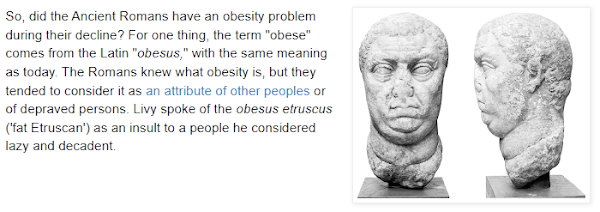 I don't think that Livy said it, but Catullus (39.11) certainly did. I don't have access to David W. Packard, A Concordance to Livy, 4 vols. (Cambridge: Harvard University Press, 1968). Also, obesus in Latin is an auto-antonym, a word that can mean the opposite of itself. It can mean both lean and fat, according to Lewis and Short.
Livy spoke of the obesus etruscus ('fat Etruscan') as an insult to a people he considered lazy and decadent.

Labels: auto-antonyms, typographical and other errors
Linguists
Joshua T. Katz, "What Linguists Are Good For," Classical World 100.2 (Winter, 2007) 99-112
(at 102, footnote omitted):
To most administrators and to all too many of our own colleagues, linguists are covered in nineteenth-century dust, which is, as we all know, a far dustier dust, being tainted with old methodology, than what classical archaeologists encounter in the Roman Forum. Or, alternatively, we are interested in so-called modern linguistic techniques, but these have the stench of social science, which some of our colleagues think smells less good than the Roman sewers' humanities. Either way, we linguists are narrowly focused misfits with a humorless eye for grammar and no interest in, much less imagination for, wider cultural questions. Such is our stereotype, but I have never met a good linguist who fit the bill (certainly none of my teachers did), and all of us must do what we can to combat it, in our scholarship and, even more important, in our teaching. Linguistics is a broad, vibrant, and result-driven discipline, not the recherché domain of fuddy-duddies, and it really shouldn't be very difficult to persuade our students and colleagues that this is so.
Social Media
Excerpt from Li Zhi, "Disciplining the Sangha" (tr. Jennifer Eichman), in A Book to Burn and a Book to Keep (Hidden): Selected Writings of Li Zhi, edd. Rivi Handler-Spitz et al. (New York: Columbia University Press, 2016), p. 184:
Not one finger or ten fingers but millions of fingers will point out your transgression.
A Century of Peace, Security and Wealth
G.M. Trevelyan, "Introducing the
Ideas and Beliefs of the Victorians," in Ideas and Beliefs of the Victorians: An Historic Revaluation
of the Victorian Age (1949; rpt. London: Sylvan Press, 1950), pp. 15-19 (at 17-18):
And it was the England and Scotland of the nineteenth century that supplied the population of those new lands. The birthrate in all classes was so high that our industrial expansion at home was rendered possible. The population of Great Britain rose from under twelve millions in 1811 to thirty-seven millions in 1901. And during those same years the tide of emigration founded these new Britains overseas. As we should not now be capable of peopling vast empty territories, it is as well that we did it just in time, while we were still a very prolific race.
A century of peace, security and wealth was in many respects favourable to the higher aspects of civilisation. In the nineteenth century our fortunate ancestors were not precluded by national poverty from obtaining the books they wanted to study, from making or buying beautiful things or from travelling to see them. The shores and mountains of their own island were opened to them by the new railways, and they had free access to the Alps, to Italy and all the ancient lands of Europe, made significant to them by their study of history and the Classics, by the writings of Shelley and Byron, Ruskin and Browning. It was an age of cheap and rapid book production, patronised by a very large leisured and semi-leisured class, and by prosperous professional and artisan classes. There was a very large public for the many good writers whom England then produced out of these same leisured and professional classes—poets, novelists, historians, scholars, essayists, humorists; many of their names are still household words today, even if too few now read their books. It was a time of active political, philosophical and religious speculations, carried on in an atmosphere of freedom, with the impact of Darwin and Huxley to stimulate it with new conceptions of the universe. It was good, serious stuff that was read. The competition of cheap journalism and literature, aimed at the lowest level of intelligence, only became dangerous at the latter end of the century.
Two Epithets of Poseidon
Homer, Iliad 13.43 (my translation):
Stephanie West on Odyssey 1.68:
earth-bearing, shaking-earthBoth epithets are used exclusively of the god Poseidon. Juxtaposed like this, they make a convenient hexameter ending (also Iliad 9.183, 13.59, 13.677, 14.355, 15.222, 23.584; Odyssey 11.241; sometimes in oblique cases). The presence of γαῖα (gaia = earth) in both compounds, at the beginning in γαιήοχος and at the end in ἐννοσίγαιος, creates a sort of chiastic arrangement.
γαιήοχος ἐννοσίγαιος
Stephanie West on Odyssey 1.68:
γαιήοχος: in Homer this title is Poseidon's alone. Its origin and meaning are controversial, mainly because of uncertainty about -οχος. The poet and his audience, like the tragedians (cf. A. Supp. 816, S. OT 160), probably connected it with ἔχω and understood the compound as 'earth-holding, the Earth Sustainer', but Laconian Γαιάϝοχος (IG V i 213, 9, etc.) rules out this etymology. The usual assumption that the second element is related to ὀχέω, Lat. veho etc., leaves the interpretation of the compound debatable: 'he who rides (as a river) beneath the earth (and thereby shakes it)' Nilsson, 'husband of Gaia' Borgeaud. Meillet's suggestion that the root is *wegh- 'shake', cf. Lat. vexare, is attractive. Cf. Hainsworth on viii 322 and see further Frisk GEW s.v. γαιάοχος, Chantraine, Dictionnaire, s.v. γῆ, LfgrE.J.B. Hainsworth on Odyssey 8.322:
Ποσειδάων γαιήοχος: the form and etymology of the divine name are discussed by C.J. Ruijgh, 'Sur le nom de Poseidon et sur les noms en -α-ϝων, -ι-ϝων,' REG lxxx (1967), 6-16. It is probable that the name consists of Ποσει- (an ossified vocative, cf. Iuppiter) +δα- 'earth', a calque of various oriental divine titles derived ultimately from the Sumerian EN.KI, 'Lord of the Earth': see Palmer, Interpretation, 255-6. The epithet γαιήοχος (< *wegh-, not *segh-, cf. Γαιάϝοχō IG V i 213), 'earth-bearing', is perhaps another version of the same title, with the nuance that the god is 'Lord of the Earth' because he is, or personifies, the 'water under the earth' on which the terrestrial disc, in Near Eastern cosmology, was conceived to float. Further literature in Burkert, Greek Religion, 402.Martha Krieter-Spiro on Iliad 14.135:
Ἐννοσίγαιος 'Earth-shaker' (from γαῖα and ἔνοσις 'tremor') for Poseidon is probably a more recent metrical variant (20× Il., 6× Od., 10× Hes., 1× h.Hom.) of the synonym Ἐνοσίχθων (at 150, 384, etc.; with one exception always in the nom., in total 23× Il., 18× Od., 4× Hes.), since in contrast to Ἐνοσίχθων it is used as a noun and is better adapted to oblique cases. Ἐννοσίγαιος has been linked to both Mycenaean e-ne-si-da-o-ne, attested on tablets from Knossos (M 719, Gg 704), which likely denotes a deity, and Ἐννοσίδας attested at Pind. Pyth. 4.33 and 173 (etc.) (Simon 1980, 70; LfgrE s.v. Ποσειδάων 1470.52 f., 1474.1 ff.).
Monday, May 23, 2022
See
Claudian, Against Rufinus 1.360 (tr. Maurice Platnauer):
See how many cities the barbarians' fires have laid low.
adspice barbaricis iaceant quot moenia flammis.
Bonkers
Pherecrates, fragment 78 (tr. Ian C. Storey):
You're out of your mind, an old man at your age.ὑοσκυαμάω = to be mad from taking henbane: to be raving mad (Liddell-Scott-Jones), from ὑοσκύαμος = henbane, from ὗς = pig and κύαμος = bean.
ὑοσκυαμᾷς ἀνὴρ γέρων.
Sunday, May 22, 2022
At a Loss in This Generation
Qu Yuan, Li Sao, lines 57-64 (tr. David Hawkes):
All others press forward in greed and gluttony,Id., lines 73-74:
No surfeit satiating their demands:
Forgiving themselves, but harshly judging others;
Each fretting his heart away in envy and malice.
Madly they rush in the covetous chase,
But not after that which my heart sets store by.
For old age comes creeping and soon will be upon me,
And I fear I shall not leave behind an enduring name.
I take my fashion from the good men of old:Id., lines 89-96:
A garb unlike that which the rude world cares for.
Truly this generation are cunning artificers,Id., lines 97-100:
From square and compass turn their eyes and change the true measurement,
Disregard the ruled line to follow their crooked fancies;
To emulate in flattery is their only rule.
But I am sick and sad at heart and stand irresolute:
I alone am at a loss in this generation.
Yet I would rather quickly die and meet dissolution
Before I ever would consent to ape their behaviour.
Eagles do not flock like birds of lesser species;
So it has ever been since the olden time.
How can the round and square ever fit together?
How can different ways of life ever be reconciled?
The Best Things
Plato, Gorgias 451e (tr. Walter Hamilton):
You have heard, I suppose, people at parties singing the well-known song where they count up the best things: asserting that the greatest good is health, the next beauty, and the third, according to the author of the song, wealth honestly come by?The song, from D.L. Page, Lyrica Graeca Selecta, no. 447 (tr. C.M. Bowra):
οἴομαι γάρ σε ἀκηκοέναι ἐν τοῖς συμποσίοις ᾀδόντων ἀνθρώπων τοῦτο τὸ σκολιόν, ἐν ᾧ καταριθμοῦνται ᾁδοντες ὅτι "ὑγιαίνειν μὲν ἄριστόν" ἐστιν, τὸ δὲ "δεύτερον καλὸν γενέσθαι, τρίτον δέ", ὥς φησιν ὁ ποιητὴς τοῦ σκολιοῦ, "τὸ πλουτεῖν ἀδόλως".
For a man health is the first and best possession,E.R. Dodds on Plato, Gorgias 451e:
Second best to be born with shapely beauty,
And the third is wealth honestly won,
Fourth are the days of youth spent in delight with friends.
ὑγιαίνειν μὲν ἄριστον ἀνδρὶ θνητῷ,
δεύτερον δὲ φυὴν ἀγαθὸν γενέσθαι,
τὸ τρίτον δὲ πλουτεῖν ἀδόλως,
καὶ τὸ τέταρτον ἡβᾶν μετὰ τῶν φίλων.
The fourth item is omitted by Plato, since it does not depend on any τέχνη. The verses probably reflect aristocratic Greek opinion pretty accurately (cf. Euthyd. 279 ab, Meno 87 e, Hipp. ma. 291 d), though a speaker in a comedy by Anaxandrides (fr. 17) derides them for putting beauty above wealth. Aristotle (Rhet. 1394b11) and Sextus Empiricus (adv. math. 11.49) declare that the ordinary man everywhere puts health first, and the latter quotes a variety of writers from Simonides onward to the same effect. As to personal beauty, we learn from Aeschines (Timarch. 145 [sic, should be 134]) that Athenian parents prayed that their children might be καλοὺς κἀγαθοὺς τὰς ἰδέας καὶ τῆς πόλεως ἀξίους, and from Aristotle (E.N. 1099b3) that ὁ τὴν ἰδέαν παναίσχης cannot be really happy. (Wilamowitz, Glaube der Hellenen, ii.254 f., asserted that the author of the quatrain had more than physical beauty in mind, but Plato does not take it so, and the addition of φυὰν makes it unlikely.) The list is confined to what Aristotle called τὴν ἐκτὸς χορηγίαν: the intellectual goods are conspicuously absent, and only ἀδόλως pays an implicit tribute to virtue. At the end of his life (Laws 661 a) Plato referred to this σκολιόν again, and reaffirmed against it his own belief that all natural good is relative to spiritual good (661 b, 631 bc): the "three best things" are best only for the man who is spiritually healthy; otherwise they can but add to his secret misery.
Sacred Groves
Wendell Berry, The Unsettling of America, chapter 3 ("A Crisis of Agriculture"):
If we are to be properly humble in our use of the world, we need places that we do not use at all. We need the experience of leaving something alone. We need places that we forbear to change, or influence by our presence, or impose on even by our understanding; places that we accept as influences upon us, not the other way around, that we enter with the sense, the pleasure, of having nothing to do there; places that we must enter in a kind of cultural nakedness, without comforts or tools, to submit rather than to conquer. We need what other ages would have called sacred groves. We need groves, anyhow, that we would treat as if they were sacred—in order, perhaps, to perceive their sanctity.
Saturday, May 21, 2022
A Foul Smell
Aristophanes, Wealth 703 (tr. Alan H. Sommerstein):
Erasmus, Adages III vii 34 (tr. Denis L. Drysdall, with his notes):
My farts aren't frankincense!A bit more literally:
οὐ λιβανωτὸν γὰρ βδέω.
Not frankincense do I fart.M.T. Quinn's school edition of Aristophanes' Plutus (London: George Bell and Sons, 1896) omits lines 697-706 altogether. In the preface Quinn admits that his edition is "expurgated".
Erasmus, Adages III vii 34 (tr. Denis L. Drysdall, with his notes):
34 Pedere thusAristophanes' "not frankincense" reminds me of Cervantes' "not ambergris" in Don Quixote 1.21 (tr. John Ormsby):
To fart frankincense
Βδέειν λιβανωτόν, To fart frankincense, has the appearance of a proverb. It will be apt for those who enjoy their own vices or those who are deeply in love. The cause of the former is φιλαυτία 'love of self,' because everyone enjoys his own vices and finds them pleasant, even if they are of the most nauseous sort.1 The cause of the latter is extravagant love: 'Even Agnes' polyp delights Balbinus' as Horace writes.2 And Aristophanes in the Plutus: 'I am not accustomed to farting frankincense.'3 The expression will also suit flatterers who praise the vilest things instead of the most noble.
34 Aristophanes (see n3 below); in Aristophanes the expression is not used proverbially — Erasmus probably associated it with Adagia III iv 2 Everyone thinks his own fart smells sweet (4 above).
1 Cf Adagia I ii 15 What is one's own is beautiful, where the passage from Horace (n2 below) is also quoted.
2 Horace Satires 1.3.40
3 Aristophanes Plutus 703
Βδέειν λιβανωτόν, id est Pedere thus, proverbii speciem habet. Accommodabitur in hos, quorum et vitia placent aut ipsis aut aliis impendio amantibus. Facit enim hoc φιλαυτία, ut unicuique sua placeant arrideantque, etiam si sint putidissima. Facit item hoc amor immoderatus, ut Polypus etiam Agnae delectet Balbinum, veluti scripsit Horatius. Aristophanes in Pluto: Οὐ λιβανωτὸν γὰρ βδέω, id est Non soleo thura pedere. Quadrabit et in assentatores turpissima pro honestissimis laudantes.
Just then, whether it was the cold of the morning that was now approaching, or that he had eaten something laxative at supper, or that it was only natural (as is most likely), Sancho felt a desire to do what no one could do for him; but so great was the fear that had penetrated his heart, he dared not separate himself from his master by as much as the black of his nail; to escape doing what he wanted was, however, also impossible; so what he did for peace's sake was to remove his right hand, which held the back of the saddle, and with it to untie gently and silently the running string which alone held up his breeches, so that on loosening it they at once fell down round his feet like fetters; he then raised his shirt as well as he could and bared his hind quarters, no slim ones. But, this accomplished, which he fancied was all he had to do to get out of this terrible strait and embarrassment, another still greater difficulty presented itself, for it seemed to him impossible to relieve himself without making some noise, and he ground his teeth and squeezed his shoulders together, holding his breath as much as he could; but in spite of his precautions he was unlucky enough after all to make a little noise, very different from that which was causing him so much fear.Related post: An Icelandic Proverb?.
Don Quixote, hearing it, said, "What noise is that, Sancho?"
"I don't know, senor," said he; "it must be something new, for adventures and misadventures never begin with a trifle." Once more he tried his luck, and succeeded so well, that without any further noise or disturbance he found himself relieved of the burden that had given him so much discomfort. But as Don Quixote's sense of smell was as acute as his hearing, and as Sancho was so closely linked with him that the fumes rose almost in a straight line, it could not be but that some should reach his nose, and as soon as they did he came to its relief by compressing it between his fingers, saying in a rather snuffing tone, "Sancho, it strikes me thou art in great fear."
"I am," answered Sancho; "but how does your worship perceive it now more than ever?"
"Because just now thou smellest stronger than ever, and not of ambergris," answered Don Quixote.
"Very likely," said Sancho, "but that's not my fault, but your worship's, for leading me about at unseasonable hours and at such unwonted paces."
"Then go back three or four, my friend," said Don Quixote, all the time with his fingers to his nose; "and for the future pay more attention to thy person and to what thou owest to mine; for it is my great familiarity with thee that has bred this contempt."
"I'll bet," replied Sancho, "that your worship thinks I have done something I ought not with my person."
"It makes it worse to stir it, friend Sancho," returned Don Quixote.
Labels: noctes scatologicae
Self-Appraisal
Excerpt from Li Zhi, "Self-Appraisal" (tr. Rivi Handler-Spitz), in A Book to Burn and a Book to Keep (Hidden): Selected Writings of Li Zhi, edd. Rivi Handler-Spitz et al. (New York: Columbia University Press, 2016), p. 138:
He was by nature narrow-minded and he appeared arrogant. His words were vulgar, and his mind was wild. His behavior was impulsive, his friends few, and his countenance ingratiating. When interacting with people, he took pleasure in seeking out their faults; he did not delight in their strengths. When he disliked people, he cut them off and sought to harm them for the rest of his life.Cf. another translation of the same passage in Rivi Handler-Spitz, Symptoms of an Unruly Age: Li Zhi and Cultures of Early Modernity (Seattle: University of Washington Press, 2017), p. 52:
He was by nature narrow-minded and he appeared arrogant. His words were vulgar, and his mind wild. His behavior was impulsive, and his friends few, but when he got together with them he treated them affectionately. When interacting with people, he took pleasure in seeking out their faults; he did not delight in their strong suits. When he hated people, he cut them off and sought to harm them all his life.
A Censorious Nature
Goethe, Faust, Part II, line 6467 (tr. David Luke):
Why must you men find fault perpetually?Id. 8992-8993:
Ihr Herren wißt an allem was zu mäkeln.
Is a censorious nature so ingrained in you
That your mouth opens only to upbraid and scold?
Ist dir denn so das Schelten gänzlich einverleibt,
daß ohne Tadeln du keine Lippe regen kannst?
Voices
Victor Klemperer (1881-1960), The Language of the Third Reich. LTI – Lingua Tertii Imperii: A Philologist's Notebook, tr. Martin Brady (2000; rpt. London: Bloomsbury, 2013), p. 229:
But there is no vox populi, only voci populi, and it can only be ascertained in retrospect which of these various voices is the true one — I mean the one which determines the course of events.For voci read voces. Compare the German original:
Aber es gibt keine vox populi, sondern nur voces populi, und welche von diesen verschiedenartigen Stimmen nun die wahre, ich meine die den Gang der Ereignisse bestimmende ist, das läßt sich immer nur hinterher feststellen.
Labels: typographical and other errors
Friday, May 20, 2022
Death
Stefan George, "Der Krieg," line 118 (tr. Olga Marx and Ernst Morwitz):
When its gods have died a people dies.
Ein volk ist tot wenn seine götter tot sind.
Disguises
Hermippus, fragment 3 Kassel and Austin (tr. Ian C. Storey):
You seem to have the speech and face of a lamb, but inside you are no different from a serpent.Matthew 7:15 (King James Version):
τὴν μὲν διάλεκτον καὶ τὸ πρόσωπον ἀμνίου
ἔχειν δοκεῖς, τὰ δ᾿ ἔνδον οὐδὲν διαφέρεις
δράκοντος.
Beware of false prophets, which come to you in sheep's clothing, but inwardly they are ravening wolves.
προσέχετε ἀπὸ τῶν ψευδοπροφητῶν, οἵτινες ἔρχονται πρὸς ὑμᾶς ἐν ἐνδύμασιν προβάτων, ἔσωθεν δέ εἰσιν λύκοι ἅρπαγες.
Thursday, May 19, 2022
The View from Here
Goethe, Faust, Part II, lines 4782-4786 (tr. David Luke):
Look down from this high place, look far and wideThe same (tr. Bayard Taylor):
Over the empire: it must seem
A nightmare of deformity, a dream
Of monsters, law to lawless power unfurled,
And rooting error spread about the world.
Wer schaut hinab von diesem hohen Raum
Ins weite Reich, ihm scheint's ein schwerer Traum,
Wo Mißgestalt in Mißgestalten schaltet,
Das Ungesetz gesetzlich überwaltet
Und eine Welt des Irrtums sich entfaltet.
Who looks abroad from off this height supremeThe same (tr. Stuart Atkins):
Throughout the realm, 'tis like a weary dream,
Where one deformity another mouldeth,
Where lawlessness itself by law upholdeth,
And 'tis an age of Error that unfoldeth.
If from this lofty vantage point one views below
your far-flung realm, it seems an ugly dream
in which Deformity holds sway among deformities
and Lawlessness prevails by legal means
as Error spreads and fills the world with error.
Scholarship and Stamp-Collecting
Leslie Mitchell, Maurice Bowra: A Life (Oxford: Oxford University Press, 2009), p. 80, with notes on p. 329:
As Maurice, self-mockingly, described his working methods, it was all a matter of perspiration and akin to stamp collecting: 'My long and boring book goes on and on. There is a lot of nonsense about learning. It is really a substitute for stamp-collecting, but instead of coloured bits of paper one collects comic little facts in the faint, far hope that one day they will fall into a pattern. But of course they don't.'57 He used nearly the same words to a goddaughter:Arthur Stanley Pease, quoted in J.P. Elder et al., "Arthur Stanley Pease 1881-1964," Harvard Studies in Classical Philology 69 (1965) ix:I have begun work on a subject so obscure that I can't tell anyone about it. It is quite mad, and I have no qualifications for it. Not that that has ever hindered me. I collect bits of useless information and put them together. It is just as if, after fifty years, I had gone back to stamp-collecting. It provides what Tennyson calls 'the sad mechanic exercise', words most appropriate to what we dignify by the name of learning.5857. C.M. Bowra to A. James, 3 Dec. [1950]; Harvard, Houghton Lib., BMS AM 1938 (152).
58. Idem to C. Clark, 28 Dec. [1960], C. Clark MSS.
I will confess that I am by nature a collector, that I began with marbles and horse-chestnuts, advanced to postage stamps, continued with botany and books, and at all times have gathered facts and occasionally ideas.
These two latter items, in lack of sufficient cranial space for dead storage, I enter methodically on 3 x 5 slips of paper. When enough of a kind are amassed, they are outspread, classified, digested, written down, dehydrated, and lo! an article, or more rarely a book, to be perused by some lone watcher in Czechoslovakia or beside the Bay of Biscay.
Wednesday, May 18, 2022
Rude Behavior
Pherecrates, fragment 93 Kassel and Austin (preserved by Pollux 10.45, from the lost play Korianno; tr. Ian C. Storey):
On the supposed etymological connection between Greek λάσανα and Italian lasagna see B.L. Ullman, "Horace Serm. I.6.115 and the History of the Word Laganum," Classical Philology 7.4 (October, 1912) 442-449, rejected by Anthony F. Buccini, "Lasagna: A Layered History," in Wrapped & Stuffed Foods: Proceedings of the Oxford Symposium on Food and Cookery 2012 (Totnes: Prospects Books, 2013), pp. 94-104.
On this fragment see Eduardo Urios-Aparisi, The Fragments of Pherecrates (diss. University of Glasgow, 1992), pp. 287-288.
Putting a chamber pot beside my head he farted.The main verb (πέρδεται) is in the present tense.
πρὸς τῇ κεφαλῇ μου λάσανα καταθεὶς πέρδεται.
On the supposed etymological connection between Greek λάσανα and Italian lasagna see B.L. Ullman, "Horace Serm. I.6.115 and the History of the Word Laganum," Classical Philology 7.4 (October, 1912) 442-449, rejected by Anthony F. Buccini, "Lasagna: A Layered History," in Wrapped & Stuffed Foods: Proceedings of the Oxford Symposium on Food and Cookery 2012 (Totnes: Prospects Books, 2013), pp. 94-104.
On this fragment see Eduardo Urios-Aparisi, The Fragments of Pherecrates (diss. University of Glasgow, 1992), pp. 287-288.
Labels: noctes scatologicae
Changes
J.R.R. Tolkien, The Lord of the Rings, Part I: The Fellowship of the Ring, 2nd ed. (Boston: Houghton Mifflin Company, 1987), p. 276 (Book II, Chapter 2; Gandalf quoting Old Gamgee):
"I can't abide changes," said he, "not at my time of life, and least of all changes for the worst." "Changes for the worst," he repeated many times.Isocrates, Nicocles 55 (tr. Yun Lee Too):
Maintain the present order of things, and do not desire change, knowing that through disturbances states must perish and private households must be overturned.
διαφυλάττετε τὴν παροῦσαν κατάστασιν, καὶ μηδεμιᾶς ἐπιθυμεῖτε μεταβολῆς, εἰδότες ὅτι διὰ τὰς ταραχὰς ἀναγκαῖόν ἐστι καὶ τὰς πόλεις ἀπόλλυσθαι καὶ τοὺς οἴκους τοὺς ἰδίους ἀναστάτους γίγνεσθαι.
A Failure
Chang Tai (1597-1684?), "An Epitaph for Myself" (excerpt), in Vignettes from the Late Ming: A Hsiao-p'in Anthology. Translated with Annotations and an Introduction by Yang Ye (Seattle: University of Washington Press, 1999), p. 100:
He studied calligraphy, and he failed. He studied swordsmanship, and he failed. He studied morals and ethics, and he failed. He studied literature, and he failed. He studied Taoism, Buddhism, farming, and gardening and he failed in all. He could only let himself be called a wastrel, a good-for-nothing, a misfit, a dull-witted pedant, a sleepyhead, or a damned old fogy.Mutatis mutandis, de me fabula narratur.
Tuesday, May 17, 2022
Books
Aldous Huxley, Eyeless in Gaza, chapter X:

Gerrit van Vucht, Stilleven met boeken (Rotterdam,
Museum Boijmans Van Beuningen, inv. no. 1285)

Gerrit van Vucht, Still Life with a Skull and Books (Oxford,
Ashmolean Museum of Art and Archaeology, acc. no. WA1940.2.77)
Newer› ‹Older
Books. The table in Anthony's room was covered with them. The five folio volumes of Bayle, in the English edition of 1738. Rickaby's translation of the Summa contra Gentiles. De Gourmont's Problème du Style. The Way of Perfection. Dostoevsky's Notes from Underground. Three volumes of Byron's Letters. The works of St. John of the Cross in Spanish. The plays of Wycherley. Lee's History of Sacerdotal Celibacy.
If only, Anthony thought as he came in from his walk, if only one had two sets of eyes! Janus would be able to read Candide and the Imitation simultaneously. Life was so short, and books so countlessly many. He pored voluptuously over the table, opening at random now one volume, now another.

Museum Boijmans Van Beuningen, inv. no. 1285)

Ashmolean Museum of Art and Archaeology, acc. no. WA1940.2.77)

