Friday, June 17, 2022
An Inscription on a Greek Vase
Attic red-figure kylix by Phintias, about 510 B.C. (Malibu, Getty Museum, 80.AE.31):
 From the Getty Museum web site:
Also from the Getty Museum web site:
Leslie Threatte (1943-2021), The Grammar of Attic Inscriptions, II: Morphology (Berlin: de Gruyter, 1996), p. 641: In other words, if Threatte's reading is adopted, the youth is saying ἥδομαι (I'm enjoying myself).
This inscription isn't listed in Henry R. Immerwahr, Corpus of Attic Vase Inscriptions, where the vase is mentioned under number 4943.

At the top, an inscription, E [...] A I E Λ O, perhaps uttered by the youth (whose lips are parted and who gestures with his right hand).To me it looks like he's gesturing with his left hand.
Also from the Getty Museum web site:
On B Ε[.]ΑΙΕΛΟ The letters are not easily recognisable, as the color has flaked off.The vase is apparently 1620.12 bis in J.D. Beazley, Attic Red-Figure Vase-Painters, 2nd ed. (Oxford, 1963), which is unavailable to me.
Leslie Threatte (1943-2021), The Grammar of Attic Inscriptions, II: Morphology (Berlin: de Gruyter, 1996), p. 641:

This inscription isn't listed in Henry R. Immerwahr, Corpus of Attic Vase Inscriptions, where the vase is mentioned under number 4943.
Changes in the Meaning of Words
Claudian, Against Eutropius 2.206-208 (tr. Maurice Platnauer):
Why give fair names to shameful weakness? Cowardice is called loyalty; fear, a sense of justice.George Orwell, 1984, chapter 1:
quid pulchra vocabula pigris
praetentas vitiis? probitatis inertia nomen,
iustitiae formido subit.
The Ministry of Truth — Minitrue, in Newspeak — was startlingly different from any other object in sight. It was an enormous pyramidal structure of glittering white concrete, soaring up, terrace after terrace, 300 metres into the air. From where Winston stood it was just possible to read, picked out on its white face in elegant lettering, the three slogans of the Party:Cf. Thucydides 3.82.4 (tr. Richard Crawley):WAR IS PEACE
FREEDOM IS SLAVERY
IGNORANCE IS STRENGTH
Words had to change their ordinary meaning and to take that which was now given them. Reckless audacity came to be considered the courage of a loyal ally; prudent hesitation, specious cowardice; moderation was held to be a cloak for unmanliness; ability to see all sides of a question inaptness to act on any. Frantic violence, became the attribute of manliness; cautious plotting, a justifiable means of self-defence.Cf. also B. Hale Wortham, tr., The Śatakas of Bhartṛihari (London: Trübner & Co., 1886), pp. 8-9:
καὶ τὴν εἰωθυῖαν ἀξίωσιν τῶν ὀνομάτων ἐς τὰ ἔργα ἀντήλλαξαν τῇ δικαιώσει. τόλμα μὲν γὰρ ἀλόγιστος ἀνδρεία φιλέταιρος ἐνομίσθη, μέλλησις δὲ προμηθὴς δειλία εὐπρεπής, τὸ δὲ σῶφρον τοῦ ἀνάνδρου πρόσχημα, καὶ τὸ πρὸς ἅπαν ξυνετὸν ἐπὶ πᾶν ἀργόν: τὸ δ᾽ ἐμπλήκτως ὀξὺ ἀνδρὸς μοίρᾳ προσετέθη, ἀσφαλείᾳ δὲ τὸ ἐπιβουλεύσασθαι ἀποτροπῆς πρόφασις εὔλογος.
The moderate man's virtue is called dulness; the man who lives by rigid vows is considered arrogant; the pure-minded is deceitful; the hero is called unmerciful; the sage is contemptuous; the polite man is branded as servile, the noble man as proud; the eloquent man is called a chatterer; freedom from passion is said to be feebleness. Thus do evil-minded persons miscall the virtues of the good.Thanks to Kevin Muse for drawing my attention to Plato, Republic 560e (tr. Paul Shorey):
In celebration of their praises they euphemistically denominate insolence 'good breeding,' licence 'liberty,' prodigality 'magnificence,' and shamelessness 'manly spirit.'Related posts:
ἐγκωμιάζοντες καὶ ὑποκοριζόμενοι, ὕβριν μὲν εὐπαιδευσίαν καλοῦντες, ἀναρχίαν δὲ ἐλευθερίαν, ἀσωτίαν δὲ μεγαλοπρέπειαν, ἀναίδειαν δὲ ἀνδρείαν.
Thursday, June 16, 2022
Epitaph for a Roman Freedwoman
Robert E.A. Palmer, "A Poem of All Seasons: AE 1928.108,"
Phoenix 30.2 (Summer, 1976) 159-173 (at 159-160, line numbers added in right margin):
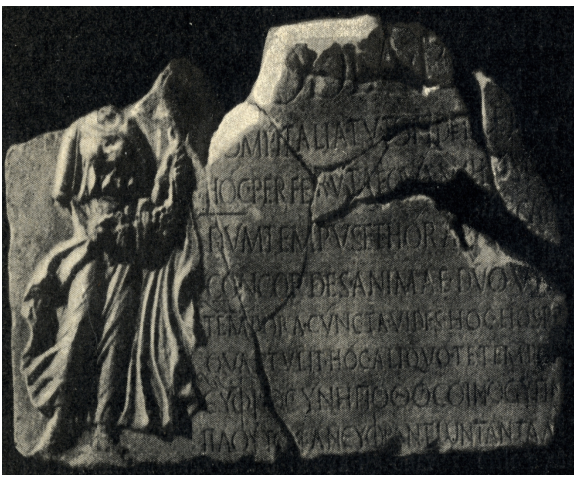
C[l]odia P(ubli) l(iberta) - - - 1Palmer didn't translate the first line, i.e. "Clodia, freedwoman of Publius." Palmer also didn't publish a photograph of the stone, so here it is:
(1) Compitalia tu totidem [qui concelebrasti] / hoc 2
(2) perfer. ut aequa mih[ifuerint Fata aspi]ce. t[um] / dum 3
(3) tempus et hora [mihi, dum suppeditat] quo[que vita], 4
(4) concordes animae duo vix[imus anno]s cas[tos]. 5
(5) Tempora cuncta vides. hoc, hospe[s, te monet hora] 6
(6) quae tulit hoc. aliquo te tempor[e terra tenebit]. 7
(1) εὐφροσύνη, πόθος, οἶνος, ὕπν[ος ταῦτ' ἐστὶ βροτοῖσι] 8
(2) πλοῦτος· ἀνευφράντων Ταντάλ[ου ἐστὶ βίος]. 9
APPARATUS
2 suppl. Palmer totide—et Lugli totide[m] te SEG 3 suppl. Palmer mihi quo Lugli 4 suppl. Palmer ---gas Lugli hora[e---]ga s SEG 5 vix[imus atque perimus Lugli anno]s cas[tos Palmer 6 hospe[s te monet annus Lugli hora Palmer 7 suppl. Lugli 8 ὕπν[ος Lugli ταῦτ' ἐστὶ βροτοῖσι Beazley μόνα ἐστὶ βροτοῖσι Harrison τέρψει σε βιοῦντα De Sanctis 9 Ταντάλ[ου ἐστὶ βίος Beazley τανταλ[ίσει σε κόρῳ De Sanctis
"You who have shared in as many Compitalia, endure this (death of mine). Consider how fair the Fates have been to me. Yesteryear while I (still) had a season and some time, while life, too, was in me, we both lived together in harmony and fidelity."2 "You see all the Seasons (figured here). Time warns you of this, stranger,—Time who brought this. At some season the earth shall hold you. Mirth, love, wine, sleep, these are men's riches; the mournful lead the life of Tantalus."
On the same stone as the inscription a relief of one of the four Seasons (Horae) is sculptured.
2 Duo may modify annos. Hence, "We lived two years in harmony and fidelity."

Withdrawing to the Vanishing Point
M.F.K. Fisher (1908-1992), Map of Another Town: A Memoir of Provence (Boston: Little, Brown and Company, 1964), p. 10:
It is mainly a question of withdrawing to the vanishing point from the consciousness of the people one is with, before one actually leaves. It is invaluable at parties, testimonial dinners, discussions of evacuation routes in California towns, and coffee-breaks held for electioneering congressmen …
Orcs
Robert Stuart, Tolkien, Race, and Racism in Middle-Earth (Cham: Palgrave Macmillan, 2022), p. 150:
Hearing the 'savage sound' of a chainsaw at work, he would exclaim 'Orcs!' (Sayer 1995, 23). A motorcyclist roaring past would evoke the same outraged exclamation: 'there is an Orc!' (Ordway 2021, 7). For Tolkien, modernity's apparatus of mechanised noise, pollution, and destruction was everywhere 'manned' by Orcs.References (id., p. 162):
Ordway, H. (2021) Tolkien's Modern Reading: Middle-earth Beyond the Middle Ages, Park Ridge IL: Word on Fire Academic.
Sayer, G. (1995) 'Recollections of J.R.R. Tolkien', in P. Reynolds and G. GoodKnight (eds). Proceedings of the J.R.R. Tolkien Centenary Conference, Keble College, Oxford, 1992, Altadena, CA: Mythopoeic Press, pp. 21–25.
Wednesday, June 15, 2022
Professors and Clods
Andrew T. Weil, "Joshua Whatmough," Harvard Crimson (May 3, 1963):
To observe the forms of his eccentricity one might listen to him lecture in Linguistics 100 ("Language"), impressively described in the catalogue of courses as dealing with such topics as the "Theory of Communication," "Language and the Nature of Man," "Language and Literature," and so forth. Actually, when Professor Whatmough lectures in Linguistics 100, he dispenses with these problems in thirty minutes. The rest of the hour gives him a chance to hold forth on everything that he feels needs speaking out against. He does this in the most elegantly precise English to be heard in Cambridge and often illustrates his points with Latin or Greek quotations which he clearly expects his listeners to understand. His manner of delivery varies with his subject. He can be quietly incisive ("A professor should be a person, not a clod. The whole system of Ph.D.'s in certain fields tends to turn professors into clods. I do not have a Ph.D.") or, if the situation demands, violently destructive ("Linguistics has much to offer psychology; psychology has nothing to offer linguistics. And that nothing is wrong.") Certain issues (whether anyone has the right to control what professors say in classes, for one) turn him purple with rage — invariably an awesome transformation. And when it is all over, Whatmough smiles, adjusts his cornflower, takes up his walking stick and leaves the lecture room contented.
Spear and Bow
Calvert Watkins (1933-2013), How to Kill a Dragon: Aspects of Indo-European Poetics (New York: Oxford University Press, 1995), pp. 21-22:
Anyone who knows by heart the couplet of the Greek soldier-poet Archilochus (2 IEG):ἐν δορὶ μὲν μοι μᾶζα μεμαγμένη, ἐν δορὶ δ᾽ οἶνοςwith its triple figure of anaphora of the weapon, will surely recognize and respond to the same figure of anaphora, this time five-fold, of another weapon in Rigveda 6.75.2:
Ἰσμαρικός, πίνω δ᾽ ἐν δορὶ κεκλιμένος,
In my spear is my kneaded bread; in my spear
Ismarian wine; I drink leaning on my spear,dhánvanā gā́ dhánvanājíṃ jayema
dhánvanā tīvrā́ḥ samádo jayema
dhánuḥ śátror apakāmáṃ kṛṇoti
dhánvanā sárvāḥ pradíśo jayema
With the bow may we win cattle, with the bow the fight;
with the bow may we win fierce battles.
The bow takes away the enemy's zeal;
with the bow may we win all the regions.
A Know-It-All
Dio Cassius 78.11.5 (on Caracalla; tr. Earnest Cary):
But this same emperor made many mistakes because of the obstinacy with which he clung to his own opinions; for he wished not only to know everything but to be the only one to know anything, and he desired not only to have all power but to be the only one to have power. Hence he asked no one's advice and was jealous of those who had any useful knowledge. He never loved anyone, but he hated all who excelled in anything, most of all those whom he pretended to love most; and he destroyed many of them in one way or another.
ὅτι ὁ αὐτὸς αὐτογνωμονῶν πολλὰ ἐσφάλη· πάντα τε γὰρ οὐχ ὅτι εἰδέναι ἀλλὰ καὶ μόνος εἰδέναι ἤθελε, καὶ πάντα οὐχ ὅτι δύνασθαι ἀλλὰ καὶ μόνος δύνασθαι ἠβούλετο, καὶ διὰ τοῦτο οὔτε τινὶ συμβούλῳ ἐχρῆτο καὶ τοῖς χρηστόν τι εἰδόσιν ἐφθόνει. ἐφίλησε μὲν γὰρ οὐδένα πώποτε, ἐμίσησε δὲ πάντας τοὺς προφέροντας ἔν τινι, μάλιστα δὲ οὓς μάλιστα ἀγαπᾶν προσεποιεῖτο· καὶ αὐτῶν συχνοὺς καὶ διέφθειρεν τρόπον τινά.
Epitaph of Telesistratos
John Granger Cook, Empty Tomb, Resurrection, Apotheosis (Tübingen: Mohr Siebeck, 2018 = Wissenschaftliche Untersuchungen zum Neuen Testament, 410), p. 227:
Thanks very much to Tim Parkin for sending me the photograph from IGUR III, 1341:
An inscription in Rome, for example, appears on a stone on which are depicted erotic scenes:Unfortunately I haven't been able to see the photograph in Inscriptiones Graecae Urbis Romae. Curavit L. Moretti. Fasciculus IV (1491-1705). Revidenda potiora (Rome: Istituto Italiano per la Storia Antica, 1990), p. 167. The stone is now in Rome (Banco di Sardegna, via Boncompagni 6), according to Moretti, op. cit., p. 165.From Germa Hiera I, Teleistratos [sic, read Telesistratos], repose in the Isles of the Blessed; I want to use these things again! During my life this was the only gain!371 IGUR III, 1341, published originally by F. Cumont, Une pierre tombale érotique de Rome, AntCl 9 (1940) 5–11 (five rows of vulvae, a monstrously erect male, and below a triangle containing the letters ΔΡΜ, another vulva). Cp. the photograph and location in IGUR IV, 1341. Trans. (and discussion) by F. dell'Oro, "Anacreon, the Connoisseur of Desires." An Anacreontic Reading of Menecrates' Sepulchral Epigram (IKyzikos 18, 520 = Merkelbach/Stauber SGO 08/01/47 Kyzikos), in: Imitate Anacreon!: Mimesis, Poiesis, and the Poetic Inspiration in the Carmina Anacreonta, ed. M. Baumbach and N. Dümmler, Berlin 2014, 67–93, esp. 87. SGO is R. Merkelbach and J. Stauber, ed., Steinepigramme aus dem Griechischen Osten, 5 vols., Stuttgart et al. 1998–2004.
Γέρμης ἐξ Ἱερῆς / Τελεσίστρατος ἐν / μακάρων νήσοις κεῖμαι, / ἔτι τῶνδε χρέος ποθέω· / τοῦτο μόνον ζῶν ἐκέρδησα.371
Thanks very much to Tim Parkin for sending me the photograph from IGUR III, 1341:

A Classical Education
Ezra Pound, radio broadcast from 1941, in Ezra Pound Speaking. Radio Speeches of World War II. Edited by Leonard W. Doob (Westport: Greenwood Press, 1978), p. 391:
In fact a classical education WOULD be useful if the universities didn't wrap it in cotton wool, and keep the stewdents from reading the more vital passages.
In fact a little Greek of the right kind or even readin' some with a crib IF you have the real curiosity would be useful.
[....]
When will American college students realize that almost ANY bit of real knowledge would keep 'em from being dead rabbits? Aristotle, Demosthenes, Mencius or Confucius, all antidotes to bein' suckers.
[....]
And of course it is a mere matter of opinion, but it WAS Aristotle's opinion, expressed in the 5th book of his Politics, that the three qualities which supreme magistrates ought to possess are loyalty to established constitutions; secondly, great capacity for the duties of the office; and thirdly, virtue and justice.
Tuesday, June 14, 2022
Epitaph of Philetos
Richmond Lattimore, Themes in Greek and Latin Epitaphs (1935; rpt. Urbana: University of Illinois Press, 1962), p. 84:
μηδὲν ἄγαν φρονέων, θνητὰ δὲ πάνθ' ὁρόω[νThe order of the clauses is mixed up in Lattimore's translation. I would revise it as follows:
ἦλθον, ἀπῆλθον ἄμεμπτος, ἃ μὴ θέμις οὐκ ἐδόκευσα,
εἴτ' ἤμην πρότερον, εἴτε χρόνοις ἔσομαι.472
I believed in overdoing nothing. I came and went away blameless. I observed everything human, but did not pry into what is forbidden, or seek to know whether I existed before or whether I ever shall again.
472 EG 615, 4-6 (Sena Gallica, 2d or 3d cent. A.D.). For further variations in Greek, cf. IGR 3, 1438; Ramsay 635; Cumont, op. cit.
I believed in overdoing nothing. I observed everything human. I came and went away blameless. I did not pry into what is forbidden, whether I existed before or whether I ever shall again.Cf. the translation of the entire inscription in G.H.R. Horsley, New Documents Illustrating Early Christianity, Vol. 4: A Review of Greek Inscriptions and Papyri published in 1979 ([North Ryde:] Ancient History Documentary Research Centre, Macquarie University, 1987), p. 32:
To the underworld gods. I was like I was in my speech, spirit, and form, possessing the implanted soul of a person just born, happy in friendship and fortunate in my mind, holding the view 'nothing in excess', and viewing everything as mortal. I came (i.e., into the world), I departed blameless, I did not think about things which I ought not to: whether I had a previous existence, whether I shall have one in time (to come). I was educated, I educated (others), I shackled the vault of the universe, declaring to men the divine virtues which proceed from the gods. The dear earth conceals me; yet what was my pure name? I was Philetos, a man beloved by all, from Limyra in Lykia.See also Andrzej Wypustek, "Laughing in the Face of Death: a Survey of Unconventional Hellenistic and Greek-Roman Funerary Verse-Inscriptions," Klio 103 (2021) 160-187 (at 170-171).
Numberless Barbarian Hordes
Ammianus Marcellinus 31.4.6 (tr. John C. Rolfe):
With such stormy eagerness on the part of insistent men was the ruin of the Roman world brought in. This at any rate is neither obscure nor uncertain, that the ill-omened officials who ferried the barbarian hordes often tried to reckon their number, but gave up their vain attempt; as the most distinguished of poets says [Vergil, Georgics 2.105-106]:Related post: Refugees.Who wishes to know this would wish to knowita turbido instantium studio orbis Romani pernicies ducebatur. illud sane neque obscurum est neque incertum, infaustos transvehendi barbaram plebem ministros, numerum eius comprehendere calculo saepe temptantes, conquievisse frustratos, "quem qui scire velit" ut eminentissimus memorat vates, "Libyci velit aequoris / idem discere quam multae zephyro truduntur harenae."
How many grains of sand on Libyan plain
By Zephyrus are swept.
ducebatur V: adducebatur Mommsen: augebatur Heraeus
truduntur V: turbentur A, codd. Vergilii
Repertories of Conjectures
Egil Kraggerud, Critica: Textual Issues in Horace, Ennius, Vergil and Other Authors (Abingdon: Routledge, 2020), p. 15, with note on p. 27:
Only in the case of a small handful of ancient authors7 have there been serious undertakings in more recent times to collect the whole output of conjectures. A full survey of conjectures from the start of the printing era until the present day, however, is an indispensable prerequisite for any critical editing of a classical text, no less so than a complete catalogue is necessary to the user of a library. That few scholars have so far given priority to the matter should not be normative for future priorities among scholars. The drawbacks and calamities following in the wake of ignorance are, of course, difficult to measure like any contra-factual evaluation. To cut the argument short, however: easily available complete information in this regard would be a particular boon to editors and commentators alike, and I am equally sure that time-saving repertories of conjectures would have much to offer philologists in general as well.In the note, make the following corrections:
7 Aeschylus: R.D. Dawe, Repertory of Conjectures on A., Leiden: Pindar, 1965; D.E. Gerber, Emendations in Pindar 1513–1972, Amsterdam: Hakkert, 1976. — Sophocles: L. van Paassen (not printed, but gratefully consulted by editors of Sophocles: R.D. Dawe and H. Lloyd-Jones – N.G. Wilson. — Catullus: D. Kiss, An Online Repertory of Conjectures, Catullus Online. — Propertius): W. R. Smyth, Thesaurus criticus ad Sexti Propertii textum, Leiden: E. J. Brill, 1970; Seneca: M. Billerbeck – M. Somazzi, Repertorium der Konjekturen in den Seneca-Tragödien [Mnemosyne. Suppl. 316], Leiden: Brill 2009.
- For "Leiden: Pindar, 1965;" read "Leiden: E.J. Brill, 1965; Pindar —"
- For "Propertius):" read "Propertius:"
Carpe Diem
Jacques Perret (1906-1992), Horace, tr. Bertha Humez ([New York:] New York University Press, 1964), pp. 94-95:
The famous phrase Carpe diem, "Pluck the passing day," makes us grasp, I believe, one of the most essential aspects of Horace's moral personality. It is, naturally, in rapport with his temperament: this man of Mercury had the mobility of quicksilver; he was impulsive and volatile. Nevertheless, it is doubtful that he would have adopted this point of view if he had not attributed a true moral value to it. In fact, he places it in opposition to those vices that always most horrified him and that he battled all his life. One of the greatest reproaches that he makes against ambition and the love of riches is that these passions mortgage and annul the present—which one neglects to experience for what it is—in favor of a future that is surely chimerical, since, even if it were to be realized, and nothing is less certain, one would turn away from it at once: for one would not know how to live in it, forever driven on by the same incapacity that makes us strangers to the time in which we are living now. In future projects Horace always feared a treason to the present, the surest mark of moral instability and weakness.Id., pp. 96-97:
Horace, then, did not like to think of the future. For him, tomorrow was the place not of hope but of uncertainties, and it was better not to try to dissipate these, for the only certitude that one risked finding instead was death. Yet death has a considerable place in the Odes, and it is clear that Horace did not like it. He did not seek to dress it up, or to volatilize it, or to persuade himself that it is a natural phenomenon that we should accept with indifference or at least without sadness. On that head, how little of an Epicurean he is! He did not succeed—but very rare, I think, are those who do—in living really entirely in the succession of present instants. Instead of feeling moment grains under his fingers like so many infrangible diamonds, he had a feeling of evanescence, and in the presence of that feeling he was without recourse. Most of us escape that anguish only by placing all our interest, all our love, in some great continuity external to ourselves, the fortunes of which will not be compromised by our own death. Horace's morality does not offer him this remedy. Should we pity him? Pity and condemn him both? If we could undertake a dialogue with him, would he not have much to say to us on the inhumanity, oversimplifications, and rejections that our behavior often dissimulates?The translation seems awkward in parts, e.g. "Instead of feeling moment grains under his fingers like so many infrangible diamonds," where the French reads "Au lieu de sentir sous ses doigts la granulation des moments comme autant de diamants infrangibles."
Monday, June 13, 2022
Bloods
Jacob Wackernagel (1853-1938), Lectures on Syntax, ed. and tr. David Langslow (Oxford: Oxford University Press, 2009), p. 18 (editor's footnotes omitted):
In the earliest period, Christian texts in Latin are almost exclusively translations from Greek texts, translations, moreover, which were made not by the intellectual elite but by simple people of limited education and learning, for whom the wording of the original was surrounded by a sacred halo. As a result, when they produced versions of holy texts, they committed gross infringements of the rules of their own language. For example, in an old translation of the New Testament, which is known in fragments—i.e., not in the Vulgate—we read at Mark 4:11 omnia dicitur, 'all things (pl.) is said (sg.)'. In Latin it is a glaring solecism to use a singular verb with a plural subject. This is explained by the fact that the Greek original has πάντα γίγνεται 'everything (pl.) comes to pass (sg.)', with the familiar Greek construction (neuter plural subject with singular verb; cf. I, 101–3 below). Similarly, in the so-called Clementina, Greek participles in the genitive absolute are rendered with genitives in the Latin, e.g. §43 contendentium tribuum, 'while the tribes were disputing'. Or again, in just the same way it can happen that in texts of the Bible even Hebraisms enter Latin. Several times in the Old Testament we have the expression ἀνὴρ αἱμάτων (lit. 'man of bloods (pl.)': 2 Kings 16:7, 8; Psalms 5:7, 25:9, etc.; Proverbs 29:10). From a Greek point of view the descriptive genitive is anomalous and so, too, is the plural, 'bloods' (αἵματα occurs only in poetry). Both features are conditioned by the Hebrew original, and accordingly the phrase used in the Latin text is uir sanguinum. This is particularly striking because sanguis in Latin has otherwise no plural at all; the grammarians, who take no notice of Christian Latin, make this an explicit rule (Servius on Aen. 4.687; Priscian 5.54 = GL II, 175).Servius on Aen. 4.687:
nec sanguines dicimus numero plurali nec cruores.See also Augustine, Enarrationes in Psalmos 50.16:
expressit latinus interpres verbo minus latino proprietatem tamen ex graeco. nam omnes novimus latine non dici sanguines, nec sanguina; tamen quia ita graecus posuit plurali numero, non sine causa, nisi quia hoc invenit in prima lingua hebraea, maluit pius interpres minus latine aliquid dicere, quam minus proprie.
An Anti-Intellectual
Dio Cassius 78.11.2 (on Caracalla; tr. Earnest Cary):
Indeed, he had no regard whatever for the higher things, and never even learned anything of that nature, as he himself admitted; and hence he actually held in contempt those of us who possessed anything like education.
οὐδὲν γὰρ τῶν καλῶν ἐλογίζετο· οὐδὲ γὰρ ἔμαθέ τι αὐτῶν, ὡς καὶ αὐτὸς ὡμολόγει, διόπερ καὶ ἐν ὀλιγωρίᾳ ἡμᾶς τούς τι παιδείας ἐχόμενον εἰδότας ἐποιεῖτο.
A Good Death
Leslie Mitchell, Maurice Bowra: A Life (Oxford: Oxford University Press, 2009), p. 302, with notes on p. 364:
In the late 1950s, he was despatched to a nursing home to be nursed through a bout of influenza. A bachelor, with no family to care for him, he had no choice in the matter. But it was an unpleasant foretaste of what was to come: 'To parody a great man—Ah the sweat and the stink and the expense. All that washing of one's arse by elderly nurses and those bed pans ... Not again for me. Better a quiet ending and a good end to the long, cloudy day.'93 When an elderly don collapsed in the street, Maurice rather envied his clean break with life: 'Dear Dawkins died very nicely in front of this college. He fell down in the street and was off to eternity ... A nice end, and may I have one like it.'94Id., p. 307, with notes on p. 366:
93. C.M. Bowra to P. Hadley, 10 Dec. [1958/9]; Bowra MSS.
94. Idem to N. Annan, 12 June [1955]; King’s Coll., Cambridge, Annan MSS.
Maurice died suddenly on 2 July 1971. He had suffered a massive heart attack, and this was exactly what he had hoped for. Of course, death was a fearsome thing, and 'most men shrank from asking what death really means, and to think of it too precisely is to feel the reason unseated ... the very essence of its terror ... is precisely that it cannot be understood or imagined, and therefore cannot be faced'.132 But, in Maurice's view, 'death is all right but not to be bed-ridden and gaga for years'.133 What terrified him was the idea that he might witness the slow disintegration of his mental and physical powers, even becoming helpless.
132. C.M. Bowra, Inspiration and Poetry (London, 1955), 257.
133. Idem to C. Connolly, 17 May 1970; Connolly MSS.
The View from Cambridge
Bernard DeVoto (1897-1955), Across The Wide Missouri (1947; rpt. Boston: Houghton Mifflin Company, 1964), p. 65:
Essentially Wyeth's plan was sound and on paper it looked foolproof. But Nate Wyeth lived in Cambridge, and in Cambridge the world has always seemed simpler, more high-minded, and more amenable to reason than it proves to be when one goes out to mingle with the children of darkness.
Sunday, June 12, 2022
Flimflam
Ezra Pound, radio broadcast on July 25, 1943, in Ezra Pound Speaking. Radio Speeches of World War II. Edited by Leonard W. Doob (Westport: Greenwood Press, 1978), pp. 376-377:
Some of you MUST stand back now and then, and sift out what you hear on your air. What you read in your papers. Must perceive that most of it is flimflam, that is, stuff poured out to get your mind off the fact, and to KEEP you from reflecting on the facts, and keep you from thinking at all of a sane order.Id., radio broadcast from 1942, p. 396:
For a decade or more, everyone NOT wholly blinded and hoodwinked has been remarking on the peculiar stink of your press, the mixture of dung and saccharin dished up each morning in your newspapers.
Runners
Panathenaic prize amphora, 333/332 BC (British Museum, inv. no. 1856,1001.1):


Curiosity
Dio Cassius 76.13.2 (on Severus; tr. Earnest Cary):
He inquired into everything, including things that were very carefully hidden; for he was the kind of person to leave nothing, either human or divine, uninvestigated.Related post: Aimless Incursions into Knowledge.
καὶ ἐπολυπραγμόνησε πάντα καὶ τὰ πάνυ κεκρυμμένα· ἦν γὰρ οἷος μηδὲν μήτε ἀνθρώπινον μήτε θεῖον ἀδιερεύνητον καταλιπεῖν.
War and Peace
Cicero, Letters to Atticus 7.14.2 (Cales, 25 January 49; tr. D.R. Shackleton Bailey):
I continue to urge peace. Even an unjust peace is better than the most just of wars against one's countrymen. But that's as fortune wills.
equidem ad pacem hortari non desino; quae vel iniusta utilior est quam iustissimum bellum cum civibus. sed haec ut fors tulerit.
Arboricide at Aquileia
Herodian 8.4.5 (tr. Edward C. Echols):
After the bridge had been completed, the army crossed over and marched to Aquileia, where they found the buildings on the outskirts deserted. The soldiers cut down all the trees and grapevines and burned them, and destroyed the crops which had already begun to appear in those regions. Since the trees were planted in even rows and the interwoven vines linked them together everywhere, the countryside had a festive air; one might even say that it wore a garland of green. All these trees and vines Maximinus' soldiers cut down to the very roots before they hurried up to the walls of Aquileia.
ἐφεστῶτος οὖν αὐτοῦ διαβὰς ὁ στρατὸς ἐπὶ τὴν πόλιν ἐχώρει. τὰ μὲν οἰκοδομήματα τῶν προαστείων ἔρημα εὕρισκον, ἀμπέλους μέντοι καὶ δένδρα πάντα ἐξέκοπτον, ἃ δὲ ἐνεπίμπρασαν, καὶ τὴν πρότερον τοῖς χωρίοις ὑπάρχουσαν ὥραν κατῄσχυνον. δένδρων γὰρ στοίχοις ἴσοις ἀμπέλων τε πρὸς ἀλλήλας δέσει πανταχόθεν ἠρτημένων ἐν ἑορτῆς σχήματι, στεφάνῳ ἄν τις τὴν χώραν κεκοσμῆσθαι ἐτεκμήρατο· ἅπερ πάντα ῥιζόθεν ἐκκόψας ὁ στρατὸς ἐπὶ τὰ τείχη ἠπείγετο.
Labels: arboricide
Saturday, June 11, 2022
Dullness
Alexander Pope, "On Dullness," lines 1-6, in The Oxford Book of Short Poems (Oxford: Oxford University Press, 1987), p. 94:
Thus Dullness, the safe opiate of the mind,
The last kind refuge weary Wit can find,
Fit for all stations, and in each content,
Is satisfied, secure, and innocent.
No pains it takes, and no offence it gives:
Unfeared, unhated, undisturbed it lives.
Pretexts
Herodian 7.7.4 (tr. Edward C. Echols):
Acts of civil war were committed in the name of freedom and peace and security.
ἐν προσχήματι ἐλευθερίας ἀδείας τε εἰρηνικῆς ἔργα πολέμου ἐμφυλίου ἐγένετο.
Walls and Men
Cicero, Letters to Atticus 7.11.3 (Formiae (?), 21 January (?) 49; tr. D.R. Shackleton Bailey, with his commentary):
Abandon Rome? I suppose you would have done the same if the Gauls were coming? 'House walls' he might answer 'don't make the Republic.' But altars and hearthstones do. 'Themistocles did it.' Yes, because one city could not stand against the tide of the whole barbarian world. But Pericles did not half a century later, though he held nothing except the town walls. Our own forebears still held the citadel after the rest of Rome was in enemy hands. 'Such the brave tales we've heard of men of old.'On "non est in parietibus res publica" cf. the famous words of Alcaeus (fragment 426, tr. David A. Campbell):
urbem tu relinquas? ergo idem, si Galli venirent. 'non est' inquit 'in parietibus res publica.' at in aris et focis. 'fecit Themistocles.' fluctum s enim totius barbariae ferre urbs una non poterat. at idem Pericles non fecit anno fere post quinquagesimo, cum praeter moenia nihil teneret; nostri olim urbe reliqua capta arcem tamen retinuerunt. nostri olim urbe reliqua capta arcem tamen retinuerunt. 'οὔτως που τῶν πρόσθεν ἐπευθόμεθα κλέα ἀνδρῶν'.
ergo ... venirent Perhaps a question, as some editors make it. The argument is a reductio ad absurdum: if Pompey is willing to abandon Rome to Caesar, he would do the same in case of a foreign, Gallic invasion. and that in the eyes of all patriots would be an unthinkable disgrace. Not 'you would have done the same (i.e. no more) if the Gauls were coming upon us'.
parietibus C. may have had in mind Thuc. VII.77.7 ἄνδρες γὰρ πόλις, καὶ οὐ τείχη οὐδὲ νῆες ἀνδρῶν κεναί. (cf. I.143.5; Herod. VIII.61.2). So Pompey to the Senate in Appian's speech (B.C. II.37) οὐ γὰρ τὰ χωρία καὶ τὰ οἰκήματα τὴν δύναμιν ἢ τὴν ἐλευθερίαν εἶναι τοῖς ἀνδράσιν.
aris et focis Cf. 136 (VII.13).1 illa templa et tecta.
Themistocles ... Pericles Cf. Plut. Pomp. 63 αἰτιᾶται καὶ Κικέρων ὅτι τὴν Θεμιστοκλέους ἐμιμήσατο στρατηγίαν μᾶλλον ἢ τὴν Περικλέους, τῶν πραγμάτων τούτοις ὁμοίων ὄντων, οὐκ ἐκείνοις; 199 (X.8).4 Pompeium ... cuius omne consilium Themistocleum est. K. von Fritz (Trans. Am. Phil. Ass. 73 (1942), p. 151; cf. p. 152) was not entitled to quote C. as saying 'that Pompey had quoted Themistocles as his model' in support of his contention that Pompey's decision to evacuate Italy in case of an open conflict with Caesar was taken half a year before its outbreak.
fluctum sqq. C.'s (if C. is to be identified with Pompey's critic) answer to Pompey's appeal to precedent. After his buoyant language in December (cf. 131 (VII.8). 4) Pompey was in no position to make the obvious rejoinder that in terms of comparative force available Caesar was as irresistible as Xerxes.
anno ... quinquagesimo Cf. K.-S. I, p. 404.
οὔτως κ.τ.λ. Il. IX.524 (οὔτω καὶ τῶν).
Cities are not stones or timbers or the craft of builders; but wherever there are men who know how to defend themselves, there are walls and cities.
οὐ λίθοι οὐδὲ ξύλα οὐδὲ τέχνη τεκτόνων αἱ πόλεις εἶεν, ἀλλ᾿ ὅπου ποτ᾿ ἂν ὦσιν ἄνδρες αὑτοὺς σῴζειν εἰδότες.
Honesty and Humility
Iris Murdoch (1919-1999), Existentialists and Mystics: Writings on Philosophy and Literature (1997; rpt. New York: Penguin Books, 1999), p. 373:
The honesty and humility required of the student — not to pretend to know what one does not know — is the preparation for the honesty and humility of the scholar who does not even feel tempted to suppress the fact which damns his theory.
Friday, June 10, 2022
First, Second, and Third
Lucilius 1207-1208 Warmington = 1337-1338 Marx = 1353-1354 Krenkel (tr. E.H. Warmington):
... and besides all this, thinking our country's interests to be foremost of all,Friedrich Marx ad loc.:
our parents' next, and then thirdly and lastly our own.
commoda praeterea patriai prima putare,
deinde parentum, tertia iam postremaque nostra.
In duobus extremis uersibus 1337. 1338 Panaetii quandam doctrinam deprehendimus: conf Cic. de off. I 58 'Sed si contentio quaedam et comparatio fiat, ... principes sint patria, et parentes, quorum beneficiis maximis obligati sumus, proximi liberi, totaque domus ... deinceps bene conuenientes propinqui' e. q. s. Parentes post deos posuerunt ueteres Attici: Euripid. fragm. 853 N edit. II τρεῖς εἰσιν ἀρεταὶ τὰς χρεών σ᾿ ἀσκεῖν, τέκνον· θεούς τε τιμᾶν, τούς τε φύσαντας γονεῖς, νόμους τε κοινοὺς Ἑλλάδος ubi Nauckius adfert [Phocylid.] 8 πρώτα θεόν τίμα, μετέπειτα δε σείο γονήας. [Isocr.] Demon. 4, 13 πρῶτον μὲν οὖν εὐσέβει τὰ πρὸς τοὺς θεούς ... τοιοῦτος γίγνου περὶ τοὺς γονεῖς, οἵους ἂν εὔξαιο περὶ σεαυτὸν γενέσθαι τοὺς σεαυτοῦ παῖδας. Auson. epiced. in patrem p. 21, 1 Peiperi 'Post deum semper patrem colui secundamque reuerentiam genitori meo debui'. Phaedr. app. VI p. 127 Hau. 'audite gentes, Delii monitus dei: pietatem colite, uota superis reddite, patriam, parentes, natos, castas coniuges defendite armis' e.q. s. 'Quae sit cognoscere uirtus' Romani hominis esse pronuntiat Vergilius eclog. IV 27: deorum honorem omnino omisit poeta philosophus.Andrew R. Dyck on Cicero, De Officiis 1.17.58:
Lucilius should perhaps be seen as representing, not Panaetian influence, but an independent (though similar) Roman tradition; cf. Wendy J. Raschke, "The Virtue of Lucilius," Latomus 49 (1990), 352-69, esp. 352-53.Related posts:
Quadrants
Homer, Iliad 5.472-474 (Sarpedon, a Lycian ally, speaking to Hector; tr. A.T. Murray, rev. William F. Wyatt):
 "Ego's λαοί" makes no sense to me. I can only assume that it is a misprint for "Hektor's λαοί." There is another misprint in Watkin's discussion — he refers to "Il. 5.473-475" instead of to "Il. 5.472-474."
From Kenneth Haynes:
Hector, where now is the force gone that before you had?Id. 17.144-145 (Glaucus, a Lycian ally, speaking to Hector):
You thought, I suppose, that without men and allies you would hold the city
alone with the aid of your sister's husbands and your brothers.
Ἕκτορ πῇ δή τοι μένος οἴχεται ὃ πρὶν ἔχεσκες;
φῆς που ἄτερ λαῶν πόλιν ἑξέμεν ἠδ᾽ ἐπικούρων
οἶος σὺν γαμβροῖσι κασιγνήτοισί τε σοῖσι.
Take thought now how by yourself you may save your city and homeCalvert Watkins, "Homer and Hittite Revisited," in Peter Knox and Clive Foss, edd., Style and Tradition: Studies in Honor of Wendell Clausen (Stuttgart: B.G. Teubner, 1998), pp. 201-216, rpt. in his Selected Writings, ed. Lisi Oliver, Vol. III: Publications 1992-2008 (Innsbruck: Institut für Sprachwissenschaft der Universität Innsbruck, 2008 = Innsbrucker Beiträge zur Sprachwissenschaft, 129), pp. 855-865, analyzed these passages in section II: "Four Quadrants of Social Appurtenance" (pp. 204-206; rpt. pp. 858-860). Watkins argued that they correspond to a twice-repeated formulaic expression in a Hittite text of ca. 1500 B.C., the Proclamation of King Telepinus (translation only shown here):
aided only by the people who were born in Ilios.
φράζεο νῦν ὅππως κε πόλιν καὶ ἄστυ σαώσῃς
οἶος σὺν λαοῖς τοὶ Ἰλίῳ ἐγγεγάασιν.
His sons (and) brothers, and his relatives by marriage,According to Watkins (p. 205; rpt. p. 859):
the members of his kindred and his soldiers were united.
The Telepinus passage describes a quadrupartite organization along two parameters: blood—alliance and close—distant.In comparing the passages from the Iliad, Watkins wrote (p. 206; rpt. p. 860):With a nod to Benveniste, we may term these quadrants of social appurtenance:8 they define the individual's relation to the ruler.
8 Emile Benveniste, "Les quatre cercles de l'appartenance sociale," Le vocabulaire des institutions indo-européennes 293 (Paris 1969).


From Kenneth Haynes:
That strange "Ego" is a bit of technical jargon from the anthropological study of kinship. It refers to the individual at the center of a kinship diagram, to person to whom the others are related in the particular ways specified by a kinship terminology.
Labels: typographical and other errors
Fighting for One's Native Land
Herodian 8.6.6 (tr. Edward C. Echols):
But those who fight for their native land can look for greater favor from the gods because they do not pray for help in seizing the property of others, but ask only to be allowed to retain in safety what is already theirs. They show an enthusiasm for battle which results not from the orders of another but from their own inner compulsion, since all the fruits of victory belong to them and them alone.
τοῖς δὲ ὑπὲρ τῆς πατρίδος μαχομένοις καὶ παρὰ τῶν θεῶν ἐλπίδες κρείττους, ἐπειδὴ οὐ τὰ ἄλλων λαβεῖν ἀλλὰ τὰ αὑτῶν σώζειν εὔχονται. τό τε ἐς τὰς μάχας πρόθυμον οὐκ ἐξ ἄλλου κελεύσεως ἀλλ' ἐξ οἰκείας ἀνάγκης ἔχουσιν, ἐπεὶ καὶ τῆς νίκης πᾶς ὁ καρπὸς αὐτοῖς περιγίνεται.
Thursday, June 09, 2022
Virtue and Wisdom
Horace, Epistles 1.1.41-42 (tr. H. Rushton Fairclough):
To flee vice is the beginning of virtue, and to have got rid of folly is the beginning of wisdom.Roland Mayer ad loc.:
virtus est vitium fugere et sapientia prima
stultitia caruisse.
41 prima goes with uirtus ἀπὸ κοινοῦ; cf. Quint. IO 8.3.41 prima uirtus est uitio carere; it is stressed in order to encourage us to get that far at least, if no further (cf. 32). uirtus combined with sapientia will be found in Ulysses (2.17).
uitium fugere recalls a Platonic doctrine (Theaet. 176B), variously taken up by later writers (e.g., Cic. Off. 1.114 nec tam est enitendum, ut bona, quae nobis data non sint, sequamur quam ut uitia fugiamus; see Fortescue on Boethius, Consol. 1.4.26, p. 18). Quintilian praised this sententia for its vigorous expression; he reckoned that the prose formulation would have been either uirtus est fuga uitiorum or uirtutis est uitium fugere (IO 9.3.10).
42 stultitia )( sanus 8; it is ignorance of moral behaviour (Dodds on Plat. Gorg. 477B7 άμαθία).
caruisse 'to have got free of' (OLD 3). The perf. infin. may indicate that all have a measure of stultitia that has to be eradicated; it might, however, be regarded as a metrical convenience (17.5n.).
Schadenfreude
Herodian 7.3.5 (tr. Edward C. Echols):
Unpleasant things which happen to those who seem to be fortunate or wealthy are not only a matter of indifference to the mob, but they often bring pleasure to mean and malicious men, who envy the powerful and the prosperous.
τὰ γὰρ τῶν εὐδαιμονεῖν δοκούντων ἢ πλουσίων πταίσματα πρὸς τῶν ὄχλων οὐ μόνον ἀμελεῖται, ἀλλά τινας τῶν κακοήθων καὶ φαύλων ἔσθ' ὅτε καὶ εὐφραίνει φθόνῳ τῶν κρειττόνων καὶ εὐτυχούντων.
For What?
Cicero, Letters to Atticus 7.7.7 (Formiae, 19 (?) December 50; tr. D.R. Shackleton Bailey):
'Better fight than be a slave', you say. For what? Proscription if you're beaten and if you win slavery just the same? What am I going to do then? What stray cattle do when they follow droves of their own species. As an ox follows the herd, so I shall follow the honest men or whoever may be called such, even if they plunge.
'depugna' inquis 'potius quam servias.' ut quid? si victus eris, proscribare, si viceris, tamen servias? 'quid ergo' inquis 'acturus es?' idem quod pecudes, quae dispulsae sui generis sequuntur greges; ut hos armenta, sic ego bonos viros aut eos quicumque dicentur boni sequar, etiam si ruent.
Drinking Party
Adespota Gnomica 3 West (tr. Charles Burton Gulick):
Friendly comrades should not abstain long from the symposium; for that is the most delightful way to remember each other.
οὐ χρὴ συμποσίοιο φίλους ἀπέχεσθαι ἑταίρους
δηρόν· ἀνάμνησις δὲ πέλει χαριεστάτη αὕτη.
Wednesday, June 08, 2022
Power Struggle
Cicero, Letters to Atticus 7.3.4 (near Trebula, 9 December 50; tr. D.R. Shackleton Bailey):
What we now see is a struggle for personal power at the community's risk and peril.
de sua potentia dimicant homines hoc tempore periculo civitatis.
A Doddering Old Man on the Throne
Herodian 7.8.5 (tr. Edward C. Echols):
But the fact is (and you will have to laugh when you hear it) that the Carthaginians have taken leave of their senses and have either persuaded or compelled a miserable old man, doddering in advanced senility, to accept the throne, making sport of the empire as if in deliberate mockery.
ἀλλὰ γὰρ (μή τι ἄρα καὶ καταγέλαστον εἰπεῖν) Καρχηδόνιοι μεμήνασι, καὶ πρεσβύτην ἄθλιον, ἐν ἐσχάτῳ γήρᾳ παραφρονοῦντα, πείσαντες ἢ βιασάμενοι ὥσπερ ἐν πομπαῖς παίζουσι βασιλείαν.
Tuesday, June 07, 2022
Pleasures
Theophilus, fragment 12, lines 3-4 (tr. S. Douglas Olson):
Because if you take all the pleasure out of life,
nothing's left but dying.
εἰ γὰρ ἀφέλοι τις τοῦ βίου τὰς ἡδονάς,
καταλείπετ' οὐδὲν ἄλλο πλὴν τεθνηκέναι.
An Unlucky Meeting
Thomas Wright, A Selection of Latin Stories: From Manuscripts of the Thirteenth and Fourteenth Centuries (London: Percy Society, 1842), p. 110 (CXVIII, "De muliere sacerdoti obviante"), tr. G.G. Coulton, Life in the Middle Ages, Vol. I: Religion, Folk-Lore and Superstition (Cambridge: Cambridge University Press, 1928), pp. 35-36:
Here is an example of a woman who used to make the sign of the Cross, as it is said, when she met her priest in the morning, and who answered that she did this lest some mishap should betide her that day. Whereunto he said: "Dost thou believe that it will be the worse to thee for having met me?" And she replied: "I fear it." Then said he: "It shall indeed be to thee as thou hast believed; for thou shalt have one mishap because thou hast met me." And, seizing her by the shoulders, he cast her into a muddy ditch, saying: "Be it unto thee even as thou hast believed!"Coulton (p. 36) adds:
Exemplum de quadam muliere se signante, ut fertur, in mane cum sacerdoti obviaret, quæ respondit quod hæc fecit ne aliquod infortunium illo die ei accideret. Cui ille, "Credis quod tibi pejus contingat, quia mihi obviasti?" At illa, "Timeo," inquit. Cui ille, "Revera fiet tibi sicut credidisti, nam unum habebis infortunium quia mihi obviasti." Et ipsa per scapulas apprehensa, in foveam projecit lutosam, dicens, "Recte fiat tibi sicut credidisti."
In Germany the same superstition was attacked in the thirteenth century by the Franciscan Berthold of Regensburg (ed. Pfeiffer, vol. i, p. 264) : "Thus some folk believe in unlucky meetings, and that a wolf is lucky to fall in with—a wolf, that doth evil to all the world, and is so unclean a beast that he stinketh in men's nostrils and no man may thrive within scent of him!—and again they believe that an anointed priest is unlucky to meet; yet all our faith lieth on the priest, and God hath exalted him above all men!"Cf. Patrick Leigh Fermor (1915-2011), Mani: Travels in the Southern Peloponnese (London: John Murray, 1958; rpt. New York: New York Review Books, 2006), p. 148:
We boarded Panayioti's little caique, the St. Nicholas, just before dawn broke. Four black-shawled women and a ragged priest clustered in the stern and, at the embarkation of the latter, Panayioti with a wink made the privy gesture of spitting to avert the Eye and the evil fortune which is supposed to dog the footsteps of priests, especially on a ship.*See also Jacob Grimm, Teutonic Mythology, tr. James Steven Stallybrass, Vol. III (London: George Bell & Sons, 1883), pp. 1124-1125.
* The alternative exorcism is to touch one's pudenda.
Monday, June 06, 2022
Unwashed Undergraduates
Leslie Mitchell, Maurice Bowra: A Life (Oxford: Oxford University Press, 2009), p. 297, with note on p. 363:
In the last decade of his life, Maurice regularly admitted in correspondence to an incomprehension of a world that increasingly marginalized him and what he thought important. Such disrespect might have been expected from the enemies, who more and more dominated university life, but there was real sadness in the realization that students, too, were now inclined to join in the work of demolition. Bowra had always encouraged the young to be critical and satirical. His Oxford had always laughed at the expense of establishment figures. In the 1950s, he found undergraduates 'much nicer to each other than my generation ever was, more careful and provident, and much more occupied with the future … the boys are very kind to me and have no respect at all, which is as it should be'.56 Until the 1960s, it never occurred to him that students would attack the University itself, the very forum in which they were encouraged to speak freely. Now, in his last years, he had to account for the spectacle of undergraduates burning books. To discover treason among the young was almost insupportable.Id., page number unknown, with note on p. 364:
56. Idem to B. Ruck, 2 Jan. [1953?]; Bowra MSS
In Bowra's view, too many young people now had no sense of humour, no appreciation of basic hygiene, washing themselves instead in self-pity. He explained that they wereId., page number unknown, with notes on p. 364:very touchy and can't bear any criticism of themselves, from their lack of prose style to their lack of hair cuts … Also they don't wash behind their ears, which I was taught to do by my nanny at the age of three. However, when asked out, they clean themselves up and look quite presentable. The classical scholars are still the best, but they are being rapidly exterminated like the Fuegans or the Great Auk.6262. C.M. Bowra to H. Hugo, 26 Nov. 1966; Sparrow MSS, Box 57
In addition, undergraduates now complained about everything. They denounced all 'interference with their private lives. As they have no private lives, this is paradoxical of them. Nor does it prevent them howling for help when they are in trouble'.66 They were 'a neurotic lot', who saw no incongruity in abusing their parents while recruiting them in campaigns against the College: 'They now bring their parents up to complain that the rooms of their offspring are too damp, too dark, too small, too big, and not sufficiently equipped with creative works of art. No wonder the boys rush off to the loony bin.'67 Oddest of all, 'some of the young do not like being at the university. I find this hard to imagine, but there it is, and of course they are right to think that they have been sold a pup by having to live in our present world.'68 Too many had a positive contempt for learning, as Bowra understood it.
66. Idem to J. Mitchell, 13 March 1965; J. Mitchell MSS.
67. Idem to G. Rylands, 26 Oct. 1967; Rylands MSS, GHWR/3/57.
68. Idem to U. Niebuhr, 15 April 1970; Niebuhr MSS
Factions and Feuds
Herodian 3.2.8 (tr. Edward C. Echols):
This is an ancient failing of the Greeks; the constant organizing of factions against each other and their eagerness to bring about the downfall of those who seem superior to them have ruined Greece. Their ancient quarrels and internal feuds had made them easy prey to the Macedonians and slaves to the Romans, and this curse of jealousy and envy has been handed down to the flourishing Greek cities of our own day.
ἀρχαῖον τοῦτο πάθος Ἑλλήνων, οἳ πρὸς ἀλλήλους στασιάζοντες ἀεὶ καὶ τοὺς ὑπερέχειν δοκοῦντας καθαιρεῖν θέλοντες ἐτρύχωσαν τὴν Ἑλλάδα. ἀλλὰ τὰ μὲν ἐκείνων γηράσαντα καὶ περὶ ἀλλήλοις συντριβέντα Μακεδόσιν εὐάλωτα καὶ Ῥωμαίοις δοῦλα γεγένηται· τὸ δὲ πάθος τοῦτο τοῦ ζήλου καὶ φθόνου μετῆλθεν ἐς τὰς καθ' ἡμᾶς ἀκμαζούσας πόλεις.
Family Ties
Cicero, Letters to Atticus 7.2.4 (Brundisium, 25 November(?) 50; tr. D.R. Shackleton Bailey, with his commentary):
I am glad your little daughter gives you pleasure and that you agree that affection for children is part of nature. Indeed if this is not the case there can be no natural tie between one human being and another, and once you abolish that, you abolish all society.
filiola tua te delectari laetor et probari tibi φυσικὴν esse τὴν <στοργὴν τὴν> πρὸς τὰ τέκνα. etenim si hoc non est, nulla potest homini esse ad hominem naturae adiunctio; qua sublata vitae societas tollitur.
στοργὴν τὴν add. Wesenberg
στοργὴν τὴν A necessary addition. The doctrine maintained by Stoics and others (cf. Madvig on Fin. III.62) that the affection of parents for their offspring is 'natural' should have been rejected by Atticus as a good Epicurean (cf. Usener, Epicurea, pp. 318 ff. [= fragment 523]). The fact that he admitted it is among the indications that the philosophy of Epicurus was not his lodestar (cf. Introd. p. 8, n. 5).
Sunday, June 05, 2022
Editio Princeps of the Ten Commandments?
Maurice Bowra, "Marcus Niebuhr Tod," New Bats in Old Belfries, or Some Loose Tiles (Oxford: Robert Dugdale, 2005), pp. 3-5:
Related post: Parodies of the Decalogue.
I sing of Marcus Niebuhr TodI don't have access to New Bats in Old Belfries. The text above comes from https://kantor.livejournal.com/96457.html, with a few minor changes from Google Books' snippet view. The verses have been incorrectly attributed to Ronald Syme.
Who found the autograph of God.
Carved on a Sinaitic cliff
He found Jehovah's hieroglyph.
A casual glance assured the date
As BC 1698.
Convinced that no epigraphist
Has entered it on any list,
The worthy Marcus looked around
And found in fragments on the ground
An interesting Hebrew text
Concerning this world and the next.
With scrupulous and loving care
He joined the pieces lying there,
And with a scholar's zeal restored
Words written by the living Lord:
"Go, worship other gods than me:
I feel the need of company.
"And copy bird or beast or fish
In wood or stone, if that's your wish.
"Rightly or wrongly, take my name:
To me it's very much the same.
"If toil of week-days you must shirk,
Then keep the Sabbath for your work.
"If what you want's a good long life,
With parents keep continual strife.
"Kill anyone who worries you:
It's easier and safer too.
"And if your neighbour's wife is free,
Of course commit adultery.
"If others have what you have not,
Why not take steps to steal the lot?
"False evidence against a friend
Brings much advantage in the end.
"If someone has what takes your eye,
Ask, and you'll get it by-and-by."
These mystic words did Marcus find,
And laid them carefully to mind,
But not before, upon his knees,
He knelt and took a loving squeeze.
When in the "Epigraphic Year"
The learned saw his work appear,
They pressed the ill-considered view
That here at last was found the true
Editio princeps of the Ten
Commandments given to the men,
Which Moses cast upon the ground.
This text, they claimed, had Marcus found.
But Marcus did not welcome this
Improbable hypothesis,
And thought that it was far too bold
For any prudent man to hold...
Perambulating Oriel Quad
I thought of Marcus Niebuhr Tod.
Related post: Parodies of the Decalogue.
Keeping Up
Mortimer Wheeler, Still Digging: Interleaves from an Antiquary's Notebook (London: Michael Joseph, 1955), p. 15 (on his father):
His mind was a map of the by-ways of literature, a scholarly map full of exciting discovery. On wet afternoons I would curl up and he would extract dusty books from the backs of his double-stacked shelves, reading and expounding a multitude of things, some of which I did not understand and others which I understood better than he knew. From my earliest years he treated me as an adult mind, and I mentally hopped and skipped alongside his talk as I hopped and skipped beside his long striding legs on our frequent walks together. As to the latter, he never abated his pace for my little steps, and I learned to walk in an abnormally fast and ungainly fashion.
The Cry of Celebration
Homer, Odyssey 22.407-416 (tr. A.T. Murray, rev. George E. Dimock; she = Eurycleia):
But she, when she beheld the corpses and the great welter of blood, made ready to raise the cry of celebration, seeing what a deed had been done. But Odysseus stayed and checked her in her eagerness, and spoke and addressed her addressed her with winged word: "In your own heart rejoice, old woman, but refrain yourself and do not cry out aloud: an unholy thing is it to boast over slain men. These men here has the fate of the gods destroyed and their own reckless deeds, for they honored no one of men upon the earth, high or low, whoever came among them; therefore by their wanton folly they brought on themselves a shameful death."Manuel Fernández-Galiano on line 408:
ἡ δ᾽ ὡς οὖν νέκυάς τε καὶ ἄσπετον εἴσιδεν αἷμα,
ἴθυσέν ῥ᾽ ὀλολύξαι, ἐπεὶ μέγα εἴσιδεν ἔργον·
ἀλλ᾽ Ὀδυσεὺς κατέρυκε καὶ ἔσχεθεν ἱεμένην περ,
καί μιν φωνήσας ἔπεα πτερόεντα προσηύδα· 410
"ἐν θυμῷ, γρηῦ, χαῖρε καὶ ἴσχεο μηδ᾽ ὀλόλυζε·
οὐχ ὁσίη κταμένοισιν ἐπ᾽ ἀνδράσιν εὐχετάασθαι.
τούσδε δὲ μοῖρ᾽ ἐδάμασσε θεῶν καὶ σχέτλια ἔργα·
οὔ τινα γὰρ τίεσκον ἐπιχθονίων ἀνθρώπων,
οὐ κακὸν οὐδὲ μὲν ἐσθλόν, ὅτις σφέας εἰσαφίκοιτο· 415
τῷ καὶ ἀτασθαλίῃσιν ἀεικέα πότμον ἐπέσπον."
ὀλολυγή (with the long -υ- which led Cobet to suggest accentuating this word with the circumflex, ὀλολῦξαι) refers to the ritual ululation of women, as of the Trojan women in the temple in Il. vi 301, whereas the deeper male equivalent, used as a war cry in xxiv 463, was called ἀλαλητός; the verb ὀλολύζω occurs here, in 411, and in iii 450 (Nestor's womenfolk at a sacrifice), iv 767 (Penelope sacrificing to Athena and entreating her help against the suitors).Id. on lines 411-416:
The authenticity of Odysseus' humane and compassionate speech, apparently so out of tune with the archaic ferocity of the rest of the Book, has been much disputed: see, for example, Heubeck, Dichter, 83, Erbse, Beiträge, 130—1, Eisenberger, Studien, 142. The deluge of deletions has been swollen, in addition, by the fact that this is a cento of Homeric passages from elsewhere: 414-15 = xxiii 65-6, a speech by Penelope; the beginning of 415 = Il. vi 489, and is similar to Od. viii 553; its ending, almost identical to xx 188; 416, a calque of 317 with an opening similar to that of xxiii 67. To the general condemnation, Blass adds his vote, somewhat irrelevantly alleging in reference to 414-16 that Odysseus' speeches to Eurycleia are otherwise (431-2, 481-4, 491) short and to the point (Interpolationen, 209-10). But Odysseus' sentiments can be paralleled elsewhere in Homer, in passages which condemn hybris and warn of its consequences: thus ii 168—9, Halitherses' prophecy and warning to the suitors to moderate their actions; ix 270—1, Odysseus calls to mind Zeus' protection of suppliants and strangers; xiv 83—4, Eumaeus states that the gods dislike σχέτλια ἔργα, honouring justice and αἴσιμ' ἔργα; xviii 141-2, Odysseus demands that no one be ἀθεμίστιος, and that all enjoy in silence the δῶρα θεῶν ... ὅττι διδοῖεν; xxi 28-9, the poet comments on Iphitus, σχέτλιος, and his lack of respect for the θεῶν ὄπιν and the table of hospitality; and so on. On the lofty tolerance and respect for the dead shown, for example, in 412, it has been objected (E.T. Vermeule, Archaeologia V, 125) that the adj. ὅσιος is nowhere used in Homer, and that there is only one other occurrence of the noun ὁσίη, formed from the adj. with the abstract suffix -ια *ὁσιιᾱ, and preceded by οὐχ in a parallel to the Lat. non fas est (xvi 423, where Penelope reproaches Antinous for the plot against Telemachus, οὐδ᾽ ὁσίη κακὰ ῥάπτειν ἀλλήλοισιν). Scholars have often adduced the parallel of Archilochus fr. 134 W οὐ γὰρ ἐσθλὰ κατθανοῦσι κερτομεῖν ἐπ᾿ ἀνδράσιν cited by the sch. on 412 (see also the apophthegm of Cheilon τὸν τεθνηκότα μὴ κακολογεῖν, and Cratinus fr. 102 φοβερὸν ἀνθρώποις τόδ᾿ αὖ | κταμένοις ἐπ᾿ αἰζηοῖσι καυχᾶσθαι μέγα); the Archilochean passage has even been proposed as the source of the supposed interpolation here (whereas Merkelbach, Untersuchungen, 129 n. 2 and 231, argues the exact contrary, asserting that the Archilochean passage is derivative and hence provides a terminus ante quem for these lines). The most illuminating parallel, however, is to be found in Odysseus' humane and sympathetic words on Socus, whom he has just killed, in Il. xi 450-5.
Leadership
Herodian 2.11.2 (tr. Edward C. Echols; he = Severus):
He shared personally in their hardships, sleeping in an ordinary army tent and eating and drinking whatever was available to all; on no occasion did he make use of imperial luxuries or comforts. As a result, he enjoyed even greater popularity among the troops; respecting him not only for sharing their hardships but also for overcoming all difficulties, they carried out his orders with enthusiasm.Plutarch, Life of Marius 7.5-6 (tr. Rex Warner, rev. Robin Seager):
ἐκοινώνει δὲ τῶν καμάτων αὐτοῖς, σκηνῇ τε χρώμενος εὐτελεῖ, καὶ σιτία καὶ ποτὰ προσφερόμενος οἷα καὶ πᾶσιν ὑπάρχειν ἠπίστατο· οὐδαμοῦ δὲ τρυφὴν ἐνεδείκνυτο βασιλικήν. ὅθεν καὶ μείζονα παρὰ τῶν στρατιωτῶν εὔνοιαν ἐπιστώσατο· οὐ γὰρ μόνον αὐτὸν συμπονοῦντα ἀλλὰ καὶ τῶν καμάτων ἄρχοντα οἱ στρατιῶται αἰδούμενοι μετὰ προθυμίας πάντα ἔπραττον.
Indeed it seems generally to be the case that our labours are eased when someone goes out of his way to share them with us; it has the effect of making the labour not seem forced. And what a Roman soldier likes most to see is his general eating his ration of bread with the rest, or sleeping on an ordinary bed, or joining in the work of digging a trench or raising a palisade. The commanders whom they admire are not so much those who distribute honours and riches as those who take a share in their hardships and their dangers; they have more affection for those who are willing to join in their work than for those who allow them to take it easy.
ὅλως μὲν γὰρ ἔοικε τοῦ κάμνειν ἑκάστῳ παραμυθία τὸ συγκάμνον ἑκουσίως εἶναι· δοκεῖ γὰρ ἀφαιρεῖν τὴν ἀνάγκην· ἥδιστον δὲ Ῥωμαίῳ θέαμα στρατιώτῃ στρατηγὸς ἐσθίων ἐν ὄψει κοινὸν ἄρτον ἢ κατακείμενος ἐπὶ στιβάδος εὐτελοῦς ἢ περὶ ταφρείαν τινὰ καὶ χαράκωσιν ἔργου συνεφαπτόμενος. οὐ γὰρ οὕτως τοὺς τιμῆς καὶ χρημάτων μεταδιδόντας, ὡς τοὺς πόνου καὶ κινδύνου μεταλαμβάνοντας ἡγεμόνας θαυμάζουσιν, ἀλλὰ μᾶλλον ἀγαπῶσι τῶν ῥᾳθυμεῖν ἐπιτρεπόντων τοὺς συμπονεῖν ἐθέλοντας.
War Must Be
J.R.R. Tolkien, The Lord of the Rings, Part II: The Two Towers, 2nd ed. (Boston: Houghton Mifflin Company, ©1982), p. 280 (Book IV, Chapter 5; Faramir speaking):
War must be, while we defend our lives against a destroyer who would devour all; but I do not love the bright sword for its sharpness, nor the arrow for its swiftness, nor the warrior for his glory. I love only that which they defend: the city of the Men of Númenor; and I would have her loved for her memory, her ancientry, her beauty, and her present wisdom.
Saturday, June 04, 2022
A Doubtful Choice
Edward de Vere, "Were I a King," in The Oxford Book of Short Poems (Oxford: Oxford University Press, 1987), p. 11:
Were I a king, I might command content,
Were I obscure, unknown should be my cares,
And were I dead, no thoughts should me torment,
Nor words, nor wrongs, nor loves, nor hate, nor fears.
A doubtful choice for me, of three things one to crave:
A kingdom, or a cottage, or a grave.
Leti Mille Repente Viae
Herodian 2.2.6 (tr. Edward C. Echols):
As you are aware, the cause of death is not one and the same for all men. The most diverse causes bring us to life's inevitable outcome.
οὐδὲ γὰρ μία οὐδ' ἡ αὐτὴ πᾶσιν ἀνθρώποις θανάτου αἰτία, διάφοροι δὲ οὖσαι ἐς ἓν τέρμα βίου συντελοῦσιν.
Husks
Cicero, Letters to Atticus 4.19.1 (Rome, end of November 54; tr. D.R. Shackleton Bailey, with his commentary):
Hurry back to Rome, come and look at the empty husks of the real old Roman Republic we used to know.Id.:
quin tu huc advolas et invisis illius nostrae rei publicae germanae puta<mina>?
puta<mina> Tucker
On the one hand we need a noun to govern the genitive rei publicae; on the other, we have puta, a vox nihili. The deficiency is supplied by Wesenberg's umbram or simulacrum after invisis, but 'entia non sunt multiplicanda praeter necessitatem'; it is from the corrupt puta that the missing substantive should be sought. So Constans reasoned, but found nothing better than γῦπα. For putamina (to be found in an otherwise extravagant paper of T.G. Tucker's, Hermath. 15 (1909), p. 290) cf. Nonius, 232 putamina non solum arborum sunt verum omnium rerum purgamenta. nam quicquid ex quacumque re proicitur putamen appellatur. Plautus in Captivis (655) nucleum amisi, reliqui pigneri putamina. All of virtue in the free constitution has departed, leaving only the husks, the lifeless trappings.
... get the smell of a Dictatorship in your nostrils ...Cf. 4.18.3:
... olface dictaturam ...
... there is some whiff of a Dictatorship in the air ...
... non nullus odor dictaturae ...
Consolations
Cicero, Letters to Atticus 4.18.2 (Rome, between 24 October and 2 November 54; tr. D.R. Shackleton Bailey):
I have many consolations. All the same, I do not move away from my position, but turn back to the life that is most congenial, to my books and studies.
multa mihi dant solacia, nec tamen ego de meo statu demigro, quaeque vita maxime est ad naturam ad eam me refero, ad litteras et studia nostra.
Friday, June 03, 2022
The Minds of the Young
Herodian 1.3.1 (tr. Edward C. Echols):
For the minds of the young, prone to pleasures, are turned very easily from the virtues of education.
ῥᾷστα γὰρ αἱ τῶν νέων ψυχαὶ ἐς ἡδονὰς ἐξολισθαίνουσαι ἀπὸ τῶν παιδείας καλῶν μετοχετεύονται.
Nothing in Common
Herodian 4.10.5 (tr. C.R. Whittaker; the letter was from Caracalla to Artabanus V):
On the receipt of this letter the initial Parthian reaction was to say that a Roman marriage to a barbarian was not suitable since they had nothing in common, they did not understand each other's language and had different habits of food and dress. The Romans had plenty of patrician families (like the Arsacids in Persia) from whom Antoninus could choose a daughter. The racial purity of neither should be contaminated.The same (tr. Edward C. Echols):
τοιούτοις αὐτοῦ γράμμασιν ἐντυχὼν ὁ Παρθυαῖος τὰ μὲν πρῶτα ἀντέλεγε, φάσκων οὐχ ἁρμόζειν Ῥωμαίῳ γάμον βάρβαρον. τίνα γὰρ ἔσεσθαι συμφωνίαν ἐν αὐτοῖς, μήτε τῆς ἀλλήλων φωνῆς συνιεῖσιν, ἔν τε διαίτῃ καὶ σκευῇ διαφέρουσιν ἀλλήλων; εἶναι δὲ παρὰ Ῥωμαίοις εὐπατρίδας πολλούς, ὧν τινὸς ἐπιλέξασθαι δύναιτ᾿ ἂν θυγατέρα, παρά τε αὑτῷ Ἀρσακίδας· καὶ μὴ δεῖν μηδέτερον γένος νοθεύεσθαι.
μὴ δεῖν: δεῖν O
At first the Parthian king did not approve of the proposals in Antoninus'’s letters, saying that it was not proper for a barbarian to marry a Roman. What accord could there be when they did not understand each other's language and differed so radically in diet and dress? Surely, the king said, there are many distinguished Romans, one of whose daughters he could marry, just as for him there were the Arsacids; it was not fitting that either race be bastardized.Related posts:
Oats, Peas, Beans and Barley Grow
Calvert Watkins (1933-2013), "Aspects of Indo-European Poetics," in his Selected Writings, ed. Lisi Oliver, Vol. II: Culture and Poetics (Innsbruck: Institut für Sprachwissenschaft der Universität Innsbruck, 1994 = Innsbrucker Beiträge zur Sprachwissenschaft, 80), pp. 673-690 (at 688-689):
Consider the traditional English round:Related post: The Law of the Increasing Members.Oats, peas, beans and barley growI am not being facetious when I claim that this is an ideal illustration of the Indo-European poet's formulaic verbal art. Consider the order of the elements, which is anything but random. The two cereals oats and barley are distracted, transposed to frame the two legumes peas and beans. The latter are linked by the indexical labial stop and identical vowel /pi-/, /bi-/. Beans must follow peas in order to alliterate with barley. Barley as the only disyllable comes last, in accord with Behagel's [sic, read Behaghel's] law of increasing members, the Gesetz der wachsenden Glieder. And oats must come first, to form a perfect phonetic ring-composition; the whole utterance begins and ends with the vowel /o/: oats, grow.
This particular utterance now functions only to amuse children; its surface linguistic expression is of no great antiquity, though doubtless of many generations, perhaps some centuries older than the present day. But in its essential semantics, formulaics, and poetics it could perfectly well have been periodically re-created on the same model, over the course of the past seven thousand years. We could have before our eyes the transformation of the central merism of an Indo-European agricultural prayer, harvest song, or the like.
Radical Surgery Is Needed
Claudian, Against Eutropius 2.11-19 (tr. Maurice Platnauer, modified):
When the body is overwhelmed by long-standing disease, 'tis all in vain that thou makest use of healing medicines. When an ulcer has penetrated to the marrow of the bones, the touch of a hand is useless; steel and fire must repair the place, that the wound heal not on the surface, apt to re-open at any moment. The flame must penetrate to the quick to make a way for the foul humours to escape; in order that, once the veins are emptied of corrupted blood, the fountain-head of the evil may be dried up. Nay, even limbs are amputated to assure the healthy life of the rest of the body.
veteri post obruta morbo
corpora Paeonias nequiquam admoveris herbas.
ulcera possessis alte suffusa medullis
non leviore manu, ferro sanantur et igni,
ne noceat frustra mox eruptura cicatrix. 15
ad vivum penetrant flammae, quo funditus umor
defluat et vacuis corrupto sanguine venis
arescat fons ipse mali; truncatur et artus,
ut liceat reliquis securum degere membris.
Gone
Cicero, Letters to Atticus 4.18.2 (Rome, between 24 October and 2 November 54; tr. D.R. Shackleton Bailey):
My dear friend, not only have we lost the vital essence of the free state—even the outward complexion and aspect it used to wear has gone. There is no Republic any longer to give me joy and solace.The same (tr. E.O. Winstedt):
amisimus, mi Pomponi, omnem non modo sucum ac sanguinem sed etiam colorem et speciem pristinam civitatis. nulla est res publica quae delectet, in qua acquiescam.
The State, my dear Pomponius, has lost not only its sap and blood, but even all its old colour and outward semblance. There is in fact no Republic to give one a feeling of joy and peace.
Thursday, June 02, 2022
In Some Quarters
Jotham Johnson, "Foreward" to Jacques Perret, Horace, tr. Bertha Humez ([New York:] New York University Press, 1964), p. v:
Aere perennius, Graecia capta, parcus deorum cultor, aurea mediocritas, integer vitae, and curiosa felicitas were household words for centuries; in some quarters they still are.
Think Locally
Sheila Kaye-Smith (1887-1956), The Challenge to Sirius (1917; rpt. London: Cassell and Company, Ltd, 1924), p. 167:
"Manchester! Wot's Manchester! I live in the Isle of Oxney. I döan't care wot happens in Manchester and such-like furrin parts. Be hemmed to all furriners, I say."A Dictionary of the Kentish Dialect (Kent Archaeological Society, 2008) has no entry for hemmed, but cf. the following, quoted s.v. blether (p. 11):
And hemmed (damned) hard work from 4 o'clock in the marnin' till 8 o'clock at noight, yayer (year) in, yayer out.Related posts:
- Regional Solidarity and Hostility
- Native Soil
- Patria Chica
- Provincialism
- A Blade of Grass
- This Is My Home
- Near and Dear
- Parochialism
- One World
- Local Attachment
- Patriotism
- Insularity
- Xenophobia
- Le Patriotisme de Clocher
- Home Sweet Home
Wednesday, June 01, 2022
Man Put to Death for Quoting Vergil
Dio Cassius 76.10.2 (tr. Earnest Cary, with his note):
While he was engaged in this war he put to death two distinguished men. One was Julius Crispus, a tribune of the Pretorians; and the reason was that Crispus, vexed at the war's havoc, had casually quoted some verses of the poet Maro,1 in which one of the soldiers fighting on the side of Turnus against Aeneas bewails his lot and says: "In order that Turnus may marry Lavinia, we are meanwhile perishing all unheeded." And Severus made Valerius, the soldier who accused him, tribune in his place.Vergil, Aeneid 11.371-373 (tr. H. Rushton Fairclough):
1 Vergil, Aen. xi.371‑3.
ἐν ᾧ δὲ ἐπολέμει, δύο ἄνδρας τῶν ἐπιφανῶν ἀπέκτεινεν, Ἰούλιον Κρίσπον χιλιαρχοῦντα τῶν δορυφόρων, ὅτι ἀχθεσθεὶς τῇ τοῦ πολέμου κακώσει ἔπος τι τοῦ Μάρωνος τοῦ ποιητοῦ παρεφθέγξατο, ἐν ᾧ ἐνῆν στρατιώτης τις τῶν μετὰ Τούρνου τῷ Αἰνείᾳ ἀντιπολεμούντων ὀδυρόμενος καὶ λέγων ὅτι "ἵνα δη τὴν Λαουινίαν ὁ Τοῦρνος ἀγάγηται, ἡμεῖς ἐν οὐδενὶ λόγῳ παραπολλύμεθα." καὶ τὸν κατηγορήσαντα αὐτοῦ στρατιώτην Οὐαλέριον χιλίαρχον ἀντ᾽ αὐτοῦ ὁ Σεουῆρος ἀπέδειξεν.
What! that Turnus may be blessed with a royal bride,The passage from Dio Cassius isn't mentioned in Nicholas Horsfall's commentary on Vergil, Aeneid 11 (Leiden: Brill, 2003).
are we, forsooth, we worthless lives, a crowd unburied and unwept,
to be strewn upon the plains?
scilicet ut Turno contingat regia coniunx,
nos animae viles, inhumata infletaque turba,
sternamur campis.
Born Again
Cicero, Letters to Atticus 4.1.8 (Rome, about 10 September 57; tr. D.R. Shackleton Bailey):
It is a sort of second life I am beginning.
alterius vitae quoddam initium ordimur.
Requests
Joel P. Brereton and Stephanie W. Jamison, The Rigveda: A Guide (Oxford: Oxford University Press, 2020), pp. 138-139:
We should begin by noting that R̥gvedic poets have no compunction about baldly demanding what they want from the gods. They seem to feel no need for politesse or indirection, with the standard linguistic means being the direct, second-person singular imperative — “give!” or “help” or “come here!” — addressed even to the most powerful of gods, Indra. They do sometimes use seemingly deferential expressions, often referring to their own hopes and desires, such as “might we win or enjoy X” in the optative mood, but this often seems to arise from the impulse to poetic variation, rather than a real sense of humility. One result of this blunt approach is that the request portion of a hymn, especially when it comes toward the end of the hymn, is generally far less poetically elaborate and carefully wrought than the parts containing praise and description.
The actual requests involve both tangible goods and divine aid and services. The poets ask very frequently for wealth, which is often then further specified: livestock (cattle and horses especially) and gold being the most commonly desired. They also request offspring and descendants, often expressed as a desire for “heroes,” which probably refers to strong and virile sons. They appeal to the gods for rain, refreshment and nourishment, and a good dwelling place (e.g., II.19.8). As for less tangible desires, they ask for protection and for help, especially help in battle, and this latter is often phrased as a request for the god (generally Indra) to inflict harm on our enemies, to help us overcome our rivals, and generally keep us out of the toils of hatred and hostilities and those who practice them. An oft-expressed desire is for the gods to lengthen our lifetime, especially to the canonical number of a hundred years (e.g., II.22.2), and to allow us “to see the sun” (e.g., II.33.1). As is appropriate for a people in need of pastureland and constantly advancing into new territory, they regularly ask the gods to “create wide space” (e.g., II.30.6) as they seek escape from the narrow environment that hems them in. Many of these requests are generic and directed to any or all gods; others are divinity specific: Indra’s aid is more likely to be solicited in battle, while Varuṇa and the other Ādityas are asked to “loosen offenses,” that is, to free us from the consequences of violation of divine commandments or other obligations (e.g., II.28.5, 7). They also ask for personal qualities, like wisdom and might (e.g., II.34.7). The various types of requests are not segregated but can jostle each other in an unordered list. Consider this multipart demand, in the last verse of an Indra hymn: II.21.6 “Indra, grant to us the best goods, the perception that belongs to sacrificial skill, and the possession of a good share, as well as a prospering of our riches, freedom from harm for our bodies, sweetness of our speech, and the blessing of good days for our days.”
Let Us Enjoy the Good Things That Are Present
Wisdom of Solomon 2:1-9 (King James Version):
[1] For the ungodly said, reasoning with themselves, but not aright, Our life is short and tedious, and in the death of a man there is no remedy: neither was there any man known to have returned from the grave.Sheila Kaye-Smith, The Challenge to Sirius (1917; rpt. London: Cassell and Company, Ltd, 1924), p. 44:
[2] For we are born at all adventure: and we shall be hereafter as though we had never been: for the breath in our nostrils is as smoke, and a little spark in the moving of our heart:
[3] Which being extinguished, our body shall be turned into ashes, and our spirit shall vanish as the soft air,
[4] And our name shall be forgotten in time, and no man shall have our works in remembrance, and our life shall pass away as the trace of a cloud, and shall be dispersed as a mist, that is driven away with the beams of the sun, and overcome with the heat thereof.
[5] For our time is a very shadow that passeth away; and after our end there is no returning: for it is fast sealed, so that no man cometh again.
[6] Come on therefore, let us enjoy the good things that are present: and let us speedily use the creatures like as in youth.
[7] Let us fill ourselves with costly wine and ointments: and let no flower of the spring pass by us:
[8] Let us crown ourselves with rosebuds, before they be withered:
[9] Let none of us go without his part of our voluptuousness: let us leave tokens of our joyfulness in every place: for this is our portion, and our lot is this.
[1] Εἶπον γὰρ ἐν ἑαυτοῖς λογισάμενοι οὐκ ὀρθῶς Ὀλίγος ἐστὶν καὶ λυπηρὸς ὁ βίος ἡμῶν, καὶ οὐκ ἔστιν ἴασις ἐν τελευτῇ ἀνθρώπου, καὶ οὐκ ἐγνώσθη ὁ ἀναλύσας ἐξ ᾅδου.
[2] ὅτι αὐτοσχεδίως ἐγενήθημεν, καὶ μετὰ τοῦτο ἐσόμεθα ὡς οὐχ ὑπάρξαντες· ὅτι καπνὸς ἡ πνοὴ ἐν ῥισὶν ἡμῶν, καὶ ὁ λόγος σπινθὴρ ἐν κινήσει καρδίας ἡμῶν,
[3] οὗ σβεσθέντος τέφρα ἀποβήσεται τὸ σῶμα, καὶ τὸ πνεῦμα διαχυθήσεται ὡς χαῦνος ἀήρ.
[4] καὶ τὸ ὄνομα ἡμῶν ἐπιλησθήσεται ἐν χρόνῳ, καὶ οὐθεὶς μνημονεύσει τῶν ἔργων ἡμῶν· καὶ παρελεύσεται ὁ βίος ἡμῶν ὡς ἴχνη νεφέλης, καὶ ὡς ὁμίχλη διασκεδασθήσεται διωχθεῖσα ὑπὸ ἀκτίνων ἡλίου καὶ ὑπὸ θερμότητος αὐτοῦ βαρυνθεῖσα.
[5] σκιᾶς γὰρ πάροδος ὁ καιρὸς ἡμῶν, καὶ οὐκ ἔστιν ἀναποδισμὸς τῆς τελευτῆς ἡμῶν, ὅτι κατεσφραγίσθη, καὶ οὐδεὶς ἀναστρέφει.
[6] δεῦτε οὖν καὶ ἀπολαύσωμεν τῶν ὄντων ἀγαθῶν, καὶ χρησώμεθα τῇ κτίσει ὡς ἐν νεότητι σπουδαίως·
[7] οἴνου πολυτελοῦς καὶ μύρων πλησθῶμεν, καὶ μὴ παροδευσάτω ἡμᾶς ἄνθος ἔαρος·
[8] στεψώμεθα ῥόδων κάλυξιν πρὶν ἢ μαρανθῆναι·
[9] μηδεὶς ἡμῶν ἄμοιρος ἔστω τῆς ἡμετέρας ἀγερωχίας, πανταχῇ καταλίπωμεν σύμβολα τῆς εὐφροσύνης, ὅτι αὕτη ἡ μερὶς ἡμῶν καὶ ὁ κλῆρος οὗτος.
Frank's heart suddenly warmed with an admiring tenderness for these old Ungodly, who ate and drank and died. In their longing and in their choice he seemed to see his own. Thousands of years ago men had asked his questions and faced his problems; they had seen life stretch before them in a grey perplexing alley, and they had said: "Let no flower of the spring pass us by." He could not see in the Choice of the Ungodly the blasphemy which the writer imputed to it. Surely it was to glorify God for a man to leave tokens of joyfulness in every place.
A Syntactic Peculiarity
Homer, Iliad 3.276-277 (tr. Peter Green):
Wackernagel's rejection of a metrical explanation looks like it could be a criticism of Basil L. Gildersleeve, who said in his review of Delbrück's Die Grundlagen der griechischen Syntax in American Journal of Philology 2.5 (1881) 83-100 (at 88):
Newer› ‹Older
Zeus, Father, ruling from Ida, most glorious, greatest, and you, Sun, the all-seeing, all-hearing...Jacob Wackernagel (1853-1938), Lectures on Syntax with Special Reference to Greek, Latin, and Germanic, tr. David Langslow (Oxford: Oxford University Press, 2009), p. 14 (from Lecture I, 2):
Ζεῦ πάτερ Ἴδηθεν μεδέων κύδιστε μέγιστε,
Ἠέλιός θ᾽, ὃς πάντ᾽ ἐφορᾷς καὶ πάντ᾽ ἐπακούεις ...
In this course on syntax, we shall have constantly to deal with inherited material, which is to be found in even the smallest details and in oddities concerning which one would hardly think in terms of inheritance. For example, at Iliad 3.276–7, in a prayer to Zeus and the Sun-god, we read: Ζεῦ πάτερ ... Ἠέλιός τε ('Zeus father (voc.) . . . and Helios (the Sun) (nom.)'), i.e. in the invocation one god is named in the vocative, the other in the nominative. It would be superficial simply to refer this to the requirements of the metre, since the poet would have had other means at his disposal for turning out a correct hexameter. From the point of view of Greek this is an oddity, particularly as vocatives elsewhere occur in coordination. This puzzle was solved by an outstanding philologist, Theodor BENFEY (1809–81). He showed (1872: 30–4) that in the Rigveda, the oldest written remains of an Indo-European language, when two forms of address are joined together with the little word ca 'and' (corresponding to Greek τε 'and'), the second is in the nominative rather than the vocative. So Homer's use of the nominative instead of the vocative is conditioned by the little word τε. This tiny detail reveals the power of linguistic habit and the influence of inheritance.The reference is to Benfey, "Über die Entstehung des indogermanischen Vokativs," Abhandlungen der hist.- philologischen Classe der Königlichen Gesellschaft der Wissenschaften zu Göttingen 17 (1872) 1–92.
Wackernagel's rejection of a metrical explanation looks like it could be a criticism of Basil L. Gildersleeve, who said in his review of Delbrück's Die Grundlagen der griechischen Syntax in American Journal of Philology 2.5 (1881) 83-100 (at 88):
Benfey's parallel between the copulation of voc. and nom. by τε in Γ 277 Ζεῦ πάτερ ... Ἠέλιός θ' ὃς κτέ, and a similar union by means of ca in Sanskrit does not seem to me to rest on a sufficiently wide basis of induction. Ἠέλιε cannot be got into the combination on account of the verse, and while it is easy enough to abuse the old device of metri causa, we cannot at all events deny the influence when there is a balance.M.L. West (1937-2015), Indo-European Poetry and Myth (Oxford: Oxford University Press, 2007), pp. 306-307:
Vedic and early Greek agree further in a syntactic peculiarity that sometimes appears when two deities are invoked together. One is addressed in the vocative, the other appended in the nominative with the copula ca or τε (both from *kwe): RV 1.2.5, 4.47.3 Vā́yav Índraś ca; Il. 3.276 f. Ζεῦ πάτερ Ἴδηθεν μεδέων κύδιστε μέγιστε, | Ἠέλιός θ᾽, ὃς πάντ᾽ ἐφορᾷς καὶ πάντ᾽ ἐπακούεις; Aesch. Sept. 140, Supp. 26; Ar. Nub. 264 f. ὦ δέσποτ᾽ ἄναξ, ἀμέτρητ᾽ Ἀήρ | ... λαμπρός τ᾽ Αἰθὴρ, σεμναί τε θεαὶ Νεφέλαι ... | ἄρθητε φάνητε. It is as if the one god is treated as being in the second person, and the other as in the third: 'O Vayu, hear, and (let) Indra (hear)'; a dual or plural verb normally follows.4
4 Cf. Pind. Ol. 10.3 ὦ Μοῖσ᾽, ἀλλὰ σὺ καὶ θυγάτηρ | Ἀλάθεια Διός, ὀρθᾷ χερί | ἐρύκετον ψευδέων | ἐνιπὰν ἀλιτόξενον; PMG 884.4 Παλλὰς Τριτογένει', ἄνασσ' Ἀθάνα, | ὄρθου τήνδε πόλιν ..., σύ τε καὶ πατήρ; Berthold Delbrück, Syntaktische Forschungen (Halle 1871–88), iv.28; Renée Zwolanek, Váyav índraśca. Studien zu Anrufungsformen im Vedischen, Avestischen und Griechischen (Munich 1970).

