Friday, September 23, 2022
Gaussargues
Lawrence Durrell, Spirit of Place: Letters and Essays on Travel, ed. Alan G. Thomas (New York: Open Road, 2012), page number unknown:
[T]he little Roman town with its graceful bridge and ambling trout-stream was certainly somewhere to linger. It figures in no guidebook—its time-saturated antiquities are considered unimportant beside those of its neighbours. But it is a jewel with its tiny medieval town and clock-tower; its rabbit warren streets and carved doorways with their battered scutcheons and mason's graffiti. Rooks calling too, from the old fort, their cries mingled with the hoarse chatter rising from the cafes under the planes. Gaussargues!
And here Pepe somehow came into his own—on the shady waterfront café before the tavern-hotel called "The Knights" where I was lodged, and where the affairs of the world were debated to the music of river-water and the hushing of the plane-fronds above us. Yes, if it was not entirely a new Pepe it was an extension of the old flamboyant figure in new terms—for here he was at home, among his friends, these dark-eyed, keen-visaged gentry wearing black berets and coloured shirts and belts. Their conversation, the whole humour and bias of their lives revolved about bulls and the cockades they carried, about football matches against the hated northern departments and the celestial fouls perpetrated during them; and more concretely about fishing and vines and olive-trees. Here too one entered the mainstream of meridional hospitality where a drink refused was an insult given—and where travellers find their livers insensibly turning into pigskin suitcases within them. Such laughter, such sunburned faces, and such copious potations are not, I think, to be found anywhere else outside the pages of Gargantua. At times the rose-bronze moon came up with an air of positive alarm to shine down upon tables covered with a harvest of empty glasses and bottles, or to gleam upon the weaker members of the company extended like skittles in the green grass of the river-bank, their dreams presumably armouring them against the onslaughts of the mosquitoes. Those of us who by this time were not too confused with wine and bewitched by folklore to stand upright and utter a prayer to Diana, managed to help each other tenderly, luxuriously to bed.…
Murier the dentist, Thoma the notary, Carpe the mason, Rickard the postmaster, Blum the mayor, and Gradon the chief policeman: such an assembly of moustaches and expressions as would delight a Happy Families addict. Massively, like old-fashioned mahogany furniture, they sat away their lives under the planes—village characters belonging to the same over- elaborated myth which created Panurge. They were terrific and they knew it!
Literal Translation
Aaron Hill, A Full and Just Account of the Present State of the Ottoman Empire (London: John Mayo, 1709), p. xiv:
A Literal Translation commonly appears Confin'd, Uneasy, Close and Aukward, like a Streight-Lac'd Lady in her New Made Stays, but when the Version has put on an Easy Paraphrase, and the Fine Lady is compleatly Dress'd, with Ribbons, Manteau, and her Looser Ornaments, tho' they are still the same, they were before, they brightly double Former Graces, and become Adorn'd with an Attractive Majesty.I owe the reference to Edith Hall, "Classics Invented: Books, Schools, Universities and Society 1679–1742," in Stephen Harrison and Christopher Pelling, edd., Classical Scholarship and Its History From the Renaissance to the Present: Essays in Honour of Christopher Stray (Berlin: de Gruyter, 2021), pp. 35-58 (at 45).
The Blood of the Lamb
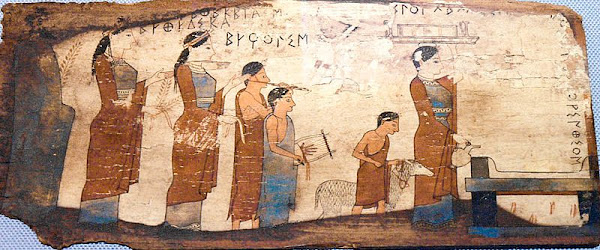
Painted wooden panel depicting a sacrificial procession, 6th century B.C. (Athens, National Archaeological Museum, inv. no. 16464):
 Matthew Dillon, Girls and Women in Classical Greek Religion (London: Routledge, 2002), p. 228, with notes on p. 355:

Four painted wooden pinakes (offering tablets; they are all polychromatic) dating to 540–520 BC were discovered in a cave, where the nymphs were worshipped, at Pitsa near Sikyon in the Peloponnese. The best-preserved pinax, with the colouring and the entire tablet almost intact, depicts a sacrificial scene in which women are prominent (Figure 7.3).105 The names of the dedicators, the deities being honoured and the name of the painter are provided by the painted inscriptions on the pinax. On the far right is an altar of the nymphs, associated with childbirth, and a procession is shown which has just arrived in front of the altar. First in front of the altar is a woman; she holds an oinochoe in her right hand, from which she appears to be about to pour a libation. On her head she carries a large flat basket, on which are two vessels on either side of what appears to be a box. The box presumably contains sacrificial items, such as perhaps the knife. She is immediately followed by a boy who leads a sheep by a rope; like the other figures the boy is wreathed. He is followed by two males, also boys but larger, yet not adults. One strums a lyre while the other plays the flute. Two women follow carrying sprigs of vegetation, and behind the second woman is a shrouded figure, also clearly carrying a sprig of vegetation; she is taller than the other women, both in height and in girth: she appears to be pregnant (unfortunately the pinax is damaged and her face is lost); the last in the processional line and clearly the largest of the figures, she is the most important and the sacrifice of the sheep is for her benefit. At least two women are named on this pinax: Euthydika and Eupolis, and perhaps a third; these could refer to the three women depicted in the procession.106Jennifer Larson, Greek Nymphs: Myth, Cult, Lore (New York: Oxford University Press, 2001), pp. 232-233, with notes on p. 326:
105 Figure 7.3: Pitsa painted wooden plaque, NM 16464; polychrome (mainly blue and red paint for the figures on a cream-brown background); the less well preserved ones are: 16465, 16466, 16467; see SEG 23.264 a–c (Hausmann 1960: 14 pl. 4; Schelp 1975: 86 K16; Robertson 1975: pl. 34d; 1981: pl. 45; Lorber 1979: 93, no. 154, pls 45.154, 46.154; Amyx 1988: 394–5, 543, 604–5; Boardman 1993: pl. vii.64; 1996: 122 fig. 112; van Straten 1995: 57–8, pl. 56; Carratelli 1996: 101; Schefold 1998: pl. 38).
106 A third group of letters could be interpreted as the name 'Ethelonche'.
The discovery in 1934 of Saftulis cave near Sikyon created a sensation when it was found to contain unique examples of archaic painting on wood panels.13 The four votive tablets, or pinakes, had been preserved in the dry atmosphere of the cave, though two were fragmentary. The best-preserved one (figure 5.1) shows a sacrificial scene, with three adult women, younger flute and lyre players, and a slave with the necessary sacrificial wares approaching an altar. A sheep is the intended victim, and the tablet is inscribed with the names of two women, Euthydika and Eucholis, and the words "dedicated to the nymphs." .... One important question is whether similar tablets would have been placed in other nymph caves, or if they were characteristic only of the Sikyon-Corinth area, which was noted for its skilled painters in this period. Indications are that wooden votives were an important part of the rustic cult tradition, and it is most likely that wooden artifacts, including pinakes, have been ost in large numbers from cave sites.14 These tablets (the two best-preserved examples were dated 540–30) provide us with some interesting information about the cult of the nymphs in the sixth century in the eastern Peloponnese. First, the nymphs receive a typical blood sacrifice like that offered to the Olympian gods. There was nothing unusual about such a sacrifice except its value. Other evidence shows that while blood sacrifices for the nymphs were not unknown, lesser offerings were more common. These votive tablets probably commemorated some special occasion that called for a richer-than-usual offering to the nymphs. The prominence of the female dedicators in the sacrificial scene is also suggestive. They invite comparison with the mother of Sostratos in Menander's Dyscolus, who is described as particularly enthusiastic in her devotions to local deities and who makes pilgrimages to their shrines with an entourage of musicians and servants similar to that shown in the tablet.See also A.D. Rizakis, Achaïe III. Les cités achéennes: Épigraphie et histoire (Paris: de Boccard, 2008 = Meletemata, 55), pp. 249-251 (number 185a), and Theodora Kopestonsky, "The Greek Cult of The Nymphs at Corinth," Hesperia 85.4 (October-December 2016) 711-777 (at 760-763).
13. Orlandos (1965) 204–5 s.v. Pitsa; AA 50 (1935) 198; Hausmann (1960) 15–16 fig. 4; Neumann (1979) 27, pl. 12a; Amyx (1988) 2.604–5. The third and fourth tablets show groups of female figures. Tablet inscriptions: BCH 91 (1967) 644–46; SEG 23 (1968) 264.
14. For the popularity of wooden tablets, see Van Straten in Versnel (1981a) 78–79; Ar. Thesm. 770–75; Aen. Tact. 31, 15; Van Straten (1995) 57–58.
Thursday, September 22, 2022
Perhaps
Kenneth Dover, The Greeks, 3rd ed. (Austin: University of Texas Press, 1989), p. 124:
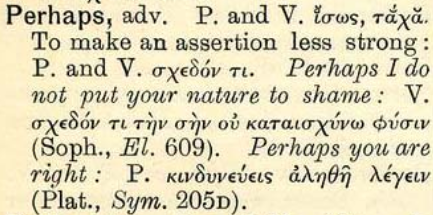 ἴσως and τάχα seem to occur more often in Thucydides than in Herodotus.
Greek historians were never afraid to use their own judgement. They were willing to say 'I don't know', to speculate about the motives of the people they described, and to qualify their opinions on occasion by 'perhaps' and 'probably'. It is the appearance of words like 'perhaps' which marks the beginning of true historical writing.S.C. Woodhouse, English-Greek Dictionary: A Vocabulary of the Attic Language (London: George Routledge & Sons, 1910), p. 606:

Wednesday, September 21, 2022
Maybe, Maybe Not
Richard Tarrant, Texts, Editors, and Readers: Methods and Problems in Latin
Textual Criticism (Cambridge: Cambridge University Press, 2016), p. 145:
E.R. Dodds: 'Our editions of Greek and Latin authors are good enough to live with'; D.R. Shackleton Bailey: 'Maybe, maybe not; it all depends on one's standard of living'.1Thanks very much to Christopher Brown for the following remarks:
1 Probably apocryphal, based on Shackleton Bailey's remark that 'when E. R. Dodds pronounced that our editions are good enough to live with, he cannot have been thinking of G. Lehnert's Teubner edition (1905) of the longer declamations falsely attributed to Quintilian' (1976a, 73).
[Tarrant] suggests that he concocted the exchange from a comment made by SB in his review of Hankason published in 1976. Great and prolific scholars often repeat themselves, and it is interesting to note that in a paper from 1975 SB writes, "Professor Dodds of Oxford, himself a highly accomplished textual critic, once opined that our (classical) texts are good enough to live with. I suppose that depends in the first place on one's standard of living" ("Editing Ancient Texts," in H.H. Paper [ed.], Language and Texts: the Nature of Linguistic Evidence [Ann Arbor 1975] 21-32 = Selected Classical Papers [Ann Arbor 1997] 324-335, at 329). That's clearly the source of the 'standard of living' language. I believe that the occasion of Dodds' opining was his inaugural lecture at Oxford, "Humanism and Technique in Greek Studies," which ruffled the feathers of a number of colleagues. Dodds tells the story (along with Bowra’s tart reaction to the lecture) in his autobiography, Missing Persons (Oxford 1977) 127.
Unhappily in Decline
Martha C. Nussbaum, "A Stoic's Confessions," Arion 4.3 (Winter, 1997) 149-160 (at 150):
The old practice of composing Greek prose and verse, now unhappily in decline, yields an active command of vocabulary, syntax, meter, and style that escapes pupils who practice a dead language only by translating.
Slow Writing
Gustave Flaubert, letter to Maxime Du Camp (June 26, 1852; tr. Geoffrey Wall):
May I die like a dog rather than try to rush through even one sentence before it is perfectly ripe.
Que je crève comme un chien plutôt que de hâter d'une seconde ma phrase qui n'est pas mûre.
A Crux in Aeschylus' Agamemnon
Aeschylus, Agamemnon 1440-1443 (Clytemnestra speaking about Cassandra; tr. Herbert Weir Smyth, with his Greek text and apparatus, from the old Loeb Classical Library edition, vol. II, pp. 128-129):
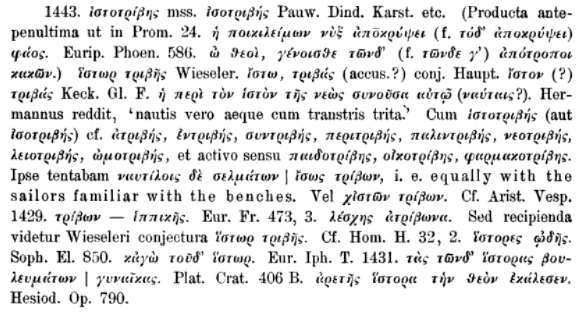 Here is a list of some more recent conjectures.
E. Scheer, "Beiträge zur Erklärung und Kritik des Aischylos," Rheinisches Museum 67 (1912) 481–514 (at 494-495, n. 2): λισποτριβής.
A.Y. Campbell, The Agamemnon of Aeschylus, a Revised Text with Brief Critical Notes (Liverpool: University Press, 1936): ναυτικῶν ἑδωλίων / ἵστωρ τρυφῆς, with the following explanation (p. 116):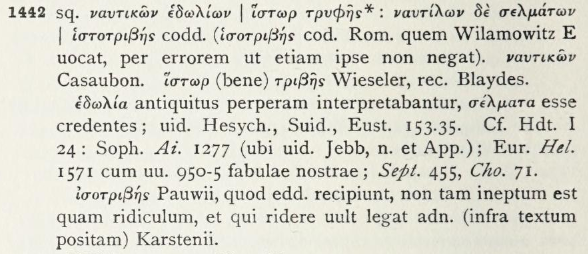 H.D. Broadhead, "Some Passages of the Agamemnon," Classical Quarterly 9.2 (November, 1959) 310-316 (at 315): ὁμοτρίβης.
Note that Gottfried Hermann had already written: "poeta si illud in mente habuisset, non ἰσοτρίβης, sed
ὁμοτρίβης dixisset."
H.D. Broadhead, "Some Passages of the Agamemnon," Classical Quarterly 9.2 (November, 1959) 310-316 (at 315): ὁμοτρίβης.
Note that Gottfried Hermann had already written: "poeta si illud in mente habuisset, non ἰσοτρίβης, sed
ὁμοτρίβης dixisset."
James Diggle, "Notes on the Agamemnon and Persae of Aeschylus," Classical Review 18.1 (March, 1968) 1-4 (at 2-3): κοιτοτρίβης.
The bibliography is extensive, but see especially Martin L. West, Studies in Aeschylus (Stuttgart: B.G. Teubner, 1990), pp. 220-221.
and here she lies, his captive, and auguress, and concubine, his oracular faithful bedfellow, yet equally familiar with the seamen's benches.The same passage (tr. Alan H. Sommerstein, with his note and Greek text and apparatus, from the new Loeb Classical Library edition of the Oresteia, pp. 174-176):
ἥ τ' αἰχμάλωτος ἥδε καὶ τερασκόπος
καὶ κοινόλεκτρος τοῦδε, θεσφατηλόγος
πιστὴ ξύνευνος, ναυτίλων δὲ σελμάτων
ἰσοτριβής.3
3 ἰσοτριβὴς Rom., ἰστοτριβὴς FV3N: Pauw
and with him this captive, this soothsayer, this chanter of oracles who shared his bed, this faithful consort, this cheap whore306 of the ship's benches.Alan H. Sommerstein, "Comic Elements in Tragic Language: The Case of Aeschylus' Oresteia," in Andreas Willi, ed., The Language of Greek Comedy (2002; rpt. Oxford: Oxford University Press, 2007), pp. 151-167 (at 155–156, footnotes omitted):
306 lit. "mast-rubber", where ἱστός "mast" is metaphorical as in Strabo's tale (8.6.20) of the Corinthian hetaera who said, when taunted with the fact that she did no proper work, "I've lowered three ἱστοί before now in [snapping her fingers?] this length of time". On the obscenity, unparalleled in tragedy, see my discussion in A. Willi ed. The Language of Greek Comedy (Oxford, 2002) 155–6.
ἥ τ' αἰχμάλωτος ἥδε καὶ τερασκόπος,
ἡ κοινόλεκτρος τοῦδε θεσφατηλόγος,
πιστὴ ξύνευνος, ναυτίλων δὲ σελμάτων
ἱστοτρίβης.3
1441 ἡ Karsten: καὶ f.
[Klytaimestra] denounces at great length the extramarital sexual activities of her husband, which in most male Greeks' view—with the sole exception of his insult to her in bringing Kassandra to her home—were none of her business. And in the course of doing so she uses two highly untragic vocabulary items. One is the notorious ἱστοτριβής (1443), referring to Kassandra. It will be necessary to take some time over this word, in view of some of the truly desperate attempts that have been made to keep Aeschylus at this point within the commonly assumed canons of tragic diction. M.L. West (1990a: ad loc.), with a reference to Iliad 1.31, notes coniugis nauticae nocturno muneri diurnum additur: but for one thing one could not do loom-weaving on board an ancient ship, for another, of the two words which on this view would refer to Kassandra's sexual duties, κοινόλεκτρος (1441) and ξύνευνος (1442), neither has anything in its own immediate context to suggest that she is being portrayed as a nautical consort, and for a third, and most importantly, it is absurd to make Klytaimestra climax this passage, which is dripping throughout with her jealousy of the women who replaced her abroad and the one who nearly supplanted her at home, by referring to the ordinary work of a maidservant which, far from being any threat to the mistress of the house, actually emphasizes her superiority inasmuch as she does not have to do it herself! Lloyd-Jones (1978: 58–9), building on a suggestion by Latte, sees an allusion to the practice in at least one Greek state (we do not know which) of punishing women for some offence (probably, but not certainly, unchastity) by making them sit on top of a ἱστός (more likely a loom, as Lloyd-Jones thinks, than a pole, as suggested by O'Daly 1985: 13: the object, according to Hesychius α 2576 [sic, read 2578], was to humiliate, not to torment). This neatly enables us to have our cake and eat it, by allowing ἱστοτριβής to mean 'whore' or the like while keeping Aeschylus free from 'an obscenity … unparalleled in tragic diction' (O'Daly 1985: 13); but it depends on our accepting that a word referring to a very specific punishment, and not one used at Athens, would be instantly intelligible to Aeschylus' Athenian audience. [....] Are we really meant to suppose that he accidentally made Klytaimestra refer to Kassandra, in a sexually charged context, by a word which could so easily be taken to mean πόρνην ἥτις τὸ πέος τρίψοι (Ar. Vesp. 739; cf. also Ar. Ach. 1149, Vesp. 1344)—and that neither he nor anyone else noticed it in rehearsal and changed the word? Unless we emend, we have no alternative but to accept the obscenity. It may be alien to tragedy, but it is far from alien to this particular tragic character. The whole point about Klytaimestra, especially in this scene, is that she breaks all the rules; and this word, prominently placed at the beginning of a line before a pause, is the culmination of her rule-breaking. What is more, by using it she contrives to perpetrate a maximal insult to Kassandra and Agamemnon at once. If, as the comic parallels suggest, ἱστοτριβής would be taken as meaning approximately 'one who gives hand jobs', then on the one hand the princess and prophetess Kassandra (to whom Klytaimestra was so elaborately sympathetic in 1035-46) is being downgraded to the level of the meanest slave in a Peiraeus brothel, and on the other hand it is being insinuated that Agamemnon had been suffering from erectile dysfunction and had needed manual assistance to overcome it.Cf. previously D.C.C. Young, "Gentler Medicines in the Agamemnon," Classical Quarterly 14.1 (May, 1964) 1-23 (at 15, on 1055-1056):
Klytaimestra is saying: 'I have no leisure to rub (wear away) this doorway', i.e. 'I can't wait hanging around the door here'. It is a vulgar expression, and she uses an even more vulgar expression involving the root τριβ- at 1443, where she refers to the corpse of Kassandra as ναυτίλων δὲ σελμάτων ἱστοτρίβης. Casaubon kept the word, translating it 'publicum navis prostibulum'. A ἱστός is anything set upright, an erection. Cf. the slang use of English 'beam', Latin trabs. Strabo, 8.378 [i.e. 8.6.20], has an anecdote about a ἑταίρα who, πρὸς τὴν ὀνειδίζουσαν, ὅτι οὐ φιλεργὸς εἴη οὐδ' ἐρίων ἅπτοιτο, retorted 'ἐγὼ μέντοι ἡ τοιαύτη τρεῖς ἤδη καθεῖλον ἱστοὺς ἐν βραχεῖ χρόνῳ τούτῳ.' ('I took down three beams in three shakes of a cow's tail'). Cf. also παιδοτριβέω sensu obscaeno = παιδεραστέω, Anth. Pal. 12.34.6; 222.2.For some older conjectures see Frederick H.M. Blaydes, ed., Aeschyli Agamemnon (Halle: In Orphanotrophei Libraria, 1898), p. 129:

E. Scheer, "Beiträge zur Erklärung und Kritik des Aischylos," Rheinisches Museum 67 (1912) 481–514 (at 494-495, n. 2): λισποτριβής.
A.Y. Campbell, The Agamemnon of Aeschylus, a Revised Text with Brief Critical Notes (Liverpool: University Press, 1936): ναυτικῶν ἑδωλίων / ἵστωρ τρυφῆς, with the following explanation (p. 116):
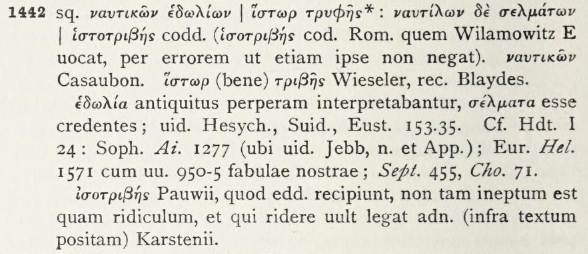
James Diggle, "Notes on the Agamemnon and Persae of Aeschylus," Classical Review 18.1 (March, 1968) 1-4 (at 2-3): κοιτοτρίβης.
The bibliography is extensive, but see especially Martin L. West, Studies in Aeschylus (Stuttgart: B.G. Teubner, 1990), pp. 220-221.
Tuesday, September 20, 2022
Engagé Poems
W.H. Auden, A Certain World: A Commonplace Book (New York: The Viking Press, 1970), p. 87:
Hat tip: Karl Maurer, An Introduction to Robert Frost: A Talk with Notes. Edited by Adam Cooper and Taylor Posey (Asheville: Taylor Posey, Publisher, 2021), p. 5, where this passage is quoted. Thanks very much to one of Karl's former students, who sent me this beautiful book as a gift, and thanks to all who are keeping Karl's memory alive.
By all means let a poet, if he wants to, write engagé poems, protesting against this or that political evil or social injustice. But let him remember this. The only person who will benefit from them is himself; they will enhance his literary reputation among those who feel as he does. The evil or injustice, however, will remain exactly what it would have been if he had kept his mouth shut.Auden indicates no source, so presumably the paragraph is his own.
Hat tip: Karl Maurer, An Introduction to Robert Frost: A Talk with Notes. Edited by Adam Cooper and Taylor Posey (Asheville: Taylor Posey, Publisher, 2021), p. 5, where this passage is quoted. Thanks very much to one of Karl's former students, who sent me this beautiful book as a gift, and thanks to all who are keeping Karl's memory alive.
A Constituent Part of Life
Thomas Mann, The Magic Mountain, chapter 5 (Settembrini speaking; tr. James E. Woods):
Permit me, permit me, my good engineer, to tell you something, to lay it upon your heart. The only healthy and noble and indeed, let me expressly point out, the only religious way in which to regard death is to perceive and feel it as a constituent part of life, as life's holy prerequisite, and not to separate it intellectually, to set it up in opposition to life, or, worse, to play it off against life in some disgusting fashion—for that is indeed the antithesis of a healthy, noble, reasonable, and religious view. The ancients decorated their sarcophagi with symbols of life and procreation, some of them even obscene. For the ancients, in fact, the sacred and the obscene were very often one and the same. Those people knew how to honor death. Death is to be honored as the cradle of life, the womb of renewal. Once separated from life, it becomes grotesque, a wraith—or even worse. For as an independent spiritual power, death is a very depraved force, whose wicked attractions are very strong and without doubt can cause the most abominable confusion of the human mind.From Kevin Muse:
Gestatten Sie. Gestatten Sie mir, Ingenieur, Ihnen zu sagen und Ihnen ans Herz zu legen, daß die einzig gesunde und edle, übrigens auch — ich will das ausdrücklich hinzufügen — auch die einzig religiöse Art, den Tod zu betrachten, die ist, ihn als Bestand teil und Zubehör, als heilige Bedingung des Lebens zu begreifen und zu empfinden, nicht aber — was das Gegenteil von gesund, edel, vernünftig und religiös wäre — ihn geistig irgendwie davon zu scheiden, ihn in Gegensatz dazu zu bringen und ihn etwa gar widerwärtigerweise dagegen auszuspielen. Die Alten schmückten ihre Sarkophage mit Sinnbildern des Lebens und der Zeugung, sogar mit obszönen Symbolen, — das Heilige war der antiken Religiosität ja sehr häufig eins mit dem Obszönen. Diese Menschen wußten den Tod zu ehren. Der Tod ist ehrwürdig als Wiege des Lebens, als Mutterschoß der Erneuerung. Vom Leben getrennt gesehen, wird er zum Gespenst, zur Fratze — und zu etwas noch Schlimmerem. Denn der Tod als selbständige geistige Macht ist eine höchst liederliche Macht, deren lasterhafte Anziehungskraft zweifellos sehr stark ist, aber mit der zu sympathisieren ebenso unzweifelhaft die greulichste Verirrung des Menschengeistes bedeutet.
I'm surprised that Woods omits to translate the phrase aber mit der zu sympathisieren... in your selection today from Settembrini's discourse on death.
Here's Lowe-Porter's version, which I think might be better here:For death, as an independent power, is a lustful power, whose vicious attraction is strong indeed; to feel drawn to it, to feel sympathy with it, is without any doubt at all the most ghastly aberration to which the spirit of man is prone.
Fertilizer
Plutarch, Life of Marius 21.3 (tr. Bernadotte Perrin):
Nevertheless, it is said that the people of Massalia fenced their vineyards round with the bones of the fallen, and that the soil, after the bodies had wasted away in it and the rains had fallen all winter upon it, grew so rich and became so full to its depths of the putrefied matter that sank into it, that it produced an exceeding great harvest in after years, and confirmed the saying of Archilochus [fragment 292 West] that "fields are fattened" by such a process.Bijan Omrani, Caesar's Footprints. A Cultural Excursion to Ancient France: Journeys Through Roman Gaul (New York: Pegasus Books, 2017), p. 42:
Μασσαλιήτας μέντοι λέγουσι τοῖς ὀστέοις περιθριγκῶσαι τοὺς ἀμπελῶνας, τὴν δὲ γῆν, τῶν νεκρῶν καταναλωθέντων ἐν αὐτῇ καὶ διὰ χειμῶνος ὄμβρων ἐπιπεσόντων, οὕτως ἐκλιπανθῆναι καὶ γενέσθαι διὰ βάθους περίπλεω τῆς σηπεδόνος ἐνδύσης ὥστε καρπῶν ὑπερβάλλον εἰς ὥρας πλῆθος ἐξενεγκεῖν καὶ μαρτυρῆσαι τῷ Ἀρχιλόχῳ λέγοντι πιαίνεσθαι πρὸς τοῦ τοιούτου τὰς ἀρούρας.
Even the modern French name of the valley, Pourrières, is said to come from the Latin campi putridi, the 'fields of putrescence'.
Monday, September 19, 2022
Lampons!
Camillo P. Merlino, "Some Old French Words in Current English," in Herbert H. Golden, ed., Studies in Honor of Samuel Montefiore Waxman (Boston: Boston University Press, 1969), pp. 56-65 (at 61):
LAMPOON. Clearly derived from lampons, first-person plural of the Old French lamper, a nasal formation from the Anglo-Saxon lapian, "to lap up, to guzzle," lampoon came to mean a drinking song; it is from the refrain lampons "let's drink," frequently recurring in ribald and satirical songs. From this background emerges our familiar lampoon in all its connotations. In modern French there still remains the popular lampée (f.) grande gorgée de liquide qu'on hume d'un coup, such as une lampée de vin. But lampons, strangely enough, has fallen by the wayside.The first thing that sets off my bullshit detector is the claim that an Old French word is derived from an Anglo-Saxon word. Unlikely. See Calvert Watkins, The American Heritage Dictionary Indo-European Roots (Boston: Houghton Mifflin Company, 1985), p. 34:
lab-. Lapping, smacking the lips; to lick. Variant of leb-2. 1. Germanic *lapjan in Old English lapian, to lap up: LAP2. 2. Nasalized form *la-m-b- in: a. Germanic *lamp- in French lamper, to gulp down: LAMPOON; b. Latin lambere, to lick: LAMBENT. [Pok. lab- 651.]Second, I'm not sure what is meant by the assertion that "lampons ... has fallen by the wayside." As a verb it survives as a toast: see e.g. Richard Olney, Lulu's Provençal Table (London: Grub Street, 2013), page number unknown:
The animated discussions at table turn around the food, the wines, and their relations to one another. As euphoria gains ground, Lucien may ask everyone to stand while he solemnly intones the ritual toast to "notre chère Méduse," figurehead of the Provençal wine confraternity, after which all present drain their glasses ("Lampons!") and exclaim "Alléluia! Alléluia!"On the etymology of lampoon, see Leo Spitzer, "Anglo-French Etymologies," Studies in Philology 41.4 (October, 1944) 521-543 (at 525-527).
Deserters
Homer, Iliad 5.532 = 15.564 (tr. A.T. Murray, rev. William F. Wyatt):
From those that flee springs neither glory nor any defence.The same (tr. Peter Green):
φευγόντων δ᾽ οὔτ᾽ ἂρ κλέος ὄρνυται οὔτέ τις ἀλκή.
Runaways get no glory, win no battles.
The Affair of the Vultures
Plutarch, Life of Marius 17.3 (tr. Bernadotte Perrin):
The affair of the vultures, however, which Alexander of Myndus relates [fragment 26 Wellmann], is certainly wonderful. Two vultures were always seen hovering about the armies of Marius before their victories, and accompanied them on their journeys, being recognized by bronze rings on their necks; for the soldiers had caught them, put these rings on, and let them go again; and after this, on recognizing the birds, the soldiers greeted them, and they were glad to see them when they set out upon a march, feeling sure in such cases that they would be successful.W. Geoffrey Arnott, Birds in the Ancient World from A to Z (London: Routledge, 2007), p. 92:
τὸ δὲ περὶ τοὺς γῦπας θαύματος ἄξιον Ἀλέξανδρος ὁ Μύνδιος ἱστόρηκε. δύο γὰρ ἐφαίνοντο πρὸ τῶν κατορθωμάτων ἀεὶ περὶ τὰς στρατιὰς καὶ παρηκολούθουν γνωριζόμενοι χαλκοῖς περιδεραίοις· ταὐτὰ δὲ οἱ στρατιῶται συλλαβόντες αὐτούς περιῆψαν, εἶτα ἀφῆκαν· ἐκ δὲ τούτου γνωρίζοντες ἠσπάζοντο αὐτούς οἱ στρατιῶται καὶ φανέντων ἐπὶ ταῖς ἐξόδοις ἔχαιρον ὡς ἀγαθὸν τι πράξοντες.
Their habit of flocking near armies on the march or in battle (Aristotle HA 563a5–12, Alexander of Myndos fr. 26 Wellmann, Aelian NA 2.46) was interpreted as implying that the birds realised battles produced corpses to eat, but is better explained by the fact that pack animals with provisions of meat always accompanied armies.See M. Wellmann, "Alexander von Myndos," Hermes 26.4 (1891) 481-566 (fragment 26 on p. 553).
Tendentious Misreadings of Antiquity
Brent Shaw, "A Groom of One's Own?" The New Republic (July 24, 1994), a review of John Boswell, Same-Sex Unions in Premodern Europe (New York: Villard Books, 1994):
The data of the past may not be all that happy for the liberationist movements of our time. Why else would those movements come into being? But what the sources record is, for better or for worse, what the sources record. A good part of what they record, certainly, is made up of systematic and successful repressions; but tinkering with the moral balance of the past is a disservice to the study of history and to the reform of society. The past is dead. We cannot change it. What we can change is the future; but the way to a better future requires an unsentimental and accurate understanding of what happened in the past, and why. A more civil and humane modernity will not be achieved by tendentious misreadings of antiquity.
Sunday, September 18, 2022
A Rural Retreat
Amphis, fragment 17 (tr. S. Douglas Olson):
Then isn't isolation as good as gold?
The fundamental source of a good life for human beings is a piece of land;
it's the only thing capable of concealing poverty.
Whereas the city is a theatre full of patent bad luck.
εἶτ' οὐχὶ χρυσοῦν ἐστι πρᾶγμ' ἐρημία;
ὁ πατήρ γε τοῦ ζῆν ἐστιν ἀνθρώποις ἀγρός,
πενίαν τε συγκρύπτειν ἐπιστάται μόνος·
ἄστυ δὲ θέατρον ἀτυχίας σαφοῦς γέμον.
2 πατήρ codd.: δοτήρ Elter: σωτήρ Kock
Beatitudes
An Anthology of Sanskrit Court Poetry: Vidyākara's "Subhāṣitaratnakoṣa" translated by Daniel H.H. Ingalls (Cambridge: Harvard University Press, 1965 = Harvard Oriental Series, 44), p. 425 (number 1621):
Happy are they who pass childhood, youth and ageRelated post: Recipes for Happiness.
gamboling in the dirt, in sensual pleasures and in peace;
playing ever in a lap
of mother, of lotus-eyed enchantress and of holy rivers,
where in each several case they drink their fill
of breast, of lower lip, of stream.
Luther on His Impending Death
Analecta Lutherana et Melanthoniana. Tischreden Luthers und Aussprüche Melanthons, ed. Georg Loesche (Gotha: Friedrich Andreas Perthes, 1892), p. 384 (§ 609, Luther to his wife, my translation, with help from a friend):
Indeed, it is as I've often said; I'm the ripe turd and the world is the gaping arsehole. So we will certainly be separated.
Es ist doch, wie ich offt gesagtt habe; ich bin der reiffe Dreck; so ist die wellt das weitte Arschloch. Darumb sein wir wol zu scheiden.
Labels: noctes scatologicae
Words, But No Deeds
Sophocles, Electra 319 (tr. H.D.F. Kitto):
He promises—and that is all he does.The same (tr. David Grene):
φησίν γε· φάσκων δ᾽ οὐδὲν ὧν λέγει ποεῖ.
He says he is—but does nothing of what he says.
A Loudmouth
Plutarch, Life of Alcibiades 26.6 (tr. Bernadotte Perrin):
He had a helper, too, in Thrasybulus of Steiris, who went along with him and did the shouting; for he had, it is said, the biggest voice of all the Athenians.
συνέπραττε δ᾿ αὐτῷ καὶ Θρασύβουλος ὁ Στειριεὺς ἅμα παρὼν καὶ κεκραγώς· ἦν γάρ, ὡς λέγεται, μεγαλοφωνότατος Ἀθηναίων.
Saturday, September 17, 2022
If You Really Want to Know
Aristophanes, Wasps 85-86 (tr. Jeffrey Henderson):
You're getting nowhere with all this hot air; you'll never find the answer.
If you really want to know, then be quiet.
ἄλλως φλυαρεῖτ᾽· οὐ γὰρ ἐξευρήσετε.
εἰ δὴ 'πιθυμεῖτ᾽ εἰδέναι, σιγᾶτέ νυν.
Who?
An Anthology of Sanskrit Court Poetry: Vidyākara's "Subhāṣitaratnakoṣa" translated by Daniel H.H. Ingalls (Cambridge: Harvard University Press, 1965 = Harvard Oriental Series, 44), p. 423 (number 1615):
He has crossed all rivers of desire
and contemned all pain.
With grief at parting from his joys assuaged
and impure thoughts removed,
he has reached happiness at last and with closed eyes
attains complete contentment. Who?
Why, a fat old corpse in a graveyard.
Overcoming Fear
Plutarch, Life of Marius 16.2 (tr. Bernadotte Perrin):
For he considered that their novelty falsely imparts to terrifying objects many qualities which they do not possess, but that with familiarity even those things which are really dreadful lose their power to affright.
ἡγεῖτο γὰρ πολλὰ μὲν ἐπιψεύδεσθαι τῶν οὐ προσόντων τὴν καινότητα τοῖς φοβεροῖς, ἐν δὲ τῇ συνηθείᾳ καὶ τὰ τῇ φύσει δεινὰ τὴν ἔκπληξιν ἀποβάλλειν.
Friday, September 16, 2022
An Ancient Lynching
Diodorus Siculus 1.83.6-9 (tr. C.H. Oldfather):
[6] And whoever intentionally kills one of these animals is put to death, unless it be a cat or an ibis that he kills; but if he kills one of these, whether intentionally or unintentionally, he is certainly put to death, for the common people gather in crowds and deal with the perpetrator most cruelly, sometimes doing this without waiting for a trial. [7] And because of their fear of such a punishment any who have caught sight of one of these animals lying dead withdraw to a great distance and shout with lamentations and protestations that they found the animal already dead. [8] So deeply implanted also in the hearts of the common people is their superstitious regard for these animals and so unalterable are the emotions cherished by every man regarding the honour due to them that once, at the time [60 or 59 B.C.] when Ptolemy their king had not as yet been given by the Romans the appellation of "friend" and the people were exercising all zeal in courting the favour of the embassy from Italy which was then visiting Egypt and, in their fear, were intent upon giving no cause for complaint or war, when one of the Romans killed a cat and the multitude rushed in a crowd to his house, neither the officials sent by the king to beg the man off nor the fear of Rome which all the people felt were enough to save the man from punishment, even though his act had been an accident. [9] And this incident we relate, not from hearsay, but we saw it with our own eyes on the occasion of the visit we made to Egypt.Anne Burton ad loc.:
Herodotus, II, 65 says that the unintentional killing of a hawk or an ibis meant death. Wiedemann, Herodots zweites Buch, p. 282, suggests that this varied from nome to nome, depending on which animals were considered sacred locally. But since the hawk and ibis (Horus and Thoth) were held to be sacred throughout most of Egypt, Herodotus is probably substantially correct. Presumably Diodorus includes the cat because he himself saw the incident he describes. This must have happened in a district where the cat was held to be particularly sacred, and it is therefore reasonable to assume that Diodorus visited Bubastis.Alexander Meeus, "Life Portraits: Royals and People in a Globalizing World," in Katelijn Vandorpe, ed., A Companion to Greco-Roman and Late Antique Egypt (Hoboken: John Wiley & Sons, Inc., 2019), pp. 89-99 (at 94):
Since this is one of very few such personal experiences that Diodorus has included in his work, it is clear that it must have made a great impression on him. Although it has been observed that Diodorus' attitude toward Egypt was more positive than that of many of his contemporaries (Isaac 2004, p. 359; Muntz 2017, pp. 228–231), the event may have made such an impression because the animal worship appeared so bizarre to him (cf. Smelik and Hemelrijk 1984):As for the various services which these animals require, the Egyptians not only do not try to avoid them or feel ashamed to be seen by the crowds as they perform them, but on the contrary, in the belief that they are engaged in the most serious rites of divine worship, they assume airs of importance, and wearing special insignia make the rounds of the cities and the countryside. (Diodorus Siculus 1.83.4, translation Oldfather, Loeb Classical Library)Was this the embassy of which Cicero would have been a member, had he accepted the invitation to join (Cicero, Epistulae ad Atticum 2.5.1)? At any rate, we would love to know how the Senate reacted to the execution of a Roman ambassador over the killing of a cat, and one wonders whether Cicero was thinking — among other things — of this episode when he asked some 15 years later:Who does not know of the custom of the Egyptians? Their minds are infected with degraded superstitions and they would sooner submit to any torment than injure an ibis or asp or cat or dog or crocodile, and even if they have unwittingly done anything of the kind there is no penalty from which they would recoil. (Cicero, Tusculanae disputationes 5.78, translation King, Loeb Classical Library)
Self-Expression
Kenneth Dover, The Greeks, 3rd ed. (Austin: University of Texas Press, 1989), p. 62:
'Self-expression', a term which has no Greek equivalent, would have meant to the Greek artist the freedom to choose and dispose the elements which in combination satisfied the community's demand, or his patron's demand, for a particular theme to fulfil a particular social and religious function. The notion that self-expression is of any value in itself was quite alien to the Greeks. If the quality of the self which was being expressed was acknowledged to be high, they would be willing to give it a look or a hearing; but if it expressed itself in a style which was technically slovenly or insufficiently subjected to self-criticism, they would soon lose patience and say, 'Go away, and don't come back until you can express yourself in a way we can respect.'
Delusion
Aeschylus, Agamemnon 222-223 (tr. Herbert Weir Smyth):
On the sentence see Andrej Petrovic and Ivana Petrovic, Inner Purity and Pollution in Greek Religion, Vol. I: Early Greek Religion (Oxford: Oxford University Press, 2016), pp. 136-138.
D.R. Shackleton Bailey dedicated two of his books to cats. The Petrovics' book is dedicated to their dog (p. ix):
For mankind is emboldened by wretched delusion, counsellor of ill, primal source of woe.παρακοπά (παρακοπή, "delusion") is the subject, from παρακόπτω, "strike awry." Both of the compound adjectives αἰσχρόμητις ("counselling shameful acts") and πρωτοπήμων ("bringing the start of sufferings") are hapax legomena. More literally, "For wretched delusion, counselling shameful acts, bringing the start of sufferings, emboldens mortals."
βροτοὺς θρασύνει γὰρ αἰσχρόμητις
τάλαινα παρακοπὰ πρωτοπήμων.
On the sentence see Andrej Petrovic and Ivana Petrovic, Inner Purity and Pollution in Greek Religion, Vol. I: Early Greek Religion (Oxford: Oxford University Press, 2016), pp. 136-138.
D.R. Shackleton Bailey dedicated two of his books to cats. The Petrovics' book is dedicated to their dog (p. ix):
Woodrow Wilson is attributed with the following saying: 'If a dog will not come to you after having looked you in the face, you should go home and examine your conscience.' Over the past eight years our wonderful dog Mr Miyagi has been inspiring us in many ways to think about inner purity. Even though he has not penned a single word of this book, his help was nevertheless endless. Hence, in gratitude, we dedicate this book to Mr Miyagi, a true creature of ϕιλοϕροσύνη. Κύον πιστότατε, ϕρὴν καθαρωτάτη, σοὶ τόδε βιβλίον τίθεμεν.
Thursday, September 15, 2022
Hills and Woods
An Anthology of Sanskrit Court Poetry: Vidyākara's "Subhāṣitaratnakoṣa" translated by Daniel H.H. Ingalls (Cambridge: Harvard University Press, 1965 = Harvard Oriental Series, 44), p. 422 (number 1606):
Let be a kingdom of the earth with all its cares,
I value not, oh Lord, an universal empire at a straw.
My heart turns rather to the hills and woods
where herds of antelopes lie down in fearless sleep.
[ŚILHAṆA COLLECTION]
Against Our Enemies
Thucydides 7.68.1-2 (speech of Gylippus; tr. Jeremy Mynott):
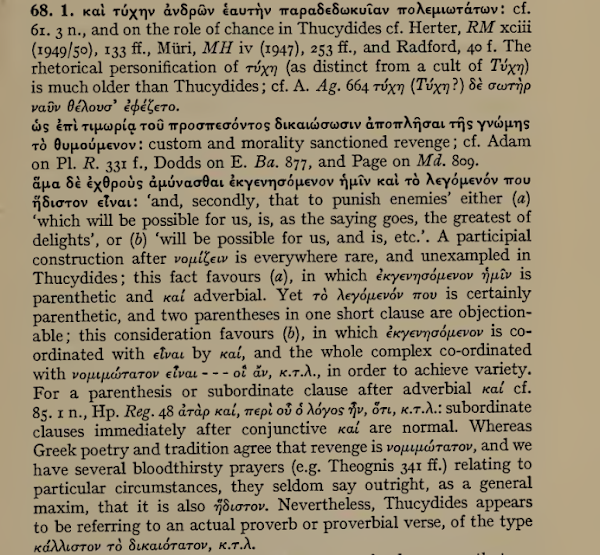

In the face, then, of such disarray and the failed fortunes of our bitterest enemies, let us engage them with real passion. Remember the general rule that against one's enemies you have a wholly legitimate right to satisfy your heart's desire in punishing the aggressor; such revenge, as the saying goes, is the sweetest of all pleasures and it is now within our grasp.A.W. Gomme et al. ad loc.:
That they are our enemies, and the worst of enemies, you all know: they came to our land to enslave us; and had they succeeded they would have inflicted the most terrible suffering on our men, gross indignities on our women and children, and on the city as a whole the ultimate brand of shame.
πρὸς οὖν ἀταξίαν τε τοιαύτην καὶ τύχην ἀνδρῶν ἑαυτὴν παραδεδωκυῖαν πολεμιωτάτων ὀργῇ προσμείξωμεν, καὶ νομίσωμεν ἅμα μὲν νομιμώτατον εἶναι πρὸς τοὺς ἐναντίους οἳ ἂν ὡς ἐπὶ τιμωρίᾳ τοῦ προσπεσόντος δικαιώσωσιν ἀποπλῆσαι τῆς γνώμης τὸ θυμούμενον, ἅμα δὲ ἐχθροὺς ἀμύνασθαι ἐκγενησόμενον ἡμῖν καὶ τὸ λεγόμενόν που ἥδιστον εἶναι.
ὡς δὲ ἐχθροὶ καὶ ἔχθιστοι, πάντες ἴστε, οἵ γε ἐπὶ τὴν ἡμετέραν ἦλθον δουλωσόμενοι, ἐν ᾧ, εἰ κατώρθωσαν, ἀνδράσι μὲν ἂν τἄλγιστα προσέθεσαν, παισὶ δὲ καὶ γυναιξὶ τὰ ἀπρεπέστατα, πόλει δὲ τῇ πάσῃ τὴν αἰσχίστην ἐπίκλησιν.


Wednesday, September 14, 2022
Counterclockwise
Karl Maurer, Interpolation in Thucydides (Leiden: E.J. Brill, 1995 = Mnemosyne, Suppl., 150), p. 74, n. 28:
Perhaps it is just worth mentioning that Thucydidean catalogues seem often, for some reason, to proceed geographically in a counterclockwise spiral, towards the west and the south, to east and north east, ending in the far north west. Thus e.g., very consistently, much of the great list of allies at Syracuse in 7.57.James M. Scott, "Luke's Geographical Horizon," in David W.J. Gill and Conrad H. Gempf, edd., The Book of Acts in its First Century Setting, Vol. 2: Graeco-Roman Setting (1994; rpt. Eugene: Wipf and Stock Publishers, , 2000), pp. 483-544 (at 526):
1 Chronicles 1 lists the nations of the world 'in a circle' which proceeds counterclockwise—from the North, to the West, to the South, and to the East—with Jerusalem in the center.
Fame
Valerius Maximus, Memorable Doings and Sayings 8.14 ext. 3 (D.R. Shackleton Bailey):
Glory is not neglected even by such as attempt to inculcate contempt for it, since they are careful to add their names to those very volumes, in order to attain by use of remembrance what they belittle in their professions.John Briscoe, ed., Valerius Maximus, Facta et Dicta Memorabilia, Book 8: Text, Introduction, and Commentary (Berlin: Walter de Gruyter, 2019), p. 219, provides no sources, but says:
ceterum gloria ne ab his quidem, qui contemptum eius introducere conantur, neglegitur, quoniam quidem ipsis voluminibus nomina sua diligenter adiciunt, ut quod professione elevant usurpatione memoriae adsequantur.
V. somewhat bizarrely implies that those who professed to despise glory should have published their books anonymously or under a pseudonym.The sentiment wasn't unique to Valerius Maximus. Cf. Cicero, In Defense of Archias 26:
Philosophers themselves, even in the books which they write about despising fame, sign their own names.and Cicero, Tusculan Disputations 1.14.34:
ipsi illi philosophi, etiam in iis libellis quos de contemnenda gloria scribunt, nomen suum inscribunt.
Do not our philosophers, in the very books which they write about despising fame, sign their own names?See also Tacitus, Histories 4.6:
nostri philosophi nonne in iis libris ipsis, quos scribunt de contemnenda gloria, sua nomina inscribunt?
Even by wise men the desire for fame is laid aside last of all.
etiam sapientibus cupido gloriae novissima exuitur.
Tuesday, September 13, 2022
He Is Still There When I Come Back to Him
Kenneth Dover, The Greeks, 3rd ed. (Austin: University of Texas Press, 1989), pp. 34-35, with note on p. 136:
Thucydides describes this critical battle:The Greek:When the Athenians came up against the barrier, with the impetus of that first onslaught they overpowered the ships stationed in front of the barrier and tried to break through what held them in. Thereupon the Syracusans and their allies bore down on them from every quarter; and now the fighting was no longer only at the barrier, but in every part of the harbour.29I suppose that by now I must have read this part of Thucydides' text more than a hundred times; I have published a commentary on books vi and vii, which involved me in some six thousand hours of work altogether, much of it on the minutiae of chronology, grammar, and textual criticism (for example, I once looked up all six hundred examples of a certain common preposition in the whole of Thucydides in order to elucidate the precise sense of one passage). Yet I still cannot read the words 'thereupon the Syracusans and their allies bore down on them from every quarter' without feeling the hair on the back on my neck stand on end, as when in a war-film a great attacking force suddenly begins to move, full of vengeful confidence. Perhaps that is why I don't mind interrupting Thucydides to talk about prepositions and the like. He is still there when I come back to him.
29. Thucydides vii 70.2 ...
ἐπειδὴ δὲ οἱ ἄλλοι Ἀθηναῖοι προσέμισγον τῷ ζεύγματι, τῇ μὲν πρώτῃ ῥύμῃ ἐπιπλέοντες ἐκράτουν τῶν τεταγμένων νεῶν πρὸς αὐτῷ καὶ ἐπειρῶντο λύειν τὰς κλῄσεις· μετὰ δὲ τοῦτο πανταχόθεν σφίσι τῶν Συρακοσίων καὶ ξυμμάχων ἐπιφερομένων οὐ πρὸς τῷ ζεύγματι ἔτι μόνον ἡ ναυμαχία, ἀλλὰ καὶ κατὰ τὸν λιμένα ἐγίγνετο.
Monday, September 12, 2022
Apples
Christopher Morley (1890-1957), Mince Pie: Adventures on the Sunny Side of Grub Street (New York: George H. Doran Company, 1919), pp. 171-173:
As we walked homeward under a frosty sparkle of sky we mused upon all the different kinds of apples we have encountered. There are big glossy green apples and bright red apples and yellow apples and also that particularly delicious kind (whose name we forget) that is the palest possible cream color—almost white. We have seen apples of strange shapes, something like a pear (sheepnoses, they call them), and the Maiden Blush apples with their delicate shading of yellow and debutante pink. And what a poetry in the names—Winesap, Pippin, Northern Spy, Baldwin, Ben Davis, York Imperial, Wolf River, Jonathan, Smokehouse, Summer Rambo, Rome Beauty, Golden Grimes, Shenango Strawberry, Benoni!Related post: Imperfections.
We suppose there is hardly a man who has not an apple orchard tucked away in his heart somewhere. There must be some deep reason for the old suspicion that the Garden of Eden was an apple orchard. Why is it that a man can sleep and smoke better under an apple tree than in any other kind of shade? Sir Isaac Newton was a wise man, and he chose an apple tree to sit beneath. (We have often wondered, by the way, how it is that no one has ever named an apple the Woolsthorpe after Newton's home in Lincolnshire, where the famous apple incident occurred.)
An apple orchard, if it is to fill the heart of man to the full with affectionate satisfaction, should straggle down a hillside toward a lake and a white road where the sun shines hotly. Some of its branches should trail over an old, lichened and weather-stained stone wall, dropping their fruit into the highway for thirsty pedestrians. There should be a little path running athwart it, down toward the lake and the old flat-bottomed boat, whose bilge is scattered with the black and shriveled remains of angleworms used for bait. In warm August afternoons the sweet savor of ripening drifts warmly on the air, and there rises the drowsy hum of wasps exploring the windfalls that are already rotting on the grass. There you may lie watching the sky through the chinks of the leaves, and imagining the cool, golden tang of this autumn's cider vats.
Excisions
William Wyse, The Speeches of Isaeus (Cambridge: At the University Press, 1904), pp. xl-xli:
S.A. Naber and H. van Herwerden following the lead of their illustrious master, Cobet, ply the knife without mercy. Apparently they think it sound criticism to excise everything which is not indispensable to a trained scholar scrutinising a speech in his study.
Smitten
Chariton, Callirhoe 2.4.3 (tr. G.P. Goold; he = Dionysius; her, she = Callirhoe):
In his mind he was at the shrine of Aphrodite, and he recalled every detail: her face, her hair, how she had turned round and looked at him, her voice, her figure, her words; her very tears were setting him on fire.
ὅλος δὲ ἦν ἐν τῷ τῆς Ἀφροδίτης ἱερῷ καὶ πάντων ἀνεμιμνήσκετο, τοῦ προσώπου, τῆς κόμης, πῶς <ἐπ>εστράφη, πῶς ἐνέβλεψε, τῆς φωνῆς, τοῦ σχήματος, τῶν ῥημάτων· ἐξέκαε δὲ αὐτὸν καὶ τὰ δάκρυα.
Sunday, September 11, 2022
Prayer
An Anthology of Sanskrit Court Poetry: Vidyākara's "Subhāṣitaratnakoṣa" translated by Daniel H.H. Ingalls (Cambridge: Harvard University Press, 1965 = Harvard Oriental Series, 44), pp. 421-422 (number 1605):
I pray that I may have before me songsters,
beside me tasteful poets from the South
and behind me girls whose graceful bracelets
jingle as they wave the flywhisk.
If this should be, be greedy, heart,
to taste the world.
If it, however, should not be,
then enter highest brahma.
UTPALARĀJA [BHARTṚHARI COLLECTION]
Rejuvenation
Aristophanes, Frogs 341-349 (chorus of initiates; tr. Stephen Halliwell):
Iakchos, hail Iakchos,Alan H. Sommerstein ad loc.:
Our light-bringing star for nocturnal rites!
The meadow blazes with flames of gleaming torches.
Even old men's knees flex in dance.
They shake off all their cares
And the heavy weight of copious years
To join the sacred worship.
Ἴακχ᾽ ὦ Ἴακχε,
νυκτέρου τελετῆς φωσφόρος ἀστήρ.
φλογὶ φέγγεται δὲ λειμών·
γόνυ πάλλεται γερόντων· 345
ἀποσείονται δὲ λύπας
χρονίους τ᾽ ἐτῶν παλαιῶν ἐνιαυτοὺς
ἱερᾶς ὑπὸ τιμᾶς.
343 brilliant star of our nocturnal rites: cf. Soph. Ant. 1146-8 (of Dionysus-Iacchus) "leader of the dance of the stars breathing fire, master of the voices heard by night" (tr. Lloyd-Jones).Plato, Laws 2.666b-c (tr. R.G. Bury):
345-9 old men's knees leap ... thanks to thy holy worship: likewise in Eur. Ba. 188-190 the power of Dionysus makes old men forget their years (cf. Pl. Laws 666b), and rejuvenation is a recurrent theme of Old Comedy too (e.g. Knights 1321ff, Wasps 1066-7, 1299ff, Peace 349-353, Lys. 667-671, Eccl. 848-850), often taking the form of the recovery of sexual potency by an old man (Dicaeopolis, Demos, Philocleon, Trygaeus, Peisetaerus, Blepyrus).
But when a man has reached the age of forty, he may join in the convivial gatherings and invoke Dionysus, above all other gods, inviting his presence at the rite (which is also the recreation) of the elders, which he bestowed on mankind as a medicine potent against the crabbedness of old age, that thereby we men may renew our youth, and that, through forgetfulness of care, the temper of our souls may lose its hardness and become softer and more ductile, even as iron when it has been forged in the fire.
...τετταράκοντα δὲ ἐπιβαίνοντα ἐτῶν, ἐν τοῖς συσσιτίοις εὐωχηθέντα, καλεῖν τούς τε ἄλλους θεοὺς καὶ δὴ καὶ Διόνυσον παρακαλεῖν εἰς τὴν τῶν πρεσβυτέρων τελετὴν ἅμα καὶ παιδιάν, ἣν τοῖς ἀνθρώποις ἐπίκουρον τῆς τοῦ γήρως αὐστηρότητος ἐδωρήσατο τὸν οἶνον φάρμακον, ὥστε ἀνηβᾶν ἡμᾶς, καὶ δυσθυμίας λήθῃ γίγνεσθαι μαλακώτερον ἐκ σκληροτέρου τὸ τῆς ψυχῆς ἦθος, καθάπερ εἰς πῦρ σίδηρον ἐντεθέντα γιγνόμενον...
Dedication of a Helmet
Etruscan helmet in the British Museum (museum number 1823,0610.1):
 Russell Meiggs and David Lewis, A Selection of Greek Historical Inscriptions to the End of the Fifth Century B.C. (Oxford: Clarendon Press, 1969), p. 62:
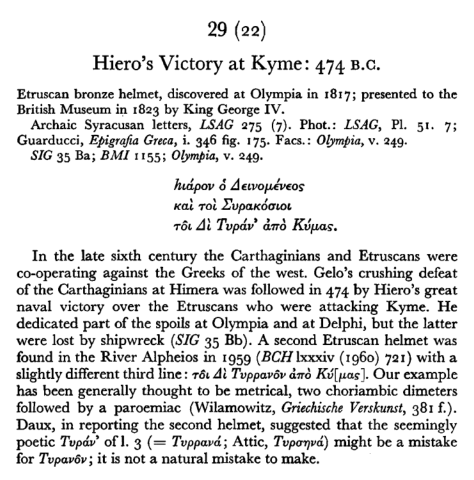 I can't figure out how to print the omicron with the circumflex accent in the third line; otherwise I would transcribe the inscription.
Critical apparatus from Enrico Chies, "Dedica di Ierone di Siracusa a Olimpia," Axon 5.1 (June, 2021) 73-102 (at 75): Translation by Kenneth Dover, The Greeks, 3rd ed. (Austin: University of Texas Press, 1989), p. 25:
Following the suggestion of a reader (https://wiki.digitalclassicist.org/Circumflex_on_omikron_or_epsilon) I tried to render omicron with circumflex by ο͂ but this makes the circumflex sit to the right of the omicron, not directly on top of it, at least in my browser (Brave):


Critical apparatus from Enrico Chies, "Dedica di Ierone di Siracusa a Olimpia," Axon 5.1 (June, 2021) 73-102 (at 75):

Hieron, son of Deonomenes, and the Syracusans
to Zeus
Etruscan (sc. spoils)
from Kyme.
Following the suggestion of a reader (https://wiki.digitalclassicist.org/Circumflex_on_omikron_or_epsilon) I tried to render omicron with circumflex by ο͂ but this makes the circumflex sit to the right of the omicron, not directly on top of it, at least in my browser (Brave):
ℎιάρον ὁ Δεινομένεος
καὶ τοὶ Συρακόσιοι
το͂ι Δὶ Τυράν' ἀπὸ Κύμας.
Saturday, September 10, 2022
Manuscripts of Chariton's Callirhoe
Chariton, Callirhoe. Edited and Translated by G.P. Goold (Cambridge: Harvard University Press, 1995 = Loeb Classical Library, 481), p. 17:
But the manuscript [Codex Florentinus Laur. Conv. Soppr. 627] had badly faded, and for his collation of 1843 (also preserved at Leiden) C.G. Cobet used chemicals which have now impaired legibility; the first folio can no longer be read.Id., p. 18:
The Codex Thebanus (Chariton erased under a Coptic text) was discovered in 1898: for a preliminary transcript Ulrich Wilcken confined himself to deciphering only the flesh side of the parchment, and this is all that survives, for by an unfortunate accident the palimpsest itself was destroyed in a fire on the docks at Hamburg.I don't see an entry for Chariton in the index of L.D. Reynolds and N.G. Wilson, Scribes and Scholars: A Guide to the Transmission of Greek and Latin Literature, 3rd ed. (Oxford: Clarendon Press, 1991).
No Better Off
Xenophon, Hellenica 7.5.27 (after the Battle of Mantinea; tr. Carleton L. Brownson):
While each party claimed to be victorious, neither was found to be any better off, as regards either additional territory, or city, or sway, than before the battle took place.
νενικηκέναι δὲ φάσκοντες ἑκάτεροι οὔτε χώρᾳ οὔτε πόλει οὔτ᾽ ἀρχῇ οὐδέτεροι οὐδὲν πλέον ἔχοντες ἐφάνησαν ἢ πρὶν τὴν μάχην γενέσθαι.
Innovation
Julian, Letters 20.453b (tr. Wilmer Cave Wright):
Cf. Montaigne, Essays 1.23 (tr. Donald M. Frame):
I avoid innovations in all things, so to speak, but more peculiarly in what concerns the gods.I think I'll adopt φεύγω τὴν καινοτομίαν ἐν ἅπασι as my motto.
φεύγω τὴν καινοτομίαν ἐν ἅπασι μέν, ὡς ἔπος εἰπεῖν, ἰδίᾳ δὲ ἐν τοῖς πρὸς τοὺς θεούς.
Cf. Montaigne, Essays 1.23 (tr. Donald M. Frame):
I am disgusted with innovation, in whatever guise.
Je suis dégousté de toute nouvelleté, quelque visage qu'elle porte.
Point of View
Kenneth Dover, The Greeks, 3rd ed. (Austin: University of Texas Press, 1989), p. 32:
We call it the 'Sicilian Disaster', which befell the 'Sicilian Expedition'. Looked at from the other end, we could call it the 'Syracusan Triumph', which ended the 'Athenian Invasion'.
Friday, September 09, 2022
Epitaph of Primus
Inscriptiones Graecae V,2 327 = Georg Kaibel, Epigrammata Graeca ex Lapidibus Conlecta 480a (pp. xiii-xiv) = Werner Peek, Griechische Vers-Inschriften 1066 (p. 301), from Arcadia, 2nd century A.D.? (my rough translation, following Peek's text):

 Kaibel:
 Peek:
Peek:
 On Arcadian feasting see Athenaeus 4.148f-149d, esp. 4.149b (tr. S. Douglas Olson):
[...] begat me, and my mother Phila bore me,Inscriptiones Graecae:
my name is Primus, and Mantinea is my fatherland;
not yet having completed my twenty-eighth year
I leave the light, having left to my wife a child, Iole.
The swift racecourse does not allow me to be forgotten, nor to be left behind
does the band of revellers allow; being good at solemn feasts, I am the leader.
Having learned these things, stranger, drink, be licentious, revel, anoint yourself with perfume.
For common to mortals are these arrangements.
[–⏕– μ' ἐ]τέκνωσε, Φίλα δέ με γεί[νατο μήτ]ηρ,
Πρεῖμος δ' οὔνομά μοι, [Μαντινέη] δὲ πάτρη·
εἰκοστὸν λυγά[βαντα καὶ] ὄγδοον οὐκέτι πλήσας
[φῶς λ]ε[ί]πω, γαμετῇ παῖδα λιπὼν Ἰόλην. 5
[οὔδε λ]αθεῖν εἴα με ταχὺς δρόμος, οὐδὲ [λιπέσθα]ι
κ[ῶ]μος, ἐν ἠλαπίναις δ' ἐσθλὸς [ἐὼν] ἕπομαι.
ταῦτα μαθ[ώ]ν, ξένε, πεῖνε, τρύ[φα, κώμ]αζε, μυρίζου·
κοινὰ γάρ ἐστι [βροτο]ις ταῦτα τὰ συνθέματα. 10


At all their dinners, but especially those referred to as mazones—this name is still used today for the Dionysiac guild—it was their custom to pour more broth into the bowls of the young men who ate more heartily, and to serve them more barley-cakes and bread. This is because they considered such individuals noble and manly, since gluttony was regarded as something that deserved respect and acclaim.
ἐνόμιζον δ' ἐν ἅπασι τοῖς δείπνοις, μάλιστα δὲ τοῖς λεγομένοις μαζῶσι — τοῦτο γὰρ ἔτι καὶ νῦν ἡ Διονυσιακὴ σύνοδος ἔχει τοὔνομα — τοῖς ἐσθίουσι τῶν νέων ἀνδρικώτερον ζωμόν τ' ἐγχεῖν πλείω καὶ μάζας καὶ ἄρτους παραβάλλειν. γενναῖος γὰρ ὁ τοιοῦτος ἐκρίνετο καὶ ἀνδρώδης ὑπάρχειν· θαυμαστὸν γὰρ ἦν καὶ περιβόητον παρ' αὐτοῖς ἡ πολυφαγία.
Thursday, September 08, 2022
Three Interests
J.P.V.D. Balsdon, Romans and Aliens (London: Duckworth, 1979), p. 42, with note on p. 267:
A healthy young man, in the Hellenistic tradition, had three commendable interests: horses, dogs and philosophy; and though philosophers were scorned by the crude soldiery and the common man in Lucilius might declare that a horse and a good warm cloak were better value as possessions than a philosopher, cultured Romans in general were not so basely materialistic.68Terence, Andria 55-57 (tr. John Sargeaunt):
68. Terence, Andr. 55-7; Pers. 5, 189-91 (cf. 6, 38); Lucil. XV, 515f. Marx.
As for the usual doings of young men, such as interesting themselves in keeping horses or hounds, or in philosophical lectures...Persius 5.189-191 (tr. G.G. Ramsay):
quod plerique omnes faciunt adulescentuli,
ut animum ad aliquod studium adiungant, aut equos
alere aut canes ad venandum aut ad philosophos...
If you talk in this fashion among your varicose Centurions, the hulking Pulfennius straightway bursts into a huge guffaw, and bids a clipped hundred-penny piece for a lot of a hundred Greeks.Lucilius, fragment 515-516 Marx (tr. E.H. Warmington):
dixeris haec inter varicosos centuriones,
continuo crassum ridet Pulfenius ingens
et centum Graecos curto centusse licetur.
If you ask me, an over-cloak, a gelding, a slave, a straw-coat—I have more use for any one of these than I have for a wiseacre.
paenula, si quaeris, cantherius servus segreste
utilior mihi quam sapiens.
Wednesday, September 07, 2022
A Fable
Justin, Epitome of Pompeius Trogus 43.4 (tr. John Selby Watson):
He added the following fable: "A bitch once asked a shepherd, when she was big with young, for a place to bring forth her puppies; having obtained it, she requested again that she might be allowed to bring them up in the same place; and at last, when her young were grown up, and she could depend upon their support, she claimed possession of the place as her own."
subnectit et illam fabulam: canem aliquando partu gravidam locum a pastore precario petisse, in quo pareret, quo obtento iterato petisse, ut sibi educare eodem in loco catulos liceret; ad postremum adultis catulis fultam domestico praesidio proprietatem loci sibi vindicasse.
Nectar or Poison
An Anthology of Sanskrit Court Poetry: Vidyākara's "Subhāṣitaratnakoṣa" translated by Daniel H.H. Ingalls (Cambridge: Harvard University Press, 1965 = Harvard Oriental Series, 44), p. 421 (number 1603):
When I think how I have known
parties where the lyre was heard
and the heavenly voice of poets,
and when I think of anguish
and of partings from my friends;
rejoicing for a moment, then despairing,
I know not what to call the world:
whether made of nectar or of poison.
A Good Soldier
Thucydides 5.9.9 (speech of the Spartan general Brasidas before the Battle of Amphipolis; tr. Charles Forster Smith):
Bear in mind that the three virtues of a good soldier are zeal, sense of honour, and obedience to his leaders.
νομίσατε <τρία> εἶναι τοῦ καλῶς πολεμεῖν, τὸ ἐθέλειν καὶ τὸ αἰσχύνεσθαι καὶ <τὸ> τοῖς ἄρχουσι πείθεσθαι.
τρία add. Schol. et Stobaeus
τὸ add. Stahl
Monday, September 05, 2022
Musing on Antiquity
Chūgan Engetsu (1300-1375), "Musing on Antiquity at Chin-lu," tr. Marian Ury, Poems of the Five Mountains
An Introduction to the Literature of the Zen Monasteries, 2nd ed. (Ann Arbor: Center for Japanese Studies 1992 = Michigan Monograph Series in Japanese Studies, 10 ), p. 42, with her note:
Its great men pass on without cease, but the land is uncrushed, ungentled;Related posts:
The Six Courts have crumbled utterly, but "the mountains and rivers abide."
The ancient sites of royal offices: merchants' and fishermen's dwellings;
The sounds that lingered from precious groves: woodsmen's and oxherds' songs.
The canyons are filled with endless clouds, constantly bearing rain;
On the Great River the winds are calmed, but waves still arise.
The fair beauties of those years — where are they now?
For the traveler from afar, in this vast view, how much to admire and to mourn!
Chin-lu, modern Nanking, had been a royal city during much of the Six Dynasties period. Line 2 contains a quotation from what is perhaps Tu Fu's best known poem. "Precious groves," literally trees of jade or jewel-trees, is a common metaphor for men of superior pure demeanor. The "Great River" is the Yangtze.
Oath
Laurence Sterne, Tristram Shandy, Chapter LXIII:
By the tomb-stone of Lucian, if it is in being; — if not, why then by his ashes! by the ashes of my dear Rabelais, and dearer Cervantes!
Labor
Adolph Menzel (1815-1905), Das Eisenwalzwerk (Moderne Cyklopen) (Berlin, Alte Nationalgalerie):


My Greeks
Kenneth Dover, The Greeks, 3rd ed. (Austin: University of Texas Press, 1989), p. 133:
My Greeks were neither sophisticated layabouts nor pious fatalists, and least of all were they portentous gurus brooding on the lost Secrets of the Ancients. They were resilient, sceptical, cheeky people, whose distinctive contribution to our history was to combine a readiness to ask 'Why?' and 'Why not?' with a conviction that only sane, reasoned, and clearly expounded answers to those questions were worth listening to.
Sunday, September 04, 2022
Naevius Anus or Naevius Anius or Naevianus?
Valerius Maximus, Memorable Doings and Sayings 7.7.6,tr. D.R. Shackleton Bailey, with his note and critical apparatus, from his Loeb Classical Library edition of Valerius Maximus (Cambridge: Harvard University Press, 2000), pp. 176-179 (I've placed the English before the Latin):
 D.R. Shackleton Bailey, "Textual Notes on Lesser Latin Historians,"
Harvard Studies in Classical Philology 85 (1981) 155-184 (at 167):
D.R. Shackleton Bailey, "Textual Notes on Lesser Latin Historians,"
Harvard Studies in Classical Philology 85 (1981) 155-184 (at 167):
Is the name Anius or Anus? In favor of the latter, see Thesaurus Linguae Latinae 2:200 (which, however, only cites inscriptional evidence, not Valerius Maximus 7.7.6):
Francis X. Ryan, Rank and Participation in the Roman Senate (Stuttgart: Franz Steiner Verlag, 1998), p. 307, argues that the man's name was actually Naevianus:
A certain Genucius, a eunuch priest of the Great Mother, had obtained an order from City Praetor Cn. Orestes restoring to him the property of Naevius Anus, of which he had received possession from the Praetor himself according to the will. Surdinus, whose freedman had made Genucius his heir, appealed to Mamercus, who cancelled the Praetor's ruling, saying that Genucius, whose genital parts had been amputated by his own choice, should not be reckoned among either men or women. A judgment appropriate to a Mamercus,7 appropriate to a Leader of the Senate; it provided that magistrates' tribunals should not be defiled by Genucius' obscene presence and tainted voice under the pretext of seeking justice.Critical apparatus from John Briscoe's Teubner edition (Vol. II, p. 487):
7 Archaic form of Marcus, redolent of old-time manners, perhaps assumed by himself.
Quid? Mamerci Aemilii Lepidi consulis quam grave decretum! Genucius quidam, Matris Magnae Gallus, a Cn. Oreste praetore urbano impetraverat ut restitui se in bona Naevii Ani76 iuberet, quorum possessionem secundum tabulas testamenti ab ipso acceperat. appellatus Mamercus a Surdino, cuius libertus Genucium heredem fecerat, praetoriam iurisdictionem abrogavit, quod diceret Genucium amputatis sua77 ipsius sponte genitalibus corporis partibus neque virorum neque mulierum numero haberi debere. conveniens Mamerco, conveniens principi senatus decretum, quo provisum est ne obscena Genucii praesentia inquinataque voce tribunalia magistratuum sub specie petiti iuris polluerentur.
76 Naevii Anii A corr.: Naeviani AL
77 sua Heraeus: sui AL

7.7.6 ut restitui se in bona Naevi Ani iuberetUnless he changed his mind between 1981 and 2000, why did Shackleton Bailey in his Loeb translation print "Naevius Anus," instead of "Naevius Anius"?
avi Kraffert. The cognomen "Anius," supported by Paris (Naevio Anio), has been much suspected (e.g. Münzer in RE XVI.1568 says it looks doubtful). To my explanation in Two Studies in Roman Nomenclature, p. 10, add that there is no need to write Anni. The spelling with one n is the older (in 4.6.1 the Bernensis [A] has anius corrected to annius).
Is the name Anius or Anus? In favor of the latter, see Thesaurus Linguae Latinae 2:200 (which, however, only cites inscriptional evidence, not Valerius Maximus 7.7.6):
Anus mul. certe cogn. CORP. X 3922 Satellia M. f. Anus. II 1476 Sulpicia L. f. Anus. II 2130 Cornelia L. f. Anus soror. 3513 Vergilia Q. f. Anus. dubium an appellativum: II 2240. V 4178. XII 4713. V.See also Iiro Kajanto, The Latin Cognomina (Helsinki: Societas Scientiarum Fennica, 1965 = Commentationes Humanarum Litterarum, XXXVI.2), p. 301 (from Chapter 9: "Cognomina Relating to Age," under the heading "old age"—Latin anus means old woman):
Anus,-ī nom. vir. Hispanum. CORP. II 2719 Q. Cae. Ano filio. Otto.
Anus (f.) CIL seven, mostly of the type of SVLPICIA L.F. ANVS (II 1476), appellative? but cf. XII 4713 COELIA ANVS L. TRYPHERANote that Kajanto also neglects the passage from Valerius Maximus.
Anicilla II 3361; dim. of anus, cf. gent.
Anilla ILG 52; dim. of anus, once found in Macrob.
Anucella VIII 2890. 7694, 13 (Numidia); cf. Anucla 19215; dim. of anus
Anullus/la Afr. one man, four women; from anus? anulla once recorded in thes.
Anul(l)inus SEN. four; CIL seven men, two women; cf. gent.
Francis X. Ryan, Rank and Participation in the Roman Senate (Stuttgart: Franz Steiner Verlag, 1998), p. 307, argues that the man's name was actually Naevianus:
The urban praetor of 77, Cn. Aufidius Orestes, had granted to a certain Genucius possessio of the goods of one Naevianus, a freedman of a Naevius Surdinus.97
97 The libertus was somehow overlooked by Treggiari. C. Kempf (Leipzig 1888) prints bona Naevi Ani and records in his apparatus "naevi ani" (LA1), "naevii anii" (A2), and the conjecture "Naeviana" (Perizonius). Shackleton Bailey (1991, 8) ingeniously explains Ani as the praenomen "Annius," but this is more clever than convincing; if ingenious explanations are to be admitted, we may interpret Ani as the abbreviation for the tribe Aniensis. Presumably we are not dealing with two nomina: Treggiari (1969, 251) thought the freedman at Suet. Gram. 5 was named "Saevius Nicanor Postumius," but the text itself plainly reads duplici cognomine, and the man in question probably was a Sevius Pothus or Postumianus; cf. Kaster 1995. 110. Fabre (1981, 403) indexes the freedman as "Naevius Anus (?)"; if Ani stood alone in the text, it could acceptably be interpreted as a cognomen. The heir is named by nomen alone and the patron by cognomen alone, so one name should suffice for the testator. That the decedent had been adopted by another freedman (or made an heir on the condition of assuming his name) is not improbable, since his estate was large enough to precipitate a struggle, but even in the absence of a reason to suspect adoption it would be perverse to take "naevi ani" to signify any name other than "Naevianus."
Not the Girl Next Door
Kenneth Dover, The Greeks, 3rd ed. (Austin: University of Texas Press, 1989), p. 61:
Confronted with a female figure in stone, if she has sixteen tits and a crocodile's head, we know she's not the girl next door; but many a goddess depicted by a Greek sculpture could be just that.
Saturday, September 03, 2022
Prayers
Valerius Maximus, Memorable Doings and Sayings 7.2 ext. 1a (tr. D.R. Shackleton Bailey):
For indeed, O mind of mortals enveloped in deepest darkness, into how widespread a field of error do you scatter your blind prayers! You seek riches, that have destroyed many. You desire offices, that have brought to ruin not a few. You have visions of kingly powers, that are often seen to end in misery. You lay hold on brilliant marriages; but while they sometimes shed lustre on a house, at others they overthrow it utterly. So cease your foolish gaping after future causes of woe as though they were the luckiest of boons and trust yourself entirely to the will of the heavenly ones, for those who are wont to give blessings easily can also choose them most appropriately.
etenim densissimis tenebris involuta mortalium mens, in quam late patentem errorem caecas precationes tuas spargis! divitias appetis, quae multis exitio fuerunt; honores concupiscis, qui complures pessum dederunt; regna tecum ipsa volvis, quorum exitus saepenumero miserabiles cernuntur; splendidis coniugiis inicis manus: at haec ut aliquando illustrant, ita nonnumquam funditus domos evertunt. desine igitur stulta futuris malorum tuorum causis quasi felicissimis rebus inhiare, teque totam caelestium arbitrio permitte, quia qui tribuere bona ex facili solent, etiam eligere aptissime possunt.
A Dying Lamp
An Anthology of Sanskrit Court Poetry: Vidyākara's "Subhāṣitaratnakoṣa" translated by Daniel H.H. Ingalls (Cambridge: Harvard University Press, 1965 = Harvard Oriental Series, 44), p. 396 (number 1523):
Suddenly it leaps to life
and then falls back in darkness:
the mind of an old man
is like the flame of a dying lamp.
Greeks Criticizing Greeks
J.P.V.D. Balsdon, Romans and Aliens (London: Duckworth, 1979), pp. 39-40, with note on p. 267:
Greeks themselves, of course, in their compartmentalised city-state existence, had never been uncritical of other Greeks. A Rhodian, representative of a state which in less troubled times was the object of widespread admiration, had said in the Senate in 167 BC, 'Some people are irascible, some headstrong, others pusillanimous. Some drink too much and some are over-sexed. The Athenians are traditionally impetuous and indulge in bold enterprises which are beyond their power; Spartans procrastinate. Nor can I deny that, as a whole, Greeks living in western Asia Minor are empty-headed and that we open our mouths far too wide.'Livy 45.23.14-16:
Even between neighbouring cities there were wide diversities. 'The Boeotians say that greed lies in Oropus, envy in Tanagra, quarrelsomeness in Thespiae, insolence in Thebes, covetousness in Anthedon, curiosity in Coronea, braggadocio in Plataea, fever in Onchestus, stupidity in Haliartus.' This was perhaps written in the second half of the third century BC or in the second.57
57. L. 45, 23, 14-16; FHG II, 59, 25, p. 260 (and Geog. Gr. Min. 1, p. 104), a fragment, probably, of Heracleides Criticus (RE VIII, 484-6, no. 46). 484-6, no.46).
gentes quoque aliae iracundae, aliae audaces, quaedam timidae, in uinum, in Venerem proniores aliae sunt. Atheniensium populum fama est celerem et supra vires audacem esse ad conandum, Lacedaemoniorum cunctatorem et vix in ea, quibus fidit, ingredientem. non negaverim et totam Asiae regionem inaniora parere ingenia, et nostrorum tumidiorem sermonem esse.Heracleides Criticus, fragment 1, § 25:
ἱστοροῦσι δ' οἱ Βοιωτοὶ τὰ κατ' αὐτοὺς ὑπάρχοντα ἴδια ἀκληρήματα λέγοντες ταῦτα· τὴν μὲν αἰσχροκέρδειαν κατοικεῖν ἐν Ὠρωπῷ, τὸν δὲ φθόνον ἐν Τανάγρᾳ, τὴν φιλονεικίαν ἐν Θεσπιαῖς, τὴν ὕβριν ἐν Θήβαις, τὴν πλεονεξίαν ἐν Ἀνθηδόνι, τὴν περιεργίαν ἐν Κορωνεία, ἐν Πλαταιαῖς τὴν ἀλαζονείαν, τὸν πυρετὸν ἐν Ὀγχηστῷ, τὴν ἀναισθησίαν ἐν Ἁλιάρτῳ.
Friday, September 02, 2022
Ritual of Reconciliation
Laurent Dubois, ed., Inscriptions grecques dialectales de Sicile (Rome: École française de Rome, 1989 = Collection de l'École française de Rome, 119), pp. 257-262 (number 206),
a decree from Nakone concerning the reconciliation of rival factions, tr. Benjamin Gray, "Civil war and civic reconciliation in a small Greek polis: two acts of the same drama?" in Henning Börm et al., edd., Civil War in Ancient Greece and Rome: Contexts of Disintegration and Reintegration (Stuttgart: Franz Steiner Verlag, 2016 = Heidelberger althistorische Beiträge und epigraphische Studien, 58), pp. 53-85 (at 60):
Comment by Gray (p. 60, footnote omitted):
In the magistracy of Leukios son of Kaisios and of Philonidas son of Phil-, on the fourth day of Adonios. It seemed good to the assembly as well as to the council: since, fortune having developed in a fine way, the common affairs (l. 5) of the Nakonians have been put in order, and it is beneficial that they should conduct their life as citizens in harmony for the future, and the envoys who came here from Segesta, Apellikos, son of Adeidas, Attikos, son of Piston, and Dionysos, son of Dek-…, deliberated concerning the common good for all the citizens, let it be decided to convene an assembly (10) of the citizens on the fourth day of Adonios. For those among whom there was conflict, as they competed concerning common affairs, let them, having been summoned to the assembly, conduct a reconciliation with each other, a list of thirty members having been written in advance for each side. Let those who were previously adversaries draw up the respective lists, each of the other faction. The (15) magistrates should write the names of each group separately on lots, and put them in two urns, and draw one from each group, and from the rest of the citizens they should draw lots for three more members, excluding those relatives whom the law requires to be absent from trials in court; and those who have been (20) drawn together should be chosen brothers of one another, united in concord with each other with all justice and friendship. When the sixty lots have been drawn, and also the others drawn together with them, let them assign the rest of the citizens by lot to groups of five, not drawing (25) relatives together, as has been written, and those drawn together should be brothers of one another like those previously drawn together. The hieromnamones should sacrifice a white goat for the sacrifice, and the steward should provide whatever is necessary for the sacrifice. And likewise all (30) the succeeding magistrates should sacrifice on this day each year to the ancestors and to Homonoia a sacrificial animal which they have had tested, one for each, and the citizens should all participate in a festival in groups, in accordance with the creations of brotherhoods. Let the archons inscribe this decree on a bronze plaque and set it up in the entry hall of the temple of Olympian Zeus.Greek here (also in Gray, p. 59).
Comment by Gray (p. 60, footnote omitted):
Some impartial arbitrators from the nearby polis of Segesta had drawn up terms of reconciliation, designed to reconcile two factions, whose members had clearly recently been engaged in intense stasis. Presumably on their recommendation, the assembly prescribed a highly distinctive ritual of reconciliation. The members of the two factions, each thirty-strong, and the remaining citizens were to gather in the assembly. New, artificial civic sub-divisions or 'brotherhoods' of five were then to be formed, cutting across factional lines: lots were to be drawn to select the members of each brotherhood, one from each of the two factions and three from the pool of neutral citizens. Once the members of the factions were all assigned, subsequent brotherhoods were to contain only neutral citizens. Significantly, fellow kinsmen could not be drawn in the same brotherhood: these brotherhoods were to be purely political constructions, which would not rely on any pre-existing bonds of loyalty.
The Nakone settlement offered as a civic ideal a very high degree of civic unity, harmony and solidarity between citizens: 'brotherhood' was invoked as a model for relations between citizens, and it was explicitly stated that the members of the brotherhoods were to live together 'with all friendship and justice'.
Ocular Revelations
John and Bogdana Carpenter, from "Conversation on Writing Poetry: An Interview with Zbigniew Herbert," Manhattan Review 3.2 (1984):
Hat tip: Eric Thomson.
Q: When did you lose your faith in the reformability of the system? In 1949 with the beginning of Stalinism in Poland, or before 1956? After 1956? After 1968, 1970? When?For ab oculos (an eyesore to a Latinist) read ad oculos.
A: I have known this since September 20, 1939. When I came into contact with the Soviets in Lwów, as a boy. I cannot stop wondering at certain intellectuals. I had my revelations ab oculos. And not through Marx or Lenin. The city was changed within a few days into a concentration camp. This system attacks a European through smells and tastes; while I am a partisan of goodness and beauty, I don't have a model for the happiness of humanity. My advice is: compare the smell, the state of the street, people's eyes, as I did in 1939.
Hat tip: Eric Thomson.
A Noodle, a Pigwidgeon, a Ninnyhammer
Logan Pearsall Smith, More Trivia (New York: Harcourt, Brace and Company, 1921), p. 13:
EVASION
'What do you think of the International Situation?' asked that foreign Countess, with her foreign, fascinating smile.
Was she a Spy? I felt I must be careful.
'What do I think?' I evasively echoed; and then, carried away by the profound and melancholy interest of this question, 'Think?' I queried, 'do I ever really think? Is there anything inside my head but cotton-wool? How can I call myself a Thinker? What am I anyhow?' I pursued the sad inquiry: 'A noodle, a pigwidgeon, a ninnyhammer, a bubble on the wave, a leaf in the wind, Madame!'
Thursday, September 01, 2022
Cadaver Trial
Michael Edward Moore, "The Body of Pope Formosus," Millennium 9.1 (2012) 277-298 (at 286-287):
The Annales Alamannici gave the following account of the Cadaver Trial:Hat tip: A friend, who compared this posthumous attack to the recent treatment of a famous classical scholar in the pages of the journal he founded. I think we should call it a "cadaver trial," whenever a deceased person arouses the indignation of the bien pensants.And thereafter Stephan put Pope Formosus out of his tomb, and placed him in the Apostolic throne, and a deacon was delegated to answer for him, and his apostolic vestment was stripped off, and dragged across the basilica; and blood was flowing from his mouth, and he was thrown into the river.58The Annales Laubacensium repeated the strange detail of blood flowing from the pope's mouth, as if the body of Formosus was still suffering:Stephan put Pope Formosus out of his sepulcre and placed him upon the throne, and a deacon was established for him, so that he might give the defense; and having deposed him, he had the pope dragged across the basilica and thrown into the river; and gore was flowing out of his mouth onto the pavement.5958 "Basilica in Lateranis maiori parte cecidit: et postea Stephanus papa formosum de sepulcro eiecit et in apostolica sede locavit, et diaconum pro eo constituit ad respondendum, et apostolicam exuit vestem, et traxit per basilicam; et sanguis de ore eius fluebat; et in flumen proiectus est." Annales Alamannici, MGH, SS 1, ed. G.H. Pertz (Hannover, 1826), Anno 896, p.53.
59 "Et Stephanus papa Formosum de sepulcro eiecit eumque super locavit, atque diaconum pro eo constituit, ut responsum dedisset, et eo devicto, fecit papam per basilicam trahere atque in flumen proicere; et ex ore eius cruor per pavimenta fluebat." Annales Laubacensium pars tertia, MGH, SS 1, ed. G.H. Pertz (Hannover, 1826), Anno 896, p.53.
Sights and Wonders
Pausanias 5.10.1 (W.H.S. Jones and H.A. Ormerod):
Newer› ‹Older
Many are the sights to be seen in Greece, and many are the wonders to be heard; but on nothing does Heaven bestow more care than on the Eleusinian rites and the Olympic games.
πολλὰ μὲν δὴ καὶ ἄλλα ἴδοι τις ἂν ἐν Ἕλλησι, τὰ δὲ καὶ ἀκούσαι θαύματος ἄξια· μάλιστα δὲ τοῖς Ἐλευσῖνι δρωμένοις καὶ ἀγῶνι τῷ ἐν Ὀλυμπίᾳ μέτεστιν ἐκ θεοῦ φροντίδος.

