Wednesday, December 31, 2014
Live for Today
Antiphon the Sophist, fragment 53a Diels (tr. Kathleen Freeman):
There are some who do not live the present life, but prepare with great diligence as if they were going to live another life, not the present one. Meanwhile time, being neglected, deserts them.
εἰσί τινες οἳ τὸν παρόντα μὲν βίον οὐ ζῶσιν, ἀλλὰ παρασκευάζονται πολλῆι σπουδῆι ὡς ἕτερόν τινα βίον βιωσόμενοι, οὐ τὸν παρόντα· καὶ ἐν τούτωι παραλειπόμενος ὁ χρόνος οἴχεται.
An Empty Bubble
Logan Pearsall Smith (1865-1946), Unforgotten Years (Boston: Little, Brown and Company, 1939), p. 278:
I shall not preach the ephemeral nothingness which Bossuet found beneath all hope and joy: the world may be an empty bubble, as the moralists tell us; but to me, as fear and hope, desire and belief, depart, the iridescence of that bubble grows lovelier every year.
To Loaf
Hal Borland (1900-1978), This Hill, This Valley (1957; rpt. Baltimore: The Johns Hopkins University Press, 1990), pp. 281-282:
I hear that the social planners are after us leisure-wasters again. We seem to be a menace to society. And our reformation depends entirely on our adopting hobbies. It's a sin to loaf. Not a mortal sin, maybe, but a sin against society. Besides, the social planners need something to do or they will have leisure to waste.James Russell Lowell (1819-1891), The Biglow Papers. Second Series (Boston: Ticknor and Fields, 1867), p. lvi:
I have tried to run down the etymology of the word loaf in the sense of taking it easy; but even the lexicographers seem unable to trace it. I have a hunch that it goes back to some language even earlier than Sanskrit, and I also have a hunch that the cryptographers who unravel the mysteries of ancient hieroglyphics will eventually find a clay tablet, perhaps from ancient Sumer, with a social planner's complaint about loafers. The planners and the loafers have been at it for a long, long time.
The heartening thing about it, to me, is that man continues to cherish his leisure and to insist on using it as he wishes. Also, I get great comfort from knowing that some of the best thoughts of all time have been generated by men who would be classified by the social planners as loafers and leisure-wasters. I'd as soon be a member of an ant colony as of a society in which a man didn't loaf now and then, just sit and think or, if he chose to, just sit.
To loaf: this, I think, is unquestionably German. Laufen is pronounced lofen in some parts of Germany, and I once heard one German student say to another, Ich lauf' (lofe) hier bis du wiederkehrest, and he began accordingly to saunter up and down, in short, to loaf.Oxford English Dictionary s.v. loaf v.2:
Etymology: Of obscure origin.Josef Bihl, "'Yokel' and 'Loaf'," Modern Language Review 23 (1928) 340:
Lowell's conjecture (adopted in recent Dicts.) that the verb is < German dialect lofen = laufen to run, is without foundation; the German verb has not the alleged sense 'to saunter up and down'. German landläufer (= land-loper n.) has a sense not very remote from that of loafer, but connection is not very probable.
N.E.D. is perhaps right in rejecting Lowell's conjecture that the word loaf is an adaptation of Ger. dial. lofen = laufen, but there can be little doubt that loaf, verb and noun, does go back to the German etymon lauf, the root being Teut. hlaup > Gothic hlaupan, A.S. hleapan, O.H.G. hlauffan. The German verb laufen not only means 'run,' but also 'saunter.' The nomen agentis, läufer, Suabian loafer, means 'a man who likes lounging about,' 'a vagrant.' N.E.D. quotes Leland to the effect that loaf, when it first began to be popular in 1834 or 1835, meant 'pilfer.' In this sense the word was already used by Luther. Mencken writes that an American authority said that loafer originated in a German mispronunciation of lover, i.e. as lofer. I should suggest an explanation just the other way round. There was a German dialect word lofer which became loafer in American. By the way, in the south of Germany, laufen sometimes means 'go to see one's sweetheart.' The only difficulty is whether American loaf, which, like yokel, was introduced into the United States by the German emigrants of the eighteenth century and afterwards migrated to England, is to be derived from the German verb or the nomen agentis. The sense of laufen (läufer) and loaf (loafer) is so much the same that connexion is not only probable but almost certain. The change of au, oa in Ger. dial. laufer, loafer into a long open English o is easy and natural: cp. Suabian loab (= standard German laib) and loaf.Related posts:
- Kayf
- Slackers
- Planet of the Apes
- Ode to Indolence
- The More Idle, the More Deserving
- Work and Leisure
- Praise of Laziness
- Lazy Man's Song
- Exquisite Pregnant Idleness
- How Can I Work?
- Dolce Far Niente
- Weekdays of Unfreedom
- The Dreary Vacuum of Idleness
- Idleness and Business
- Archilochus on the Idle Life
- Idleness
- Futile Work
- Otium Cum Dignitate
Tuesday, December 30, 2014
Life
Antiphon the Sophist, fragment 51 Diels (tr. Kathleen Freeman):
The whole of life is wonderfully open to complaint, my friend; it has nothing remarkable, great or noble, but all is petty, feeble, brief-lasting, and mingled with sorrows.
εὐκατηγόρητος πᾶς ὁ βίος θαυμαστῶς, ὦ μακάριε, [καὶ] οὐδὲν ἔχων περιττὸν οὐδὲ μέγα καὶ σεμνόν, ἀλλὰ πάντα σμικρὰ καὶ ἀσθενῆ καὶ ὀλιγοχρόνια καὶ ἀναμεμειγμένα λύπαις μεγάλαις.
Beatus Vir
Logan Pearsall Smith (1865-1946), Unforgotten Years (Boston: Little, Brown and Company, 1939), pp. 229-230:
What mortal is happier after all than the complacent, self-satisfied, self-applauding prig?
Research
Logan Pearsall Smith (1865-1946), Unforgotten Years (Boston: Little, Brown and Company, 1939), pp. 187-188:
This ideal of endowment for research was particularly shocking to Benjamin Jowett, the great inventor of the tutorial system which it threatened. I remember once, when staying with him at Malvern, inadvertently pronouncing the ill-omened word. "Research!" the Master exclaimed. "Research!" he said. "A mere excuse for idleness; it has never achieved, and will never achieve, any results of the slightest value." At this sweeping statement I protested, whereupon I was peremptorily told, if I knew of any such results of value, to name them without delay. My ideas on the subject were by no means profound, and anyhow it is difficult to give definite instances of a general proposition at a moment's notice. The only thing that came into my head was the recent discovery, of which I had read somewhere, that on striking a patient's kneecap sharply he would give an involuntary kick, and that by the vigor or lack of vigor of this "knee jerk," as it is called, a judgment could be formed of his general state of health.
"I don't believe a word of it," Jowett replied. "Just give my knee a tap."
I was extremely reluctant to perform this irreverent act upon his person, but the Master angrily insisted, and the undergraduate could do nothing but obey. The little leg reacted with a vigor which almost alarmed me, and must, I think, have considerably disconcerted that elderly and eminent opponent of research.
Monday, December 29, 2014
Gleaners
Ernest G. Sihler (1853-1942), From Maumee to Thames and Tiber: The Life-Story of an American Classical Scholar (New York City: The New York University Press, 1930), p. 215:

Jean-François Millet, Des glaneuses
There is a famous French canvas, "the Gleaners"—peasant women bending down to their humble work in the stubbly field. What, after all, are we, the classicists of these later times, but gleaners?

In Honor of Silvanus
Corpus Inscriptionum Latinarum 8.27764 = Carmina Latina Epigraphica 2151 (tr. E. Courtney):
Carmina Latina Epigraphica, III: Supplementum, ed. Ernest Lommatzsch (Leipzig: B.G. Teubner, 1926), pp. 110-112:
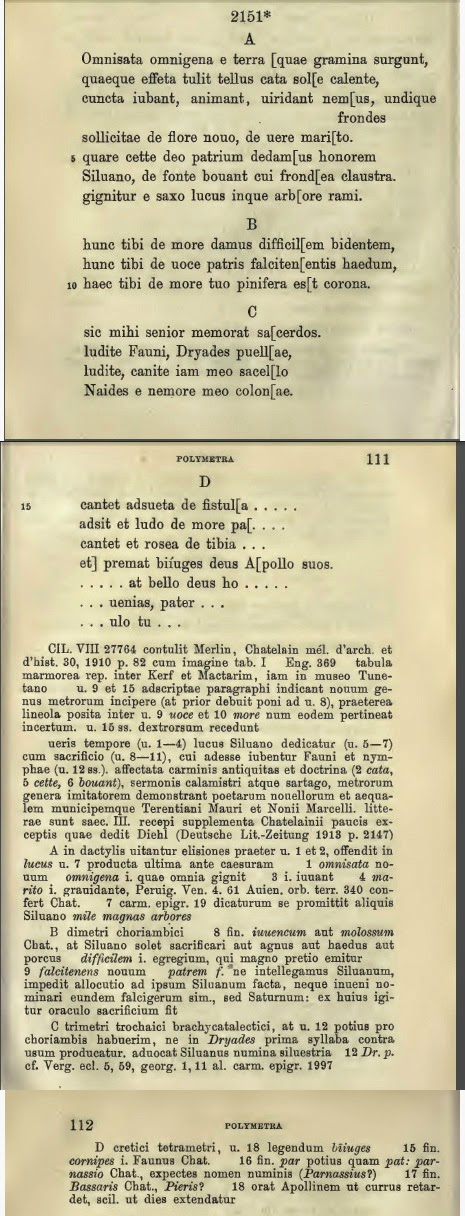
Bibliography:
Vegetation of all kinds which rises from the multi-planted earth, and the plants (?) which the ground, exhausted by the hot sun, has produced, all gladden, animate, give greenery to the grove; on all sides is foliage, anxious about the new flowers and about spring, its spouse. So, come along, let us give to the god Silvanus his ancestral honour; he has leafy bowers rustling from the spring, a grove growing from rock, and buds on the trees.Latin text (from Courtney):
According to custom we give you this intractable [ ], according to your sickle-bearing father's utterance we give you this (goat); according to custom you have this garland of pine.
The aged priest says this to me: 'Disport yourselves, Fauns, and, Dryad maidens, disport yourselves; Naiad dwellers, sing now from my temple out of my grove'.
Let [ ] make music from his usual pipe, and according to custom let Pan (?) attend the sport, and let [ ], rosy from playing the pipe, make music, and let divine Apollo halt his chariot. Let the god (Mars) cease from wild war, and you, father, come...
Omnisata omnigena e terra [quae gramina surguntCourtney tentatively translates his conjecture sata instead of the stonecutter's cata in line 2.
quaeque effeta tulit tellus cata sol[e calente,
cunta iubant, animant, uiridant nem[us; undique frondes
sollicitae de flore nouo, de uere mari[to.
quare cette deo patrium dedam[us honorem 5
Siluano, de fonte bouant cui frond[ea tecta,
gignitur e saxo lucus inque arb[ore gemmae.
hunc tibi de more damus difficil[em ˘¯x
hunc tibi de uoce patris falciten[entis haedum,
haec tibi de more tuo pinifera es[t corona. 10
sic mihi senior memorat sa[cerdos:
ludite Fauni Dryades puell[ae]
ludite, canite iam meo sacel[lo]
Naides e nemore meo colon[ae.]
cantet adsueta de fistul[a 15
adsit et ludo more pa.[
cantet et rosea de tibia [
et] premat biíuges deus A[pollo
desi]nat bello deus ho[rrido
tuque] uenias pater [ 20
Carmina Latina Epigraphica, III: Supplementum, ed. Ernest Lommatzsch (Leipzig: B.G. Teubner, 1926), pp. 110-112:
Bibliography:
- Louis Châtelain, "Le culte de Silvain en Afrique et l'inscription de la plaine du Sers (Tunisie)," Mélanges d'archéologie et d'histoire 30 (1910) 77-97
- G.B. Pighi, "Sul metro e sul significato di CIL VIII 27764 CE 2151," Epigraphica 5/6 (1943/1944) 40-44, rpt. in his Studi di Ritmica e Metrica (Torino: Bottega d'Erasmo, 1970), pp. 380-393 (non vidi)
- E. Courtney, Musa Lapidaria (Atlanta: Scholar's Press, 1995), pp. 144-147 (text and translation), 353-354 (commentary)
- Rocío Carande Herrero, "Huellas del estilo métrico" Habis 33 (2002) 599-614 (at 612-614)
Important Events of the 1950's
Eric Handley (1926-2013), "Lampada Tradam" (a speech delivered by Handley on the occasion of the celebration of his 80th birthday at Trinity College, Cambridge), p. 7:
The important event of the 1950's, apart from the ascent of Everest, the coronation of Queen Elizabeth II, and the decipherment of the Linear B script by Michael Ventris, was the recovery, towards the end of the decade, of a lost play by Menander from a papyrus codex bought for the Bodmer library in Geneva.Hat tip: Alan Crease.
Sunday, December 28, 2014
The Function of a University
Alston Hurd Chase (1906-1994), letter to the editor of the Harvard Crimson (January 31, 1934), rpt. in his Time Remembered (San Antonio: Parker Publishing Inc., 1994), pp. 157-159:
I should be very grateful to you if you would allow me a perhaps inordinate amount of space in your columns to discuss what seem to me two great and lamentable fallacies in President Conant's report as you print it this morning. I make no apologies for so sharp a disagreement with Mr. Conant; his views and mine represent two completely hostile theories of the function of a university, and it seems to me that this is a proper moment for a clear definition of these divergent beliefs.
In the first place, Mr. Conant has more than once frankly expressed his conviction that a university is primarily a group of scholars dedicated to the pursuit and perpetuation of learning. I believe, on the contrary, that a university is an institution supported by society primarily for the purpose of educating young men and young women to take a useful and happy part in the life of their community, of their country, and of the world. Certainly this was the purpose in the mind of the great majority of those who have left endowments from their own property or who have voted special privileges and state support to the universities. The subordination of the educational function of a university to any other interest constitutes a betrayal of the implicit or explicit agreement contained in the acceptance of such aid. Such a betrayal is particularly regrettable today, when the fate of democratic institutions is in the balance, when the need for men trained not in factual minutiae but in the art of thought is greater than ever before.
Scholarship pure and unapplied is the game of a certain class, and such scholarship in a faculty is of no more ultimate importance than the powers of the university football team. By a process of diligent mystification, the learned classes have hood-winked society into believing that such scholarship is really important. With a good memory, a certain amount of industry, a talent for choosing obscure fields and perverse points of view one may become a famous scholar and console oneself in the polemics of the study for one's realized inferiority in other fields. There is no harm in such scholarship; it is a pleasant and, to a certain degree, a necessary thing, but to place it first among the functions of a university is, I repeat, a betrayal of the trust placed in us by society. It is to mistake a privilege for an inalienable right, exactly as the nobility and clergy of France forgot that their feudal privileges were merely payment for their services of protection and consolation and continued to demand those privileges long after they had ceased to do their duty. Society today is little tolerant of useless shibboleths. If we demand our privileges and refuse our duties we cannot expect so long a shrift as was granted the "ancien régime," and we can only hope that our fall may be, not less sudden, but less fatal.
I know that Mr. Conant insisted that scholarship and teaching ability should be combined, but the direction of his thought is clear from these words in which he explains that to be a good tutor or a good lecturer is not enough. When he does not say that it is not enough to be a good scholar, I find his silence eloquent.
The second fallacy in his position springs from his education as a scientist. Minute research is necessary in science, and is sometimes useful or, as in chemical warfare, fatal to society. In the field of the arts, however, this type of research is absolutely inappropriate. Most of the necessary cataloguing and indexing has been done. There will always remain, however, a place for books upon great authors and upon movements of profound importance. But such books are the fruit of a lifetime of patient and understanding contemplation, during which the scholar has become the very flesh and blood of his subject. The scientific method of minute research has only a subordinate place here, and calls for no great ability. Yet the arts have been striving for years to imitate the sciences and have filled Widener with their petty lucubrations upon dead themes. This is the second fallacy, to expect of the arts a type of scholarship proper only to science, to require this scholarship from young men, and thereby to discourage them in that leisurely, deep, and sincere study of their field which might bring forth works of real profit to mankind.
The scholarship which universities need is that which is born of a profound love of its subject, which is nourished by years of thought in the company of other minds, especially in classroom and conference, which is tested by teaching, and which is matured at last as a book which shall enable men to live with greater charity and nobility. Socrates, the greatest teacher men have known, said that no one knew a thing if he were unable to impart it to others. Countless lecture rooms bear ineloquent testimony to the ignorance of scholars.
At the risk of being found sentimental, I dare confess that I think that teaching is a mission. We are not here merely to create other puny scholars in our own image, but to send out into life men who shall, in the words of Pericles, be most completely and most gracefully self-sufficient in the face of the most varied circumstances. I know that I am not speaking for myself alone when I say that I had rather send forth one such man than be the lauded agent in dragging the poor bones of the dead from the oblivion to which they are committed by time's kindly hand.
Saturday, December 27, 2014
What's a Man Got Brains For?
Elias Canetti (1905-1994), Auto-da-Fé, Part II, Chapter I (tr. C.V. Wedgwood; Fischerle speaking):
A person who can't play chess, isn't a person. Chess is a matter of brain, I always say. A person may be twelve foot tall, but if he doesn't play chess, he's a fool. I play chess. I'm not a fool. Now I'm asking you; answer me if you like. If you don't, don't answer me. What's a man got brains for? I'll tell you, or you'll be worrying your head about it, wouldn't that be a shame? He's got brains to play chess with. Do you get me? Say yes, then that's that. Say no, I'll explain it all over again, for you.
Morning Walks of a Sinologist
Elias Canetti (1905-1994), Auto-da-Fé, Part I, Chapter I (tr. C.V. Wedgwood):
There is nothing else I can do, he said at last; he stepped aside into the porch of a house, looked round — nobody was watching him — and drew a long narrow notebook from his pocket. On the title page, in tall, angular letters was written the word: STUPIDITIES. His eyes rested at first on this. Then he turned over the pages; more than half the note-book was full. Everything he would have preferred to forget he put down in this book. Date, time and place came first. Then followed the incident which was supposed to illustrate the stupidity of mankind. An apt quotation, a new one for each occasion, formed the conclusion. He never read these collected examples of stupidity; a glance at the title page sufficed. Later on he thought of publishing them under the title 'Morning Walks of a Sinologist'.
Friday, December 26, 2014
Holidays
Gilbert K. Chesterton (1874-1936), Utopia of Usurers and Other Essays (New York: Boni and Liveright, 1917), pp. 31-32:
To anyone who knows any history it is wholly needless to say that holidays have been destroyed. As Mr. Belloc, who knows much more history than you or I, recently pointed out in the "Pall Mall Magazine," Shakespeare's title of "Twelfth Night: or What You Will" simply meant that a winter carnival for everybody went on wildly till the twelfth night after Christmas. Those of my readers who work for modern offices or factories might ask their employers for twelve days' holidays after Christmas. And they might let me know the reply.
Supreme Days in the Classicist's Life
Alston Hurd Chase (1906-1994), Time Remembered (San Antonio: Parker Publishing Inc., 1994), p. 96 (on Charles Burton Gulick):
I recall his telling us that there were two supreme days in the Classicist's life, that when he began to read Homer and that when he began to read Plato, each in the original Greek.
The Progress of American Education
Alston Hurd Chase (1906-1994), Time Remembered (San Antonio: Parker Publishing Inc., 1994), p. 3:
I must make one other comment upon my grandfather and his brothers. I recently found a number of their letters to their father and to one another. The orthography is faultless, the style, though slightly formal by modern standards, is natural and always clear. This provokes some musing upon the progress of American education, for these men had no schooling beyond that of a simple, one-room country schoolhouse, whereas vast numbers of today's graduates from our large and costly high schools are unable to write a simple declarative sentence or correctly maintain a checking account.
Thursday, December 25, 2014
Let Us All Be Merry
George Wither (1588-1667), "A Christmas Carroll," stanzas I-II:
So, now is come our joyfulst Feast;
Let ever man be jolly.
Each Roome, with Ivie leaves is drest,
And every Post, with Holly.
Though some Churles at our mirth repine,
Round your foreheads Garlands twine,
Drowne sorrow in a Cup of Wine.
And let us all be merry.
Now, all our Neighbours Chimneys smoke,
And Christmas blocks are burning;
Their Ovens, they with bakt-meats choke,
And all their Spits are turning.
Without the doore, let sorrow lie:
And, if for cold, it hap to die,
We'll bury 't in a Christmas Pie,
And evermore be merry.
The Dreaded Infant
John Milton (1608-1674), "On the Morning of Christ's Nativity," stanzas XIX-XXV:
XIX
The Oracles are dumm,
No voice or hideous humm
Runs through the arched roof in words deceiving. 175
Apollo from his shrine
Can no more divine,
With hollow shreik the steep of Delphos leaving.
No nightly trance, or breathed spell,
Inspire's the pale-ey'd Priest from the prophetic cell. 180
XX
The lonely mountains o're,
And the resounding shore,
A voice of weeping heard, and loud lament;
From haunted spring and dale
Edg'd with poplar pale, 185
The parting Genius is with sighing sent,
With flowre-inwov'n tresses torn
The Nimphs in twilight shade of tangled thickets mourn.
XXI
In consecrated Earth,
And on the holy Hearth, 190
The Lars, and Lemures moan with midnight plaint,
In Urns, and Altars round,
A drear, and dying sound
Affrights the Flamins at their service quaint;
And the chill Marble seems to sweat, 195
While each peculiar power forgoes his wonted seat.
XXII
Peor, and Baalim,
Forsake their Temples dim,
With that twise-batter'd god of Palestine,
And mooned Ashtaroth, 200
Heav'ns Queen and Mother both,
Now sits not girt with Tapers holy shine,
The Libyc Hammon shrinks his horn,
In vain the Tyrian Maids their wounded Thamuz mourn.
XXIII
And sullen Moloch fled, 205
Hath left in shadows dred.
His burning Idol all of blackest hue,
In vain with Cymbals ring,
They call the grisly king,
In dismall dance about the furnace blue; 210
The brutish gods of Nile as fast,
Isis and Orus, and the Dog Anubis hast.
XXIV
Nor is Osiris seen
In Memphian Grove, or Green,
Trampling the unshowr'd Grasse with lowings loud: 215
Nor can he be at rest
Within his sacred chest,
Naught but profoundest Hell can be his shroud:
In vain with Timbrel'd Anthems dark
The sable-stoled Sorcerers bear his worshipt Ark. 220
XXV
He feels from Juda's land
The dredded Infants hand,
The rayes of Bethlehem blind his dusky eyn;
Nor all the gods beside,
Longer dare abide, 225
Nor Typhon huge ending in snaky twine:
Our Babe, to shew his Godhead true,
Can in his swadling bands controul the damned crew.
Greek and Latin
Gabriel Setoun, pseudonym of Thomas Nicoll Hepburn (1861–1930), Robert Urquhart (New York: R.F. Fenno & Company, 1896), p. 33:
"Is he no college-bred after a'?" he asked.
"Ou, he's college-bred richt enough."
Michael felt relieved.
"He'll be able to read Greek an' Latin then, like his mother-tongue."
"Greek an' Latin!" Watty joined in the conversation, hurling out the words with a vehemence that startled his friends. "Ye say the words as if they were sacred, makin' to yoursel's gods o' godless languages. An' what's your M.A.'s an' your B.A.'s after a', but empty shibboleths, that no mair distinguish the learned frae the onlearned, than the names their fathers ga'e them. Gold's stampet because it is gold, no because it has come through the meltin' pat."
Wednesday, December 24, 2014
The Same Fate
Homer, Iliad 9.318-320 (tr. Samuel Butler):
He that fights fares no better than he that does not; coward and hero are held in equal honour, and death deals like measure to him who works and him who is idle.The same, tr. Richmond Lattimore:
Fate is the same for the man who holds back, the same if he fights hard.The same, tr. Alexander Pope:
We are all held in a single honour, the brave with the weaklings.
A man dies still if he has done nothing, as one who has done much.
Fight or not fight, a like reward we claim,The Greek:
The wretch and hero find their prize the same.
Alike regretted in the dust he lies,
Who yields ignobly, or who bravely dies.
ἴση μοῖρα μένοντι καὶ εἰ μάλα τις πολεμίζοι·
ἐν δὲ ἰῇ τιμῇ ἠμὲν κακὸς ἠδὲ καὶ ἐσθλός·
κάτθαν᾽ ὁμῶς ὅ τ᾽ ἀεργὸς ἀνὴρ ὅ τε πολλὰ ἐοργώς.
More Hexameters Consisting of Words in Asyndeton
Greek Anthology 5.51 (tr. W.R. Paton):
Greek Anthology 5.135 (an address to a wine-jar; tr. W.R. Paton):
For similar examples in Latin and Greek see:
Newer› ‹Older
I fell in love, I kissed, I was favoured, I enjoyed, I am loved; but who am I, and who is she, and how it befel, Cypris alone knows.The first line, a hexameter, consists entirely of a series of verbs in asyndeton.
ἠράσθην, ἐφίλουν, ἔτυχον, κατέπραξ᾿, ἀγαπῶμαι·
τίς δέ, καὶ ἧς, καὶ πῶς, ἡ θεὸς οἶδε μόνη.
Greek Anthology 5.135 (an address to a wine-jar; tr. W.R. Paton):
Round, well-moulded, one-eared, long-necked, babbling with thy little mouth, merry waitress of Bacchus and the Muses and Cytherea, sweetly-laughing treasuress of our club, why when I am sober are you full and when I get tipsy do you become sober? You don't keep the laws of conviviality.The first line, a hexameter, consists entirely of a series of vocative adjectives in asyndeton.
στρογγύλη, εὐτόρνευτε, μονούατε, μακροτράχηλε,
ὑψαύχην, στεινῷ φθεγγομένη στόματι,
Βάκχου καὶ Μουσέων ἱλαρὴ λάτρι καὶ Κυθερείης,
ἡδύγελως, τερπνὴ συμβολικῶν ταμίη,
τίφθ᾽ ὁπόταν νήφω, μεθύεις σύ μοι, ἢν δὲ μεθυσθῶ,
ἐκνήφεις; ἀδικεῖς συμποτικὴν φιλίην.
For similar examples in Latin and Greek see:
- Some Lines in Lucretius
- Asyndeton Filling Hexameters
- Asyndeton Filling Hexameters in Sidonius
- Verse-Filling Asyndeton
- Verse-Filling Asyndeton: Some Greek Examples
- Another Greek Example of Verse-Filling Asyndeton
- More Examples of Asyndeton Filling Hexameters
- Asyndeton Filling Hexameters in Corippus
- Twelve Gods
- Seven Cities
- A Hexameter Consisting of Nouns in Asyndeton

