Wednesday, November 16, 2022
A Syllogism in Some Inscriptions
Werner Peek, Griechische Vers-Inschriften, Vol. I: Grab-Epigramme (Berlin: Akademie-Verlag, 1955), p. 320, number 1126 (Eretria, 3rd century BC, simplified text followed by my translation):
Peek, p. 600, number 1941 (from Thisbe, 2nd-3rd century AD):
Pseudo-Epicharmus, in D.L. Page, Further Greek Epigrams (Cambridge: Cambridge University Press, 1981), p. 154:
Corpus Inscriptionum Latinarum VI 29609 = Carmina Latina Epigraphica 974, followed by my translation:
Corpus Inscriptionum Latinarum VI 35887 = Carmina Latina Epigraphica 1532, followed by my translation:
An inscription from Cyrene has recently come to light which is similar to the above. I've combined text (simplified) and translation from Angela Cinalli, "Pseudo-Epicharmean verses in a new inscription from the Necropolis of Cyrene (Tomb S147)," in Francesco Camia et al., edd., Munus Laetitiae. Studi Miscellanei offerti a Maria Letizia Lazzarini (Rome: Sapienza Università Editrice, 2018), Vol. I, pp. 77-92 (at 79), and Federico Favi, "Textual and Exegetical Notes on a New Funerary Inscription from Cyrene," Zeitschrift für Papyrologie und Epigraphik 209 (2019) 112–114:
χαῖρε, Διοδώρου Διόγενες, φὺς δίκαιος καὶ εὐσεβής.
εἰ θεός ἐσθ' ἡ γῆ, κἀγὼ θεός εἰμι δικαίως·
ἐκ γῆς γὰρ βλαστὼν γενόμην νεκρός, ἐκ δὲ νεκροῦ γῆ.
Διογένης.
Hail, Diodorus' son Diogenes. You were just and pious.
If the earth is a god, I too am rightly a god;
for, sprung from earth, I became a corpse, and from a corpse, earth.
Diogenes.
Peek, p. 600, number 1941 (from Thisbe, 2nd-3rd century AD):
ἐπὶ ἱερείᾳ Χάροπος.Translation in Andrzej Wypustek, Images of Eternal Beauty in Funerary Verse Inscriptions of the Hellenistic and Greco-Roman Periods (Leiden: Brill, 2013), p. 32:
τύµβος ὁ µυριόκλαυστος, ὁδοιπόρε, τᾶς ἱερείας,
ἇς ὁ τόπος ναῶν ἄξιος, οὐχί τάφων.
εἰ δ' ἄρα τὰν ἀίπαιδα ὁ βάσκανος ἅρπασεν ῞Αιδας,
οὐ µέγα· καὶ µακάρων παῖδας ἔκρυψε κόνις.
ἐνθάδ' ἐγὼ κεῖµαι νεκρὰ κόνις· εἰ δέ κόνις, γῆ·
εἰ δ' ἡ γῆ θεός ἐστι, ἐγὼ θεός, οὐκέτι νεκρά.
For the priestess of Charops.
This tomb, traveller, which many times with tears has been bedewed,
belongs to a priestess; her place worthy of a temple not of a tomb.
If indeed issueless she was snatched by jealous Hades,
it's no great matter; dust also envelops the children of the blessed.
Here I lie, dead, and I am dust; if dust, then the earth.
If earth is a goddess, I am a goddess, and I am not dead.
Pseudo-Epicharmus, in D.L. Page, Further Greek Epigrams (Cambridge: Cambridge University Press, 1981), p. 154:
εἰμὶ νεκρός, νεκρὸς δὲ κόπρος, γῆ δ' ἡ κόπρος ἐστίν·Translation by Kathleen Freeman, Ancilla to the Pre-Socratic Philosophers (Oxford: Basil Blackwell, 1948), p. 40:
εἰ δ' ἡ γῆ θεός ἔστ', οὐ νεκρὸς ἀλλὰ θεός.
I am a corpse. A corpse is dung, and dung is earth.
If Earth is a god, then I am not a corpse but a god.
Corpus Inscriptionum Latinarum VI 29609 = Carmina Latina Epigraphica 974, followed by my translation:
invida sors fati rapuisti Vitalem, sanctam puellam,See Peter Kruschwitz, "Five Feet Under: Exhuming the Uses of the Pentameter in Roman Folk Poetry," Tyche: Beiträge zur Alten Geschichte, Papyrologie und Epigraphik 35 (2020) 71-98 (at 92-94).
bis quinos annos, nec patris ac matris es miserata preces.
accepta et cara sueis, mortua hic sita sum.
cinis sum, cinis terra est, terra dea est, ergo ego mortuua non sum.
O hostile chance of Fate, you snatched away Vitalis, an innocent girl,
twice five tears old, and you did not take pity on the prayers of her father and mother.
Pleasing and dear to mine own, I lie here dead.
I am ash, ash is earth, earth is a goddess, therefore I am not dead.
Corpus Inscriptionum Latinarum VI 35887 = Carmina Latina Epigraphica 1532, followed by my translation:
cara meis vixi, virgo vitam reddidi,
mortua heic ego sum et sum cinis, is cinis terrast,
sein est terra dea, ego sum dea, mortua non sum.
I lived dear to mine own, I gave up my life while a maiden,
I am dead here and I am ash, this ash is earth,
but if earth is a goddess, I am a goddess, I am not dead.
An inscription from Cyrene has recently come to light which is similar to the above. I've combined text (simplified) and translation from Angela Cinalli, "Pseudo-Epicharmean verses in a new inscription from the Necropolis of Cyrene (Tomb S147)," in Francesco Camia et al., edd., Munus Laetitiae. Studi Miscellanei offerti a Maria Letizia Lazzarini (Rome: Sapienza Università Editrice, 2018), Vol. I, pp. 77-92 (at 79), and Federico Favi, "Textual and Exegetical Notes on a New Funerary Inscription from Cyrene," Zeitschrift für Papyrologie und Epigraphik 209 (2019) 112–114:
νεκρὸς ἠμὶ κόπρος· κόπρος δὲ γῆ·
Γῆ δ' ἐστὶ θεός· ἤ τι θέον Γῆ,
καὶ θεὸς δ' ἐστὶ νεκρός.
χαῖρε Φιλησὼ Ἱλρίωνος Lz.
I, a corpse, am dirt. But dirt is earth.
But Earth is god. If Earth is something divine,
then a corpse is god too.
Farewell Phileso daughter of Hilarion, aged seven.
Tuesday, November 15, 2022
Banquet Scene
Paul Zanker and Björn C. Ewald, Living with Myths: The Imagery of Roman Sarcophagi, tr. Julia Slater (Oxford: Oxford University Press, 2012),
p. 173, illustration 161, followed by the caption:

There is a fuller illustration, showing the lid, in Stine Birk, Depicting the Dead: Self-Representation and Commemoration on Roman Sarcophagi with Portraits (Aarhus: Aarhus University Press, 2013), p. 149, fig. 81, followed by caption: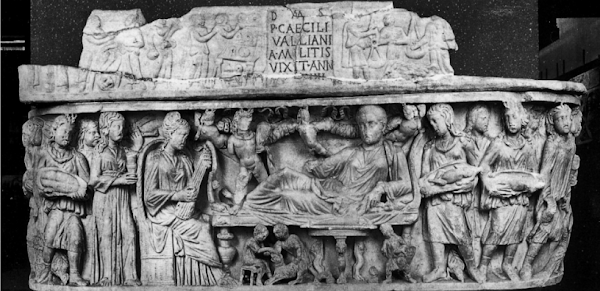

The deceased lies at table, and four long-haired servants serve him with the best things Nature has to offer. Two women play music to him, and behind him cupids are holding a long garland. Vatican Museums. Around 280.Id., p. 172, with note on p. 275:
The most elaborate of all the known picnic banquet scenes is on a sarcophagus in the Vatican, carved around 280 (Ill. 161).131 The relief—like the kline monuments (p. 29)—shows only one person lying on a couch, who is being pampered and served in the most lavish way. A woman is playing a stringed instrument (pandurium), and behind her another plays the double flute. Four handsome boys with long hair are bringing to the table the best produce the countryside has to offer. Three flying cupids are hanging up a garland and a larger cupid is strewing flowers on the banqueter, just as in Lucian's Elysian Fields. The prepared dishes and the uncooked animals brought along from the countryside (a hare and a peacock) show that nothing is lacking here.The reference is to Rita Amedick, Die antiken Sarkophagreliefs, Band. 1: Sarkophage mit Darstellungen aus dem Menschenleben, Teil 4: Vita Privata (Berlin: Gebr. Mann Verlag, 1991) (non vidi).
131. Amedick, ASR I 4 (1991), 167 f;, no. 286, plates 15 ff.
There is a fuller illustration, showing the lid, in Stine Birk, Depicting the Dead: Self-Representation and Commemoration on Roman Sarcophagi with Portraits (Aarhus: Aarhus University Press, 2013), p. 149, fig. 81, followed by caption:

The sarcophagus of P. Caecilius Vallianus (cat no. 536). Rome, Musei Vaticani, Museo Gregoriano profano, inv. 9538/9539. Photo: FA-S5718-01.The inscription is Corpus Inscriptionum Latinarum XI 3800 (from Isola Farnese / Veii):
D(is) M(anibus) s(acrum) / P(ubli) Caecili / Valliani / a militi(i)s / vixit ann(os) / LXIIIIKatherine M. D. Dunbabin, "The Waiting Servant in Later Roman Art," American Journal of Philology 124.3 (Autumn, 2003) 443-468 (at 450):
Vallianus reclines on his couch in the centre, with the table in front bearing a fish; a woman seated beside him plays a musical instrument, the pandurium. A maidservant with a vessel stands behind her, and on either side youthful male servants (six in all) hurry to serve their master. Three carry huge plates with various delicacies—a cake, a suckling pig, a fowl—a fourth carries the jug and basin used for handwashing; the two at either end bear live animals, a peacock and a hare. Baskets of roses stand at the ends beyond them. All the servants are similar in type, with long hair flowing over their shoulders, smooth cheeks, torques around their necks, soft shoes, and long-sleeved full tunics reaching to their knees.
Nobody Is Happy
Verses by Walther von der Vogelweide (Lachmann number 124, lines 18-24), tr. Philip Wilson, The Bright Rose: Early German Verse 800–1250 (Todmorden: Arc Publications, 2015), page numbers unknown:
Alas, how miserably the young people act
who were once so courteous in all they did.
All they know is sorrow: why is it so?
Nobody is happy no matter where I go.
Dance, laughter, song are all cast down.
Did ever Christian see such a lamentable crowd?
Owê wie jaemerlîche junge liute tuont!
den ê vil hovelîchen ir gemüete stuont,
die kunnen niuwan sorgen: owê wie tuont si sô?
swar ich zer welte kêre, dâ ist nieman frô;
tanzen, lachen, singen zergât mit sorgen gar,
nie kein kristenman gesach sô jaemerlîche schar.
Latinity of the Dark Ages
Gustaf Sobin (1935-2005), Ladder of Shadows: Reflecting on Medieval Vestige in Provence and Languedoc (Berkeley: University of California Press, 2009), p. 112:
Id., p. 164:
The constraints of one age would provide, ultimately, for the dynamic of the next, but only after those saeculae obscurae had come—mercifully—to a close.Read saecula obscura.
Id., p. 164:
One can safely say that in the tripart division of the natural world as constituted by the Romans—ager for cultivation, saltus for grazing, and silva for woodlands and forest—the first two of these, ager and saltus, would have seriously infringed upon the third—upon silvus, that is—by the end of antiquity.For silvus read silva.
Labels: typographical and other errors
Pious Destruction
Paul MacKendrick, Roman France (New York: St. Martin's Press, 1972), p. 169 (on Sanxay):
From the northeast corner of the baths a vaulted corridor led to a building with nineteen cubicles, perhaps a house of prostitution. Local legend hints that the corridor, when found in the nineteenth century, was adorned with indecent frescoes, piously destroyed by the excavator, a priest.
Monday, November 14, 2022
Goodbye
Epicurus, fragment 70 Usener (tr. A.A. Long and D.N. Sedley):
We should honour rectitude and the virtues and suchlike things if they bring pleasure; but if not, we should say goodbye to them.
τιμητέον τὸ καλὸν καὶ τὰς ἀρετὰς καὶ τοιουτότροπα, ἐὰν ἡδονὴν παρασκευάζῃ· ἐὰν δὲ μὴ παρασκευάζῃ, χαίρειν ἐατέον.
These Boots Are Made for Walking
Berthold Brecht, "Jenny's Song," Rise and Fall of the City of Mahagonny (tr. H.R. Hays):
As you make your bed you must lieThe same, tr. W.H. Auden and Chester Kallman:
And no one denies it's true
And if anyone does any stepping, that's me,
And when anyone's stepped on, that's you.
Denn wie man sich bettet, so liegt man,
Es deckt einen da keiner zu
Und wenn einer tritt, dann bin ich es,
Und wird einer getreten, dann bist's du.
As you make your bed, so you lie on it,The insistence on rhyme obscures the meaning of Brecht's German in these translations. I think the lines mean:
The bed can be old or brand-new;
So if someone must kick, why, that's my part
And another get kicked, that part's for you!
For as you make your bed, so must you lie,
And no one tucks anyone in there
And if anyone kicks, then I'm the one,
And if anyone gets kicked, then it's you.
Death of a Hunter
Supplementum Epigraphicum Graecum 54:788 (from Marmaroto on the island of Kos, 2nd/1st century BC):
πρὶν μὲν ἐνὶ ζωοῖσιν ἔτ' ὤν, Στίβε, πολλὰ κατ' ἄγκηMy translation:
τέρπεο γαυριόων κυδαλίμοισιν ἄγραις,
νῦν δέ σε τεθνειῶτα μέλαν νέφος ἀμφικαλύπτει·
ὀκτωκαιδεχέτη μοῖραν ἐπερχόμενον
εἷλ' ἁμῖ]ν Ἀΐδας· ἀλλ' ὦ Κυλλάνιε δαῖμον,
παῖδα τὸν ἀκρήβην πέμψον ἐπ' εὐσεβέας.
Formerly, when you were still among the living, Stibos, down many mountain glensThe Kyllenian god is of course Hermes Psychopompos, conductor of souls.
you used to take pleasure, rejoicing in glorious hunts,
but now a black cloud enfolds you who have died;
at eighteen years old when you came upon your fate,
Hades took you away from us; but, o Kyllenian god,
send this boy, a youth in his prime, to the pious ones.
Sunday, November 13, 2022
Epitaph of Alexandros
Supplementum Epigraphicum Graecum 46:902, in Searchable Greek Inscriptions (from Marcianopolis, 3rd-4th century AD; click once or twice to enlarge):
 Simplified transcription of the Greek, followed by my translation:
 The description in Searchable Greek Inscriptions — "Funerary epigram for Alexandros, son of Oiskos" — is misleading. Alexandros was a native (not a son) of Oiskos, which is a place name, not a personal name.

μή με τὸν ἐν φθιμένοις σπεύδων παρίδης, παροδεῖτα,Photograph of the stone (in Museum Devnya, inv. no. 235), from A. Angelov et al., "Eine Grabinschrift von Marcianopolis," Zeitschrift für Papyrologie und Epigraphik 112 (1996) 102–104 (at 103):
ἀλλὰ μάθε ταχέως τίς ἡ πατρὶς ἤτ’ ὅτις εἰμί·
πατρὶς μὲν Οἶσκος, τοὔνομα δὲ Ἀλέξανδρος·
ἀλλ' ἐτρύφησα καλῶς.
Don't overlook me, among the dead, as you hurry, o passerby,
but quickly learn what my fatherland is and who I am;
my fatherland is Oiskos, and my name is Alexandros;
but I enjoyed myself well.

Labels: typographical and other errors
Hold Fast
Cicero, Philippics 4.5.12-13 (tr. Walter C.A. Ker):
For the issue is, not on what terms we shall live, but whether we are to live at all, or perish in torture and ignominy. Nature has indeed appointed death for all men, yet against a death of cruelty and dishonour, valour, the native possession of the Roman race and lineage, ever affords a defence. Hold fast, I beseech you, to that which your ancestors have bequeathed you, as it were an heirloom. For while all things else are false and uncertain, perishable and shifting, valour alone is planted with the deepest roots; by no force can it be shaken or removed from its place.
agitur enim non qua condicione victuri, sed victurine simus an cum supplicio ignominiaque perituri. quamquam mortem quidem natura omnibus proposuit, crudelitatem mortis et dedecus virtus propulsare solet, quae propria est Romani generis et seminis. hanc retinete, quaeso, quam vobis tamquam hereditatem maiores vestri reliquerunt. nam cum alia omnia falsa, incerta sint, caduca, mobilia, virtus est una altissimis defixa radicibus; quae numquam vi ulla labefactari potest, numquam demoveri loco.
seminis codd.: nominis Ernesti
Young and Old
Epicurus, Vatican Sayings 17 (tr. A.A. Long and D.N. Sedley):
Blessed is not the young man but the old one who has lived honourably. For the young man keeps changing his mind and veers about under the influence of fortune. But the old one has lowered his anchor in old age as though in harbour, and with secure gratitude has clamped the good things he hardly hoped for previously.
οὐ νέος μακαριστὸς ἀλλὰ γέρων βεβιωκὼς καλῶς· ὁ γὰρ νέος ἀκμὴν πολὺς ὑπὸ τῆς τύχης ἑτεροφρονῶν πλάζεται· ὁ δὲ γέρων καθάπερ ἐν λιμένι τῷ γήρᾳ καθώρμικεν, τὰ πρότερον δυσελπιστούμενα τῶν ἀγαθῶν ἀσφαλεῖ κατακλείσας χάριτι.
ἀκμὴν Cronert: ἀκμῇ cod.
Death of Timanthes
Pausanias 6.8.4 (tr. W.H.S. Jones):
Timanthes, they say, met his end through the following cause. On retiring from athletics he continued to test his strength by drawing a great bow every day. His practice with the bow was interrupted during a period when he was away from home. On his return, finding that he was no longer able to bend the bow, he lit a fire and threw himself alive on to it. In my view all such deeds, whether they have already occurred among men or will take place hereafter, ought to be regarded as acts of madness rather than of courage.
τῷ δὲ Τιμάνθει τὸ τέλος τοῦ βίου συμβῆναί φασιν ἐπὶ αἰτίᾳ τοιᾷδε. πεπαῦσθαι μὲν ἀθλοῦντα, ἀποπειρᾶσθαι δὲ ὅμως αὐτὸν ἔτι τῆς ἰσχύος, τόξον μέγα ἐπὶ ἑκάστης τείνοντα τῆς ἡμέρας, ἀποδημῆσαί τε δὴ αὐτὸν καὶ ἐπὶ τῷ τόξῳ τηνικαῦτα ἐκλειφθῆναί οἱ τὴν μελέτην· ὡς δὲ ἐπανήκων οὐχ οἷός τε ἔτι τεῖναι τὸ τόξον ἐγίνετο, πῦρ ἀνακαύσας ἀφίησι ζῶντα ἐς τὴν πυρὰν αὑτόν. ὁπόσα δὲ ἤδη τοιαῦτα ἐγένετο ἐν ἀνθρώποις ἢ καὶ ὕστερόν ποτε ἔσται, μανία μᾶλλον ἢ ἀνδρία νομίζοιτο ἂν κατά γε ἐμὴν γνώμην.
Saturday, November 12, 2022
Confound Their Politics, Frustrate Their Knavish Tricks
G.K. Chesterton, "The National Anthem," The Illustrated London News (July 29, 1911):
I see that there is a movement in many influential quarters for cutting out the best verse in the National Anthem. This is very typical of many of our 'reforms' that arise out of a sense of refinement and not out of a sense of right. When I say the best verse, I mean the one that confounds the tricks of all the enemies of the State. And I call it the best verse because, in a work that no one particularly praises or preserves for literary reasons, it is the most quaintly national, the most unique, the most sincere and vigorous, and by far the most democratic. One does not hold up 'God Save the King' as a poem like the 'Mariners of England', any more than one holds up the picture of John Bull as something beautiful and well-proportioned, like the St George of Donatello. The thing is a patriotic curiosity; and the most curious and patriotic part of it is exactly the part that these people want to cut out. And, ethically, it is excellent.Confound their politics,may not be very good poetry, but it is very good, sound Christian morals. If there are any knavish tricks, I hope we all pray they may be frustrated. And as for confounding politics, a good many of us have been in sympathy with the idea ever since we made a study of the ways of the confounded politicians. The poem does not define the people denounced, except in so far that they are the enemies of the King, who is in all such symbolic songs made a symbol of the commonwealth. I happen to think that the King's worst enemies often sit at his own Council-board, and that England's worst invaders and destroyers often have the high places in the senate; but all this does not prevent me from singing the anthem with heartiness and relish.
Frustrate their knavish tricks,
What the refined people (confound their knavish tricks!) will not see is that, if you are loyal to anything and wish to preserve it, you must recognize that it has or might have enemies; and you must hope that the enemies will fail.
[....]
Nothing is baser in our time than the idea that we can have special enthusiasms for things, so long as they are secure, without pledging ourselves to uphold them if they are ever in peril. You cannot have a devotion that is not a boundary. You cannot have a boundary that is not a barricade. If you do not think mankind a sacred brotherhood to be everywhere saluted and saved, then do not say so. But if you do say so, then you must certainly be ready to save it from sharks or tigers, from monsters or from microbes. If you do not think your nation a solid entity and a holy soil, then do not call it your nation. But if you do, you must admit that it might be as much hated by others as it is loved by you. If it is really individual, it is just as likely to be hated as it is to be loved.
Our Own Dark Age
Gustaf Sobin (1935-2005), Ladder of Shadows: Reflecting on Medieval Vestige in Provence and Languedoc (Berkeley: University of California Press, 2009), pp. 96-97:
One wonders, living in a time such as ours, whether a similar period couldn't recur. Whether, indeed, in its own surreptitious way, it hasn't already begun. Of course, our own Dark Age, were it to develop, would be luminous: luminous with neon, cathode ray, with the green screens of countless monitors functioning autonomously in some postlinguistic semiotics, determining every aspect of our lives, shaping not only our decisions but our very choices. Yes, a dark, an incandescent dark, that would have no further need of those very creatures—ourselves—who'd first wired its circuits and set its screens aglow. Haven't we already entered that age, that shadow, the edge of that terrestrial eclipse? Aren't there signs sufficient enough: not the least of them, the steady, ineluctable breakdown in literacy as we move, today, from the verbal to the visual. From an articulated culture to one electronically programmed. From a consciousness rooted in speech to one in which so many neurons react spontaneously to so much optical stimuli. To life, in short, as video game.
Epitaph of Apollonios
Reinhold Merkelbach and Josef Stauber, edd., Steinepigramme aus dem griechischen Osten, Bd. 4: Die Südküste Kleinasiens, Syrien und Palaestina (München: K.G. Säur, 2002), pp. 73-74, number 17/19/03, from Olympos in Lykia, 4th century AD (click once or twice to enlarge):
 References are to Gül Işın, "The easternmost relief rock-cut tomb in Lycia: 'Topalgavur' at Asartaş," Lykia 1 (1994) 68-78 (non vidi), and
Michael Wörrle, "Leben und Sterben wie ein Fürst. Überlegungen zu den Inschriften eines neuen Dynastengrabes in Lykien," Chiron 28 (1998) 77-84, to which add Walter Burkert, "Sardanapal zwischen Mythos und Realität: Das Grab in Kilikien," in Ueli Dil and Christine Walde, edd., Antike Mythen: Medien, Transformationen und Konstruktionen (Berlin: Walter de Gruyter, 2009), pp. 502-515 (at 509-510).
Transcription of the Greek, followed by my translation:

Transcription of the Greek, followed by my translation:
τῇδε θανὼν κεῖμαι Ἀπολλώνιος Ἑλλαφίλου παῖς.Not in Searchable Greek Inscriptions.
ἠργασάμην δικαίως, ἡδὺν βίον εἶχον ἀεὶ ζῶν,
ἐσθίων καὶ πίνων καὶ παίζων. ἀλλ' ἴθι χαίρων.
Here I lie, having died, Apollonios, Hellaphilos' son.
I acted justly, I always had a pleasant life while I lived,
eating and drinking and playing. But go rejoicing.
Friday, November 11, 2022
Eight Billion People
Cypria, fragment 1 (tr. Martin L. West)
There was a time when the countless races <of men> roaming <constantly> over the land were weighing down the <deep->breasted earth's expanse. Zeus took pity when he saw it, and in his complex mind he resolved to relieve the all-nurturing earth of mankind's weight by fanning the great conflict of the Trojan War, to void the burden through death. So the warriors at Troy kept being killed, and Zeus' plan was being fulfilled.Related posts:
ἦν ὅτε μυρία φῦλα κατὰ χθόνα πλαζομένων <αἰεὶ
ἀνθρώπων ἐ>βάρυ<νε βαθυ>στέρνου πλάτος αἴης.
Ζεὺς δὲ ἰδὼν ἐλέησε, καὶ ἐν πυκιναῖς πραπίδεσσιν
σύνθετο κουφίσαι ἀνθρώπων παμβώτορα γαῖαν,
ῥιπίσσας πολέμου μεγάλην ἔριν Ἰλιακοῖο,
ὄφρα κενώσειεν θανάτῳ βάρος. οἱ δ' ἐνὶ Τροίῃ
ἥρωες κτείνοντο, Διὸς δ' ἐτελείετο βουλή.
- The Weight of Mankind
- Overpopulation (Ovid, Heroides 16.183-184)
- Overpopulation (Tertullian, On the Soul 30.4)
Statue of Vercingetorix
Statue of Vercingetorix by Aimé Millet:
 Bijan Omrani, Caesar's Footprints. A Cultural Excursion to Ancient France: Journeys Through Roman Gaul (New York: Pegasus Books, 2017), p. 103:
In a clearing of tattered oaks and beeches on the western height of Mont Auxois, above the village of Alise-Sainte-Reine, stands a statue of Vercingétorix, looking down over the scene of his defeat. The clearing is empty and silent when I visit, and the peaks of the surrounding hills where Caesar camped are hidden in cloud. Rainwater has washed seawatery green stains from the metal body of the statue into the limestone plinth, and the mass of it lours dark against a leaden sky. The statue has stood here since the 1860s, when it was commissioned by Emperor Napoleon III. Its inscription, adapted from the commentaries of Caesar, bespeaks the power imputed to its subject: La Gaule Unie, formant une seule nation, animée d'une même esprit, peut défier l'univers ('Gaul, united, forming a single nation, animated by the same spirit, is able to defy the universe'). Caesar had defeated and captured Vercingétorix, imprisoned and executed him, and appropriated the record of his deeds for his own benefit. And yet Caesar, for all his self-glorification and destructiveness, had laid sufficient foundations for a new identity for Vercingétorix — and for Gaul — to emerge in years to come.Related posts:
Hiding the Sausage
Paul MacKendrick, Roman France (New York: St. Martin's Press, 1972), p. 139 (on Montmaurin):
In 1983 a "reproduction augmentée" of Fouet's book was published. Neither edition is available to me.
A local farmer has set up, discreetly veiled by shrubbery, one of his finds, a twenty-inch phallus; which the village abbé, in his innocence, had failed to recognize for what it was.From Google Books' snippet view, I see the following in Georges Fouet, La villa gallo-romaine de Montmaurin (Haute-Garonne) (Paris: Éditions du Centre national de la recherche scientifique, 1969 = Gallia, Supplément XX), p. 171:
M. François Miro avait découvert dans les ruines un grand phallus de calcaire qu'il plaqua, afin de le dissimuler partiellement, contre le bâti maçonné d'une meule à aiguiser derrière des massifs d'arbustes de son jardin.Fouet, p. 189, Pl. LV is an illustration of a "Grand phallus en calcaire" (invisible in Google Books' snippet view).
In 1983 a "reproduction augmentée" of Fouet's book was published. Neither edition is available to me.
Thursday, November 10, 2022
We Live in an Armed Camp
G.K. Chesterton, "A Defence of Detective Stories," The Defendant (New York: Dodd, Mead & Co., 1902), pp. 118-123 (at 122-123):
There is, however, another good work that is done by detective stories. While it is the constant tendency of the Old Adam to rebel against so universal and automatic a thing as civilization, to preach departure and rebellion, the romance of police activity keeps in some sense before the mind the fact that civilization itself is the most sensational of departures and the most romantic of rebellions. By dealing with the unsleeping sentinels who guard the outposts of society, it tends to remind us that we live in an armed camp, making war with a chaotic world, and that the criminals, the children of chaos, are nothing but the traitors within our gates.
Uniformity
Keith Thomas, The Ends of Life: Roads to Fulfilment in Early Modern England (Oxford: Oxford University Press, 2009), p. 27, with notes on p. 279 (I corrected Crammer to Cranmer in n. 76):
The pluralism which underlies modern liberal social theory rests on the assumption that people pursue different goals and that those differences should be respected. In the early modern period, by contrast, disagreement about matters of politics and religion was more likely to be perceived as evidence of error or sinfulness. The expression of heterodox opinions could lead to severe punishment. Save during the Cromwellian Protectorate, it was not until after 1689 that a degree of religious toleration was officially permitted; and not until the nineteenth century that Catholics and Jews lost their civil disabilities. It was also well into the eighteenth century before it was accepted that politicians could pursue opposing objectives without regarding each other as guilty of treason. In an age of violently competing political and religious opinions, the accepted ideal was moral unanimity. Those who failed to adhere to conventional expectations, whether in their religion or their tastes or their personal behaviour, were accused of the great vice of 'singularity', of following their 'private fancy and vanity'. 'Desire not to be singular, nor to differ from others,' warned a Jacobean cleric, 'for it is a sign of a naughty spirit, which hath caused much evil in the world from the beginning.'75 Even a group of separatists in late Elizabethan Dover strongly denied any intention 'to become singular'.76
75. OED, s.v. 'singularity'; The Diary of Sir Henry Slingsby, ed. Daniel Parsons (1836), 203-4; Helen Berry, 'Sense and singularity', in Identity and Agency, ed. French and Barry, 179, 194; Richard Kilby, The Burthen of a Loaded Conscience, 6th imp. (Cambridge, 1616), 89.
76. Patrick Collinson, From Cranmer to Sancroft (2006), 161.
Wednesday, November 09, 2022
Epitaph of Epitynchanon
Inscription from Antinooupolis (3rd century AD), in Werner Peek, Griechische Vers-Inschriften, Vol. I: Grab-Epigramme (Berlin: Akademie-Verlag, 1955), pp. 341-342 (number 1167), and Étienne Bernand, Inscriptions métriques de l'Égypte gréco-romaine (Besançon: Université de Franche-Comté, 1969), pp. 143-147 (number 26, my translation):
The inscription was discovered and first published by Carl Schmidt, "Eine griechische Grabinschrift aus Antinoë," in Aegyptiaca: Festschrift für Georg Ebers (Leipzig: Verlag von Wilhelm Engelmann, 1897), pp. 99-106. I learned about it from J.P.V.D. Balsdon, Romans and Aliens (London: Duckworth, 1979), p. 219, with n. 38 on p. 294, and was surprised to find no complete English translation. See Frank M. Snowden Jr., "Some Greek and Roman Observations on the Ethiopian," Traditio 16 (1960) 19-38 (at 30), who compares Menander, fragment 612 Koerte (835 Kassel and Austin), lines 11-12 (tr. Francis G. Allinson):
If you know a man by the name of Pallas,On line 7, cf. Homer, Iliad 17.56 (βρύει ἄνθεϊ λευκῷ).
commander of ten men, in charge of (public) works of Antinoë,
to him a god led me, as a servant,
from the land of Ethiopia, where my ancestors are.
As for skin color, among the living, I was quite black, 5
the sort of one whom the sun's shafts make;
But my soul, always swelling with white flowers,
attracted the good will of a wise master,
for beauty ranks second to a good soul,
and crowned well my black form. 10
As the frenzied god (i.e. Dionysus) went among the Indians
to send forth dread tribes of barbarians to his altars,
such I was before, burned by the sun.
But now on the other hand in the grave I have hidden everything,
the soul and the body that surrounded me before, 15
and, of all that, there remains to me only a name.
For you may know, o stranger, that I am Epitynchanon,
having chanced upon all things pleasant to mortals;
May god give my master in recompense for these things
both a long road and at the same time fair fame. 20
Πάλλαντος εἴ τιν' οἶσθας ἄνδρ’ ἐπώνυμον,
δεκάδαρχον, ἔργων Ἀντινόοιο προστάτην,
τούτῳ με δαίμων οἰκέτην κατήγαγεν
Αἰθιοπίδος γῆς, ἔνθ' ἐμοὶ φυτόσποροι.
χροιήν μὲν ἐν ζωοῖσιν ἦν μελάντερος, 5
οἷον βολαὶ ποιοῦσιν ἡλιωτίδες·
ψυχὴ δὲ λευκοῖς ἄνθεσιν βρύουσ' ἀεὶ
εὔνοιαν εἷλκε δεσπότου σαόφρονος,
ψυχῆς γὰρ ἐσθλῆς κάλλος ἐστὶ δεύτερον,
μορφήν τέ μοι μέλαιναν εὖ κατέστεφεν . 10
οἷος μετ' Ἰνδοὺς ἦλθε μαινόλης θεός,
βωμοῖς ἀνήσων αἰνὰ φῦλα βαρβάρων,
τοιοῦτος ἦν πάροιθεν ἡλιούμενος.
νῦν αὖτε τύμβῳ πάντ' ἀποκρύψας ἔχω,
θυμόν τε μορφήν θ' ἥ με τὸ πρὶν ἄμπεχεν, 15
λοιπὸν δὲ πάντων οὔνομ' ἐστί μοι μόνον.
Ἐπιτυγχάνοντα γάρ με γινώσκοις, ξένε,
πάντων τυχόντα τῶν βροτοῖσιν ἡδέων·
τούτων δ' ἀμοιβὴν δεσπότῃ δοίη θεὸς
βίου τε μακρεὶν οἶμον εὔκλειάν θ' ὁμοῦ. 20
The inscription was discovered and first published by Carl Schmidt, "Eine griechische Grabinschrift aus Antinoë," in Aegyptiaca: Festschrift für Georg Ebers (Leipzig: Verlag von Wilhelm Engelmann, 1897), pp. 99-106. I learned about it from J.P.V.D. Balsdon, Romans and Aliens (London: Duckworth, 1979), p. 219, with n. 38 on p. 294, and was surprised to find no complete English translation. See Frank M. Snowden Jr., "Some Greek and Roman Observations on the Ethiopian," Traditio 16 (1960) 19-38 (at 30), who compares Menander, fragment 612 Koerte (835 Kassel and Austin), lines 11-12 (tr. Francis G. Allinson):
The man whose natural bent is good,As Bernand says (p. 147), "L'épitaphe est écrite tout autant à la gloire du maître ... qu'en souvenir de l'esclave," i.e., "the epitaph was composed as much to glorify the master as to remember the slave."
He, mother, he, though Aethiop, is nobly born.
ὅς ἂν εὖ γεγονὼς ᾖ τῇ φύσει πρὸς τἀγαθά,
κἂν Αἰθίοψ ᾖ, μῆτερ, ἐστὶν εὐγενής.
Don't Get Involved
Herodotus 7.148.3 (the Delphic Oracle to representatives from Argos; tr. Aubrey de Sélincourt):
N.G. Wilson, Herodotea: Studies on the Text of Herodotus (Oxford: Oxford University Press, 2015), p. 140:
Loathed by your neighbours, dear to the immortal gods,Heinrich Stein ad loc. (my translation):
Hold your javelin within and sit upon your guard.
Guard the head well, and the head will save the body.
ἐχθρὲ περικτιόνεσσι, φίλ᾽ ἀθανάτοισι θεοῖσιν,
εἴσω τὸν προβόλαιον ἔχων πεφυλαγμένος ἧσο
καὶ κεφαλὴν πεφύλαξο· κάρη δὲ τὸ σῶμα σαώσει.
For κεφαλή (head) refers to the ruling class, the full citizens, but σῶμα (body) to the remaining mass of the population.The oracle is number 92 in H.W. Parke and D.E.W. Wormell, The Delphic Oracle, Vol. II: The Oracular Responses (Oxford: Basil Blackwell, 1956), p. 40, who cite "Chalcidius (Baehrens F.P.R. Fr. 18). Vicinis offensa, deo carissima plebes, | armorum cohibe munimina; corporis omne | discrimen sola capitis tutabitur umbra."
Denn κεφαλή geht auf die regierende Gemeinde, die Vollbürger, σῶμα aber auf die übrige Masse der Bevölkerung.
N.G. Wilson, Herodotea: Studies on the Text of Herodotus (Oxford: Oxford University Press, 2015), p. 140:
H. Diels, Sibyllinische Blätter (Berlin, 1890), 60 n. 2, considered that in l. 3 of the oracle 'ein geschulter Dichter' would certainly have written δέ τε, and probably that was the wording of the oracle. But he thought it 'misslich' to emend. However, it is so easy and obvious that one should not declare it to be beyond the capacity of a less than expert poet, and I think his view verges on the perverse. Maas proposed the emendation, admittedly with a query.Wilson adopted Maas' emendation in his Oxford Classical Text edition, vol. II, p. 653. On δέ τε see J.D. Denniston, The Greek Particles, 2nd ed. (Oxford: Clarendon Press, 1954), pp. 532-533.
Epitaph of Amandos
Werner Peek, Griechische Vers-Inschriften, Vol. I: Grab-Epigramme (Berlin: Akademie-Verlag, 1955), p. 190, number 730 (from Tiberias, 3rd century AD):
 Peek's references are to Moshe Schwabe, "Ein griechisches Grabepigramm aus Tiberias," Journal of the Palestine Oriental Society 16 (1936) 158-165 (non vidi), and Aldo Ceresa-Gastaldo, "ΑΓΑΠΗ nei documenti anteriori al Nuovo Testamento," Aegyptus 31.2 (1951) 269-306 (at 288-290).
Transcription of the Greek:

Transcription of the Greek:
ἐνθάδε κεῖμε Ἄμανδος, τρυφῆς πάσης ὁ μετασχών,Translation by Seth Schwartz, Imperialism and Jewish Society: 200 B.C.E. to 640 C.E. (Princeton: Princeton University Press, 2001), p. 151 (brackets in original; footnote omitted):
ἰσοθέως ζήσας πουλὺν ἐτῶν ἀριθμόν,
ἐνδόξως στρατιᾶς ἄρξας δεκαταρχίδι τειμῇ,
καὶ μετὰ τὸν θάνατον ζῶσαν ἔχων ἀρετήν·
τίς γὰρ τόσσ' ἐτρύφησεν ἐν ἀνθρώποις ὅσ' ἐγώ περ;
ἢ τίς ὑπὸ πάτρης τόσσην ἔσχ' ἀγάπην;
γνώριμος ἐν πολλοῖσιν ὑπάρχων ἀνδράσιν αἰεί,
ὃν ποθέεσκε πάτρη, ἣ τέκεν Εὐ ⏑ ⏑ –.
Here I lie, Amandus, who has partaken of every luxury, who has lived, godlike [isotheôs], a great number of years, honorably having the rank of decurion of the army, having virtue [aretê] which lives even after death. Who has enjoyed as many luxuries among men as I? Who is so beloved of his native city [patrê]? I, who am always well-known among many men, whom the native city longs for, [T]i[berias?], that is, which bore me.Schwartz, p. 152:
[T]he epigram does feature some of the conventional themes of the genre—the love of the native city for the deceased, for example. A striking feature is the repeated emphasis on luxury, tryphê. In pagan literary works this word has the unambiguously negative connotations of softness, effeminacy, feebleness, and so on (see LSJ sub v.).81 Addiction to tryphê was thought servile. Yet in this text, written up, at any rate, by someone who had read a bit, participation in tryphê is presented as a praiseworthy accomplishment. It would be a mistake to attribute this sentiment to the eccentricity and ignorance of an ex-soldier in a remote provincial town, or to the ineptitude of the "epigrammatist" hired to compose the text. For notwithstanding the invariably pejorative sense tryphê possesses in classical texts, in funerary epigrams, including some of considerable elegance clearly composed by and for the highly literate, tryphê is commonly a neutral value and occasionally an admirable one. Common in epigrams is the "eat, drink, and be merry, for tomorrow you die" theme,82 for example, in this Greek epigram from the city of Rome: "Life is good but short; light is sweet but it fails. Enjoy your luxuries [tryphêson] while you can, for here eternal night awaits you." In such texts, tryphê is morally neutral, even, implicitly, somewhat inferior to moderation; after all, the poems imply, if not for the insouciance produced by the inevitability of death, you might have been inclined to avoid luxury! But in other texts, tryphê is, as in our Tiberian text, a virtue, possession of which is a source of pride.83
81 In Christian texts, though, the word frequently has a positive connotation, for example, it is regularly used of man's state before the Fall (see Lampe, Patristic Greek Lexicon, s.v.). The Christian usage is conceivably revelatory of the word's meaning in a nonliterary semantic register.
82 E.g., J. Robert and L. Robert, BullEp, 1960, no. 445; L. Robert, Hellenica 13 (1965): 184– 92; B. Lifshitz, "Notes d'épigraphie palestinienne," RB 73 (1966): 248–57.
83 Peek 263 (from Dorylaeum, Phrygia, second century C.E.); Peek 1113a.
Tuesday, November 08, 2022
Civil Unrest
Dio Chrysostom, Discourses 46.11 (tr. J.W. Cohoon):
For to be enraged at one's own fellow citizens — I care not whether justly or unjustly, but at all events at fellow citizens, citizens in good standing, yes, as good as anybody — and not to let them explain or to make an explanation to them, but without more ado to try to stone them and burn their houses, with a view to consuming in one conflagration, if possible, them and their children and their wives — what kind of human beings act that way?
τὸ γὰρ πολίταις ἑαυτῶν ὀργιζομένους — εἰ μὲν ἀδίκως ἢ δικαίως, ἐῶ, πολίταις δ' οὖν καὶ τούτοις ἐπιτίμοις καὶ μηδενὸς χείροσι — μὴ δοῦναι λόγον μηδὲ λαβεῖν, ἀλλ' εὐθὺς λιθάζειν καὶ κατακαίειν τὰς οἰκίας, ἵνα, εἰ ἐδύνασθε, μετὰ τῶν παίδων αὐτοὺς καὶ τῶν γυναικῶν συμφλέξητε, τίνων ἐστὶν ἀνθρώπων;
Bonus Eventus?
Paul MacKendrick, Romans on the Rhine: Archaeology in Germany (New York: Funk & Wagnalls, 1970), p. 158:
 Id., p. 159 (footnote omitted):
 On the Bonus Eventus hypothesis see id., pp. 114-115.

Another imported bronze, this time life-size, fished out of the Rhine near Xanten, may provide further evidence of Roman cult in Germany, if it represents, as has been plausibly conjectured, Bonus Eventus, the god of good result, whether in crops or any other human activity. He is represented (Fig. 6.3) as a boy in his early teens, with outstretched arms. Since his effeminate air closely resembles statues of the Emperor Hadrian's boy-love Antinous, he has been dated about A.D. 130. Whether he came from a temple or a villa, he is evidence of close religious connection with the homeland kept up by the Roman Establishment on a far frontier.Better known as the Xantener Knabe (Berlin, Staatliche Museen, Antikensammlung, inv. no. SK 4). See Uwe Peltz and Hans-Joachim Schalles, Der Xantener Knabe. Technologie, Ikonographie, Funktion und Datierung (Darmstadt: Verlag Philipp von Zabern, 2011 = Xantener Berichte, 22), from which I borrowed the following (Tafel 1):

Monday, November 07, 2022
Epitaph of Kyros
Christian Marek, Stadt, Ära und Territorium in Pontus-Bithynia und Nord-Galatia (Tübingen: Ernst Wasmuth Verlag, 1993 = Istanbuler Forschungen, 39), p. 144, number 28 of "Katalog der Inschriften von Pompeiopolis" (click once or twice to enlarge):
 I don't have access to Marek's photograph of the stone.
Reinhold Merkelbach and Josef Stauber, Steinepigramme aus dem griechischen Osten, Bd. 2: Die Nordküste Kleinasiens (Marmarasee und Pontos) (Munich: K.G. Saur, 2001), p. 322 (10/05/04, from Pompeiopolis in Paphlagonia; click once or twice to enlarge): Transcription of the Greek (with some minor punctuation changes), followed by my translation:

Reinhold Merkelbach and Josef Stauber, Steinepigramme aus dem griechischen Osten, Bd. 2: Die Nordküste Kleinasiens (Marmarasee und Pontos) (Munich: K.G. Saur, 2001), p. 322 (10/05/04, from Pompeiopolis in Paphlagonia; click once or twice to enlarge):

χήροις ὦ παροδεῖτ', ὅσσον δ' ἐσορᾷς φάος ἠοῦς,Could Ἀρηίφιλος be a personal name? See Lexicon of Greek Personal Names, vols. 4 and 5b, s.v. Ἀρηΐφιλος (3 examples, but not this one).
εὔφραινν' ἐν θαλίαισιν ἑὴν φρένα, τέρπες σεαὐτόν
εἰλαπίναις τε χοροῖς Κύπριδος τ' ἐραταῖσιν ἐπ' εὐναῖς,
εἰδὼς τοῦτο σαφῶς· ὁ θανὼν ὅτι τῶνδε λέλησται.
εἰ δὲ θέλις γενεήν τε καὶ οὔνομα τοὐμὸν ἀκοῦσαι, 5
οὔνομά μοι Κῦρος, πατρὶς δέ μοι Λάμψακός ἐστιν,
κεῖμαι δ' ἐν γαίῃ Πομπηίου, φῶς τόδε λείψας,
πολλὰ κοσμήσας θυμέλαις τὸν θεῖον Ὅμηρον,
ζήσας εἴκοσιπεντ' ἐπὶ τοῖς ΕΙ[ ] λυκαβάντας, 10
σῆμ[α δὲ τοὐμὸν ἔ]τευξεν ἀρηίφιλος [ ⏑ ⏑ – – ]
τερπνὸς Ὁμη[ριστὴς (?) ] ὃς δίχ' ἐν Υ[ ]
[ ]λλους εἰ [ ]νω[
Greetings, o passerby! As long as you see dawn's light,
gladden your heart in the festivities, delight yourself
with banquets and dances and on the lovely beds of Kypris,
knowing this clearly, that he who has died has forgotten these things.
If you wish to hear my origin and my name,
my name is Kyros, my fatherland is Lampsakos,
I lie here in the country of Pompey, having left this light,
having honored divine Homer often on the stage,
having lived 25 years [...]
One dear to Ares made my memorial [...]
a delightful actor of Homeric scenes [...] who asunder in [...]
[....]
Justice
Aeschylus, Libation Bearers 309-314 (tr. Herbert Weir Smyth):
"For a word of hate let a word of hate be said," Justice cries out as she exacts the debt, "and for a murderous stroke let a murderous stroke be paid." "Let it be done to him as he does," says the age-old wisdom.Hesiod, fragment 286 (tr. Glenn W. Most):
ἀντὶ μὲν ἐχθρᾶς γλώσσης ἐχθρὰ
γλῶσσα τελείσθω· τοὐφειλόμενον 310
πράσσουσα Δίκη μέγ᾽ ἀυτεῖ·
ἀντὶ δὲ πληγῆς φονίας φονίαν
πληγὴν τινέτω. δράσαντι παθεῖν,
τριγέρων μῦθος τάδε φωνεῖ.
If someone sowed evils, he would reap evil profits;Pindar, Nemean Odes 4.32 (tr. John Sandys):
if he suffered what he committed, the judgment would be straight.
εἰ κακά τις σπείραι, κακὰ κέρδεά κ' ἀμήσειεν·
εἴ κε πάθοι, τά τ’ ἔρεξε, δίκη κ' ἰθεῖα γένοιτο.
'Tis fitting that whoso doeth aught should suffer also.Sophocles, fragment 223b Radt, 229 Pearson (my translation):
ῥέζοντά τι καὶ παθεῖν ἔοικεν.
For the one who does something ought also to suffer.
τὸν δρῶντα γάρ τι καὶ παθεῖν ὀφείλεται.
Sunday, November 06, 2022
Inscription on a Spoon
Corpus Inscriptionum Latinarum III 12274c = Carmina Latina Epigraphica 1923 (Lampsacus, 6th century AD), tr. E. Courtney, Musa Lapidaria (Atlanta: Scholar's Press, 1995), p. 161 (his number 170b), with his note on p. 370:
On the entire set of 8 spoons see Reinhold Merkelbach and Josef Stauber, Steinepigramme aus dem griechischen Osten, Bd. I: Die Westküste Kleinasiens von Knidos bis Ilion (Stuttgart; B.G. Teubner, 1998), pp. 640-642 (number 07/07/03).
Baths, wine, love make our destiny speed up.Not self-castration and not accidental — see Martial 3.24 (tr. D.R. Shackleton Bailey):
Watch your groin while sacrificing.
balnea, vina, Venus faciunt properantia fata.
θύων τήρι τὴν κήλην σου.
(b) is inscribed on a spoon found at Gallipoli; the Greek refers to the story of accidental self-castration at a sacrifice recounted by Mart. 3.24.
A billy goat guilty of gnawing a vine stood sentenced to die at your altar, Bacchus, a welcome victim at your rites. When the Tuscan soothsayer was about to sacrifice hirn to the god, he told a rude country fellow, as it chanced, to be quick and sever the goat's testicles with a sharp sickle, so as to get rid of the noisome smell of unclean flesh. While he himself, bent over the green altar, was cutting the throat of the struggling animal with a knife and pressing hirn down with his hand, an enormous hernea stood revealed to the indignant rites. The bumpkin seizes thereon and cuts it with his steel, in the belief that ancient ritual of sacrifice so required and that with such organs the deities of old are worshipped. So, soothsayer, recently Tuscan but now Gaul, in slaughtering a goat you yourself became a gelding.On the Greek half of the inscription see Wilhelm Froehner, Kritische Analekten = Philologus Supplementband 5 (1889), p. 59:
Vite nocens rosa stabat moriturus ad aras
hircus, Bacche, tuis victima grata sacris.
quem Tuscus mactare deo cum vellet aruspex,
dixerat agresti forte rudique viro
ut cito testiculos †et acuta† falce secaret, 5
taeter ut immundae carnis abiret odor.
ipse super virides aras luctantia pronus
dum resecat cultro colla premitque manu,
ingens iratis apparuit hirnea sacris.
occupat hanc ferro rusticus atque secat, 10
hoc ratus antiquos sacrorum poscere ritus
talibus et fibris numina prisca coli.
sic, modo qui Tuscus fueras, nunc Gallus aruspex,
dum iugulas hircum, factus es ipse caper.
5 praeacuta Heinsius: curvata Schneidewin
Der französische herausgeber [Salomon Reinach] glaubt, die einzig erlaubte übersetzung sei: „während des opferns gib acht auf deinen hodenbruch“, und citiert das epigramm Martials (III, 24) de haruspice hernioso, das soweit als möglich abliegt. Andere witze über hodenbrüchige stehen im Philogelos (n. 113. 117-119 Eberhard; vergl. Rhein. museum 38, 521). Mir scheint, es müsse auch hier, der analogie halber, ein zusammenhang mit dem hexameter gesucht werden, und ein solcher wird erreicht, wenn wir θύων als einen schreibfehler betrachten und στύων lesen. Die verantwortlichkeit der conjectur übernehme ich ungern.If στύων were read instead of θύων, the Greek would mean something like "If you have a hard-on, watch your groin."
On the entire set of 8 spoons see Reinhold Merkelbach and Josef Stauber, Steinepigramme aus dem griechischen Osten, Bd. I: Die Westküste Kleinasiens von Knidos bis Ilion (Stuttgart; B.G. Teubner, 1998), pp. 640-642 (number 07/07/03).
The Purpose Driven Life
Aristotle, Eudemian Ethics 1.2.1 (1214 b 6-14; tr. C.D.C. Reeve):
Fixing one’s thought on these considerations, then, anyone capable of living in accord with his own deliberate choice should posit some target for living nobly, whether honor, reputation, wealth, or education, looking toward which he will do all his actions (on the supposition that not ordering life in relation to some end is a sign of great foolishness).
περὶ δὴ τούτων ἐπιστήσαντας ἅπαντα τὸν δυνάμενον ζῆν κατὰ τὴν αὑτοῦ προαίρεσιν θέσθαι τινὰ σκοπὸν τοῦ καλῶς ζῆν, ἤτοι τιμὴν ἢ δόξαν ἢ πλοῦτον ἢ παιδείαν, πρὸς ὃν ἀποβλέπων ποιήσεται πάσας τὰς πράξεις (ὡς τό γε μὴ συντετάχθαι τὸν βίον πρός τι τέλος ἀφροσύνης πολλῆς σημεῖον ἐστίν).
Toponyms
Gustaf Sobin (1935-2005), Luminous Debris: Reflecting on Vestige in Provence and Languedoc (Berkeley: University of California Press, 1999), pp. 112-113:
Nothing's older, in many places, than the toponyms themselves. Not even the archaic sites they still, occasionally, designate: the ruins, the earthworks, the beheaded remainders, say, of some oppidum lying perched on its long since abandoned outcrop. Nomen, quite frequently, antedates habitatio, for a particular place was often named—attributed—prior to being settled. Thus the toponym constitutes an artifact of its own, a "document," as the scholars would put it. Nothing, in turn, receives more focused attention, not even the potsherds, the stray coin, the scrupulously analyzed cross sections of the carpolithes (the fossilized fruit of the site's earliest inhabitants). As the founding vocable, the toponym is treated with all the care of an immensely delicate, perfectly irreplaceable object.
An object? Can a word, a locution, a breath-shred be endowed with all the properties—the material attributes—of an object? Containing everything that might be found, eventually, within its sonorous outlines, can it be considered, indeed, as the object of objects, the "thing" preeminent?
Like the archeologist, the toponymist goes under. Searches, in the present-day place name, for some archaic particle, some linguistic vestige that has somehow managed to survive its lost origins.
Saturday, November 05, 2022
What I Ate and Drank
Corpus Inscriptionum Latinarum IX 2114 = Carmina Latina Epigraphica 187 = Inscriptiones Latinae Selectae 8155 (from Benevento; my translation):

Corpus Inscriptionum Latinarum VI 18131 = Carmina Latina Epigraphica 244 = Inscriptiones Latinae Selectae 8155a (from Rome, 1st-2nd century AD), tr. Valerie M. Hope, Death in Ancient Rome: A Sourcebook (London: Routledge, 2007), p. 53: E. Courtney, Musa Lapidaria (Atlanta: Scholar's Press, 1995), p. 369:
Publius Clodius Pius, son of Publius, of the Stellatine tribe, 30th Legion.Franz Buecheler, Carmina Latina Epigraphica (Leipzig: B.G. Teubner, 1895), p. 91, number 187:
While I lived, I lived as befits a freeborn man.
What I ate and drank, (that) alone is mine.
P(ublius) Clodius P(ubli) f(ilius) Ste(llatina) Pius leg(ione) XX[X].
dum vixi, vixi quomodo condecet ingenuom.
quod comedi et ebibi, tantum meu est.

Corpus Inscriptionum Latinarum VI 18131 = Carmina Latina Epigraphica 244 = Inscriptiones Latinae Selectae 8155a (from Rome, 1st-2nd century AD), tr. Valerie M. Hope, Death in Ancient Rome: A Sourcebook (London: Routledge, 2007), p. 53:
To the spirits of the departed. Titus Flavius Martialis lies here. I have with me what I have eaten and drunk, I have lost what I left behind. He lived for 80 years. In front the tomb measures 5 feet, into the field ... [damaged]Franz Buecheler, Carmina Latina Epigraphica (Leipzig: B.G. Teubner, 1895), p. 115, number 244:
D(is) M(anibus) T(itus) Flavius Martialis hic situs est.
quod edi bibi, mecum habeo, quod reliqui, perdidi.
v(ixit) a(nnos) LXXX in f(ronte) p(edes) V in a(gro) p(edes)...

This is a sentiment derived from an alleged epigram on the tomb of Sardanapallus, translated by Cicero, Tusc. 5.101 (IGM 232, Suppl. Hell. 335, with parodies in 338 and 355). It is often found on walls and tombs (CLE 187, 2207 etc.); likewise IGRR 4.923 (from Cibyra) ἃ ἔφαγον ἔχω, ἃ κατέλιπον ἀπώλεσα. It debases the sentiment of 172.10. See further Nock 885-6, Lier (1904), 59, Lattimore 261, RE, Sardanapal 2441 sqq. With quōd (cf. quīd 89.4) this is a septenarius.Related post: The Epitaph of Sardanapalus.
Oops
Andrew Stewart, Art in the Hellenistic World: An Introduction (Cambridge: Cambridge University Press, 2014), p. 13:
 Transcription of the caption:

Temple of Athena at Priene in western Anatolia (Turkey). Designed in the 340s by the city's native son, the great architect Pytheos, but not completed for 300 years, it exemplified the so-called Ionian renaissance in architecture; its southeast corner also anchored the city's grid. Unfortunately, in 1965-66 a contractor, working independently, reerected five of its columns incorrectly, omitting part of their bases and several upper drums, making them almost 10 ft. shorter than they should be. By the late second century, the temple housed a colossal replica of Pheidias's fifth-century Athena Parthenos at Athens as a cult image. Original column H 37 ft. 5 in. (11.4 m); present H ca. 28 ft. (8.5 m).
Tests
G.K. Chesterton, All Things Considered (London: Methuen & Co., 1908), p. 203:
So far from it being irreverent to use silly metaphors on serious questions, it is one's duty to use silly metaphors on serious questions. It is the test of one's seriousness. It is the test of a responsible religion or theory whether it can take examples from pots and pans and boots and butter-tubs. It is the test of a good philosophy whether you can defend it grotesquely. It is the test of a good religion whether you can joke about it.Bruno Snell, The Discovery of the Mind, tr. T.G. Rosenmeyer (New York: Harper Torchbooks, 1960), p. 41:
We find it difficult to understand how the gods of one's faith could be subjected to Aristophanic jests. But laughter is part of the meaning, the fruitfulness, the positive side of life, and it is therefore, in the eyes of the Greeks, more godlike than the sour solemnity which we associate with piety.Hugh Lloyd-Jones, The Justice of Zeus, 2nd ed. (Berkeley: University of California Press, 1983), p. 133:
The occasional fun poked at the gods in comedy is no evidence against the religious conservatism of the common man; it is when religion is sure of itself that such amusement is permitted.Richard Janko, The Iliad: A Commentary, Volume IV: Books 13-16 (Cambridge: Cambridge University Press, 1992), p. 170 (on 14.153-353):
Few Greeks ever took their gods wholly seriously: this is, perhaps, the Greeks' greatest gift to civilization.
Friday, November 04, 2022
A Collage of Quotations
Keith Thomas, The Ends of Life: Roads to Fulfilment in Early Modern England (Oxford: Oxford University Press, 2009), p. 5, with notes on p. 273:
In this book I have cited contemporaries so liberally that at times my text comes close to being a collage of quotations. Collector, non auctor, ego sum ('I am the collector, not the author').9 I have some sympathy with the German cultural critic Walter Benjamin (1892-1940), whose ideal was a work consisting entirely of quotations, put together so skilfully that it could dispense with any accompanying text.10
9. Joannes Susenbrotus (1484/5-1542/3), cit. Brian Vickers, In Defence of Rhetoric (Oxford, 1988), 331.
10. See the introduction by Hannah Arendt to her edition of Walter Benjamin, Illuminations, trans. Harry Zohn (1973), 47.
A Worrying Trend
W.D.C de Melo, review of Catherine Tracy, Epidicus by Plautus: an annotated Latin text, with a prose translation (Cambridge: Open Book Publishers, 2021), in Bryn Mawr Classical Review (BMCR 2022.11.06):
Tracy's introduction is representative of a worrying modern trend: an old topic—here Plautine comedy—is rehashed, but without meaningful—even introductory—treatments of technical elements, of broader questions concerning Roman comedy, or of important scholarly trends in approaching this play. In their stead we find diatribes about the evils of antiquity.
[....]
[O]utrage is a poor substitute for scholarly discussion. It is remarkable how oppression and victimhood are treated as articles of faith, without any nuance.
Beguiling Goddesses
Gustaf Sobin (1935-2005), Ladder of Shadows: Reflecting on Medieval Vestige in Provence and Languedoc (Berkeley: University of California Press, 2009), p. 50, with note on p. 214:
 Related posts: Mutilation and Vandalism.
"By destroying cultic statues," writes Béatrice Caseau, "people were making sure that the goddesses would not have any means of harming them."5 One might readily rephrase that statement to read: by destroying cultic statues, people were making sure that the goddesses would not have any means of charming, beguiling, abducting them—once again—into the sensuous gardens of a paganism, profoundly telluric in its orientation. It was this very magnetism to things earthen, carnal, immediate that the new faith had proscribed. It advocated, now, a marked displacement of the senses. A purported heaven had come to supplant a deprecated earth, and, along with it, the ever more remote figures of the venerated had replaced the corporal splendor of those decried idols. The devout had begun looking elsewhere, beseeching an entirely invisible deity.Id., p. 49, fig. 5 ("Mutilated Venus figure. Musée de l'Arles et de la Provence Antiques. Photo by the author."):
5. Béatrice Caseau, s.v. "Sacred Landscapes," in Late Antiquity: A Guide to the Postclassical World, ed. G.W. Bowersock, Peter Brown, and Oleg Grabar (Cambridge: Mass.: Belknap Press, 1999), 21.

Epitaph of Victor the Gladiator
Reinhold Merkelbach and Josef Stauber, edd., Steinepigramme aus dem griechischen Osten, Bd. 4: Die Südküste Kleinasiens, Syrien und Palaestina (München: K.G. Säur, 2002), p. 56, no. 17/10/05, from Xanthos in Lykia, 2nd century AD (click once or twice to enlarge):
 Werner Peek, Griechische Vers-Inschriften, Vol. I: Grab-Epigramme (Berlin: Akademie-Verlag, 1955), p. 151, number 621:
 Simplified transcription of the Greek followed by my translation:
Roger Dunkle, Gladiators: Violence and Spectacle in Ancient Rome (2008; rpt. London: Routledge, 2013), p. 45, with notes on p. 316:


Βίκτορα πᾶλον αʹ σεκούτοραχαίρεται = χαίρετε
Βίκτορα τὸν στεναρόν με σεκούτορα νῦν ἐσορᾶτε,
ὃν πάντες τρόμεον σύνζυγοι ἐν σταδίοις·
οὗ πατρὶς ἦν Λιβύη· νῦν δὲ Ξάνθοιό με γαία
Αυξάνιον δάπεδον κατέχει σὺν δόγματι Μοιρο͂ν.
παῖζε, γέλα, παροδεῖτα, βλέπων ὅτι καὶ σὲ θανεῖν δεῖ.
Ἀμαζὼν Βίκτορι ἀνδρὶ ἰδίῳ ἐκ το͂ν ἑαυτοῦ μνείας χάριν τὸν βωμόν. εἴ τις δὲ καθελὼν ὀρύξῃ, δώσει εἰς τὸν φίσκον (δηνάρια) φʹ.
χαίρεται, παροδεῖται.
Victor, first-rank [primus palus], chaser [secutor].
Now look upon me, Victor, the strong chaser,
before whom all my yoke-fellows trembled in the arena.
My fatherland was Libya; but now the land of Xanthos,
the Auxanian plain, holds me by decree of the Fates.
Play, laugh, o passerby, seeing that you too must die.
Amazon (set up) the altar in memory of her husband Victor at her own expense. But whoever tears it down and digs up (the spot) will give 500 denarii to the treasury.
Farewell, o passersby.
Roger Dunkle, Gladiators: Violence and Spectacle in Ancient Rome (2008; rpt. London: Routledge, 2013), p. 45, with notes on p. 316:
Each category of gladiators was divided into four segments named after the post used for training exercises: first, second, third and fourth palus.87 Gladiators of the same gladiatorial type were ranked in these hierarchical groups according to the number of times they had been victorious in the arena. For example, all the thraeces in the school were divided in these four ranks. Robert notes that, in inscriptions, gladiators very seldom mention their membership in the two lowest classes (tertius and quartus palus).88 There was no glory in advertising membership in these lowest ranked groups. On the other hand, gladiators trumpeted their membership in the primus and secundus palus89. [....] The primus palus in each category of fighting style consisted of the most successful gladiators in the ludus, while the quartus palus contained those with the smallest number of victories. The gladiator in training, called a tiro ('apprentice'), could become a part of this ranking system only when he was promoted to the status of 'veteran' after his first bout, if he survived. In fact, many tirones never received that promotion because they were killed in their first bout. [....] The leader of a group of gladiators of the same type (thraeces, murmillones, etc.) in a school received a title derived from name of the highest-ranked group in that category. He was called the primus palus. For example, the emperor Commodus, whose fantasy of gladiatorial glory was nourished by his unbalanced mind, considered himself the leading secutor ('pursuer') in that category in Rome and thus was given (or took) the title of primus palus, which entitled him to a special cell in what was probably the largest gladiatorial school in the empire, the Ludus Magnus in Rome.Id., p. 108, fig. 16, a mosaic showing a retiarius, referee, and secutor:
87 See Robert, Les Gladiateurs, 29 and Marcus Junkelmann, 'Familia Gladiatoria: The Heroes of the Amphitheater', in Eckart Köhne and Cornelia Ewigleben (eds), The Power of Spectacle in Ancient Rome: Gladiators and Caesars (Berkeley, CA, 2000) 32–3. Ville (La Gladiature, 324, n. 217) points out that the hierarchical ranking for each type of gladiator in the ludus did not exist until after the reign of Domitian (AD 81–96). Carter (Gladiatorial Ranking and the 'SC de Pretiis Gladiatorum Minuendis' (CIL II 6278 = ILS 5163) Phoenix 57.1/2 (2003) 90) suggests the possibility of the existence of a sixth, and even an eighth palus in some schools.
88 Les Gladiateurs, 30–1.
89 Inscriptions 16, 35, 89, 179, 293, 298 in Robert, Les Gladiateurs. See Cass. Dio 72.22.3.
David Magie, Roman Rule in Asia Minor to the End of the Third Century after Christ (Princeton: Princeton University Press, 1950), p. 534 (Vol. I), with note on p. 1393 (Vol. II):

This process of Romanization appears also in the introduction of spectacles of the kind popular in Italy. [....] But after Lycia was made a Roman province, it became customary for wealthy men to present gladiatorial combats as well as wild-beast fights and hunts for the entertainment of their fellow-citizens. Spectacles of this kind were given at Oenoanda for two days by Licinius Longus on the occasion of his election as Lyciarch, at Myra and Patara by Opramoas at the time when he held this office, and at Telmessus and the Temple of Leto near Xanthus, respectively, by a federal and a local priest of the Augusti.64 The presence of gladiators at Telmessus and Xanthus, moreover, is shown by monuments erected after their death.Related post: Epitaph of a Gladiator (with a line almost identical to παῖζε, γέλα, παροδεῖτα, βλέπων ὅτι καὶ σὲ θανεῖν δεῖ above).
64. I.G.R. III 492 and 500 III (Oenoanda): T.A.M. II 905 = I.G.R. III 739, c.59 (Myra and Patara): T.A.M. II 15 = I.G.R. III 539 (Telmessus): T.A.M. II 287 = I.G.R. III 631 (Xanthus). See also T.A.M. III 143 = I.G.R. III 527 (Lydae). If the honorific inscription from Pinara, T.A.M. II 508 = I.G.R. III 681, is really to be dated in the first century before Christ (see above note 34), the mention of wild-beast fights and hunts presented at Tlos, Pinara, Cyaneae (?), Corydalla (?) and Telmessus shows that spectacles of this kind antedated the annexation of Lycia. The λουσώριον at Termessus Minor (I.G.R. III 481 = 1501 = Dessau 8870) and the βουκονιστήριον at Oenoanda (I.G.R. III 484) were presumably arenas in which fights were held. For the monuments of gladiators see T.A.M. II 355 (primus ? palus secutor) and 356 (primus palus myrmillonum) from Xanthus: T.A.M. II 117 (secunda rudis [Samniti]um, with portrait) from Telmessus. The man portrayed as a retiarius who σὺν τῶν συνκελλαρίων made a dedication to Hermes at Telmessus (T.A.M. II 107 = I.G.R. III 541) was evidently a gladiator. For gladiatorial combats and wild-beast hunts in the eastern provinces in general see L. Robert Les Gladiateurs dans l'Orient Grec (Paris 1940) and Chap. XXVII note 60.
Thursday, November 03, 2022
The Great Curse of Archaeology
M.I. Finley, "Technical Innovation and Economic Progress in the Ancient World,"
Economic History Review 18.1 (1965) 29-45 (at 41):
We are too often victims of that great curse of archaeology, the indestructibility of pots.
Irrevocable
Aeschylus, Agamemnon 1018-1021 (tr. Eduard Fraenkel):
But a man's dark blood, once fallen aforetime in death on the earth — who by incantation can call it up again?Fraenkel on πρόπαρ (line 1019):
τὸ δ' ἐπὶ γᾶν πεσὸν ἅπαξ
θανάσιμον πρόπαρ ἀνδρὸς
μέλαν αἷμα τίς ἂν
πάλιν ἀγκαλέσαιτ' ἐπαείδων;
Curious explanations have been put forward. Paley: 'at a man's feet'; Wecklein: 'the blood pouring from the breast flows to the ground in front of the man': Plüss: 'πρόπαρ ἀνδρός "he who was before a real living man".' Headlam, however, is probably right: 'But human blood once fallen aforetime'; i.e. πρόπαρ is adverbial as it is in the only other passage in which it occurs in Aeschylus, Suppl. 791 πρόπαρ θανούσας δ᾽ Ἀίδας ἀνάσσοι. There too πρόπαρ is clearly temporal (cf. the immediately preceding θέλοιμι δ᾽ ἂν μορσίμου βρόχου τυχεῖν ... πρὶν κτλ.), but at the same time the meaning 'prius' passes into 'potius', as it does so often: 'before it comes to that, sooner, rather'. In Ag. 1019 the temporal sense seems to be stressed. 'When blood has once been shed previously', then there is no escape afterwards, never in all the rest of time.Fraenkel on ἐπαείδων (line 1021):
as the flow of blood can be stopped, in the case of a wounded man who still lives, by ἐπαοιδή (Blomfield refers to τ 457 f. ἐπαοιδῆι δ' αἷμα κελαινὸν ἔσχεθον and the scholia on it); cf. in the parallel passage (see above on 1018 ff.) Eum. 649 ἐπωιδάς. The verb ἀνακαλεῖν (or ἀνακαλεῖσθαι) was, as early as Aeschylus (Pers. 621), used to denote the calling up of the spirit of a dead person by means of magic and particularly by incantation. Aeschylus uses the same verb here, where it is a case not of a spirit being summoned but of a dead man being brought back to complete physical existence.
The World of Men
Walter Burkert, Homo Necans: The Anthropology of Ancient Greek Sacrificial Ritual and Myth, tr. Peter Bing (Berkeley: University of California Press, 1983), p. 18:
The success of the "hunting ape" was due to his ability to work cooperatively, to unite with other men in a communal hunt. Thus, man ever since the development of hunting has belonged to two overlapping social structures, the family and the Männerbund; his world falls into pairs of categories: indoors and out, security and adventure, women's work and men's work, love and death. At the core of this new type of male community, which is biologically analogous to a pack of wolves, are the acts of killing and eating. The men must constantly move between the two realms, and their male children must one day take the difficult step from the women's world to the world of men. Fathers must accept their sons, educating them and looking after them—this, too, has no parallel among mammals. When a boy finally enters the world of men, he does so by confronting death.Id., p. 20:
[I]t is precisely group demonstration of aggression toward outsiders that creates a sense of close personal community. The Männerbund becomes a closed, conspiratorial group through the explosive potential of aggression stored internally. This aggression was released in the dangerous and bloody hunt. The internal and external effects of aggression mutually enhanced the chances of success. Community is defined by participation in the bloody work of men.
Wednesday, November 02, 2022
Horatian Counsels
Anatole France (1844-1924), The Crime of Sylvestre Bonnard, Part I (tr. Lafcadio Hearn):
I admire, as I tread the lava pavements of the strada, those porters and fishermen who move by me chatting, singing, smoking, gesticulating, quarrelling, and embracing each other the next moment with astonishing versatility of mood. They live through all their sense [sic, read senses] at the same time; and, being philosophers without knowing it, keep the measure of their desires in accordance with the brevity of life. I approach a much-patronised tavern, and see inscribed above the entrance this quatrain in Neopolitan patois:"Amice, alliegre magnammo e bevimmoEven such counsels was Horace wont to give to his friends. You received them, Posthumus; you heard them also, Leuconoë, perverse beauty who wished to know the secrets of the future. That future is now the past, and we know it well. Of a truth you were foolish to worry yourselves about so small a matter; and your friend showed his good sense when he told you to take life wisely and to filter your Greek wines—"Sapias, vina liques."
N fin che n'ce stace noglio a la lucerna:
Chi sa s'a l'autro munno n'ce verdimmo?
Chi sa s'a l'autro munno n'ce taverna?"*
* "Friends, let us merrily eat and drink as long as oil remains in the lamp: Who knows if we shall meet again in another world? Who knows if in the other world there will be a tavern?"
J'admire, en foulant les dalles de lave de la Strada, ces portefaix et ces pêcheurs qui vont, parlent, chantent, fument, gesticulent, se querellent et s'embrassent avec une étonnante rapidité. Ils vivent à la fois par tous les sens et, sages sans le savoir, mesurent leurs désirs à la brièveté de la vie. Je m'approchai d'un cabaret fort achalandé et je lus sur la porte ce quatrain en patois de Naples:Amice, alliegre magnammo e bevimmoHorace donnait de semblables conseils à ses amis. Vous les reçûtes, Postumus; vous les entendîtes, Leuconoé, belle révoltée qui vouliez savoir les secrets de l'avenir. Cet avenir est maintenant le passé et nous le connaissons. En vérité, vous aviez bien tort de vous tourmenter pour peu, votre ami se montrait homme de sens en vous conseillant d'être sage et de filtrer vos vins grecs. Sapias, vina liques.
N fin che n'ce stace noglio a la lucerna:
Chi sa s'a l'autro munno nc'e vedimmo?
Chi sa s'a l'autro munno n'ce taverna?
Amis, mangeons et buvons joyeusement
Tant qu'il y a de l'huile dans la lampe:
Qui sait si dans l'autre monde nous nous reverrons?
Qui sait si dans l'autre monde il y a une taverne?
A Wine Cooler
Red-figure psykter by Euphronios (late 6th century BC, found at Cerveteri), at St. Peterburg, State Hermitage Museum (Inv. No. Б. 1650, Inv. No. ГР. 4584), photographs from
Kamilla Kalinina et al., "A Psykter with Hetaerae in the State Hermitage Museum Collection: History, Questions, Future Possibilities," tr. Catherine Phillips,
Reports of the State Hermitage Museum 70 (2013) 79-94 (at 80):


 The hetaerae are named on the vase: Sekline (playing an aulos), Agape (raising a cup), Palaisto (drinking), and Smikra (playing kottabos). Above and below Smikra's right arm is the inscription τὶν τάνδε λατάσσο, Λέαγρε, i.e., I throw this [drop] to
you, Leagros.
The vase is number 200078 in the Beazley database.
On the use of the wine cooler see Brian A. Sparkes and Lucy Talcott, Pots and Pans of Classical Athens, 6th printing (Princeton: American School of Classical Studies at Athens, 1977), no page numbers: Transcribed text from Pots and Pans:


On the use of the wine cooler see Brian A. Sparkes and Lucy Talcott, Pots and Pans of Classical Athens, 6th printing (Princeton: American School of Classical Studies at Athens, 1977), no page numbers:

In warm weather wine is not served directly from the mixing bowl but from a psykter or wine cooler. Into the long-stemmed vessel goes the wine; into the mixing bowl, decorated or plain, goes cold water. The psykter is set inside the mixing bowl and a slender ladle reaches into its cool depths.On the Hermitage wine cooler see Allison Glazebrook, "Prostitutes, Plonk, and Play: Female Banqueters on a Red-figure Psykter from the Hermitage," Classical World 105.4 (Summer, 2012) 497-524.
Tuesday, November 01, 2022
Dual Citizenship
Inscription from Kotiaion in Phrygia, 1st-2nd century AD, in Reinhold Merkelbach and Josef Stauber, edd., Steinepigramme aus dem griechischen Osten, Bd. 3: Der „Ferne Osten“ und das Landesinnere bis zum Tauros (München: K.G. Säur, 2001), p. 283, number 16/32/05:
 Georg Kaibel, Epigrammata Graeca ex Lapidibus Conlecta (Berlin: Reimer, 1878), p. 161, number 362:
 Werner Peek, Griechische Vers-Inschriften, Vol. I: Grab-Epigramme (Berlin: Akademie-Verlag, 1955), p. 285, number 1016:
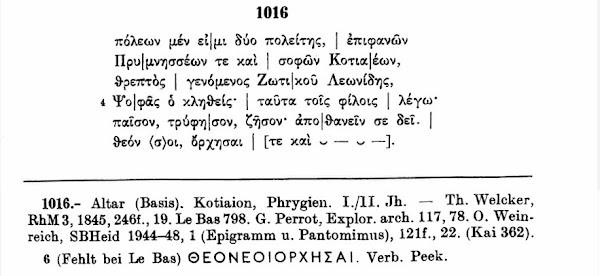 Transcription of the Greek followed by my translation:
Update. Thanks very much to Gonzalo Jerez Sánchez for the following information:
There is a Latin translation of the epitaph in Ed. Cougny, Epigrammatum Anthologia Palatina cum Planudeis et Appendice Nova Epigrammatum Veterum ex Libris et Marmoribus, Vol. III (Paris: Firmin-Didot, 1890), p. 158 (number 405), omitting the last fragmentary line:


πόλεων μέν εἰμι δύο πολείτης, ἐπιφανῶνI don't understand θεόν σοι, ὄρχησαι in the last line. Merkelbach and Stauber translate it as "Bei Gott, tanze," and I've followed them, but is an accusative of exclamation (I don't see any other way to parse it) really possible here? Also, it seems a stretch to identify Leonides as "ein Tänzer" on the basis of ὄρχησαι. Franco Mosino, in Epitaffi greci. La Spoon River ellenica di W. Peek (Milan: Bompiani, 2019), p. 487, translates θεόν σοι, ὄρχησαι as "Un dio per te, e danza," but that doesn't explain the accusative.
Πρυμνησσέων τε καὶ σοφῶν Κοτιαέων,
θρεπτὸς γενόμενος Ζωτικοῦ Λεωνίδης,
Ψόφαξ ὁ κληθείς· ταῦτα τοῖς φίλοις λέγω·
παῖσον, τρύφησον, ζῆσον· ἀποθανεῖν σε δεῖ.
θεόν σοι, ὄρχησαι [τε καὶ ⏑–⏑–].
I am a citizen of two cities, famous
Prymnessos and wise Kotiaion,
Leonides, the foster son of Zotikos,
the one called Psophax [i.e. Noisy]; this I say to my friends:
Play, have a good time, live; you must die.
By God, dance and ...
Update. Thanks very much to Gonzalo Jerez Sánchez for the following information:
No comment in Wackernagel nor Schwyzer but this could help with that accusative: Bos, L. (1830), Greek ellipses, London, pp. 185-186.These pages in Bos concern the ellipse of ὄμνυμι (I swear), and two of his examples are especially apposite, first Carmina Anacreontea 9 West, lines 1-2 (ἄφες με, τοὺς θεούς σοι, / πιεῖν, πιεῖν ἀμυστί) and second Marcus Aurelius, Meditations 7.17.1 (ἀπέρχου, τοὺς θεούς σοι, ὡς ἦλθες). For more examples see Alexia Zotou, Carmina Anacreontea 1‒34: Ein Kommentar (Berlin: De Gruyter, 2014), p. 63. So the last line of my translation should read "(I swear by) God to you, dance and..."
There is a Latin translation of the epitaph in Ed. Cougny, Epigrammatum Anthologia Palatina cum Planudeis et Appendice Nova Epigrammatum Veterum ex Libris et Marmoribus, Vol. III (Paris: Firmin-Didot, 1890), p. 158 (number 405), omitting the last fragmentary line:
Urbium quidem sum duarum civis illustrium,To Merkelbach and Stauber's note on names ending in -αξ add Paul Kretschmer and Ernst Locker, Rückläufiges Wörterbuch der griechischen Sprache, 2. Aufl. Mit Ergänzungen von Georg Kisser (Göttingen: Vandenhoeck & Ruprecht, 1963), pp. 197-200, 697 (ψόφαξ on p. 200), and Douglas Olson and Ryan Seaberg, Kratinos, frr. 219-514 (Göttingen: Vandenhoeck & Ruprecht, 2018 = Fragmenta Comica, Bd. 3.6), p. 246 (on Kratinos, fragment 416).
Prymnessensiumque et sapientium Cotiæensium,
alumnus qui fui Zotici, Leonides
Psophax cognominatus: hæc amicis dico:
Lude, voluptati indulge, vive: mori te oportet.
A Valiant Trencherman
Eupolis, fragment 166 Kassel and Austin (from Kolakes; tr. S. Douglas Olson):
he/she/it is engaged in profoundly vigorous gluttonyRelated posts:
λαφύσσεται λαφυγµὸν ἀνδρεῖον πάνυ
- Hail, Hail, Plump Paunch!
- Slim
- Let Me Have Men About Me That Are Fat
- Greatest of Divinities
- Anti-Obesity Legislation
- Apollonius of Tyana Meets a Fat Man
- Good Living to You
- A Very Valiant Trencherman (Balzac)
- A Very Valiant Trencherman (Samuel Johnson)
- A Hearty Eater
- Men That Are Fat
Teacher to Student
P. British Museum 9994, tr. Miriam Lichtheim, Ancient Egyptian Literature, Vol. II: The New Kingdom (Berkeley: University of California Press, 1973), pp. 168-175 (at 168):
Young fellow, how conceited you are! You do not listen when I speak. Your heart is denser than a great obelisk, a hundred cubits high, ten cubits thick.
Live Free or Die
Aeschylus, Agamemnon 1364-1365 (tr. Eduard Fraenkel):
Newer› ‹Older
Nay, it is not to be endured; to die is better,
for that is a milder lot than tyranny.
ἀλλ' οὐκ ἀνεκτόν, ἀλλὰ κατθανεῖν κρατεῖ·
πεπαιτέρα γὰρ μοῖρα τῆς τυραννίδος.

