Friday, July 08, 2022
Unsurprising
Pseudo-Epicharmus, fragment 279, preserved in
Diogenes Laertius 3.16 (tr. R.D. Hicks, modified):
 See Sara Tosetti, Analisi linguistica
dei frammenti 'ex Alcimo'
di Epicarmo e la tradizione
degli Pseudepicharmeia (diss. Venezia, Università Ca' Foscari, 2013), pp. 113-118.
Related posts:
It is no wonder then that we talk thusText and apparatus from R. Kassel et C. Austin, edd., Poetae Comici Graeci, I: Comoedia Dorica, Mimi, Phlyaces (Berlin: Walter de Gruyter, 2001), p. 163:
and are pleased with ourselves and think
we are fine folk. For to a dog a dog
appears the fairest of things, and an ox to an ox,
an ass to an ass the fairest, and verily a pig to a pig.
θαυμαστὸν οὐδὲν ἁμὲ ταῦθ᾽ οὕτω λέγειν
καὶ ἁνδάνειν αὐτοῖσιν αὐτοὺς καὶ δοκεῖν
καλὼς πεφύκειν· καὶ γὰρ ἁ κύων κυνὶ
κάλλιστον εἶμεν φαίνεται καὶ βοῦς βοΐ,
ὄνος δ᾽ ὄνῳ κάλλιστον, ὗς δέ θην ὑί.

Related posts:
- People of the Same Stock
- Incompatibility
- Flocking Together
- Birds of a Feather Flock Together
- Like Is Dear to Like
- Akin and Alike
- Worlds Apart
Thursday, July 07, 2022
Synthetic Men
C.S. Lewis, letter to Arthur Greeves (June 22, 1930):
Tolkien once remarked to me that the feeling about home must have been quite different in the days when a family had fed on the produce of the same few miles of country for six generations, and that perhaps this was why they saw nymphs in the fountains and dryads in the wood—they were not mistaken for there was in a sense a real (not metaphorical) connection between them and the countryside. What had been earth and air & later corn, and later still bread, really was in them. We of course who live on a standardised international diet (you may have had Canadian flour, English meat, Scotch oatmeal, African oranges, & Australian wine to day) are really artificial beings and have no connection (save in sentiment) with any place on earth. We are synthetic men, uprooted. The strength of the hills is not ours.
Epitaph of Chrysogonos
Inscriptiones Graecae XII 4 (Cos, 2nd-3rd century A.D.; my translation):
 I don't have access to Mario Segre, Iscrizioni di Cos, Vols. 1: Testo and 2: Tavole (Rome: "L'Erma" di Bretschneider, 1993 = Monografie della Scuola Archeologica di Atene e delle Missioni Italiane in Oriente, 6). Mario Segre died at Auschwitz at the age of 39 in 1944, with his wife and young son.
Here lies a servant of the Nymphs, Chrysogonos by name,Photograph of the inscription, from Rudolf Herzog, Koische Forschungen und Funde (Leipzig: Dieterich'sche Verlagsbuchhandlung / Theodor Weicher, 1899), Tafel VI, 2:
saying to every passerby: drink, you see the end.
83 years.
οὔνομα Χρυσόγονος Νυνφῶν λάτρις ἐνθάδε κεῖτα[ι],
παντὶ λέγων παρόδῳ· πεῖνε, βλέπις τὸ τέλος.
ἐτῶν πγ'.
1 Νυνφῶν Herzog: ΝΟΝΥΦΩΝ lapis: μακάρων dub. Peek

Native Soil
J.R.R. Tolkien, The Lord of the Rings, Part 3: The Return of the King (VI.6: Many Partings):
...the tree grows best in the land of its sires..Livy 38.17.13 (tr. Evan T. Sage):
Whatever grows in its own soil has greater excellence; transplanted to another soil, its nature being modified to suit that in which it grows, it loses its virtue.Related posts:
est generosius, in sua quidquid sede gignitur; insitum alienae terrae in id quo alitur, natura vertente se, degenerat.
- Stability and Mobility
- Domi Manere Oportet
- Oikos Philos, Oikos Aristos
- Small Houses
- Staying Put
- My Native Hills
- More on Aglaus of Psophis
- Staying at Home
- Lottites
- To Be Happy At Home
- Aglaus of Psophis
- Here
Tuesday, July 05, 2022
Restoration of Overthrown Statues
Tacitus, Histories 3.7.2 (tr. Clifford H. Moore):
An act long desired was now received with delight and given a flattering interpretation beyond its deserts, when Antonius [Primus] gave orders that in all the towns Galba's statues, which had been thrown down in the disorders of the times, should again be honoured. His real motive was that he believed that it would dignify Vespasian's cause if this were accounted an approval of Galba's principate and a revival of his party.
desiderata diu res interpretatione gloriaque in maius accipitur, postquam Galbae imagines discordia temporum subversas in omnibus municipiis recoli iussit Antonius, decorum pro causa ratus, si placere Galbae principatus et partes revirescere crederentur.
Word-Hunter
Greek
ὀνοματοθήρας occurs only twice (in Athenaeus, 3.98a and 14.649b) according to the dictionaries.
Epitaph of Hermes
Here is an inscription on a cenotaph from Termessos in Pisidia (2nd-3rd century A.D.), first printed with German translation and commentary by
Johannes Nollé, "Grabepigramme und Reliefdarstellungen aus Kleinasien," Zeitschrift für Papyrologie und Epigraphik 60 (1985) 117-135 (at 121-126), and reprinted in Reinhold Merkelbach and Josef Stauber, edd., Steinepigramme aus dem griechischen Osten, Bd. 4: Die Südküste Kleinasiens, Syrien und Palaestina
(München: K.G. Säur, 2002), p. 98, no. 18/01/19 (line break symbols | omitted):
τῆλε θανόντα πάτρης με χυτὴ κατὰ γαῖα κάλυψεν·I can't find any English translation, so here is my own rough version:
ἣν δ' ἐσορᾷς στήλην, θήκα[ν]το φίλοι ποθέοντες.
οὔνομα δ' εἰ ζητεῖς· Ἑρμῆν με πατρὸς καλέεσκον
Κάστορος, ὃν λιπόμην πένθεϊ τειρόμενον.
ἤκμασα κλυτὸς ἐγώ· χαίτην ἔστεψ' ἐν ἀγῶσιν 5
κηρύκων ἐνοπῇ σταδίοισί τε πάντοτ' ἐνείκων.
ἀλλὰ φίλος, πάντεσσι θανεῖν πεπρωμένον ἐστιν
οὐδέ τιν' ἔστι θανόντα πάλιν πόρον οἴκαδ' ἱκέσθαι.
ταῦτα μαθὼν εὔφραινε τεὸν πολυκηδέα θυμόν·
πεῖνε, τρύφα, τέρπου δώροις χρυσῆς Ἀφροδείτης. 10
αὐτομάτως ἤνθησα καὶ ἤκμασα καὶ <ἔ>λιπον φῶς.
Heaped-up earth covered me, who died far from my homeland.
Friends, who miss me, set up this monument that you see.
If you ask my name, they called me Hermes, (son) of father
Kastor, whom I left oppressed by grief.
I was at my prime, famous; I crowned my head in competitions 5
to the acclamation of heralds, and I always won in the race-courses.
But, friend, it is fated for everyone to die,
nor is it possible for anyone who has died to find a way back home.
Having learned these lessons, gladden your much-grieving heart;
Drink, revel, take pleasure in the gifts of golden Aphrodite. 10
Spontaneously I blossomed, and I was at my prime, and I left the light.
Monday, July 04, 2022
Life
First two lines of an inscription from Akmonia, Phrygia (1st-2nd century A.D., epitaph of Pollianos), in
Reinhold Merkelbach and Josef Stauber, edd., Steinepigramme aus dem griechischen Osten, Bd. 3: Der „Ferne Osten“ und das Landesinnere bis zum Tauros (München: K.G. Säur, 2001), p. 168, no. 16/03/03 (with my critical apparatus):
τὸ ζῆν τροφὴ πότος τε η τι [ _ ˘ _My translation, adopting Wilhelm's supplement:
περισσὰ δέ ἐστι τὰ˘ἄλλα [ _ x _ ˘ _
1 ἠτι[μασμένα Ramsay: ἤ τί [καὶ πλέον; Wilhelm
2 [ἃ ἀνθρώποις μέλει Ramsay
Life is food and drink, or what more besides?
The rest is superfluous.
Three Truths
Giacomo Leopardi (1798-1837), Zibaldone, tr. Kathleen Baldwin et al. (New York: Farrar, Straus and Giroux, 2013), p. 2071 (Z 4525):
Two truths that men will generally never believe: one, that we know nothing, the other, that we are nothing. Add the third, which depends a lot on the second: that there is nothing to hope for after death.
Due verità che gli uomini generalmente non crederanno mai: l'una di non saper nulla, l'altra di non esser nulla. Aggiungi la terza, che ha molta dipendenza dalla seconda: di non aver nulla a sperare dopo la morte.
Sunday, July 03, 2022
Unmastered Learning
"Wisdom's Soup," from the Mahabharata, tr. Arthur William Ryder, Relatives, Being Further Verses Translated from the Sanskrit (San Francisco: A.M. Robertson, 1919), p. 104:
A scholar who can merely quote
Unmastered learning got by rote,
Is erudition's luckless dupe,
A spoon to ladle wisdom's soup.
The fool who hears but cannot prize
The wisdom of the truly wise,
He too is erudition's dupe,
A spoon to ladle wisdom's soup.
But you, dear reader, if you prize
This wisdom of the truly wise,
Will soon be added to the group
Of tongues that relish wisdom's soup.
Bear Goddess
Corpus Inscriptionum Latinarum XIII 5160 (from Muri, in the canton of Bern, Switzerland, 2nd century AD?):


 Bern is an appropriate location for the statue group, since by folk etymology it is derived from German
Bär and has a bear on its coat of arms.
Ranko Matasović, Etymological Dictionary of Proto-Celtic (Leiden: Brill, 2009), pp. 42-43:
Deae Artioni Licinia SabinillaThat is,
Licinia Sabinilla for the goddess ArtioThe inscription is on the base of a bronze statue group in Bern, Historisches Museum, inventory number 16170/16210. The following photographs, by Stefan Rebsamen, appear in Annemarie Kaufmann-Heinimann, Dea Artio, die Bärengöttin von Muri: römische Bronzestatuetten aus einem ländlichen Heiligtum (Bern: Bernisches Historisches Museum, 2002):


Ranko Matasović, Etymological Dictionary of Proto-Celtic (Leiden: Brill, 2009), pp. 42-43:

The Futile Pastime of Misguided Acumen?
Andreas Willi, "Flowing riches: Greek ἄφενος and Indo-European streams," in J.H.W. Penney, ed., Indo-European Perspectives: Studies in Honour of Anna Morpurgo Davies (Oxford: Oxford University Press, 2004), pp. 323-337 (at 323):
Flicking through the etymological dictionaries of Greek can be a sobering experience: 'unklar', 'unerklärt', 'inconnue', and 'obscure' seem to be among Frisk's and Chantraine's favourite lexemes. At first sight, it may look as if there were not much harm in this: if we understand what Homer and Plato meant, why should we want to find out what Homer's and Plato's ancestors would have understood, had they read the same texts? However, ignoring etymologies also means ignoring cultural (pre)history and forsaking the historians goal of looking at past worlds through the eyes of those who were shaping them. Hence, etymologizing — sometimes regarded as the futile pastime of misguided acumen — remains a worthy form of philological work even if it is not crowned by the achievement of absolute certainty.
Saturday, July 02, 2022
How Much Our Opinions Are Worth
John Ruskin (1819-1900), Sesame and Lilies, rev. ed. (London: Smith, Elder & Co., 1871), pp. 32-33:
And by this process you will gradually come to attach less weight to your own "Thus I thought" at other times. You will begin to perceive that what you thought was a matter of no serious importance; — that your thoughts on any subject are not perhaps the clearest and wisest that could be arrived at thereupon: — in fact, that unless you are a very singular person, you cannot be said to have any "thoughts" at all; that you have no materials for them, in any serious matters;* — no right to "think," but only to try to learn more of the facts. Nay, most probably all your life (unless, as I said, you are a singular person) you will have no legitimate right to an "opinion" on any business, except that instantly under your hand. What must of necessity be done, you can always find out, beyond question, how to do. Have you a house to keep in order, a commodity to sell, a field to plough, a ditch to cleanse? There need be no two opinions about these proceedings; it is at your peril if you have not much more than an "opinion" on the way to manage such matters. And also, outside of your own business, there are one or two subjects on which you are bound to have but one opinion. That roguery and lying are objectionable, and are instantly to be flogged out of the way whenever discovered; — that covetousness and love of quarrelling are dangerous dispositions even in children, and deadly dispositions in men and nations; — that, in the end, the God of heaven and earth loves active, modest, and kind people, and hates idle, proud, greedy, and cruel ones; — on these general facts you are bound to have but one, and that a very strong, opinion. For the rest, respecting religions, governments, sciences, arts, you will find that, on the whole, you can know NOTHING, — judge nothing; that the best you can do, even though you may be a well-educated person, is to be silent, and strive to be wiser every day, and to understand a little more of the thoughts of others, which so soon as you try to do honestly, you will discover that the thoughts even of the wisest are very little more than pertinent questions.
* Modern "Education" for the most part signifies giving people the faculty of thinking wrong on every conceivable subject of importance to them.
They Deserved It
Homer, Odyssey 23.65-67 (tr. Peter Green):
For they had no respect for any dwellers upon this earth
whether high or low, whoever might come among them;
so they've come to grief through their own mad folly.
οὔ τινα γὰρ τίεσκον ἐπιχθονίων ἀνθρώπων,
οὐ κακὸν οὐδὲ μὲν ἐσθλόν, ὅτις σφέας εἰσαφίκοιτο·
τῷ δι' ἀτασθαλίας ἔπαθον κακόν.
A Motley Crew
Thucydides 7.5.4 (tr. Jeremy Mynott):
E.C. Marchant ad loc. compares Livy 22.43.2 (of Hannibal's troops; tr. B.O. Foster):
And in terms of spirit it was unthinkable that men who were Peloponnesians and Dorians should not expect as a right to overcome a group of Ionians, islanders and other assorted rabble and drive them from the land.A.W. Gomme et al. ad loc.:
τῇ δὲ γνώμῃ οὐκ ἀνεκτὸν ἐσόμενον εἰ μὴ ἀξιώσουσι Πελοποννήσιοί τε ὄντες καὶ Δωριῆς Ἰώνων καὶ νησιωτῶν καὶ ξυγκλύδων ἀνθρώπων κρατήσαντες ἐξελάσασθαι ἐκ τῆς χώρας.
In ξυγκλύδων Gylippos turns against the Athenian forces the reproach which Alkibiades (vi.17.2) used against the Sikeliots.σύγκλυς = "proper. tossed by the waves, fig. forming a rabble, collected at random" (Franco Montanari, The Brill Dictionary of Ancient Greek).
E.C. Marchant ad loc. compares Livy 22.43.2 (of Hannibal's troops; tr. B.O. Foster):
...the soldiers, the mingled offscourings of every race on earth...See also Jordanes, Gothic History 39.204 (speech of Attila before the Battle of the Catalaunian Plains in 451; tr. Charles Christopher Mierow):
...milites mixtos ex conluvione omnium gentium...
Despise this union of discordant races!
adunatas dispicite dissonas gentes.
Friday, July 01, 2022
Fog Children
John Ruskin (1819-1900), Sesame and Lilies, rev. ed. (London: Smith, Elder & Co., 1871), pp. 29-30:
This is literally true of all false religious teaching; the first and last, and fatalest sign of it, is that "puffing up." Your converted children, who teach their parents; your converted convicts, who teach honest men; your converted dunces, who, having lived in cretinous stupefaction half their lives, suddenly awaking to the fact of there being a God, fancy themselves therefore His peculiar people and messengers; your sectarians of every species, small and great, Catholic or Protestant, of high church or low, in so far as they think themselves exclusively in the right and others wrong; and, pre-eminently, in every sect, those who hold that men can be saved by thinking rightly instead of doing rightly, by word instead of act, and wish instead of work; — these are the true fog children — clouds, these, without water; bodies, these, of putrescent vapour and skin, without blood or flesh: blown bag-pipes for the fiends to pipe with — corrupt, and corrupting, — "Swollen with wind, and the rank mist they draw."
I Pledge My Hate
John Swinnerton Phillimore (1873-1926), "On Taking Leave of Connaught," II, lines 9-14, Things New and Old (Oxford: Humphrey Milford, 1918), p. 90:
I pledge my hate of the obscene brood that gathered"The gorged apostate Tudor" was Henry VIII. Phillimore was a Roman Catholic.
To eat the gorged apostate Tudor's bounty;
Of the Bible-canting perjurers I pledge
My hate, of the lickerish sons of Zeal, Hell-fathered,
Who ravished hearth and cloister, town and county,
With lust, oppression, usury, sacrilege.
Augmented Triad
J. Fraser, "Indogerman Grammar," a review of Hermann Hirt, Indogermanische Grammatik, in Classical Review 43.1 (February, 1929) 25-27 (at 26):
 M.L. West, Indo-European Poetry and Myth (Oxford: Oxford University Press, 2007), pp. 117-119:
Joshua T. Katz, "Inherited Poetics," in Egbert J. Bakker, ed., A Companion to the Ancient Greek Language (Malden: Wiley-Blackwell, 2010), pp. 357–369 (at 366-367):
Some New Testament examples, thanks to Joel Eidsath:
In Vol. I., 126 f., there is a discussion of a 'rhetorical peculiarity of Idg. poetry,' the peculiarity being that when there is a succession of three or four proper names, the third or fourth is provided with an epithet. A number of examples from Homer are given, four from Sanskrit Epic, and a like number from early Germanic verse. Finally, the author appears to think that he strengthens his case by giving as an example from Latin Erebumque Chaosque tergeminumque (sic) Hecaten. The device is admirably illustrated in the refrain of 'Widdicombe Fair,' and to claim Indogermanic origin for it does injustice to the ingenuity of later craftsmen.The passage from Hirt:

A special case of Behaghel's Law that is distinct and easily recognizable is what I call the Augmented Triad. It consists of the construction of a verse from three names (or occasionally other substantives), of which the third is furnished with an epithet or other qualification. I have devoted a paper to this topic and collected there numerous examples from the Vedas, the Indian epics, the Avesta, Hesiod and Homer, and the Germanic and Celtic literatures (West 2004). A few will suffice here by way of illustration. I can now add one from Hittite and a couple from Latvian.West 2004 = Martin L. West, "An Indo-European stylistic feature in Homer," in Anton Bierl et al., edd., Antike Literatur in neuer Deutung: Festschrift für Joachim Latacz anlässlich seines 70. Geburtstages (München: K.G. Saur, 2004), pp. 33-49.If he has seen something with his eyes,In the Indian, Greek, Germanic, and Celtic traditions we often find such triadic lines within longer catalogues of names. Catalogues are typical of heroic poetry, as they are of genealogical and other antiquarian verse. They may have been a feature of Indo-European heroic poetry, and the augmented triad a traditional device in them.
or taken something with his hand,
or trodden something with his powerful foot. (CTH 760 V iv 1 ff.)133
Diyaúr, Vánā, Giráyo vṛkṣákeśāḥ.
The Sky, the Forests, the Mountains tree-tressed. (RV 5.41.11)
Tváṣṭā, Savitā́, suyámā Sárasvatī
Tvaṣtṛ, Savitṛ, easy-guided Sarasvatī. (RV 9.81.4)
Daityānāṃ Dānavānaṃ ca Yakṣāṇāṃ ca mahaujasām.
Daityāna and Dānavāna and Yakṣāṇā of great might. (MBh. 1.2.76)
Βῆσσάν τε Σκάρφην τε καὶ Αὐγειὰς ἐρατεινάς.
Bessa and Skarphe and lovely Augeae. (Il. 2.532)
Heorogār ond Hrōðgar ond Hālga til.
Heorogar, Hrothgar, and Halga the good. (Beowulf 61)
Vara sandr né sær né svalar unnir.
There was not sand nor sea nor the cool waves. (Vọluspá 3)
Nōe, Ladru Lergnaid, luath Cuar.
Nóe, Ladru Lergnaid, the swift Cuar. (Campanile (1988), 29 no. 6. 3)
Simtiem dzina govis, vēršus, | simtiem bērus kumeliṇus.
Par centaines elle menait les vaches, les taureaux,
par centaines les bruns chevaux. (LD 33957; Jonval (1929), no. 144)
Līgo bite, līgo saule, | līgo mana līgaviṇa.
Sing, bee, sing, sun, | sing, O my bride. (LD 53542)
But triads also appear where there is no longer list but just a trio of names. Sometimes it is explicitly noted that the last name is the third: Il. 14.117 'Agrios and Melas, and horseman Oineus was the third', cf. 15.188; Campanile (1988), 33 no. 17.3 f. 'from a branch of Galian's line (came) Find fer Umaill (i.e. Find and his father Umall); an active hero was Trénmór as third';134 Grípisspá 37.3–4 'Gunnarr and Hǫgni and you, prince, as third'.
Sometimes the trio of names is preceded by the announcement that they are three. There is one especially common type, where three sons are recorded as sprung from one father, for example:Τρωὸς δ᾽ αὖ τρεῖς παῖδες ἀμύμονες ἐξεγένοντο,In these and in many other cases we have a more or less identical pattern: the words 'three sons', with the father's name in the genitive, with or without a verb such as 'were born'; a general qualification of the sons as 'fine', 'renowned', etc.; and then their individual names in an Augmented Triad.135
Ἶλός τ᾽ Ἀσσάρακός τε καὶ ἀντίθεος Γανυμήδης.
From Tros three fine sons were born:
Ilos and Assarakos and godlike Ganymedes. (Il. 20.231 f.)
trayas tv Aṅgirasaḥ putrā loke sarvatra viśrutāḥ:
Bṛhaspatir Utathyaś ca Saṃvartaś ca dhṛtavratāḥ.
But of Angiras, three sons renowned everywhere in the world:
Bṛhaspati and Utathya and Samvarta the resolute. (MBh. 1.60.5)
Tri meib Giluaethwy ennwir,
tri chenryssedat kywir:
Bleidwn, Hydwn, Hychdwn hir.
The three sons of false Gilfaethwy,
three champions true:
Bleiddwn, Hyddwn, Hychdwn the tall. (Math vab Mathonwy 281–3 Ford)
trī meic Nōe nair cech neirt:
Sem, Cam, Iafet aurdairc.
Three sons of Noah, of every (kind of) strength:
Shem, Ham, Japheth the glorious. (Lebor Gabála Érenn 189 f.)
It is hard to avoid the inference that this was a traditional formula from the common poetic inheritance. Here we seem to find a remnant of the Indo-European storyteller's building work: a recognizable structural component, with the lineaments of its verbal patterning still in place.
133 Quoted by Watkins (1995), 251.
134 So emended by Campanile, 57.
135 To the examples quoted in my 2004 paper, 46 f., may be added a further Irish one from The Fort of Árd Ruide (E. Gwynn, The Metrical Dindshenchas, iv (Dublin 1924), 368–71), 'Three sons did Lugaid leave; | whither are gone their riches?— | Ruide, son of broad-built Lugaid, | Eochaid and manly Fiachu'.
Joshua T. Katz, "Inherited Poetics," in Egbert J. Bakker, ed., A Companion to the Ancient Greek Language (Malden: Wiley-Blackwell, 2010), pp. 357–369 (at 366-367):
There are also poetic features at play that point to inherited material of greater complexity than simple sounds and morphemes. The most obvious one concerns the entirety of verse [Iliad 2.]460. "Geese or cranes or long-necked swans" is a paradigmatic example of what is often known as Behaghel's Law, a stylistic figure named after the Germanist Otto Behaghel that was evidently part of the repertoire of the artful Proto-Indo-European: NOUNx, NOUNy, and/or [EPITHET + NOUN]z (in general, the number of syllables also increases from x to y to z). This figure (it is not a "law" at all) forms a subset of the Gesetz der wachsenden Glieder ("law of increasing members"), one of four general principles of discourse that Behaghel formulated in the first half of the twentieth century; West (2004 and 2007: 117-19), who notes that it is found with special frequency in the Catalogue of Ships (West 2004: 34-5), has now dubbed it the "Augmented Triad." The nouns are frequently proper names (as in Il. 1.145 ἢ Αἴας ἢ Ἰδομενεὺς ἢ δῖος Ὀδυσσεύς "whether Ajax or Idomeneus or godly Odysseus" (all three are vowel-initial; the list continues with further augmentation in the next verse and — for an early example outside epic — Alcm. Partheneion 75-6 Φίλυλλα Δαμαρ[έ]τα τ᾿ ἐρατά τε Ϝιανθεμίς "Philylla and Damareta and lovely Wianthemis" (Watkins 1995: 31 notes the phonetic effect in the middle of 76)) and in one other instance in Homer are names of birds: σκῶπές τ᾽ ἴρηκές τε τανύγλωσσοί τε κορῶναι "owls and hawks and long-tongued crows" (Od. 5.66). Examples abound in Indo-European poetry from India to Ireland, as documented by West (see also now Galjanić 2008: 138-43), who does not ignore the tricky matter of trying to square the idea that "Behaghel triads" are a poetic inheritance with a plausible picture of Proto-Indo-European meter, which for him involves, quite reasonably, hepta- and especially octo-syllabic sequences (West 2004: 44-5, 47-8, referring back to West 1973b). Also desirable are investigations into the status of these triads as a purely Indo-European phenomenon (is it really?) and also into their relationship with the wider Gesetz, whose rhetorical effects are said to be visible in languages all over the world and occur by no means just in poetry. One example among many from Ciceronian Latin of what classicists generally call a "rising tricolon" or a "tricolon crescendo" is si acerbe, si crudeliter, si sine causa sum a tuis oppugnatus "if I have been attacked bitterly, cruelly, without reason by your family" (Fam. 5.2.10); Morgan (1983), suggesting that triads of various kinds may be one of the "bas[e]s of a grammar of folk-poetry" (55), gives examples of triads of various kinds in Sumerian, Egyptian, and Biblical Hebrew, as well as in Indo-European languages, ancient, medieval, and modern.See also J.P. Oakden, "The Survival of a Stylistic Feature of Indo-European Poetry in Germanic, Especially in Middle-English," Review of English Studies, Vol. 9, No. 33 (January, 1933) 50-53.
Some New Testament examples, thanks to Joel Eidsath:
τὸν Πέτρον καὶ Ἰάκωβον καὶ Ἰωάνην τὸν ἀδελφὸν αὐτοῦ (Matthew 17:1)
εἰς τὸ ὄνομα τοῦ Πατρὸς καὶ τοῦ Υἱοῦ καὶ τοῦ Ἁγίου Πνεύματος (Matthew 28:19)
Rah! Rah! Rah!
Herbert Pierrepont Houghton (1880-1964), "Gildersleeve on the First Nemean," Classical Journal 49.5 (February, 1954) 215-220 (at 216):
The Second Nemean he said was "really a small affair; it is a Greek articulate expression for the college boys' Rah! rah! rah! Nothing but a series of shouts, as one might say: Zeto! Hurrah!"
Thursday, June 30, 2022
A Magic Potion
Friedrich Nietzsche, Homer and Classical Philology, Inaugural Address, University of Basel, May 28, 1869 (tr. John McFarland Kennedy, rev. Jessica N. Berry):
It must be freely admitted that philology is to some extent borrowed from several other sciences, and is mixed together like a magic potion from the strangest liquids, metals, and bones...
Man muß nämlich ehrlich bekennen, daß die Philologie aus mehreren Wissenschaften gewissermaßen geborgt und wie ein Zaubertrank aus den fremdartigsten Säften, Metallen und Knochen zusammengebraut ist...
A Lover of the Past
C.S. Lewis, interview with Sherwood E. Wirt, in God in the Dock: Essays on Theology and Ethics, ed. Walter Hooper (1970; rpt. Grand Rapids: William B. Eerdmans Publishing Company, 2014), pp. 285-296 (at 292):
Wirt: How would you evaluate modern literary trends as exemplified by such writers as Ernest Hemingway, Samuel Beckett and Jean-Paul Sartre?Hat tip: Joel Eidsath.
Lewis: I have read very little in this field. I am not a contemporary scholar. I am not even a scholar of the past, but I am a lover of the past.
Ruins
Rutilius Namatianus, De reditu suo 1.409-414 (tr. J.Wight Duff and Arnold M. Duff):
The memorials of an earlier age cannot be recognised;
devouring time has wasted its mighty battlements away.
Traces only remain now that the walls are lost:
under a wide stretch of rubble lie the buried homes.
Let us not chafe that human frames dissolve:
from precedents we discern that towns can die.
agnosci nequeunt aevi monumenta prioris:
grandia consumpsit moenia tempus edax. 410
sola manent interceptis vestigia muris:
ruderibus latis tecta sepulta iacent.
non indignemur mortalia corpora solvi:
cernimus exemplis oppida posse mori.
Wednesday, June 29, 2022
We Have Lost Something
Lisa Jardine, Erasmus, Man of Letters: The Construction of Charisma in Print (Princeton: Princeton University Press, 2015), pp. 4-5:
We twentieth-century advancers of learning have altogether lost any such confidence in grand designs. We are painfully aware of an apparently flagging eminence, a diminished stature, a waning of a world in which men of letters made the agenda, and worldly men then strove to pursue it. We have ceased, I suggest, to promote learning as such, because we have lost Erasmus's conviction that true learning is the originator of all good and virtuous action—that right thought produces right government. In fact, of course, we try not to use words like true, good, virtuous, and right at all, if we can help it. They embarrass us. We are too deeply mired in the relativity of all things to risk truth claims. And on the whole we believe that in all of this, our age is one of loss—that we have lost something which the age of Erasmus possessed.
Freedom and Ease from Strife
John Swinnerton Phillimore, "Lermontov's Despair," lines 9-12, Things New and Old (Oxford: Humphrey Milford, 1918), p. 22:
No, there is naught I look for now in life,
For nothing in the past I feel regret:
Freedom is all I seek, and ease from strife.
Ah, could a man sleep soundly and forget!
Newcomers and Gangrels
J.R.R. Tolkien, The Lord of the Rings, Part 3: The Return of the King (VI.7: Homeward Bound; Barliman Butterbur speaking):
'No one comes nigh Bree now from Outside,' he said. 'And the inside folks, they stay at home mostly and keep their doors barred. It all comes of those newcomers and gangrels that began coming up the Greenway last year, as you may remember; but more came later. Some were just poor bodies running away from trouble; but most were bad men, full o' thievery and mischief.'
Imagine the Scene
Joshua T. Katz, "The Case for Secular American Yeshivas," Sapir: A Journal of Jewish Conversations 4 (Winter 2022):
Without philology — literally “love of words” in Greek — no one can properly follow, reproduce, or debate the merits and failings of a text.
And yet, sidelining philology is what most humanities departments have been doing for decades. All too often, professional humanists, and therefore also their students, do not so much read texts as approach them with one or another deliberate lens. They prioritize what is typically referred to as theory, believing — in large part in order not to seem irrelevant in a progressive world — that the central mission of education is not the search for truth but rather innovation, however wacky, for the sake of innovation. Textual tradition be damned.
[....]
If I sound like a cranky professor, it’s because I am one. I appreciate innovative thinking as much as the next person, but I also believe in tradition, and it is baffling to me that there are classicists who don’t.
[....]
How many people take the time to read about the hot-button issues of the day from all sides, assessing arguments and sources dispassionately rather than throwing out 280 ill-informed characters based on a sound bite or two from a single media source?
[....]
Imagine the scene: small groups of 18-year-olds sitting around a table hunched over some text or other and arguing cheerfully but with determination over the interpretation of the Second Amendment. Or the difference between the coverage of some event in the Washington Post and the Washington Examiner. Or the meaning of statesmanship, as defined by Plato, George Washington, and Barack Obama. The discussion of a given text or set of texts could go on for hours or days or weeks: There would be no formal curriculum, just a sense of doing philology, which Friedrich Nietzsche described as “slow reading.” I love this picture.
Garden Ornament
Columella, On Agriculture 10.29-34 (tr. E.S. Forster and Edward F. Heffner):
Related post: On Guard Duty.
Seek not a statue wrought by DaedalusSee Hans Herter, De Priapo (Giessen: Alfred Töpelmann, 1932 = Religionsgeschichtliche Versuche und Vorarbeiten, XXIII), p. 208.
Or Polyclitus or by Phradmon carved
Or Ageladas, but the rough-hewn trunk
Of some old tree which you may venerate
As god Priapus in your garden's midst,
Who with his mighty member scares the boys
And with his reaping-hook the plunderer.
neu tibi Daedaliae quaerantur munera dextrae,
nec Polyclitea nec Phradmonis, aut Ageladae
arte laboretur: sed truncum forte dolatum
arboris antiquae numen venerare Priapi
terribilis membri, medio qui semper in horto
inguinibus puero, praedoni falce minetur.
Related post: On Guard Duty.
Tuesday, June 28, 2022
The Fault Is Within Us
Manilius 1.904-905 (tr. G.P. Goold):
Wonder not at the grievous disasters which betide man and man's affairs, for the fault oft lies within us: we have not sense to trust heaven's message.This reminds me somewhat of Shakespeare, King Lear 1.2.116-130, although the moral is different:
ne mirere gravis rerumque hominumque ruinas,
saepe domi culpa est: nescimus credere caelo.
This is the excellent foppery of the world, that, when we are sick in fortune, often the surfeit of our own behaviour, we make guilty of our disasters the sun, the moon, and the stars; as if we were villains on necessity; fools by heavenly compulsion; knaves, thieves, and treachers by spherical pre-dominance; drunkards, liars, and adulterers by an enforc'd obedience of planetary influence; and all that we are evil in, by a divine thrusting on. An admirable evasion of whore-master man, to lay his goatish disposition to the charge of a star! My father compounded with my mother under the Dragon's Tail, and my nativity was under Ursa Major, so that it follows I am rough and lecherous. Fut! I should have been that I am, had the maidenliest star in the firmament twinkled on my bastardizing.Related post: Lack of Judgement.
Epitaph of C. Stallius Hauranus
Corpus Inscriptionum Latinarum X 2971 = Carmina Latina Epigraphica 961 (from Naples; tr. Dirk Obbink):
On the inscription see Allison Catherine Boex, Hic Tacitus Lapis: Voice, Audience, and Space in Early Roman Verse-Epitaphs (diss. Cornell University, 2014), pp. 109-115, and on C. Stallius Hauranus see Kent J. Rigsby, "Hauranus the Epicurean," Classical Journal 104 (2008) 19-22.
I'm not a very clubbable man, but it wouldn't upset me to be labeled as "ex Epicureio gaudivigente choro" or "Epicuri de grege porcum" (Horace, Epist. 1.4.16).
Related post: Epitaph of an Epicurean.
Gaius Stallius Hauranus watches this place,Gaudivigens is a hapax legomenon; Franz Buecheler ad loc. says, "gaudiuigens noue fictum quasi ἡδυθαλής, animus laetitia uiget Lucr. [3.149-150]," but ἡδυθαλής is also "noue fictum," so far as I can tell. I don't have access to Thomas Lindner, Lateinische Komposita: Ein Glossar vornehmlich zum Wortschatz der Dichtersprache (Innsbruck, 1996 = Innsbrucker Beiträge zur Sprachwissenschaft, 105).
a member of the Epicurean chorus that flourishes in joy.
Stallius Gaius has sedes Hauranus tuetur,
ex Epicureio gaudivigente choro.
1 Hauranus lapis: Gauranus Hagenbuch
On the inscription see Allison Catherine Boex, Hic Tacitus Lapis: Voice, Audience, and Space in Early Roman Verse-Epitaphs (diss. Cornell University, 2014), pp. 109-115, and on C. Stallius Hauranus see Kent J. Rigsby, "Hauranus the Epicurean," Classical Journal 104 (2008) 19-22.
I'm not a very clubbable man, but it wouldn't upset me to be labeled as "ex Epicureio gaudivigente choro" or "Epicuri de grege porcum" (Horace, Epist. 1.4.16).
Related post: Epitaph of an Epicurean.
Mock-Sanskrit in Joyce's Ulysses
James Joyce, Ulysses, Episode 12 (Cyclops):
Hat tip: John O'Toole.
Questioned by his earthname as to his whereabouts in the heavenworld he stated that he was now on the path of prālāyā or return but was still submitted to trial at the hands of certain bloodthirsty entities on the lower astral levels. In reply to a question as to his first sensations in the great divide beyond he stated that previously he had seen as in a glass darkly but that those who had passed over had summit possibilities of atmic development opened up to them. Interrogated as to whether life there resembled our experience in the flesh he stated that he had heard from more favoured beings now in the spirit that their abodes were equipped with every modern home comfort such as tālāfānā, ālāvātār, hātākāldā, wātāklāsāt and that the highest adepts were steeped in waves of volupcy of the very purest nature.Pralaya (without the macrons) is a real Sanskrit word, but the others of course aren't.
Hat tip: John O'Toole.
Monday, June 27, 2022
An All-Embracing Collective
Clifford Ando, Imperial Ideology and Provincial Loyalty in the Roman Empire (Berkeley: University of California Press, 2000), pp. 40-41 (footnote omitted):
Starting in particular with the reign of Hadrian, the imperial administration also explicitly advertised an ideology of unification. This ideology constructed the empire as an all-embracing collective by minimizing differences in culture and class and emphasizing the similarity of each individual's relationship to the emperor and especially the all-inclusive benefits of Roman rule.
Addition and Subtraction
William Morris (1834-1896), A Tale of the House of the Wolfings and All the Kindreds of the Mark (London: Reeves and Turner, 1889), p. 181 (from chapter XXIX):
[T]he host of the dead grew, and the host of the living lessened.
Imperishable Fame
Calvert Watkins (1933-2013), How to Kill a Dragon: Aspects of Indo-European Poetics (New York: Oxford University Press, 1995), pp. 12-13:
Rigvedic ákṣiti śrávaḥ (1.40.4b, 8.103.5b, 9.66.7c), śrávaḥ ... ákṣitam (1.9.7bc) and Homeric κλέος ἄφθιτον (Il. 9.413) all mean 'imperishable fame'. The two phrases, Vedic and Greek, were equated by Adalbert Kuhn as early as 1853, almost en passant, in an article dealing with the nasal presents in the same two languages.1 Kuhn's innovation was a simple one, but one destined to have far-reaching consequences. Instead of making an etymological equation of two words from cognate languages, he equated two bipartite noun phrases of noun plus adjective, both meaning 'imperishable fame'. The comparability extended beyond the simple words to their suffixal constituents śrav-as- a-kṣi-ta-m, κλεϝ-ες ἀ-φθι-το-ν.2 What Kuhn had done was to equate two set or fixed phrases between two languages, which later theory would term formulas. Thus in M.L. West's somewhat lyrical words (1988a:152), 'With that famous equation of a Rig-Vedic with a Homeric formula... Kuhn in 1853 opened the door to a new path in the comparative philologist's garden of delights.' The equation has itself given given rise to a considerable literature, notably Schmitt 1967:1-102 and Nagy 1974; it is discussed at length with further references and the equation vindicated in chap. 15.The Indo-European origin of the Homeric phrase is disputed by Margalit Finkelberg, "Is κλέος ἄφθιτον a Homeric Formula?" Classical Quarterly 36 (1986) 1-5, and "More on κλέος ἄφθιτον," Classical Quarterly 57 (2007) 341–350, both reprinted in her Homer and Early Greek Epic (Berlin: De Gruyter, 2020), pp. 3-8 and 66-77. For a defence of the Indo-European origin see Katharina Volk, "κλέος ἄφθιτον Revisited," Classical Philology 97 (2002) 61–68.
1. KZ 2.467. The journal, Zeitschrift für Vergleichende Sprachforschung, was founded by Kuhn only the previous year, and for the first hundred volumes of its existence was so abbreviated, for "Kuhns Zeitschrift". With volume 101 (1988) it became Historische Sprachforschung (HS).
2. The identity of the equation could be captured by a reconstruction reducing each of the two to the same common prototype. Historically the first reconstruction in Indo-European studies, with precisely the declared aim of capturing the common prototype underlying the feminine participles Greek -ουσα and Indie -antī, had been made by August Schleicher only the year before Kuhn's article, in the preface to Schleicher 1852.
An Inescapable Fact
Eleanor Dickey, An Introduction to the Composition and Analysis of Greek Prose (Cambridge: Cambridge University Press, 2016), p. x:
As necessary as memorization is consolidation. It is an inescapable fact that for most people, Greek grammatical forms and syntactic rules have a tendency to depart rapidly from the mind soon after being learned. One must simpiy accept this fact and learn the material repeatedly...
Epitaph of Asiarches
Richmond Lattimore, Themes in Greek and Latin Epitaphs (1935; rpt. Urbana: University of Illinois Press, 1962), p. 260:
I can't find a complete English translation of the inscription anywhere, so here is my rough version:
There remain to be considered a number of additional epitaphs which might be classed, very loosely, as philosophical.359 Tolman calls them "frivolous," and the fact is that the "philosophy" is mainly that which has for a long time passed as Epicurean; the conclusion that since life is short and death certain, the best one can do is enjoy the fun as long as it lasts. This grows from meditations on the nature of life itself, concerning which a late Roman epitaph may be cited:Lattimore cites as his source Georg Kaibel, Epigrammata Graeca ex Lapidibus Conlecta (Berlin: Reimer, 1878), p. 282, number 699, which I print here with my own critical apparatus:ἄστατος ὄντως359 Cf. Tolman 95-96; Lier (1904), 56-64.
θνητῶν ἐστι βίος καὶ βραχὺς οὐδ' ἄπονος.360
In truth the life of mortals is unsteady, short, and not without troubles.
360 EG 699, 5-6, (Rome, 3d cent. A.D.).
Νήπιον, ὠκύμορον κατέχω χθών, ὦ ξένε, παῖδα,Other editions include L. Moretti, Inscriptiones Graecae Urbis Romae III 1162 (unavailable to me), Inscriptiones Graecae XIV 1422, and Werner Peek, Griechische Vers-Inschriften (Berlin, 1955), p. 212, number 789.
ζώσαντ' ἐν μελάθροις ἐς λυκάβαντα τέταρτον.
οὔνομα δ' ἐν τοκέεσσι φίλοις κέκλητ' Ἀσιάρχης·
αὐτοὶ δ' οἳ θρέψαν τήνδ' ἐπέθοντο κόνιν
καὶ δακρύοισιν ἔβρεξαν ὅλον τάφον· ἄστατος ὄντως 5
θνητῶν ἐστι βίος καὶ βραχὺς οὐδ' ἄπονος.
versus 2 metro claudicat: μέχρις vel ὡς ante ἐς add. dub. Peek; λυκάβαντα lapis: λυκάβαν Wilhelm; τέταρτον lapis: τρίτον dub. Kaibel
I can't find a complete English translation of the inscription anywhere, so here is my rough version:
I, the earth, cover a prematurely dead infant child, o stranger,There is a Spanish translation in María Luisa del Barrio Vega, Epigramas funerarios griegos (Madrid: Editorial Gredos, 1992), p. 174:
who lived in his house up to his fourth year.
By name he was called Asiarches by his dear parents;
they who raised him buried these ashes
and drenched the whole tomb with their tears; unsteady in truth
is the life of mortals, and short, and not without troubles.
Yo soy la tierra que guarda a un niño de corta edad, de prematura muerte, extranjero: cuatro años fueron los que vivió en su casa. Asiarques era el nombre con el que lo llamaban sus padres. Este polvo esparcieron quienes lo criaron, y con sus lágrimas han humedecido toda su tumba. Fugaz es, en verdad, la vida de los mortales, breve y llena de pesares.
Sunday, June 26, 2022
Dislike of Travel
Eleanor Dickey, "J.N. Adams (1943-2021)," Commentaria Classica 8 (2021) 225-228 (at 227):
Born in Sydney, Australia, in 1943, Adams graduated from the University of Sydney in 1965 and in 1967 flew to England to embark on doctoral work at Oxford. He found the flying so traumatic that he could never get on an aeroplane again and remained in Britain for the rest of his life, though he always considered himself emphatically Australian. Adams' dislike of travel was not confined to flying: he almost never crossed the Channel by any means, and even within the UK rarely attended conferences. He thereby gained much more time for writing, and he ran no risk of being sidelined from contemporary scholarly discourse: the world's Latinists flocked to consult him individually, both about his ideas and about their own.
We May No Longer Endure These Outlanders
William Morris (1834-1896), A Tale of the House of the Wolfings and All the Kindreds of the Mark (London: Reeves and Turner, 1889), p. 154 (from chapter XXV):
But now look to it what ye will do; for we may no longer endure these outlanders in our houses, and we must either die or get our own again: and that is not merely a few wares stored up for use, nor a few head of neat, nor certain timbers piled up into a dwelling, but the life we have made in the land we have made. I show you no choice, for no choice there is.
Attentive Reading
John Ruskin (1819-1900), Sesame and Lilies, rev. ed. (London: Smith, Elder & Co., 1871), p. 17:
[Y]ou must get into the habit of looking intensely at words, and assuring yourself of their meaning, syllable by syllable—nay, letter by letter.Related posts:
The Founders of the Modern Spirit
Ernest Renan (1823-1892) The Future of Science (London: Chapman and Hall, Limited, 1891), p. 131:
The modern spirit, that is, rationalism, criticism, liberalism, was founded on the same day that philology was founded. The founders of the modern spirit are the philologists.
L'esprit moderne, c'est-à-dire le rationalisme, la critique, le libéralisme, a été fondé le même jour que la philologie. Les fondateurs de l'esprit moderne sont des philologues.
Saturday, June 25, 2022
Accidents Happen
Joshua T. Katz, "The Muse at Play: An Introduction," in Jan Kwapisz et al., edd., The Muse at Play: Riddles and Wordplay in Greek and Latin Poetry (Berlin: De Gruyter, 2013), pp. 1-30 (at 5, footnote omitted):
Acrostics are seemingly straightforward, but the existence of C-A-C-A-T-A ("shitty") in Eclogue 4.47–52 will suffice to show that accidents happen.
I'm Vexed and Grieved
Aristophanes, Assemblywomen 174-179 (tr. Stephen Halliwell):

I'm vexed and grieved to seeR.G. Ussher ad loc.:
The poor condition the city's affairs are in.
I notice how she always has as leaders
The rotten types. If one of them is decent
For one whole day, he's rotten then for ten!
If you switch to another, he'll only make things worse.
ἄχθομαι δὲ καὶ φέρω
τὰ τῆς πόλεως ἅπαντα βαρέως πράγματα. 175
ὁρῶ γὰρ αὐτὴν προστάταισι χρωμένην
ἀεὶ πονηροῖς. κἄν τις ἡμέραν μίαν
χρηστὸς γένηται, δέκα πονηρὸς γίγνεται.
ἐπέτρεψας ἑτέρῳ· πλείον᾿ ἔτι δράσει κακά.
175 ἅπαντα codd.: σαπέντα Palmer: παρόντα Jackson

Masked Words
John Ruskin, Sesame and Lilies, rev. ed. (London: Smith, Elder & Co., 1871), pp. 19-20:
There are masked words droning and skulking about us in Europe just now, — (there never were so many, owing to the spread of a shallow, blotching, blundering, infectious "information," or rather deformation, everywhere, and to the teaching of catechisms and phrases at school instead of human meanings) — there are masked words abroad, I say, which nobody understands, but which everybody uses, and most people will also fight for, live for, or even die for, fancying they mean this or that, or the other, of things dear to them: for such words wear chameleon cloaks — "ground-lion" cloaks, of the colour of the ground of any man's fancy: on that ground they lie in wait, and rend them with a spring from it. There never were creatures of prey so mischievous, never diplomatists so cunning, never poisoners so deadly, as these masked words; they are the unjust stewards of all men's ideas: whatever fancy or favourite instinct a man most cherishes, he gives to his favourite masked word to take care of for him; the word at last comes to have an infinite power over him, — you cannot get at him but by its ministry.Chameleon comes from χαμαί (on the ground) and λέων (lion).
The Mad Impulse of One Mind
Jordanes, Gothic History 36.193 (tr. Charles Christopher Mierow):
What just cause can be found for the encounter of so many nations, or what hatred inspired them all to take arms against each other? It is proof that the human race lives for its kings, for it is at the mad impulse of one mind a slaughter of nations takes place, and at the whim of a haughty ruler that which nature has taken ages to produce perishes in a moment.Related post: The King and His Subjects.
quae potest digna causa tantorum motibus invenire? aut quod odium in se cunctos animavit armari? probatum est humanum genus regibus vivere, quando unius mentis insano impetu strages sit facta populorum et arbitrio superbi regis momento defecit quod tot saeculis natura progenuit.
Friday, June 24, 2022
For You Too
Inscriptiones Graecae I2 972, tr.
Paul Friedländer and Herbert B. Hoffleit, Epigrammata: Greek Inscriptions in Verse from the Beginnings to the Persian Wars (Berkeley: University of California Press, 1948), p. 88:
Before the tomb of brave and wise Antilochus
[shed a tear]; for you too death awaits.
Aristion made me.
Ἀ]ντιλόχου ποτὶ σῆμ' ἀγαθοῦ καὶ σόφρονος ἀνδρὸς
[δάκρυ κ]άταρ[χ]σον̣, [ἐ]π[ε]ὶ καὶ σὲ μένει θάνατος.
Ἀριστίον μ' ἐπόησεν.
Reverence for the Text
H. Craig Melchert, "In Memoriam
Calvert Watkins," Journal of Indo-European Studies 41.3/4 (Fall/Winter 2013) 506-526 (at 510-511):
With his gift for large-scale synthesis and willingness to explore novel approaches, Calvert Watkins nevertheless firmly believed that "the devil is in the details." All of his linguistic analyses and hypotheses, from the most modest individual word etymology to his grandest and boldest reconstructed schemata rested on rock-solid philological foundations—and he insisted that his students' analyses did likewise. Originality without proper grounding veers easily into unbridled fantasy, and generalizations become self-perpetuating dogma. In Watkins' work an unwavering "reverence for the text" forestalled any such tendencies. He viewed recalcitrant facts that did not fit an analysis not as inconveniences to be ignored, but as priceless clues to a better solution—something to which he hoped his students would contribute.Related post: The Courage to Make a Mistake.
Blacksmith Working on a Helmet
Attic red-figure stemmed cup depicting a blacksmith working on a helmet, attributed to the Antiphon Painter, ca. 480 B.C. (Oxford, Ashmolean Museum, accession number AN1896-1908.G.267):
 John H. Oakley, A Guide to Scenes of Daily Life on Athenian Vases (Madison: The University of Wisconsin Press, 2020), pp. 51-52:

Second in popularity on Athenian vases, after the images connected with pottery production, were scenes of metalworkers. Interestingly, a major metalworking area of Athens was in the northwest Agora and not far from the Kerameikos, the potters' quarters, so that the painters did not have far to look for inspiration. Several of the metalworking scenes are mythological, showing Thetis and/or Hephaistos or Athena, and occasionally satyrs, so they are not included here. Armor is the most common object being worked on by the smiths, with a helmet, as in the tondo of a red-figure cup in Oxford by the Antiphon Painter of 480 BC (fig. 2.5), being the most popular object. Seated on a diphros, the smith holds out a Corinthian helmet in his left hand and a file/rasp in his right. Other tools, five files/rasps of different sizes, hang above him in the background; a furnace stands behind him and an anvil, an akmotheton, is set in a mound before him. On other vases, greaves, tripods, statues, and swords are shown being worked on.
Skill
Bernard DeVoto (1897-1955), Across The Wide Missouri (1947; rpt. Boston: Houghton Mifflin Company, 1964), pp. 158-160:
Skill develops from controlled, corrected repetitions of an act for which one has some knack. Skill is a product of experience and criticism and intelligence. Analysis cannot much transcend those truisms. Between the amateur and the professional, between the duffer and the expert, between the novice and the veteran there is a difference not only in degree but in kind. The skillful man is, within the function of his skill, a different integration, a different nervous and muscular and psychological organization. He has specialized responses of great intricacy. His associative faculties have patterns of screening, acceptance and rejection, analysis and sifting, evaluation and selective adjustment much too complex for conscious direction. Yet as the patterns of appraisal and adjustment exert their automatic and perhaps metabolic energy, they are accompanied by a conscious process fully as complex. A tennis player or a watchmaker or an airplane pilot is an automatism but he is also criticism and wisdom.
It is hardly too much to say that a mountain man's life was skill. He not only worked in the wilderness, he also lived there and he did so from sun to sun by the exercise of total skill. It was probably as intricate a skill as any ever developed by any way of working or living anywhere. Certainly it was the most complex of the wilderness crafts practiced on this continent. The mountains, the aridity, the distances, and the climates imposed severities far greater than those laid on forest-runners, rivermen, or any other of our symbolic pioneers. Mountain craft developed out of the crafts which earlier pioneers had acquired and, like its predecessors, incorporated Indian crafts, but it had a unique integration of its own. It had specific crafts, technologies, theorems and rationales and rules of thumb, codes of operating procedure — but it was a pattern of total behavior.
Treatises could be written on the specific details; we lack space even for generalizations. Why do you follow the ridges into or out of unfamiliar country? What do you do for a companion who has collapsed from want of water while crossing a desert? How do you get meat when you find yourself without gunpowder in a country barren of game? What tribe of Indians made this trail, how many were in the band, what errand were they on, were they going to or coming back from it, how far from home were they, were their horses laden, how many horses did they have and why, how many squaws accompanied them, what mood were they in? Also, how old is the trail, where are those Indians now, and what does the product of these answers require of you? Prodigies of such sign-reading are recorded by impressed greenhorns, travelers, and army men, and the exercise of critical reference and deduction which they exhibit would seem prodigious if it were not routine. But reading formal sign, however impressive to Doctor Watson or Captain Fremont, is less impressive than the interpretation of observed circumstances too minute to be called sign. A branch floats down a stream — is this natural, or the work of animals, or of Indians or trappers? Another branch or a bush or even a pebble is out of place — why? On the limits of the plain, blurred by heat mirage, or against the gloom of distant cottonwoods, or across an angle of sky between branches or where hill and mountain meet, there is a tenth of a second of what may have been movement — did men or animals make it, and, if animals, why? Buffalo are moving downwind, an elk is in an unlikely place or posture, too many magpies are hollering, a wolf's howl is off key — what does it mean?
Such minutiae could be extended indefinitely. As the trapper's mind is dealing with them, it is simultaneously performing a still more complex judgment on the countryside, the route across it, and the weather. It is recording the immediate details in relation to the remembered and the forecast. A ten-mile traverse is in relation to a goal a hundred miles, or five hundred miles, away: there are economies of time, effort, comfort, and horseflesh on any of which success or even survival may depend. Modify the reading further, in relation to season, to Indians, to what has happened. Modify it again in relation to stream flow, storms past, storms indicated. Again in relation to the meat supply. To the state of the grass. To the equipment on hand. . . . You are two thousand miles from depots of supply and from help in time of trouble.
All this (with much more) is a continuous reference and checking along the margin or in the background of the trapper's consciousness while he practices his crafts as hunter, wrangler, furrier, freighter, tanner, cordwainer, smith, gunmaker, dowser, merchant. The result is a high-level integration of faculties. The mountain man had mastered his conditions — how well is apparent as soon as soldiers, goldseekers, or emigrants come into his country and suffer where he has lived comfortably and die where he has been in no danger. He had no faculties or intelligence that the soldier or the goldseeker lacked; he had none that you and I lack. He had only skill.
Thursday, June 23, 2022
Retirement
Aristophanes, Assemblywomen 464 (tr. Jeffrey Henderson):
You can stop groaning and stay at home farting all day.
σὺ δ᾽ ἀστενακτὶ περδόμενος οἴκοι μενεῖς.
Labels: noctes scatologicae
A Fair City
J.R.R. Tolkien, The Lord of the Rings, Part 3: The Return of the King (VI.5: The Steward and the King):
In his time the City was made more fair than it had ever been, even in the days of its first glory; and it was filled with trees and with fountains, and its gates were wrought of mithril and steel, and its streets were paved with white marble; and the Folk of the Mountain laboured in it, and the Folk of the Wood rejoiced to come there; and all was healed and made good, and the houses were filled with men and women and the laughter of children, and no window was blind nor any courtyard empty; and after the ending of the Third Age of the world into the new age it preserved the memory and the glory of the years that were gone.
New Poetry Anthology
"GCSE removes Wilfred Owen and Larkin in diversity push," The Times (June 23, 2022):
Hat tip: Eric Thomson, who remarks, "'All that will survive of us is love'. If there's much more of this sort of craven pandering, nothing will survive of me but a puddle of bile."
"What will survive of us is love," Philip Larkin wrote in An Arundel Tomb.GCSE = General Certificate of Secondary Education; OCR = Oxford, Cambridge and Royal Society of Arts
Neither the poem nor the poet, however, has survived a shake-up of works included in a GCSE poetry anthology.
OCR, one of the three main exam boards, has removed works by John Keats, Thomas Hardy, Wilfred Owen and Larkin from its English literature syllabus from this September.
Some poems by Hardy and Keats will remain, but there will be no poetry by Larkin, Seamus Heaney or Owen, whose Anthem for Doomed Youth is on the present syllabus.
The "conflict" section of the anthology contains none of the best known First World War poets, such as Siegfried Sassoon, Rupert Brooke and Robert Graves. Instead, it has new works including We Lived Happily during the War by Ilya Kaminsky, Colonization in Reverse by Louise Bennett Coverly [sic, read Coverley] and Thirteen by Caleb Femi. OCR said 15 new poems were included, 30 retained and 15 removed. The syllabus will be used in exams in the summer of 2024.
The exam board described the new poems as "exciting and diverse", adding: "Our anthology for GCSE English literature students will feature many poets that have never been on a GCSE syllabus before and represent diverse voices, from living poets of British-Somali, British-Guyanese and Ukrainian heritage to one of the first black women in 19th century America to publish a novel. Of the 15 poets whose work has been added, 14 are poets of colour. Six are black women, one is of South Asian heritage. Our new poets also include disabled and LGBTQ+ voices."
The anthology has three themes: love and relationships, conflict, and youth and age. It also retains works by William Blake, Emily Brontë, Sylvia Plath and Carol Ann Duffy and adds the British-Jamaican poet Raymond Antrobus, 36, and Kaminsky, 45, a Ukrainian-American who is deaf.
Works by the British-Somali poet Warsan Shire, 33, and British-Nigerian poet Theresa Lola, 28 — both young people's laureates for London — illustrate the theme of "youth and age".
Judith Palmer, director of the Poetry Society, said: "It's fantastic to see this new selection including poets from such a range of backgrounds and identities, writing in such diverse forms, voices and styles."
Hat tip: Eric Thomson, who remarks, "'All that will survive of us is love'. If there's much more of this sort of craven pandering, nothing will survive of me but a puddle of bile."
Evils of the Machine Age
G.M. Trevelyan, "Macaulay and the Sense of Optimism," in Ideas and Beliefs of the Victorians: An Historic Revaluation of the Victorian Age (1949; rpt. London: Sylvan Press, 1950), pp. 46-52 (at 50-51):
Macaulay was not wrong in thinking that the English were better off materially, and were certainly more humane than in the past. The facts that escaped his notice, and escaped the notice of most of his contemporaries, were other evils that the machine age had brought—the destruction of craftsmanship and the intelligent joy of man in his daily work, the ugliness and depressing aspect of the great new cities which were taking the place of farm, village and country town as the scene of ordinary human existence; the loss of rural tradition, which had been the real basis of our higher civilisation in England from the days of Chaucer and Shakespeare onwards.
Credible Evidence
Jordanes, Gothic History 5.38 (tr. Charles Christopher Mierow):
For myself, I prefer to believe what I have read, rather than put trust in old wives' tales.
nos enim potius lectioni credimus quam fabulis anilibus consentimus.
Wednesday, June 22, 2022
Doktorvater
Joshua Katz, "The Educational Guild," Daily Princetonian (April 2, 2013):
No one needs me to explain that, thanks to nature and nurture, all of us inherit and take on traits, good and bad, from our parents. But there are academic parents, too, and their influence, which can naturally have a profound effect on any student, is typically of particular importance to those of us who choose to follow seriously in their intellectual footsteps and join the educational guild ourselves.Joshua Katz wrote 36 articles for the Daily Princetonian. I have been able to find only two on the World Wide Web, this one and My Two Ferdinands. Considering the current frenzy in favor of cancellation, I downloaded them, because I don't know how much longer they will survive in cyberspace.
I was astonishingly fortunate in my teachers, both in college and in graduate school, and it would be wrong of me to name any one of them as my most important influence: I study what I study, teach what I teach and in many ways am what I am because I am a mutt, the son of all of them. Nevertheless, when one's Doktorvater — that wonderful German word for Ph.D. supervisor, literally "doctor-father" — is the single most prominent scholar in the field, and when that scholar is also a deeply kind person who has no truck with hierarchy, it would be wrong to downplay the extraordinary role he has had in shaping one's career. And that's the case with me: My Doktorvater was Calvert Watkins, the leading historical and comparative linguist and Indo-Europeanist of our times ...
[....]
But it isn't because of his brilliance that I loved Calvert. I loved him because he had a fantastic sense of humor, because he was the consummate host, because he had a thing about black-eyed peas, because he introduced me to Myers's Rum with a splash of tonic and a wedge of lime, because he devoured mysteries, because he wasn't pretentious and yet wore a pocket watch and because he really and truly couldn't understand how anyone could claim to be educated without being able to read cuneiform. During my years as a graduate student, few days passed when I didn't have at least one formal or informal class with him, few days when we didn't have at least one informal meal or drink together. In and out of the classroom, day after day, he taught simply by being himself.
[....]
The pursuit and advancement of knowledge is a traditional craft, in some ways not unlike blacksmithing and the production of stained glass, and giving a lecture of this kind is a neat way of demonstrating to students that they are part of a tradition.
Arminius
Statue of Arminius in New Ulm, Minnesota (click once or twice to enlarge):

 Thanks to Mrs. Laudator for taking the photographs.
Related posts:


Related posts:
So Fares Hot Blood
William Morris (1834-1896), A Tale of the House of the Wolfings and All the Kindreds of the Mark (London: Reeves and Turner, 1889), p. 144 (from chapter XXIII):
So fares hot blood to the glooming and the world beneath the grass;
And the fruit of the Wolfings' orchard in a flash from the world must pass.
Men say that the tree shall blossom in the garden of the folk,
And the new twig thrust him forward from the place where the old one broke,
And all be well as aforetime: but old and old I grow,
And I doubt me if such another the folk to come shall know.
Epitaph of Arcadion
Epitaph of Arcadion, preserved by Athenaeus 10.436d = Werner Peek, Griechische Vers-Inschriften, Vol. I: Grab-Epigramme (Berlin: Akademie-Verlag, 1955), p. 58, # 221 (tr. S. Douglas Olson):
This tomb, which belongs to Arcadion of the many cups,See Francis Cairns, Hellenistic Epigram: Contexts of Exploration (Cambridge: Cambridge University Press, 2016), pp. 254-255.
was erected here beside the path that leads to the city
by his sons Dorcon and Charmylus. The man died,
sir, by gulping down six cups of strong wine.
τοῦ πολυκώθωνος τοῦτ' ἠρίον Ἀρκαδίωνος
ἄστεος ὤρθωσαν τᾷδε παρ' ἀτραπιτῷ
υἱῆες Δόρκων καὶ Χαρμύλος· ἔφθιτο δ' ὡνήρ,
ὤνθρωπ', ἓκ χανδῆς ζωροποτῶν κύλικας.
4 ἐκ χανδῆς codd.: ἓκ χανδὸν Dilthey: εὐχανδεῖς Lobeck
Tuesday, June 21, 2022
Fatalism
"Fatalism," from the Hitopadesha, tr. Arthur William Ryder, Relatives, Being Further Verses Translated from the Sanskrit (San Francisco: A.M. Robertson, 1919), p. 70:
What shall not be, will never be;The same, tr. Edwin Arnold, The Book of Good Counsels, from the Sanskrit of the 'Hitopadeśa' (London: W.H. Allen and Co., Limited, 1893), p. 18:
What shall be, will be so:
This tonic slays anxiety;
Taste it, and end your woe.
That which will not be, will not be — and what is to be, will be: Why not drink this easy physic, antidote of misery?
For Virile Power
Calvert Watkins, "The Third Donkey: Origin Legends and Some Hidden Indo-European Themes," in J.H.W. Penney, ed., Indo-European Perspectives: Studies in Honour of Anna Morpurgo Davies (Oxford: Oxford University Press, 2004), pp. 65-80, rpt. in his Selected Writings, ed. Lisi Oliver, Vol. III: Publications 1992-2008 (Innsbruck: Institut für Sprachwissenschaft der Universität Innsbruck, 2008 = Innsbrucker Beiträge zur Sprachwissenschaft, 129), pp. 1033-1048 (at 1035-1036):
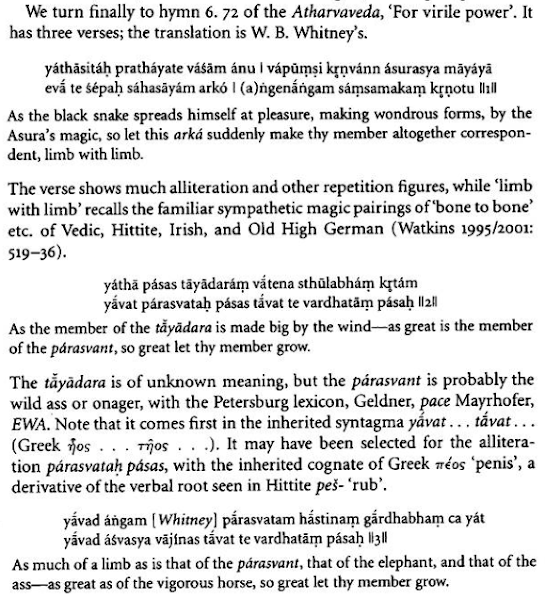 I'm too lazy to transcribe this, because of all the diacritics. If you substitute my for thy, this could be a personal prayer. I hope it works for you.

Glory
Homer, Odyssey 8.147-148 (tr. Richmond Lattimore):
For there is no greater glory that can befall a man livingNeither speed nor strength is in the Greek. The same (tr. A.T. Murray):
than what he achieves by speed of his feet or strength of his hands.
οὐ μὲν γὰρ μεῖζον κλέος ἀνέρος ὄφρα κ᾽ ἔῃσιν,
ἤ ὅ τι ποσσίν τε ῥέξῃ καὶ χερσὶν ἑῇσιν.
For there is no greater glory for a man so long as he lives than that which he achieves by his own hands and his feet.W.B. Stanford ad loc.:
147-8 are lines worth memorizing as an expression of the Greeks' intense love and admiration of athletics, as illustrated also in the Victory Odes of Pindar and the athletic sculptures of the fifth century.
Monday, June 20, 2022
Epicurean Advice
Corpus Inscriptionum Graecarum III 3846.L (Aizanoi, Phrygia) = Philippe Le Bas, Voyage archéologique en Grèce et en Asie Mineure fait pendant les années 1843 et 1844, Tome III, Première Partie: Inscriptions (Paris: Didot, 1870), p. 266, number 977 (my translation):
"Down here" means in the grave. I take Anthos to be a personal name, rather than "a flower". See e.g. T. Corsten, ed., A Lexicon of Greek Personal Names, Vol. V.A: Coastal Asia Minor: Pontos to Ionia (Oxford: Clarendon Press, 2010), p. 34. Franz Cumont, "Une pierre tombale érotique de Rome," L'Antiquité Classique 9 (1940) 5–11 (at 8), also regards it as a proper name, but Andrzej Wypustek, "Laughing in the Face of Death: a Survey of Unconventional Hellenistic and Greek-Roman Funerary Verse-Inscriptions," Klio 103 (2021) 160-187 (at 174), translates it (wrongly, in my view) as "the flower".
Anthos to the passersby: greetings! Bathe, drink, eat, copulate. For down here you have none of these things.The Packard Humanities Institute's Searchable Greek Inscriptions lists the source as C.W.M. Cox et al., Monumenta Asiae Minoris Antiqua, Vol. IX: Monuments from the Aezanitis (London: Society for the Promotion of Roman Studies, 1988 = Journal of Roman Studies Monographs, 4), p. 189 (number P300), which is next to worthless, since MAMA IX doesn't print the Greek and merely refers to the publications listed above.
Ἄνθος τοῖς παροδείταις χαίριν· λοῦσαι, πίε, φαγὲ, βείνησον· τούτων γὰρ ὧδε κάτω [οὐ]δὲ<ν> ἔχις.
"Down here" means in the grave. I take Anthos to be a personal name, rather than "a flower". See e.g. T. Corsten, ed., A Lexicon of Greek Personal Names, Vol. V.A: Coastal Asia Minor: Pontos to Ionia (Oxford: Clarendon Press, 2010), p. 34. Franz Cumont, "Une pierre tombale érotique de Rome," L'Antiquité Classique 9 (1940) 5–11 (at 8), also regards it as a proper name, but Andrzej Wypustek, "Laughing in the Face of Death: a Survey of Unconventional Hellenistic and Greek-Roman Funerary Verse-Inscriptions," Klio 103 (2021) 160-187 (at 174), translates it (wrongly, in my view) as "the flower".
A Hard Student
Thomas Jefferson, letter to Vine Utley (March 21, 1819):
I was a hard student until I entered on the business of life, the duties of which leave no idle time to those disposed to fulfill them; & now, retired, and at the age of 76, I am again a hard student.
Pindar
Calvert Watkins, "ΕΠΕΩΝ ΘΕΣΙΣ. Poetic Grammar: Word Order and Metrical Structure in the Odes of Pindar," in Heinrich Hettrich, ed., Indogermanische Syntax: Fragen und Perspektiven (Wiesbaden: Reichert, 2002), pp. 319–337, rpt. in his Selected Writings, ed. Lisi Oliver, Vol. III: Publications 1992-2008 (Innsbruck: Institut für Sprachwissenschaft der Universität Innsbruck, 2008 = Innsbrucker Beiträge zur Sprachwissenschaft, 129), pp. 1005-1023 (at 1005):
If I may quote a recent personal communication from the Regius Professor, Peter Parsons of Christ Church, Oxford: "The very word Pindar — as I know from teaching him — turns otherwise muscular colleagues to jelly."Related posts:
Sunday, June 19, 2022
Some European Personal Names
Calvert Watkins, "Two Celtic Notes," in Peter Anreiter and Erzsébet Jerem, edd., Studia Celtica et Indogermanica: Festschrift für Wolfgang Meid zum 70. Geburtstag (Budapest: Archaeolingua Alapítvány, 1999), pp. 539-543, rpt. in his Selected Writings, ed. Lisi Oliver, Vol. III: Publications 1992-2008 (Innsbruck: Institut für Sprachwissenschaft der Universität Innsbruck, 2008 = Innsbrucker Beiträge zur Sprachwissenschaft, 129), pp. 916-920 (at 919, on the etymology of Gaulish buððutton):
[T]he number of European personal names like Mentula, Couillard, Schwanz, Schmuck, perhaps Gvozdanović and quite possibly Wacker-nagel would suggest the male organ as a likelier onomastic etymon than 'kiss.'Related post: Squeamishness.
Life
Bhartrihari, "Life," tr. Arthur William Ryder, Relatives, Being Further Verses Translated from the Sanskrit (San Francisco: A.M. Robertson, 1919), p. 44:
Here is the sound of lutes, and there are screams and wailings;
Here winsome girls, there bodies old and failing;
Here scholars' talk, there drunkards' mad commotion—
Is life a nectared or a poisoned potion?
Alii Alia
Egil Kraggerud, Critica: Textual Issues in Horace, Ennius, Vergil and Other Authors (Abingdon: Routledge, 2020), p. 21:
An annoying trait that seems to persist among industrious compilers should be banned once and for all; that is the habit, usually prompted by fatigue I believe, of adding an alii alia or the like to two or three proposals mentioned, sometimes no doubt more or less by chance.
Swords into Plowshares, Spears into Pruning Hooks
Claudian, Against Eutropius 2.194-196 (tr. Maurice Platnauer):
Go then, busy thyself with the plough, cleave the soil, bid thy followers lay aside their swords and sweat o'er the harrow.
i nunc, devotus aratris
scinde solum positoque tuos mucrone sodales
ad rastros sudare doce.
Frugality
Thomas Jefferson, letter to Elbridge Gerry (January 26, 1799):
I am for a government rigorously frugal & simple, applying all the possible savings of the public revenue to the discharge of the national debt; and not for a multiplication of officers & salaries merely to make partisans, & for increasing, by every device, the public debt, on the principle of it's being a public blessing.
Saturday, June 18, 2022
Minding Other People's Business
Bertolt Brecht, Mann ist Mann, Scene 4 (tr. Gerhard Nellhaus):
There are some people who will keep sticking their noses into everything. Give them a finger and they'll have your whole hand.Related posts:
Es gibt Leute, die ihre Nase in gar alle Angelegenheiten hineinstecken müssen. Wenn man solchen Leuten den kleinen Finger reicht, nehmen sie gleich die ganze Hand.
- Let's Stop Somebody from Doing Something!
- Foolish
- Right Thinkers
- Against Busybodies and Nosey Parkers
- Recipe for a Happy Life
Silver Stag Vessels
Silver stag vessel, Central Anatolia, ca. 14th–13th century B.C., in the Metropolitan Museum of Art (acc. no. 1989.281.10, gift of the Norbert Schimmel Trust):


 See Theo van den Hout, "The Silver Stag Vessel: A Royal Gift," Metropolitan Museum Journal 53 (2018) 114-127.
Silver stag vessel found in Mycenae, Grave Circle A, Grave IV, ca. 16th century B.C., in Athens, National Archaeological Museum (inv. no. 388): See Robert B. Koehl, "The Silver Stag 'Bibru' from Mycenae," in Jane B. Carter and Sarah P. Morris, edd., The Ages of Homer: A Tribute to Emily Townsend Vermeule (Austin: The University of Texas Press, 2014), pp. 61-66.


Silver stag vessel found in Mycenae, Grave Circle A, Grave IV, ca. 16th century B.C., in Athens, National Archaeological Museum (inv. no. 388):

An Awful Tigress
Bhartrihari, "Heedlessness," tr. Arthur William Ryder, Relatives, Being Further Verses Translated from the Sanskrit (San Francisco: A.M. Robertson, 1919), p. 6:
Old age, an awful tigress, growls:The same, tr. B. Hale Wortham, The Śatakas of Bhartṛihari (1886; rpt. Abingdon: Routledge, 2000), p. 55:
And shafts of sickness pierce the bowels;
Life's water trickles from its jar—
'Tis strange how thoughtless people are.
Old age menaces the body like a tiger; diseases carry it off like enemies; life slips away like water out of a broken jar; and yet man lives an evil life in the world. Truly this is marvellous.
Friday, June 17, 2022
The Sweet Luxury of Being Taught
Ray Monk, Robert Oppenheimer: A Life Inside the Center (New York: Anchor Books, 2014), pp. 204-205:
Oppenheimer's concern with truth, goodness, and beauty led him in the early 1930s to a serious study of ancient Hindu literature; so serious, indeed, that he took lessons in Sanskrit so that he could read the Hindu texts in their original language. The first mention of this comes in his letter to Frank of August 10, 1931, in which he writes, "I am learning Sanskrit, enjoying it very much, and enjoying again the sweet luxury of being taught."Id., pp.455-456:
His teacher was Arthur Ryder, who was professor of Sanskrit at Berkeley. Harold Cherniss has described Ryder as "a friend half divine in his great humanity." In his views on education, he was a curious mixture of the ultra-traditionalist and the iconclast. He believed on the one hand that a university education ought to consist primarily of Latin, Greek, and mathematics (with the other sciences and humanities given as a reward to good students and the social sciences ignored altogether). On the other hand, his approach to the teaching of Sanskrit was refreshingly free from the deadening hand of dry scholarship. He regarded the learning of Sanskrit as the opening of a door onto great literature, not as an academic discipline. Perhaps for that reason he was the ideal teacher for Oppenheimer, who held him in enormously high regard. "Ryder felt and thought and talked as a stoic," Oppenheimer once told a journalist, extolling him as "a special subclass of the people who have a tragic sense of life, in that they attribute to human actions the completely decisive role in the difference between salvation and damnation. Ryder knew that a man could commit irretrievable error, and that in the face of this fact, all others were secondary."
Because of its use in this context (recollections of the Trinity atomic tests) by Oppenheimer, "Now that I am become death, the destroyer of worlds" has become one of the best-known lines from the Bhagavad Gita. Those who go looking for those words, however, often fail to find them, since in most English translations of the text they do not appear. The Sanskrit word that Oppenheimer translates as "death" is more usually rendered as "time," so that, for example, in the Penguin Classics edition, the line is given as: "I am all-powerful Time, which destroys all things." In the famous translation by the nineteenth-century poet Edwin Arnold it appears as: "Thou seest Me as Time, who kills, Time who brings all to doom, The Slayer Time, Ancient of Days, come hither to consume," which conveys an image diametrically opposed to that of a sudden release of deadly power. Oppenheimer, however, was following the example of his Sanskrit teacher, Arthur Ryder, whose translation reads: "Death am I, and my present task destruction."Id., pp. 675-676:
Soon after he arrived back in Princeton, Oppenheimer received a letter dated February 1 from The Christian Century, a nondenominational magazine, asking him to "jot down — almost on impulse" a list of up to ten books "that most shaped your attitudes in your vocations and philosophy of life." The list he sent them was as follows:Hat tip: Jim K., old and dear friend, with whom I've shared the six things (Panchatantra, tr. Arthur Ryder):
1. Les Fleurs du mal
2. Bhagavad Gita
3. Riemann's Gesammelte mathematische Werke
4. Theaetetus
5. L'Education sentimentale
6. Divina Commedia
7. Bhartrihari's Three Hundred Poems
8. "The Waste Land"
9. Faraday's notebooks
10. Hamlet
Six things are done by friends:
To take, and give again;
To listen, and to talk;
To dine, to entertain.
Faction Within Faction
Josephus, Jewish War 5.1.4 (tr. H. St. J. Thackeray):
Newer› ‹Older
This new development might be not inaccurately described as a faction bred within a faction, which like some raving beast for lack of other food at length preyed upon its own flesh.
ταύτην δ᾽ οὐκ ἂν ἁμάρτοι τις εἰπὼν στάσει στάσιν ἐγγενέσθαι, καὶ καθάπερ θηρίον λυσσῆσαν ἐνδείᾳ τῶν ἔξωθεν ἐπὶ τὰς ἰδίας ἤδη σάρκας ὁρμᾷ.

